

Quick Answer
Porcelain vs zirconia is really four ceramics: feldspathic porcelain, lithium disilicate, layered zirconia and monolithic zirconia. For most single crowns, monolithic zirconia's real rival is lithium disilicate, not the feldspathic porcelain most comparisons describe.
Zirconia itself holds up well. A 2020 prosthodontic review concluded that zirconia crowns seem "both well tolerated and sufficiently resistant." Lithium disilicate is the one picked for looks. One crown lab's own material guide claims it belongs on back teeth only at premolars or first molars, "never a second molar," and calls monolithic zirconia its first choice for every posterior case, so the contest really turns on which tooth is getting the crown.
Key Points
- A 2020 prosthodontic review on the NIH's PubMed Central concluded zirconia crowns seem "both well tolerated and sufficiently resistant," while lithium disilicate remains the pick for looks.
- A 2017 randomized controlled trial in the Journal of Dentistry found zirconia-based crowns fared just as well as metal-based crowns over 5 years, singling out monolithic zirconia as especially durable.
- In a 2025 video, dentist Riat Ismagilov called metal ceramic and zirconia "practically identical materials in terms of strength" and gave zirconia a lifespan range of 10 to 20 years.
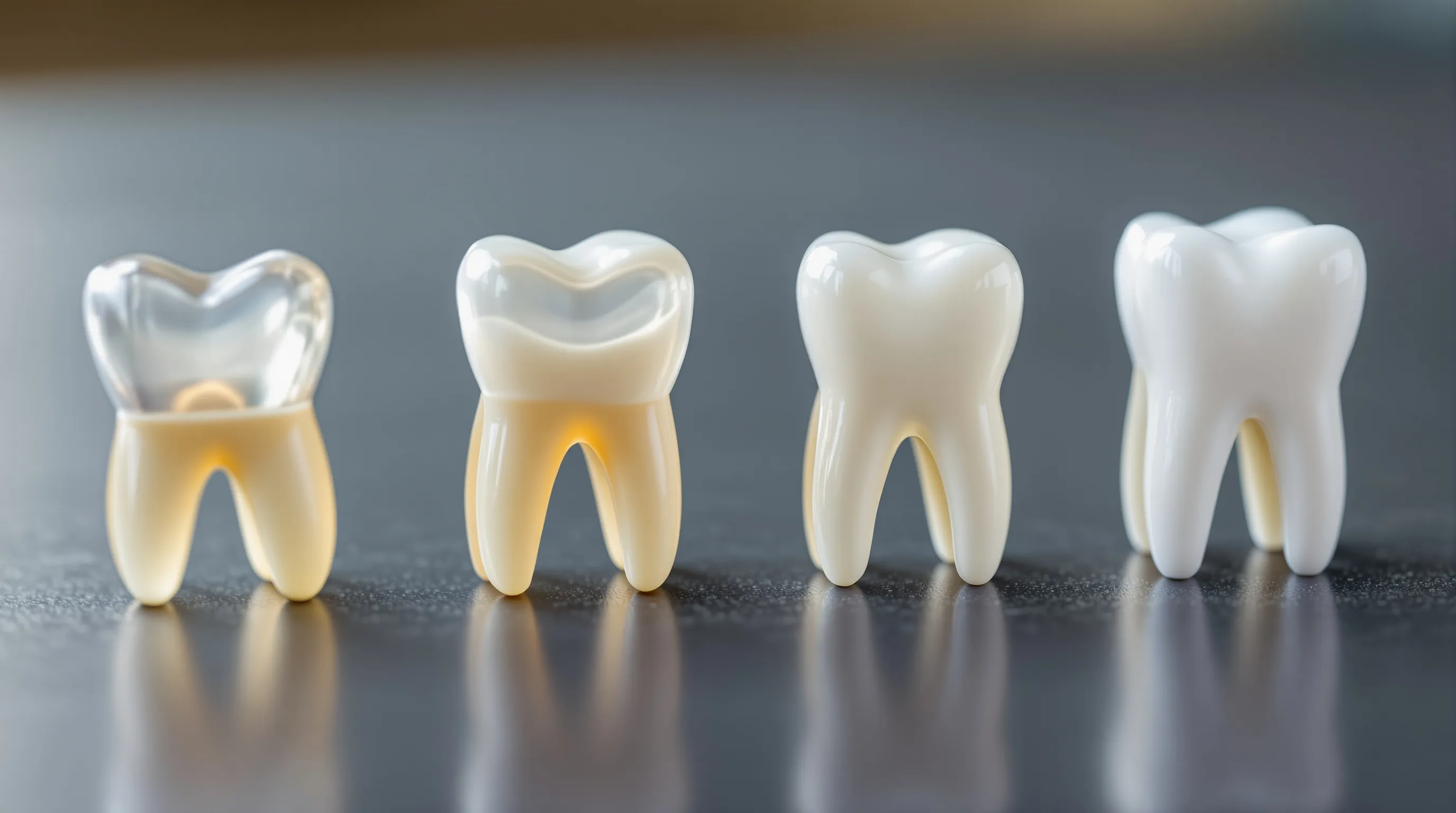
Porcelain vs zirconia is really a choice among four ceramics, each built differently.
The best cosmetic dentists in Lawrenceville, NJ name the exact ceramic for each tooth and explain the preparation, since loose zirconia crowns may trace back to cement and tooth preparation.
Picture a plate of oysters. In a 2015 thread on Reddit's r/Dentistry forum, a patient described biting down on a piece of shell and chipping the cheek-side corner of a crown. They had been told it was made "in-town" with "nothing but the highest quality materials," and their dentist called the damage "only a surface chip." Then a second chip showed up after pizza! Premium materials, it turns out, settle very little on their own.
One commenter in that thread had a blunt rule for the last tooth in the arch, saying they "typically stick with monolithic materials like Zirconia, or if appropriate, gold/metal." Monolithic here means milled from one solid block, a single layer of material with no porcelain on top to chip. That same commenter warned that "cracked porcelain will likely continue to crack," and guessed the damaged crown might last another 4 years rather than 20.
Money enters the story, too. Back in 2015, the commenter noted that insurance typically paid for a new crown on the same tooth only after 7 years, though 5 and 10 year policies existed, and that a patient who switched dentists without mentioning how recent the crown was risked a denied claim and owing 100% of the new one. Did you catch that? The wrong build on the wrong tooth can turn into an out-of-pocket surprise long before any warranty conversation starts.
The sections ahead take that oyster story apart piece by piece: why online answers disagree, what each ceramic gives up, which one suits which tooth, and what to ask before you sign a crown quote that only says porcelain or zirconia.
Picture a chalky white block of zirconium dioxide inside a dental furnace. At room temperature its crystals are monoclinic, past 1170°C they shift to tetragonal, and above 2370°C they turn cubic, as a 2020 review from Tehran University of Medical Sciences describes. In 2020, that review reported that the 3Y-TZP zirconia dominating restorations was stabilized with 2% to 3% mol of yttria and could form a crown core just 0.5 mm thick. Back in 2003, Yildirim and colleagues found zirconia's fracture resistance under static loads was more than twice that of alumina. Amazing, right?
Yet "porcelain vs zirconia" still gets searched as if it were a two-horse race. It isn't. Porcelain splits into traditional feldspathic ceramic and lithium disilicate, a glass-ceramic often sold as E-max. Zirconia splits into layered crowns, with porcelain fired over a zirconia core, and monolithic crowns milled from one solid block. Four ceramics, two labels, endless confusion.
The clinical record backs up the zirconia excitement, at least in the medium term. A 2017 randomized controlled trial found zirconia-based crowns fared just as well as metal-based crowns over 5 years, and it singled out monolithic zirconia as especially durable. A 2022 study of zirconia crowns placed over implants reported similar results across the same span.
So the real question is not which word wins. For most single crowns, monolithic zirconia's true rival is lithium disilicate, while the feldspathic porcelain most comparisons describe has quietly slipped into a supporting role, often as the pretty outer coat on layered zirconia. Telling the four apart starts with one question to ask at your very next crown appointment.
What will matter most for crown choices over the next 12 to 24 months?
The build will matter more than the label. Expect monolithic zirconia on back molars, lithium disilicate or layered zirconia on visible teeth, and quotes that name which one you are buying.
Forecasts are risky, and we would rather be honest than flashy! Still, the weak signals all lean one way. Over the next 12 to 24 months, we expect patients to stop asking porcelain or zirconia? and start asking which of the four builds belongs on which tooth, and the three shifts below are where that change should show up first.
| Prediction | Weak signal | Why it matters | Public source |
|---|---|---|---|
| Monolithic zirconia becomes the default for back molars, with layered builds saved for the teeth people see. | A 2020 health explainer called zirconia a possible "good choice for crowns in the back of your mouth" because of chewing force. In 2026, forum commenters agreed that porcelain chipped off a metal crown "can't reliably" be glued back on. | On a molar, ask whether the crown is monolithic or layered before comparing anything else. | Consumer health explainer on zirconia crowns (2020); dental advice forum thread (2026) |
| Crown quotes get priced by build, not by name. | In a 2025 explainer video, one dentist put a zirconia crown at 15 to 30,000 rubles against 12 to 20,000 rubles for metal ceramic, a modest gap even outside the US. | Insurance may not cover crowns at all, so two totals only compare fairly when both name the same ceramic. | Dentist's explainer video comparing metal ceramic and zirconia (2025) |
| Metal-based crowns hold their ground, while zirconia gains on looks rather than on a proven lifespan edge. | That same 2025 video put a metal ceramic crown's lifespan at 10 to 15 years and said a patient with metal ceramic crowns below would most often get them above too. A 2026 forum commenter called a 10-year run "a good lifespan for a crown." | On a hidden molar, a pricier metal-free crown mostly buys appearance and biocompatibility, not a clearly longer-lasting tooth. | Dentist's explainer video (2025); dental advice forum thread (2026) |
Look at that last row again. It cuts against the zirconia hype, and on purpose. The porcelain-over-metal crown in that 2026 thread had chipped, yet commenters described the metal underneath as "what is protecting your tooth," and several treated the crown as still serviceable. Old technology, still on the job!
What would change our minds? If long-term follow-ups of zirconia crowns show survival slipping well below the early trial results, or if monolithic zirconia turns out rougher on opposing teeth than the wear research so far suggests, the molar forecast weakens fast. There is a gap on our side, too. We have not yet published which of the four ceramics we place by tooth position for our own Lawrenceville patients, and once that tally exists it will show whether this forecast holds in Mercer County or only in the literature. Until then, the question worth writing on every molar quote is a plain one: monolithic or layered?
Why do porcelain vs zirconia answers disagree so much?
Answers disagree because "porcelain" and "zirconia" each cover two different ceramics. Our patients, who gave Imagine Advanced Dental Arts a 4.9 average across 587 Google reviews, deserve that four-way split spelled out.
Before you compare any two crown quotes, ask three plain questions:
- Which ceramic, exactly? Traditional feldspathic porcelain, lithium disilicate, layered zirconia or monolithic zirconia.
- Is the zirconia solid, or does it wear a porcelain coat? That one detail changes how the crown looks and where it can chip.
- Which tooth, and how hard do you bite? A front tooth and a back molar in a nighttime grinder are very different jobs.
Let's look at how we got here, because the history explains the whole muddle! For decades, the metal-ceramic crown ruled the dental world. A 2020 review by prosthodontists at Tehran University of Medical Sciences, published on the NIH's PubMed Central, noted that metal-ceramic crowns had been "the restoration of choice" for the last few decades, thanks to their looks and high success rate. Then zirconia arrived. The same review called zirconia's mechanical properties "the highest ever reported for any dental ceramic", which is quite a résumé for a material its authors said had been restoring missing teeth for "approximately a decade" at that point!
Though the excitement was real, the review stayed refreshingly honest. Its authors concluded that zirconia crowns seemed well tolerated and sufficiently resistant, yet long-term clinical follow-up remained "a vital requirement" before anyone could call the material highly reliable. Hype outran the data. That gap still shapes every comparison you read online.
Conventional wisdom says zirconia is the strong one and porcelain is the pretty one. Well, that tidy split could not have been more wrong! "Porcelain" can mean a delicate traditional ceramic or a far tougher glass-ceramic called lithium disilicate, and "zirconia" can mean a solid, single-block crown or a zirconia core dressed in a layer of porcelain. Blend those four together in one article, and of course the strength charts and lifespan promises stop agreeing with each other.
The material is only half the story, too. Every zirconia crown passes through digital scanning, design, milling and sintering, and an inaccuracy at any one of those steps can compromise both fit and durability. Put 4 pieces of evidence side by side and one pattern keeps repeating: the label on the quote matters less than the build, the tooth and the hands behind it.
That is why a crown decision deserves a restorative mindset rather than a quick menu pick. Our clinical roots include a DMD and residency completed with honors in prosthodontics and oral reconstruction, the branch of dentistry devoted to rebuilding teeth and bites. Curious how that approach feels from the patient's side of the chair? Our patient testimonials tell the story in their own words.
So what, exactly, are the four ceramics hiding behind two little words? Let's line them up.
What do you give up when you pick zirconia over porcelain?
Monolithic zirconia trades away natural translucency, while a porcelain layer improves color matching but invites chips. After forty-two years in one Lawrenceville office, most of our cases finish right here.
Every crown material is a bargain between strength and beauty, and zirconia's bargain shifts depending on how it is built. Healthline's 2020 explainer on zirconia crowns laid the trade-offs out plainly. A monolithic zirconia crown is made only from zirconia, with no other ceramic or metal mixed in, which makes it the most opaque option and the hardest to color-match. On a back molar, that may matter less. On a front tooth? It can be a dealbreaker!
So dentists reach for a clever fix: layer porcelain over the zirconia core. The color match improves beautifully. The catch, according to the studies that explainer summarized, is that the porcelain layer can make the crown "a little more likely to chip or delaminate", which simply means separate into layers. You buy back beauty, and you buy back some risk right along with it.
Zirconia does hand back a few real gifts. Because the material is so strong, the tooth needs less preparation, so more of your natural tooth stays where it belongs. Many dentists also choose it for biocompatibility, since zirconia is less likely to provoke inflammation or an immune response.
The common assumption is that a material this hard must grind down the teeth it bites against, and some dentists have hesitated over exactly that fear. Yet a 2021 study found that feldspathic porcelain was much more likely than zirconia to wear the enamel of opposing teeth. Old-style porcelain was the rougher neighbor. That flips a lot of tired advice on its head.
Price adds one more wrinkle. In 2020, zirconia crowns ran $1,000 to $2,500, compared with $1,000 to $2,000 for dental crowns generally, with geography shaping the number and insurance not always covering crowns at all. Before comparing two totals, ask which ceramic each quote actually describes.
Even dental websites trip over this confusion. One competing cosmetic practice's crown page insists zirconia typically outlasts porcelain, then lists the very same 10 to 15 year lifespan for both materials. Well, both claims cannot be true at once! The muddle happens because "porcelain" on a page like that stretches from old-style feldspathic ceramic all the way to modern glass-ceramics, which behave nothing alike under a hard bite.
Grinding complicates everything. What a bite does at night can decide which ceramic survives, and our team includes a Diplomate of the ABDSM, board certified in dental sleep medicine, so the sleep side of the story and the crown side can be explored under one roof. Planning a brighter smile at the same time? Ask about professional teeth whitening before your crown shade is chosen, because a ceramic's color is locked in the day it is made.
And metal, the very material zirconia was supposed to retire? Unfazed by all the hype, it is still very much in the game.
The 12-24 months Outlook, As We See It
Where crown materials head after porcelain vs zirconia
Forecasts on how dentists, labs and patients will split crown choices among zirconia, glass ceramics and metal-ceramic over the next two years.
How crown ceramics are likely to shift
Read each forecast against the tooth being restored, since molar and front-tooth crown choices are moving in different directions.
Crown quotes will increasingly be tiered by construction. Monolithic zirconia will sit in a mid-range band, while layered zirconia and lithium disilicate (E-max) sit at the premium end. Zirconia's $1,000-$2,500 range already overlaps the $1,000-$2,000 typical of crowns generally.
Metal-ceramic will remain one of the two most common crown types, and stainless steel crowns will stay standard for children's back teeth. Zirconia's gains will come from its metal-free appearance rather than a proven survival edge over metal.
Over the next 12-24 months, more dentists will specify monolithic (unlayered) zirconia for back molars and patients who grind. Layered porcelain will be reserved for visible teeth, because the porcelain veneer, not the core, remains the part that chips.
Early Whispers A 2017 randomized trial found zirconia-based crowns matched metal-based crowns over 5 years and singled out monolithic zirconia as especially durable. Patient threads, meanwhile, describe porcelain chipping off a metal-backed crown. Zirconia carries only a modest premium over metal-ceramic outside the US as well: 15 to 30,000 rubles for a zirconia crown against 12 to 20,000 rubles for metal-ceramic. Stainless steel crowns on primary teeth report 10-year success between 97 and 99%. Metal ceramic and zirconia are still named together as the most common crown types.
Studies and patient reports behind each call
Each public source below is listed with the single line it contributes to these crown-material forecasts.
| Source | What it states | Forecasts it backs |
|---|---|---|
| Zirconia Crown Benefits, Disadvantages, Costs, Other Options [Web source] | Zirconia crowns cost $1,000-$2,500, compared with $1,000-$2,000 for dental crowns generally. Geographic location affects price, and insurance may not cover crowns. “According to a 2017 randomized controlled trial published in the Journal of Dentistry, zirconia-based crowns fared just as well over the course of 5 years as…” A 2017 randomized controlled trial in the Journal of Dentistry found zirconia-based crowns performed as well as metal-based crowns over 5 years. Monolithic zirconia crowns were described as "especially durable.". |
Crown prices sort by build, not by name Monolithic zirconia becomes the molar default |
| What to choose in 2025? METAL-CERAMICS or ZIRCONIUM? [Video] | "The price of a zirconia crown ranges from 15 to 30,000 rubles." [11:16]. “The metal will start to show through. And after a couple more years, you'll develop a metallic taste in your mouth.” Four crown types are named: "plastic crowns, metal crowns, metal ceramic crowns, and zirconia crowns." Metal ceramic and zirconia are described as "the most common ones." [0:00-1:21]. |
Crown prices sort by build, not by name Metal-based crowns hold their ground |
| Zirconia vs Metal Hall Crowns vs Conventional with Dr Tim Keys [Video] | A conventional stainless steel crown on a primary tooth has a 10-year success rate "between 97 and 99%" (Tim Keys, [19:20]). “The success rate at 10 years sits between 97 and 99%.” | Metal-based crowns hold their ground |
| Broken/chipped crown [Community / Forum] | Commenters described a porcelain-over-metal crown. The porcelain chipped off and exposed the metal underneath, and that metal is "what is protecting your tooth.". “you can't reliably glue that back on.” | Monolithic zirconia becomes the molar default |
What would shift the crown material outlook
Every projection assumes the current trend line holds. These are the events that would bend it.
Keeping It Real
“Crown prices sort by build, not by name” has the most evidence behind it, but keep an eye on “Metal-based crowns hold their ground”, since that is where we are least certain.
- 15-year follow-ups of zirconia crowns show survival falling well below the 5-year figures.
- Monolithic zirconia proves to wear opposing teeth or fail in ways that layered crowns do not.
- Lithium disilicate becomes cheaper than the mid-range zirconia band.
Which crown should you actually trust for your tooth?
No single ceramic wins everywhere: lithium disilicate or layered zirconia suit visible teeth, monolithic zirconia suits hard-working molars. Our practice, awarded "Practice of the Year," stands behind that match.
Let's start with a surprise! Metal never really left. In a 2025 video, dentist Riat Ismagilov named four crown types, "plastic crowns, metal crowns, metal ceramic crowns, and zirconia crowns," and singled out metal ceramic and zirconia as "the most common ones." He went further and called the strength question a red herring, describing the two as "practically identical materials in terms of strength" for everyday purposes. As he put it, "No matter how hard we try to clench our jaws, we simply won't be able to exceed the strength limit of either a metal ceramic crown or a zirconia crown."
So where does the real difference live? In what happens after a chip. Once the ceramic surface of a metal ceramic crown breaks and the metal base shows, he said, "in most cases the crown will have to be completely replaced." Zirconia also asks for much less grinding of the tooth underneath. He gave zirconia a lifespan range of 10 to 20 years, a longer ceiling than he gave metal ceramic, while cautioning that the tooth under either crown can break down in exactly the same way.
Children's dentistry tells a remarkably similar story. On the Protrusive Dental Podcast in 2025, Dr Tim Keys, who places crowns on baby teeth, said success rates are pretty similar between stainless steel and zirconia crowns when they are placed well, and that on back teeth, choosing zirconia is "just purely aesthetics. That's it." In 2025, zirconia made up about 40% of the crowns that practice placed, and Keys reported that year that conventional stainless steel crowns on primary teeth reached a 10-year success rate "between 97 and 99%."
Placement beats the label. Looks are a perfectly fair reason to choose a crown, as long as you know that is what you are paying for.
Which brings us back to adults and the four ceramics. Here is how the evidence lines up, tooth by tooth:
- Front teeth: lithium disilicate, the glass-ceramic often sold as E-max, or layered zirconia when a little extra strength is needed.
- Premolars and first molars that flash when you laugh: the genuine head-to-head between lithium disilicate and aesthetic or layered zirconia.
- Back molars and heavy grinders: monolithic zirconia, with nothing layered on top to chip away.
- Hidden molars on a budget: metal ceramic is still an honest option, provided you accept that a chip can expose dark metal.
One Texas family practice's crown guide puts its back-molar advice bluntly: "Monolithic zirconia every time." We agree with the spirit, if not the absolutism. And notice what has quietly slipped off the list? Feldspathic porcelain on its own has largely given way on back teeth, and today it often shows up as the lovely outer coat on layered zirconia, which is exactly where chips begin. For most single crowns, the true rival to monolithic zirconia is lithium disilicate, not the old-style porcelain so many comparisons still describe.
The same four-way choice follows you into bigger work, too, since a dental bridge can be built from these very materials. Ask which ceramic is on your quote, and ask before the impression is taken.
So, porcelain or zirconia? Contrary to how most crown quotes read, that is four questions wearing one label, and the next few years will reward patients who ask for the build by name. Trial data spanning half a decade already singled out monolithic zirconia as especially durable, yet that verdict tells you nothing about a layered crown or a pressed lithium disilicate one. Can a crown really fail on a snack?
In a 2020 thread on Reddit's r/Dentistry forum, one patient wrote that a crown in place "for only a little over a year" cracked while they were eating cashews! A commenter who appeared to run a dental office was unfazed: "It's not an emergency. The crown will need to be replaced." With no pain, that commenter added, the tooth underneath was most likely still protected. Which ceramic was it? The thread never says.
A candid aside: none of the evidence behind this article follows all four ceramics side by side on matching teeth for decades, so no honest practice can promise which one outlasts the rest in your particular bite. What a quote can do is name its material plainly. Ask whether zirconia means layered or monolithic. Ask whether porcelain means feldspathic or lithium disilicate. Then ask what happens if it cracks within the first year, because that same forum commenter said a crown from their own office that broke in that window would be replaced for free, and a straight answer given before your tooth is ever prepared tells you plenty about the hands placing it.
Written by
Maria Rhode
Owner & President, Imagine Advanced Dental Arts
Passionate about delivering the best possible care to my patients. From my days in residency to owning a beautiful hi-tech dental office, I never stop learning and advancing myself and now my practice.
Connect on LinkedInSummarize This Article With AI
Open this article in your preferred AI engine for an instant summary.
Frequently Asked Questions
What else should you ask before choosing a crown material?
The questions below come down to looks, gum health, tooth removal and single-visit crowns, and each answer depends on which of the four ceramics is involved.
Can you get a zirconia crown in a single visit?
Sometimes! A 2020 health explainer described CEREC, short for Chairside Economical Restoration of Esthetic Ceramics, which uses computer design and an in-office milling machine to cut a crown from a zirconia block so it can go in during one visit. Not every office has that equipment, though.
Does a zirconia crown stop gum recession?
No. One dentist explaining the choice in a 2025 video said recession is "just as inevitable" with zirconia as with metal ceramic crowns. What changes is the view afterward: zirconia leaves no black line at the gumline, an advantage that same dentist called "a bit deceptive," since the tooth under either crown can break down in exactly the same way. Checkups every six months were recommended for both.
How much of your tooth gets removed for each crown?
Less for zirconia. Because the material is so strong, a zirconia crown needs less preparation, while a thicker metal ceramic crown often means grinding the tooth down further, sometimes "leaving just little stumps." When a crown is replaced later, the tooth usually is not ground down again, and the new crown is simply made slightly longer.
Is a zirconia crown completely metal-free?
Yes. A monolithic zirconia crown is made only from zirconia, with no other ceramic or metal, and a layered zirconia crown adds porcelain rather than metal. Prosthodontic researchers list low corrosion potential, low thermal conductivity and good biologic compatibility among zirconia's features.
Are zirconia crowns used on children's teeth?
Yes, alongside stainless steel. Many children's back teeth are crowned with the Hall technique, a stainless steel crown pressed on with no tooth preparation, and in 2025 one pediatric clinician said about 80% of those cases needed no drilling at all. Did you know a crown could go on without a drill?
Where can you book a crown consultation near Lawrenceville?
Imagine Advanced Dental Arts serves patients across New Jersey with four credentialed dentists, right from our Lawrenceville office. Reach us through our Contact Us page, and bring your current crown quote so we can tell you which of the four ceramics it actually names.