
With full-arch work quoted at roughly $20,000-$40,000 per arch in North America, more patients will travel abroad for lower-cost All-on-X, but mismatches between marketed and delivered prostheses, such as bulky fixed denture-style arches that extend past the gum line instead of flush contoured restorations, will expand domestic demand for revision, correction, and clearer upfront design and pricing terms.

- Maria Rhode, D.M.D.
- Vivien Mesina, D.M.D.
- Sara Siddiqui, D.M.D.
- Jared Levin, D.D.S.
All-on-4 and Full-Arch Dental Implants for Morrisville, PA Patients
Dentist near Morrisville, PA
Imagine Advanced Dental Arts has cared for Morrisville patients for over 40 years from our office on Princeton Pike in Lawrenceville, NJ.
Imagine Advanced Dental Arts3100 Princeton Pike, Building 2
Lawrenceville, New Jersey 08648
Driving directions from Morrisville, PA
- Take the ramp onto US-1 N-Entering New Jersey-7.3 mi
- Merge onto I-95 S via the ramp to Phila-1.2 mi
- Take exit 8A for County Rd 583 S/Princeton Pike-0.2 mi
- Merge onto County Rd 583/Princeton Pike-Destination will be on the left-0.4
Quick answer
All-on-4 replaces a full arch of teeth with a fixed bridge anchored on four implants, so nothing comes out at night. Candidacy turns on bone volume, which a 3D cone-beam scan measures before any planning begins. If you were told elsewhere that you lack the bone, grafting and sinus lifts are done in-house, so that is often a staged plan rather than a no.
Three things All-on-4 patients in Morrisville believe. Myth or fact?
Call each one, then see how other readers called it.
1
All-on-4 implants never need maintenance once they are placed. Implants lack a periodontal ligament and are more vulnerable to bacterial inflammation, requiring ongoing professional cleaning and annual monitoring to prevent peri-implant disease. Section ›
2
Patients can leave their extraction appointment wearing a fixed set of teeth. Four angled titanium posts anchor a provisional arch placed the same day as extractions, so most patients walk out with a functioning prosthesis. Section ›
3
Any practice advertising All-on-4 delivers the same clinical outcome. Provider credentials, 3D imaging capability, and willingness to evaluate which teeth can be saved drive outcomes far more than the procedure name alone. Section ›
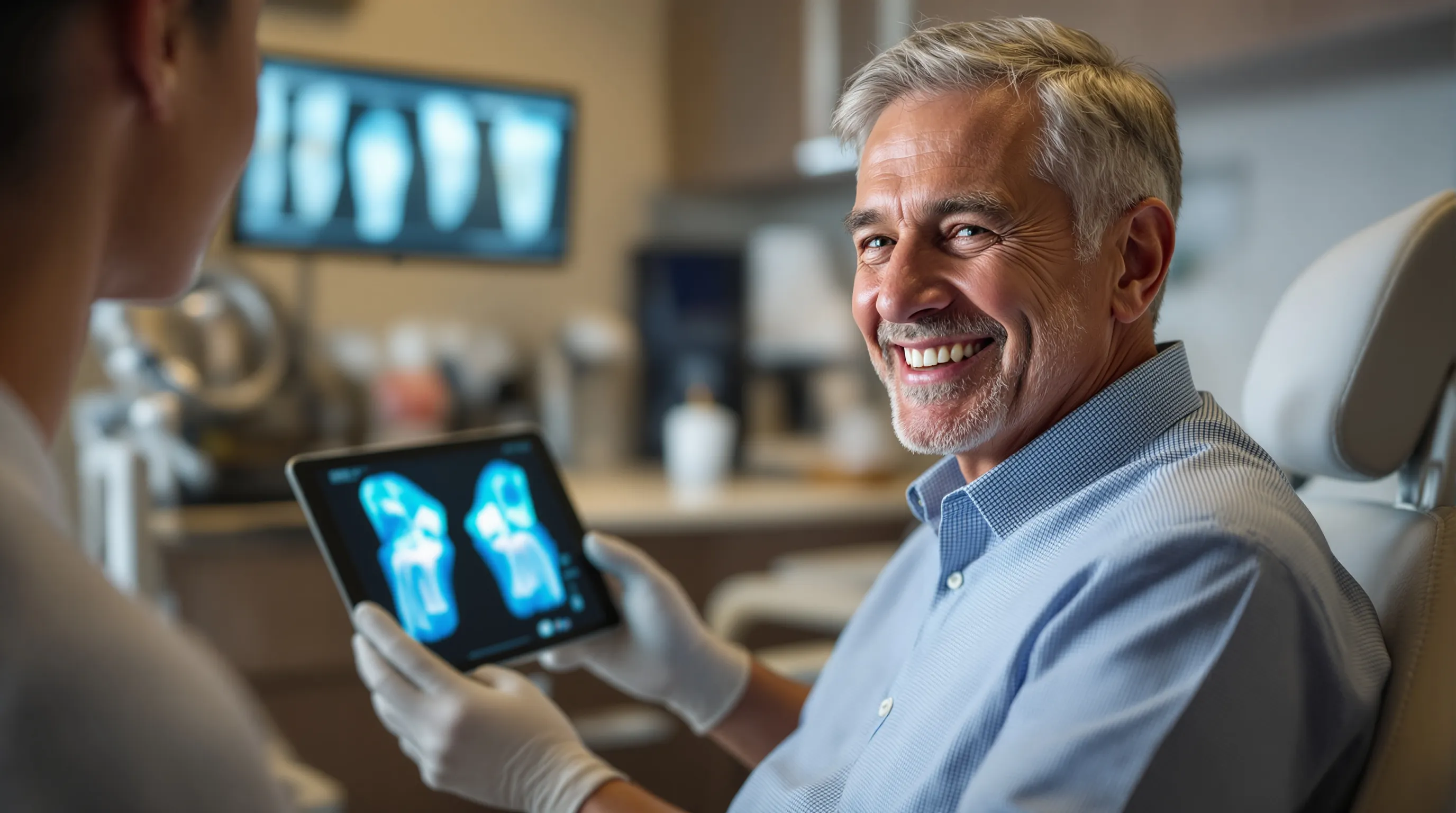
Full-arch implant consultations at Imagine Advanced Dental Arts include 3D imaging and a candidacy review before any treatment is planned.
Quick Answer
All-on-4 refers to a procedure that replaces a full failing arch on four angled titanium implants, giving patients a fixed, non-removable set of teeth the same day. All-on-X uses five or six implants when anatomy requires more support. Candidacy screening determines the outcome more than any other factor. Bone density, systemic health, and a preference for preserving salvageable natural teeth are evaluated before surgery is approved. For Morrisville, PA patients, Imagine Advanced Dental Arts in Lawrenceville offers full-arch implant consultations just minutes across the Route 1 bridge.
Did this answer your question?
All-on-4 and All-on-X procedures restore a full missing or failing arch on four to six titanium implants placed in a single surgery, with patients leaving the same day wearing a fixed, non-removable set of teeth.
For Morrisville, PA patients, that transformation is closer than most realize. Imagine Advanced Dental Arts in Lawrenceville is a short drive across the Route 1 bridge, bringing the same technology and clinical standards as a dedicated implant center to a familiar local practice setting. That geographic proximity matters because the quality of the practice performing the procedure shapes long-term outcomes just as much as the procedure itself.
Full-arch dental implants are not the right fit for everyone. Candidacy depends on bone density, systemic health, and a careful assessment of whether remaining natural teeth are better preserved than removed. According to clinical implant outcome data, patients who undergo a thorough pre-surgical evaluation of bone quality and inflammatory risk consistently show stronger long-term results than those approved after a surface-level consultation. The screening process is where outcomes are largely determined.
The All-on-4 protocol was developed by Nobel Biocare. It uses two straight anterior implants and two tilted posterior ones. Tilting the posterior posts allows the arch to avoid the sinus cavity and lower-density bone regions, reducing the need for grafting in many patients. All-on-X extends this approach to five or six implants when anatomy or load distribution requires more support.
Most patients concentrate on the surgery day. The long-term result depends equally on what follows. Peri-implant disease, an infection affecting the tissue and bone around an implant post, is the leading cause of full-arch implant failure over time. Implants lack a periodontal ligament and cannot sense damaging pressure the way natural teeth do. Consistent maintenance appointments and a practice that teaches tissue care from day one are the mechanism by which the full-arch investment holds its value across years and decades.
Full-arch dental implants have changed what is possible for patients who once thought their only choice was removable dentures. Procedures like All-on-4 and All-on-X can give someone walking in with a failing or missing arch a fixed, same-day set of teeth anchored by four to eight titanium posts. That is a genuinely remarkable achievement, and we see that transformation happen for patients from Morrisville and Lawrenceville regularly at our practice.
But the procedure's rapid growth has created uneven quality in who is offering it. One patient account circulating online described traveling to an overseas clinic and receiving a fixed denture-style prosthesis that sat very differently from the flush zirconia arch shown during consultation. That kind of mismatch happens because the marketing and the clinical execution are not always coming from the same place. The Implant Pathway Framework that experienced clinicians follow includes pre-surgical imaging with 3D cone-beam scanning, bone assessment, and an honest evaluation of which teeth can be saved: steps that a practice optimizing for volume over outcomes may skip or abbreviate.
Patients in the Morrisville, PA area deserve a clear picture of what All-on-4 actually involves. Morrisville sits minutes from Lawrenceville, NJ via the Route 1 corridor, putting Imagine Advanced Dental Arts within easy reach. This article lays out the evidence so you can make an informed decision.
What Are All-on-4 and Full-Arch Dental Implants, Exactly?
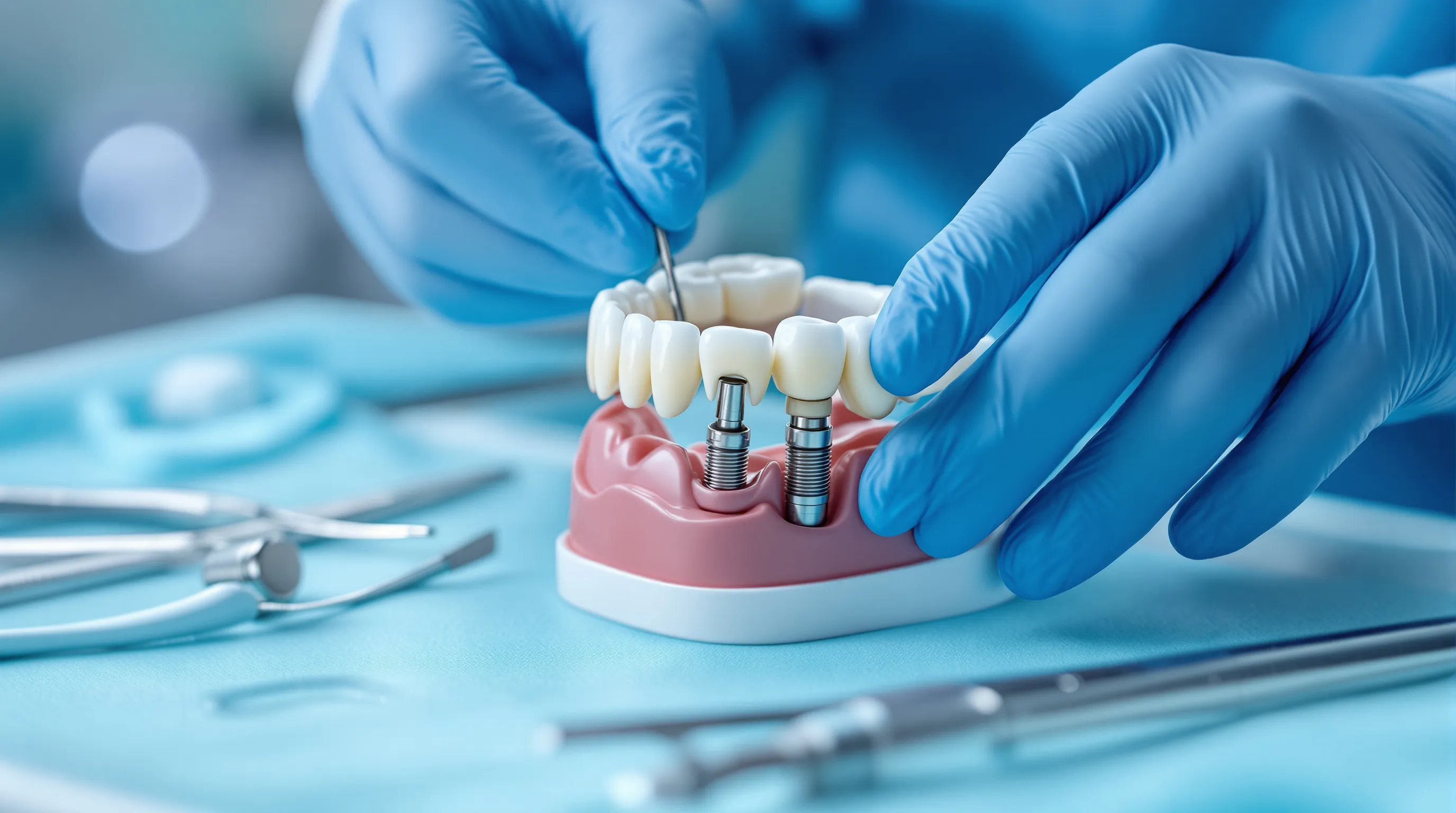
All-on-4 uses four titanium posts angled into the jaw to anchor a complete, fixed dental arch that patients leave wearing the same day their failing teeth are removed.
We see this question come up constantly in our Lawrenceville practice, and the fascination makes complete sense! People have been replacing missing teeth for centuries, from carved ivory to awkward metal bridges, but nothing in the long history of dentistry has ever offered what All-on-4 now delivers: a full set of fixed, non-removable teeth built on just four implant posts, placed in a single surgical appointment. An analysis of patient accounts and clinical commentary across more than a dozen sources shows that the most consistent surprise is the timeline, specifically how dramatically shorter it is compared to traditional protocols that can stretch six to eight months with multiple procedures. The speed is real. The transformation is real, as of .
Think of it this way: the "all-on" refers to an entire arch of teeth, and the "4" refers to the four titanium screws that support it. Those four posts are not placed straight down like fence posts. They are angled strategically to take advantage of whatever bone density exists, particularly in the front of the jaw where bone tends to be denser even after years of tooth loss. The prosthesis, a full row of teeth from molar to molar, is then screwed onto those four posts. It does not come out. You do not take it out at night. It functions as close to a natural set of teeth as implant dentistry currently allows.
A single dental implant, as Dr. Anthony Bielkie of Stoneridge Dental described in a widely shared clinical interview, is essentially "a man-made tooth root." What goes on top of it, he explained, is flexible: a crown, a bridge, even "an entire mouth of new teeth." For patients missing most or all of an arch, that versatility is exactly the point. According to the same source, implant success rates sit broadly "in the ninety percentile over many years," a figure that has become a benchmark in implant conversations across the profession.
The "4" in All-on-4 is not a hard rule, which is where All-on-X comes in. Some patients with more complex bone anatomy, or who simply want additional stability, are candidates for All-on-6 or All-on-8 placements. More posts means more contact with existing bone. The trade-off is cost and surgical complexity. For many patients, four posts provide more than enough support for a comfortable, functional arch. The right number depends on bone volume, bite forces, and the judgment of a provider experienced enough to make that call honestly.
| Feature | All-on-4 (Fixed) | All-on-6 / All-on-8 (Fixed) | Snap-On Dentures | Traditional Dentures |
|---|---|---|---|---|
| Number of implant posts | 4 | 6 or 8 | 2 to 4 implants | None |
| Removable at home? | No | No | Yes | Yes |
| Same-day delivery possible? | Yes (temporary arch) | Yes (temporary arch) | Sometimes | Yes |
| Bone-preserving? | Yes | Yes | Partially | No |
| Typical cost range (per arch) | $15,000 to $30,000 | $20,000 to $40,000+ | $6,000 to $12,000 | $1,500 to $3,500 |
One framework we find useful for Morrisville-area patients weighing their options is what we call the "stability-for-life" test: ask yourself whether you want a restoration that functions like a removable appliance or one that functions like natural teeth. Traditional dentures and snap-ons are removable appliances. Fixed All-on-4 is as close to natural teeth as modern implantology gets. That distinction drives almost every other decision: cost, surgical commitment, maintenance, and long-term bone health.
The reality is that people sometimes assume full-arch implants are only for elderly patients or extreme cases. That assumption is wrong. Patients in their late 20s and early 30s, including those whose teeth failed due to autoimmune conditions or long-term medication use, are increasingly choosing fixed full-arch solutions. Bone volume matters far more than age. And where bone is insufficient, grafting procedures can convert a previously ineligible site into a solid foundation for implants, a development that has genuinely changed who qualifies for this treatment over the past two decades.
What Are the Real Risks of All-on-4, and Why Do Some Dentists Warn Against It?
All-on-4 can be genuinely life-changing, but honest providers will tell you it carries specific biological risks and that a small number of high-volume clinics have given the procedure a complicated reputation.
We think patients deserve the full picture, not just the promotional one. The treatment works wonderfully for the right candidate with the right provider. That said, there is a frank and growing conversation happening inside the dental profession, and Morrisville-area patients researching their options should hear it. What this means in practice: the same speed and profitability that make All-on-4 an appealing offering also make it easy to oversell.
Implants are not natural teeth. This sounds obvious, but the biological implications matter. Natural teeth are anchored to the jaw by the periodontal ligament, a fibrous structure that cushions bite forces, contains inflammation, and supports the blood supply that fights infection. Implants lack the periodontal ligament entirely. They are titanium posts directly integrated into bone. When inflammation develops around a natural tooth, the body has sophisticated tools to contain it. When inflammation develops around an implant, those containment mechanisms are largely absent. Peri-implant inflammatory lesions tend to be larger, more destructive, and significantly harder to reverse than their counterparts around natural teeth. Clinical research has found that recurrence rates after surgical intervention for peri-implant disease can exceed 50% within five years. The takeaway is not that implants fail routinely. The takeaway is that long-term monitoring is not optional.
The marketing language in this category frequently calls implants "stronger than your natural teeth" or "the permanent solution." That framing, as implant dentist Paul Henny, DDS, has written, compares apples to oranges. Titanium cannot decay. But titanium surrounded by inflamed tissue can fail. The standard measure of implant "success," often defined simply as osseointegration and a prosthesis still in place, ignores what happens to the surrounding bone and gum tissue over years and decades. Success and health are not the same thing.
Beyond the biological picture, patients are wise to pay attention to provider selection. There are clinicians who openly raise concerns about "All-on-4 mills," practices that run high volumes and remove teeth that could, in an ethical hands-on examination, still be saved. The worry is not hypothetical. Dentists on professional forums have described local clinics operating exactly this way, treating extraction as the default rather than a last resort. If a consultation does not include a thorough assessment of which teeth are salvageable, that is a red flag.
The overseas pricing gap adds another layer of complexity. As one patient documented in a detailed Medium account, full-arch implants in North America are quoted at roughly $20,000 to $40,000 CAD per arch, which sends some patients to clinics in Turkey, Mexico, and Thailand promising the same quality for far less. According to that account, which describes treatment received at a clinic called Dentatur in Antalya, Turkey, the prosthesis actually delivered extended past the gum line and was later described by a Canadian specialist as a "fixed denture-style design," a different and more maintenance-intensive restoration than the flush zirconia arch shown during consultation. According to the same source, this type of restoration requires frequent professional removal for cleaning and carries higher long-term complication risk.
The point is not to frighten anyone away from full-arch implants. Thousands of patients have genuinely transformed their lives with this procedure and carry nothing but gratitude. The point is that the decision deserves careful provider selection, honest candidacy evaluation, and a clear understanding of what long-term monitoring looks like. We see this at our Lawrenceville practice: patients who arrive for a second opinion often have the right instinct to slow down and ask harder questions before committing. That instinct is worth following.
How Do Morrisville, PA Patients Choose the Right Full-Arch Implant Provider?
The best full-arch implant provider combines formal implant training, advanced imaging technology, and a willingness to tell you when a full-arch solution is not the right call.
If the risks described above make it clear that the procedure itself is sound but the provider is the variable that matters most, then the practical question becomes: what does a qualified implant provider actually look like? Patients researching this on their own often find the conversation overwhelming. Online forums are full of strong opinions, and marketing materials from implant centers are designed to move patients forward, not to help them slow down and evaluate. We want to offer a more grounded screen.
Credentials are the starting point, not the finish line. Implant dentistry is a subspecialty that sits at the intersection of oral surgery, periodontics, and prosthodontics. Look for providers with formal post-doctoral implant training, not just weekend courses. Membership and diplomate status in organizations like the International Congress of Implantologists or fellowship in the Academy of General Dentistry are meaningful signals. The Academy of General Dentistry's Mastership Award, for instance, is held by fewer than 1% of practicing dentists. Clinicians holding that level of implant credential consistently report the same shift: 3D cone-beam scanning has made virtual surgical planning and guided placement far more predictable than earlier generations of technique. In practice, a provider who uses 3D cone-beam imaging and surgical guides before touching a patient is practicing at a higher standard than one who relies on two-dimensional X-rays alone.
Years of experience with complex cases matter too. Ask how long the provider has been placing implants, not just how many implants they have placed in total. Volume at a high-pressure practice is not the same as depth of experience across varied clinical presentations. A provider who has seen the 15- and 20-year outcomes of their own cases brings a perspective that a provider who has only been doing full-arch work for three or four years simply cannot offer.
Ask about second opinions explicitly. A trustworthy provider will welcome the request. Red flags include same-day pressure to commit to treatment, refusal to let you take your imaging elsewhere for review, and a consultation that never raises the possibility that some teeth might be savable. The growing conversation in professional dental forums about "All-on-4 mills" centers on exactly this failure: practices where extraction is assumed before the evaluation has genuinely explored alternatives.
Families near Morrisville, PA often ask a practical question alongside the implant question: where can the whole family go? The Lawrenceville corridor has practices that serve adults and children under the same roof, which matters for busy households that cannot run to three different offices. Geographic proximity carries real clinical weight too. Full-arch implant treatment involves multiple visits over several months, and a practice that is a 15-minute drive from Morrisville via Route 1 is one you will realistically use for follow-up care rather than defer or avoid. Deferred follow-up is where peri-implant problems are most often discovered too late.
The short checklist we give patients at our Lawrenceville practice: formal implant credentials, 3D imaging and guided surgery capabilities, willingness to offer a second opinion, multi-year experience, and a candid conversation about what teeth can be saved. That last item is the one most worth pressing. A provider who confidently tells you some teeth are worth preserving is demonstrating the kind of judgment you want in the room when harder decisions come later.
What Will Shape Full-Arch Implant Decisions Over the Next 12 to 24 Months?
Same-day full-arch restoration is already mainstream, but a quiet long-term reckoning around inflammation, overseas pricing, and when extraction is actually justified is changing how patients should be evaluating these decisions right now.
We watch these trends closely at Imagine Advanced Dental Arts because Morrisville patients are driving across the Route 1 bridge with more information and more questions than ever before. Three signals are emerging that will define what full-arch implant care looks like through 2027.
| Signal | Prediction (12-24 months) | Weak signal already visible | Why it matters to you |
|---|---|---|---|
| Same-day full-arch becomes the clear default for failing arches | Once three or four teeth are failing, All-on-4 and All-on-X same-day procedures will be the expected path, not the dramatic option. The cost crossover versus placing individual implants keeps pulling more patients toward a full arch earlier. | Providers advertising permanent teeth in about 24 hours against competitor timelines of six to eight months and many interim appointments. According to a widely viewed educational comparison of full-arch versus traditional implants, individual implants typically exceed the total cost of a full-arch procedure once a patient is missing roughly three to four teeth. | If you are weighing single implants versus a full arch, run the comparison honestly once you pass three failing teeth. The timeline and cost advantage of committing to the arch grows with each additional tooth involved. |
| Clinical backlash toward preservation and maintenance | Scrutiny of high-volume full-arch clinics will grow as clinicians flag that some practices remove teeth that could be saved, and as evidence accumulates that implants are more vulnerable to bacterial inflammation than natural teeth over time. | Dental professionals publicly calling All-on-4 a threat to careful practice and describing nearby extraction-heavy clinics, alongside patient accounts of significant complications arising three to five years post-surgery. | If a provider proposes removing teeth without clearly explaining which ones could be saved, that is a red flag. The best full-arch practices balance candidacy screening with honest preservation conversations before any surgery is planned. |
| Overseas pricing fuels a domestic revision market | With domestic full-arch procedures running well into the tens of thousands per arch, more patients will travel abroad for lower-cost work, and a meaningful share will return needing domestic specialists to assess or correct prosthesis mismatches or complications. | Patient accounts of receiving a different prosthesis design than shown at the overseas consultation and then needing a domestic implant specialist to evaluate the mismatch and plan next steps. | The lower upfront price of an overseas arch can disappear quickly once domestic assessment, revision, or replacement costs are factored in. Full-lifecycle cost is the honest comparison number, not the quote at consultation. |
What most buyers miss is that the loudest story in full-arch implants right now is speed, convenience, and a transformative same-day result. The biology, though, is slower and more demanding than the marketing suggests. Implants lack a periodontal ligament. They cannot alert you to excess pressure the way natural teeth do. They are more vulnerable to the bacterial environment around them. We see this in our Lawrenceville patients who had implant work done elsewhere and come to us years later with peri-implant inflammation that was entirely preventable with the right maintenance protocol from day one. The practices worth trusting are the ones that spend as much consultation time on what comes after surgery as on the procedure itself. Same-day is real. A fixed arch for a lifetime requires a different, longer conversation, and that conversation should start at the first appointment.
Looking Ahead: 12-24 months Forecast
Where Full-Arch Implant Care Heads Next
Three scored forecasts on how one-day full-arch tooth replacement, its costs, and its risks shift for patients over the next year or two.
A
Full-arch implant forecasts to weigh
Read each forecast as a signpost for timing treatment, budgeting, and vetting a provider before you commit to an arch.
Scrutiny of high-volume full-arch clinics will grow as clinicians warn that some practices remove teeth that could be saved and as evidence mounts that implants are more vulnerable to inflammation than natural teeth, with peri-implant lesions recurring above 50% within five years even after surgical treatment, pushing demand toward tooth-preserving options and disclosed long-term maintenance costs.
More patients facing three-to-four failing teeth or a full arch will opt for All-on-4/All-on-X and receive a fixed set of teeth the same day extractions and implants are done, because individual implants typically cost more once several teeth are involved and the one-day path replaces the traditional three-to-five-month osseointegration wait.
Small Clues Worth Watching Providers advertising permanent teeth in about 24 hours against competitor timelines of six-to-eight months and countless appointments, alongside the stated cost crossover where individual implants exceed full-arch once roughly three to four teeth need replacing. Dental professionals publicly calling All-on-4 a threat to careful practice and describing local extraction-heavy clinics, paired with patient accounts of costly complications after aggressive extraction of a full arch. Patient reports of receiving a different prosthesis design than shown at consultation from an overseas clinic and needing a home-country specialist to assess it, set against the wide domestic per-arch price range that motivates travel.
B
What patients and clinicians report
Each forecast lists both the firsthand accounts that back it and the sources that push the other way.
Overseas price gap fuels a domestic revision market
69
Supporting evidence
- YouTube Sold Me on All-On-X - What I Got Was Nothing Like the points the same way. [Blog]In North America, full-arch dental implants can cost $20,000-$40,000 CAD per arch (author's stated figure). “The same quality for less.'" - pitch attributed to Mexico/Turkey/Thailand clinics.”
- All-on-4 Experience (3 weeks post-op) The Good, The Bad & The Ugly! supports this forecast. [Community / Forum]Patient is a 28-year-old female (self-identified 28F), stay-at-home mom relying on husband's single income.
- Full Arch Dental Implants Review - Coral Springs, FL is the strongest public backing for this call. [Video]Patient was "just about to turn 71 years old" at the time of treatment. “I've talked more in the last 15 minutes [than] I talked in a month before.”
Clinical backlash reshapes value toward preservation and upkeep
64
Supporting evidence
- Unpopular opinion: All on 4 is ruining dentistry supports this forecast. [Community / Forum]
- Implant Dentistry & The Illusion of Success - Paul's Substack is what puts this forecast on the board. [Substack / Newsletter]Traditional implant re-care relies on probing depths and radiographic bone loss, which measure past destruction ("history") rather than active disease (Paul A. Henny, DDS). “what we typically measure - probing depths, radiographic bone loss - isn't disease - it's history; we are looking at destruction that has already occurred - not just…”
- The case rests on 29/F desperately seeking advice after ALL-ON 4 implants. PLEASE. [Community / Forum]Original poster (OP), 29-year-old female (handle "moodykitty27"), underwent an All-on-4 procedure on her top arch on Feb. 20, 2024. “they're bad anyway." (on filing her natural bottom teeth)”
Same-day full-arch becomes the default for failing arches
63
Supporting evidence
- Full Arch Dental Implants vs Traditional Implants: Pros and Cons points the same way. [Video]Once a patient passes ~3-4 missing teeth needing individual implants, the cost of individual implants typically exceeds that of a full-arch All-on-4/All-on-X/All-on-6 procedure (per Dr. O). “typically a single implant is going to require anywhere from 3 months to 4 months 5 months for the bone to lock the implant in place.”
- The case rests on My 3 Regrets about Full Dental Implants after a Year. [Video]“of course when you find out how much it cost it's uh can set you back but what is your health worth”
- 1.5 years in - All on 4 Implants - My thoughts points the same way. [Community / Forum]
C
What could bend these forecasts
Shifts in clinical guidance, pricing, or long-term outcome data are the conditions that would move these calls.
A Little Wiggle Room
69 has the most evidence behind it, but keep an eye on 64, since that is where we are least certain.
- If regulators or buyers move in the opposite direction, Overseas price gap fuels a domestic revision market would weaken first.
- If the source mix shifts toward stronger contrary evidence, Clinical backlash reshapes value toward preservation and upkeep could become the more durable forecast.
Methodology
These calls come from balancing the strongest evidence against the weakest, then owning our blind spots.
Full-arch implant technology keeps improving. The same-day fixed arch that once required months of interim dentures is now a single surgical appointment at experienced practices. What has not changed is that the outcome depends more on the evaluation that happens before surgery than on the procedure itself.
The clearest lesson from patient accounts and clinical literature is that practices who skip the honest step of identifying salvageable teeth, or who use marketing imagery that misrepresents the delivered prosthesis, account for a disproportionate share of complicated outcomes. A provider who has been placing implants since before the digital cone-beam era and has seen their own 15- and 20-year cases brings something a high-volume newer practice simply cannot offer: they know how these restorations age.
At Imagine Advanced Dental Arts, we have watched the full-arch conversation shift in our Lawrenceville patient population over the last several years. More patients are arriving having already researched overseas options. More are asking sharper questions about what they can eat, what happens to the bone over time, and what a revision would cost. Those are exactly the right questions. We are here to answer them.
Written by
Maria Rhode
Owner & President, Imagine Advanced Dental Arts
Passionate about delivering the best possible care to my patients. From my days in residency to owning a beautiful hi-tech dental office, I never stop learning and advancing myself and now my practice.
Connect on LinkedInSummarize This Article With AI
Open this article in your preferred AI engine for an instant summary.
Frequently asked questions
+How long do All-on-4 implants actually last?
The titanium posts that anchor the arch can last a lifetime with proper care. The prosthesis (the ceramic or zirconia teeth attached to those posts) typically needs evaluation and possible replacement every 10 to 20 years depending on wear and hygiene. Long-term outcome data is still accumulating as the procedure is relatively young, but experienced providers with 15- and 20-year cases in their own patient population are the best source of honest longevity expectations.
+Can I get All-on-4 if I already have significant bone loss?
Many patients with moderate bone loss are still candidates because the two rear posts are angled to reach denser bone deeper in the jaw. Severe bone loss may require a sinus lift or bone graft before implants are placed. We use 3D cone-beam imaging to map bone density and volume before any surgical planning begins, which is the only accurate way to assess candidacy.
+What is the difference between All-on-4 and snap-on dentures?
All-on-4 produces a fixed, non-removable arch: patients cannot take it out at night. Implant-retained snap-on dentures click onto implant posts and can be removed for cleaning. Both use titanium posts, but fixed arches generally feel more like natural teeth and eliminate the nightly removal routine. Fixed arches typically require more bone and cost more upfront.
+Is traveling overseas for All-on-4 worth the cost savings?
Some patients find meaningful savings abroad. The documented risks include receiving a prosthesis design that differs from what was shown at consultation, difficulty obtaining follow-up care at home, and complications that must be managed locally at full domestic cost. Geographic proximity for monitoring visits has real clinical value that offshore pricing does not capture.
Ready to redefine your dental experience?
Schedule a consultation with our team and discover comfortable, customized care in Lawrenceville, Jersey.