

Quick Answer
A zirconia crown is a smart pick for back teeth that chew hard; for visible front teeth, translucent or layered zirconia, or a glassier ceramic like e.max, usually blends in better.
Here's the honest catch. The prettier, more translucent grades give up some of the toughness that made zirconia famous. Funny enough, one dentist in a 2018 r/Dentistry thread reached for plain zirconia on purpose to match an older porcelain-fused-to-metal crown, because both look equally opaque! So the right crown depends on which tooth it covers, and on the lab shading it.
Key Points
- In 2014, a systematic review of zirconia-based crowns found cumulative 5-year survival of 95.9% for tooth-supported crowns and 97.1% for implant-supported crowns.
- A 2016 National Dental Practice-Based Research Network survey of 1,777 dentists found 54% picked lithium disilicate for a front tooth, while only 17% chose layered zirconia.
- Zirconia is billed under the same procedure code as porcelain crowns, CDT D2740 , so a plan covering porcelain or ceramic crowns may cover zirconia too.
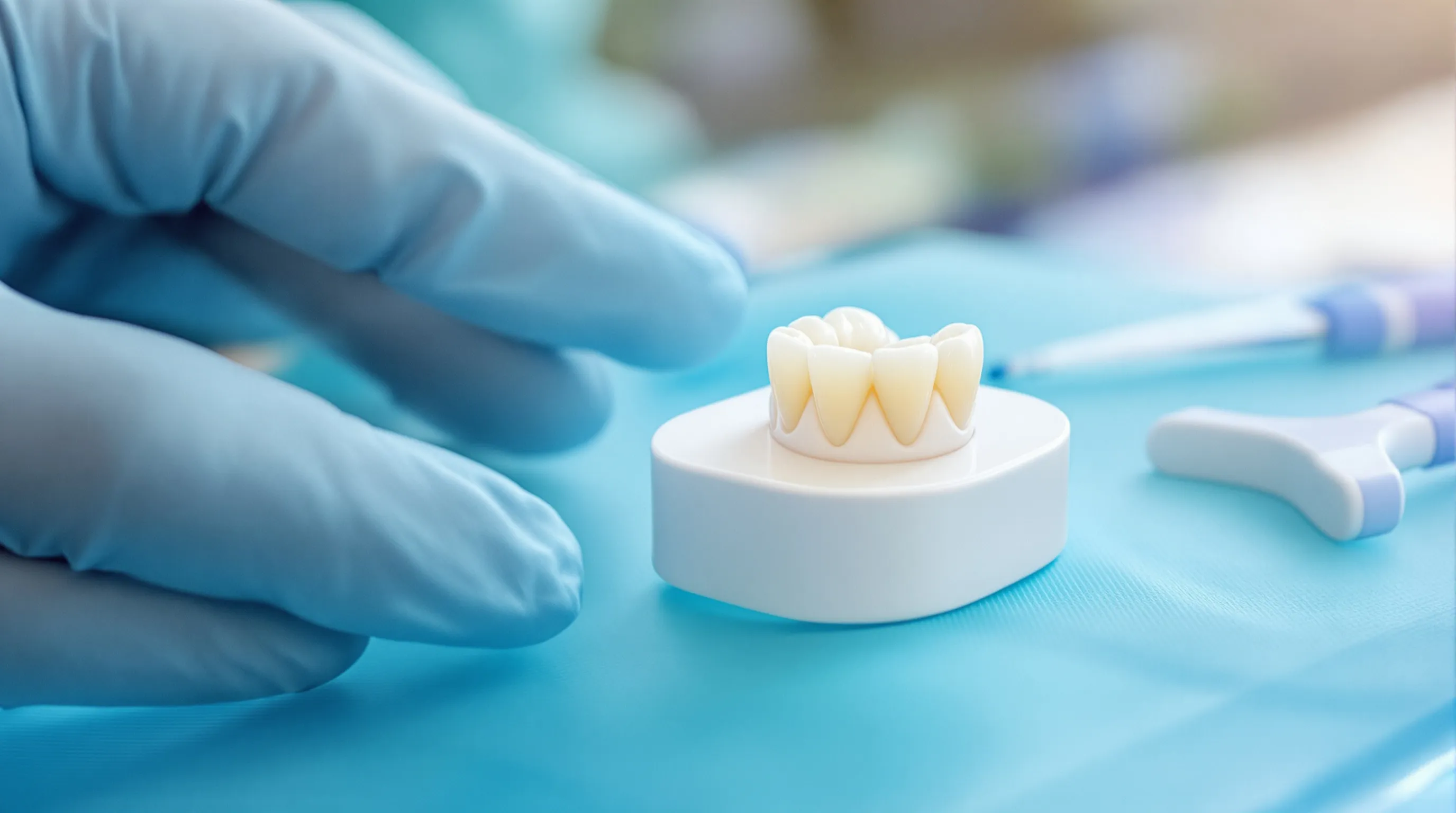
Zirconia or porcelain? The right crown depends on which tooth it covers.
The best cosmetic dentist for a crown lays out every material that fits your tooth, zirconia, porcelain or gold, and explains why, instead of insisting only one will work.
Did you know patients have been pushing back on one-material answers for years? In a 2015 r/Dentistry thread, a patient with a cracked molar filling said their dentist insisted they "absolutely" needed zirconia and that other crown types "will not work." Commenters weren't convinced. For a molar nobody sees, several said porcelain-fused-to-metal or gold would do the job, and one pointed out that zirconia's big cosmetic perk, having no metal collar, matters most in visible spots.
Money was part of that story too. Back in 2015, one commenter noted that cash prices for crowns were often $900+, while some HMO plans paid around $300 for a crown. A gap like that can quietly shape which crown gets recommended.
Front teeth raise a whole different question! In a 2018 r/Dentistry thread, dentists told a patient that solid zirconia looks too opaque beside natural front teeth. They pointed instead to high-translucency zirconia, porcelain fused to zirconia, Empress or e.max, and one credited modern ceramics plus a skilled lab with making a single front crown easy to match. Isn't it amazing how much one word, "zirconia," can hide? The sections below sort out where each option shines, starting with how long these crowns really last and how much trust the research deserves.
Picture 1,777 working dentists answering one simple question: which material would you use to crown a back tooth? When the National Dental Practice-Based Research Network asked exactly that in a 2016 survey, the answers came back almost dead even, with 32% choosing all-zirconia and 31% choosing porcelain-fused-to-metal. Ask about a front tooth, though, and the picture flipped! 54% picked lithium disilicate, a glassy, porcelain-style ceramic, while in that 2016 survey only 17% chose layered zirconia.
That split tells the whole story of the zirconia dental crown. Zirconia is tough. In the same 2016 study, lithium disilicate was described as having only about 40% of zirconia's strength and 57% of its fracture toughness. Yet strength is not the only job a crown has. It also has to look like a real tooth, fit snugly against the gum and make sense for your budget. A 2014 systematic review judged the early track record of zirconia-based crowns comparable to porcelain-fused-to-metal, while warning that the research behind that verdict was still thin.
So which crown should you choose? Start by asking your dentist which material they would pick for this exact tooth, and why, then use our guide to choosing a crown by tooth position to weigh the answer. Let's walk through it, one tooth at a time.
How long do zirconia crowns last, and how solid is the evidence?
Most zirconia crowns are still working after five years, and many published series keep them going past ten. Fifteen-year results are thinner and less rosy, especially for layered crowns.
Before you trust any lifespan number you read online, put it through three quick checks:
- How many years did the study actually follow patients?
- Was the crown solid zirconia, or zirconia layered with porcelain?
- Does the number mean the crown is simply still in the mouth, or that it never had a problem at all?
Let's look at the strongest evidence first. In 2014, a systematic review of zirconia-based crowns found cumulative 5-year survival of 95.9% for tooth-supported crowns and 97.1% for implant-supported crowns. The reviewers judged that record comparable to porcelain-fused-to-metal crowns, the long-time workhorse of restorative dentistry. That is amazing news for a material that was still the new kid on the block! Here is the catch. The review screened 3,216 titles, kept just 16 studies, and only 3 of them were randomized controlled trials. The authors themselves asked for larger studies with longer follow-up before anyone treats zirconia as a settled recommendation.
The common assumption is that zirconia is close to indestructible. Well, the long-term numbers tell a humbler story! Much of the data past five years comes from labs and clinics describing their own crowns, so it deserves a careful eye. One prospective series reported 92.9% survival at 10 years. A 15-year Italian study of 562 zirconia crowns landed at about 71.7% survival, and 15.3% of cases needed recementing because the crown had loosened. One practice's roundup puts gold at 96% survival over 10 years, with zirconia at an estimated 85% to 95%. For a yardstick, one practice's 2024 guide put the average dental crown, of any material, at about 10 to 15 years.
An analysis of 5 sources shows the same arc: excellent early numbers, then a slow fade as chipping and loosening add up. In practice, the first five years are the easy part. What happens after year ten depends on design, fit and your bite.
The research section below walks through these findings. On a 2020 episode of the Dental Hacks podcast, a guest who helped develop full-contour zirconia at Glidewell put full-strength zirconia at about 1,100 megapascals of flexural strength and argued it does not need to be any stronger. Even so, that guest still preferred full-strength zirconia on first and second molars, where chewing forces peak.
At Imagine Advanced Dental Arts, a practice awarded "Practice of the Year," we treat these figures as a reason to plan carefully rather than a promise printed on the box. If you are still deciding where to have the work done, our guide to choosing a dentist near West Windsor covers the checks worth making before you book. Durability is only half the story, though, because a crown that lasts twenty years still has to look right every time you smile.
Do zirconia crowns look natural on front teeth, or is porcelain the better choice?
Solid zirconia often looks too opaque beside natural front teeth. Layered zirconia, high-translucency zirconia and lithium disilicate (e.max) can all blend in beautifully when a skilled lab shades them.
Picture a bright smile with one front tooth that looks a little chalky, like a pearl sitting in a row of glass. That is the classic complaint about solid zirconia up front! In a 2018 r/Dentistry discussion, one commenter put it bluntly: "Solid zirconia crowns look too opaque for front teeth restorations." Another dentist in the same thread said plain zirconia "is going to look opaque like a porcelain fused to metal," and that dentist would rather reach for lithium disilicate on front teeth.
Though that sounds like a firm no, the same thread listed front-tooth options that "would look great": high-translucency zirconia, Empress, porcelain fused to zirconia, and e.max. So the single word "zirconia" on a treatment plan tells you surprisingly little. The kind matters.
Here is where a bit of chemistry sneaks in. Dentists comparing notes in a 2024 r/Dentistry thread explained that newer "aesthetic" zirconia, known as 5Y, carries more yttria and lets more light through. The trade? It gives up transformation toughening, the built-in trick that lets older 3Y zirconia pinch a crack closed as it forms. In plain terms, the prettier grades are the weaker grades. One commenter recalled that translucent 5Y zirconia and e.max test about the same for strength, which makes the choice between them more about looks and handling than raw toughness.
Layered zirconia takes another route: a strong zirconia core under a natural-looking porcelain skin. The original poster in that 2024 thread, a dentist, described color-matching an anterior layered zirconia crown to an e.max crown. "It looked practically identical. The patient couldn't tell the difference." Isn't that amazing? A dental assistant with zirconia crowns on their own front teeth wrote that "no one even knows, not even the dentist I work for until I say something." The porcelain layer is the part that can chip, so it is a beauty with a small asterisk.
Practices that promote zirconia also say the material has been engineered in recent years to look far more lifelike, with translucency closer to a real tooth. That may well be true for some grades. Still, the material is only half of the answer.
The lab is the other half. Commenters across these discussions kept circling back to the same idea: modern ceramics plus a skilled lab technician make front-tooth matching far easier than it used to be. We would always rather a patient ask which grade of zirconia is planned, and who will shade it, than simply hear the word "zirconia" and nod. If you are comparing practices for visible front-tooth work, our walkthrough on choosing a dentist near Plainsboro covers what to look for before you book. And once you know how each material looks, the next question is a personal one: is zirconia actually the right fit for your tooth, your bite and your budget?
What actually goes wrong with a zirconia crown, and who decides which kind you get?
Ask what can go wrong with a zirconia crown and the obvious guess is that the material cracks. A 15-year study of 562 crowns points first to a humbler problem: crowns coming loose.
The study, an Italian prospective series of single and multi-unit zirconia crowns on natural teeth and on implants, reached a cumulative failure rate of 28.33% over 15 years. We know it secondhand, through a clinical guide from a dental lab that makes zirconia restorations. When the lab breaks down what went wrong, one problem comes up more often than breakage.
15.3% came loose, 5.0% chipped
In the 15-year study of 562 zirconia crowns, 15.3% of cases needed the crown cemented back on after it lost its hold. Veneer fractures, many of them minor, affected 5.0%.
Chipping still matters, but it happens in one specific place: the porcelain layered over the zirconia to give it a natural look. Reviews cited by the same lab put veneer chipping at roughly 10 to 15% of layered zirconia cases, which makes it the most common way those crowns fail. According to the lab's guide, solid zirconia with no porcelain on top "virtually eliminates porcelain chipping." The tradeoff is appearance, covered in the section above.
Crowns coming loose show up well beyond that one study. A 2014 systematic review of zirconia-based crowns named loss of retention among the most common complications on natural teeth. A 2022 study of 1,037 single crowns of all materials, published in the Journal of Oral Rehabilitation, found it was the most common reason crowns failed.
Part of the explanation is chemistry. Lithium disilicate has a glass matrix that can be etched with acid and bonded chemically to the tooth, note the authors of a 2016 study on crown materials. Zirconia has no glass phase to etch, said a guest on a 2020 dental podcast who helped bring full-contour zirconia into wide use at a large lab. Its bond relies on a special primer, which the guest estimated at roughly 30 to 35% weaker. The tooth's shape matters too. The lab guide recommends walls about 4 mm tall after the tooth is prepared, and suggests bonding with resin cements that contain MDP when the tooth is short. One anonymous dentist on a professional forum reported zirconia crowns coming off early at 2 to 3% a year "in my hands," one practitioner's hint that technique plays a part.
Then there is the tooth underneath. In the 2014 review, crowns on natural teeth failed as often for biologic reasons, meaning nerve or gum problems, as for technical ones. In the 2022 study, crowns on root-canal-treated teeth had a hazard ratio of 1.89, which means they failed nearly twice as often. Grinding and placement on front teeth also raised the risk. Those figures cover every crown material, so the risk sits with the tooth. "Crowns do not get cavities. But the tooth underneath can," wrote Nga Huynh, a Chicago dentist who summarized the study.
Which crown you are offered may depend partly on who is offering it. A 2016 survey of 1,777 dentists in the National Dental Practice-Based Research Network found no single default material for the front or the back of the mouth.
The more striking result was the pattern behind those percentages. Choices for front teeth and back teeth varied significantly with the dentist's gender, the practice type, the region, how busy the practice was and how many hours the dentist worked each week. Choices for back teeth also varied with insurance coverage. "Decisions for crown material may be influenced by factors unrelated to tooth and patient variables," the authors wrote. Preferences may have changed since 2016. We place crowns ourselves, so the finding applies to us as much as to anyone.
Read side by side, these studies move the risk away from the zirconia itself, toward the porcelain on top, the cement holding it on and the tooth beneath. And the material you are offered reflects the dentist as well as the tooth. You will learn more by asking how a crown is built, how it is held on and what it sits on than by asking whether zirconia is strong enough.
- Is this crown solid or layered zirconia, and if it is layered, what happens if the porcelain chips?
- How will the crown be held on, cemented or bonded, and is my tooth tall enough after preparation for that method?
- Has this tooth had a root canal, or do I grind, and how does that change the plan and how often you check the tooth?
- Why this material for this particular tooth, and would you choose the same one if the tooth were at the front or the back of my mouth?
How we checked this
We used a 2016 peer-reviewed survey of dentists, the abstract of a 2014 systematic review, a dental lab's clinical guide, a Chicago dentist's summary of a 2022 journal study, a machine transcript of a 2020 dental podcast and an anonymous dentists' forum. No figures in this section come from our practice. We know the 15-year Italian study only through the lab's guide, and the lab sells zirconia crowns. The 2022 study covers crowns of all materials. The 2014 review rests on 16 studies, only 3 of them randomized trials. The podcast figure is one guest's estimate from an automated transcript, and the forum comment is one person's experience. We place crowns, including zirconia, so we have a stake in this topic. Still unknown: how solid zirconia holds up over 15 years. The longest result for it in our sources ran five years.
- Makhija SK and colleagues, survey of dentists' crown material choices, Journal of Dentistry, September 2016.
- Systematic review of zirconia-based crowns, PubMed abstract, 2014.
- Haresh Savani, Advance Dental Export, guide to zirconia crown survival rates, January 2026.
- Nga Huynh, DDS, review of crown longevity data, including the 2022 Journal of Oral Rehabilitation study, February 2026.
- The Very Dental Podcast Network, episode on zirconia, March 2020.
- r/Dentistry, dentists' discussion of zirconia and e.max, August 2024.
Who is a good candidate for a zirconia crown, and what should you ask first?
Zirconia suits single back-tooth crowns that take heavy chewing. Visible front teeth, heavy grinders and full-arch cases need a closer look before anyone commits to it.
Think of it as a fit test between the material and your mouth. A strong case for zirconia usually looks like this: a single molar or premolar, a bite that works hard, and a spot where a slightly less glassy look will never show. A weaker case is a lone front tooth in a bright smile, a patient who grinds hard at night, or a whole arch of teeth. On that last one, a full-arch zirconia restoration drew sharp criticism from a lab podcast host who said they usually talk dentists out of it, calling it too harsh on opposing teeth, too heavy and not repairable. Single crowns, the same conversation agreed, are a different story.
Before you say yes, bring these five questions to your consultation:
- Which kind of zirconia is planned, solid, layered or high-translucency, and why does it suit this particular tooth?
- Will the crown be milled in the office or made by an outside lab, and will there be a try-in where changes are still possible?
- How much tooth will be removed, and will the crown be bonded or simply cemented?
- Does my bite or grinding history point toward gold or another material instead?
- How will the crown be billed, and what will my plan actually pay?
Why such fuss over the second question? In a 2022 r/askdentists thread, a patient described a first crown made in the office that they had been told "would look like my normal tooth." Instead it looked poor to them and "feels a bit big," after the dentist seated it, had them tap, pulled it out and drilled it down "over and over a few times." One commenter replied: "If they had to drill a bunch just to get it to fit, they should've just sent it back to the lab and had it redone." The patient had paid $1,700 in 2022. Ouch!
The fifth question matters just as much. Back in 2015, a patient on r/Dentistry was quoted $950 for a zirconia molar crown they believed insurance would not cover. Commenters pointed out that zirconia is billed under the same procedure code as porcelain crowns, CDT D2740, so a plan covering porcelain or ceramic crowns may cover zirconia too. Others noted that some HMO plans cover zirconium crowns and some do not. One practice's current price guide lists zirconia at $1,200 to $2,500 per tooth and says insurance typically covers 50% to 80% when the crown is medically necessary.
Quotes swing that widely for a reason. A good question turns a mystery number into a plan you understand. For more on sizing up a practice before you book, see our guide to choosing a dentist near Hamilton. Then bring your list, your insurance card and your honest grinding history to the very first visit.
What's the smartest way to choose your crown from here?
Match the material to the tooth's job, then judge it against your whole face; we're certified in BOTOX® Cosmetic and dermal fillers, so we look beyond one tooth.
Did you know the crown question is really two questions? For back teeth, zirconia is on its way to becoming the everyday default, and the strength debate there is mostly settled. Before you say yes, ask whether your dentist has checked your gum health and how much natural tooth remains, two factors one practice's guide lists alongside visibility and bite. Though zirconia has won plenty of skeptics over, the long-term research that reviewers called thin back in 2014 still has catching up to do, so careful dentists keep gold and other options on the table for some mouths.
Well, the stakes climb fast with bigger cases! In a 2021 Reddit AMA, one patient described getting a full mouth of zirconium crowns in Istanbul. A full arch magnifies every choice about wear, fit and repair. So bring your x-rays, your grinding habits and your smile goals to the consultation, and ask us which material each tooth actually needs before anyone picks up a drill.
Summarize This Article With AI
Open this article in your preferred AI engine for an instant summary.
Frequently Asked Questions
What else do people ask about zirconia dental crowns?
Most questions come down to lifespan, looks, cost and whether traveling for cheaper work is worth it. Here are plain answers, drawn from the evidence above.
What is a zirconia crown, exactly?
A zirconia crown is a tooth-colored cap made from zirconia, a very strong ceramic, that covers a damaged tooth. It can be solid all the way through or layered with porcelain on the outside. The layered kind looks softer. The solid kind is tougher.
Will a zirconia crown last the rest of my life?
Probably not, and no honest dentist will promise that. In a 2021 r/AMA thread, one commenter had "heard" that crowns on shaved-down teeth last around 15 years maximum, though they gave no source. The real-world numbers sit in the lifespan section above, and they're better than that rumor!
Is it smart to get a full mouth of zirconia crowns abroad?
Think hard first. Another commenter in that same thread said an Istanbul clinic placed crowns they didn't need when they asked for a "Hollywood Smile," and they were left looking for a new dentist to repair the damage and pain. Once healthy tooth is shaved down, there's no undo button.
Does zirconia look as natural as porcelain?
On back teeth, almost nobody can tell. Up front, it depends on the zirconia grade and the lab's skill, so ask to see the shade before your crown is finished.
Where can I get a zirconia crown near Lawrenceville?
Right here! Imagine Advanced Dental Arts serves patients across New Jersey with four credentialed dentists. Reach us through our contact page and bring your x-rays, your insurance card and that list of questions about which grade of zirconia suits your tooth.
Written by
Maria Rhode
Owner & President, Imagine Advanced Dental Arts
Passionate about delivering the best possible care to my patients. From my days in residency to owning a beautiful hi-tech dental office, I never stop learning and advancing myself and now my practice.
Connect on LinkedIn