

Quick Answer
Implant overtreatment refers to a treatment plan larger than your diagnosis requires. Think of an All-on-4 full-arch quote for one failing tooth, healthy teeth marked for extraction, or sinus lifts nobody explained. A high case count at a busy or DSO-affiliated clinic does not prove your plan is right. It proves the clinic is busy. Before you sign, ask for a tooth-by-tooth diagnosis in writing, the smaller alternative and why it was ruled out, and an itemized quote. Then get a second opinion from a dentist who isn't selling the plan.
Key Points
- According to Grand View Research, dental clinics, including independent and DSO-affiliated clinics, held 82.3% of end-use implant revenue in 2025, so case counts track business structure.
- A 2022 Journal of Oral Medicine and Oral Surgery series found 83% of lost implants were in the upper jaw and 42% followed a pre-implant sinus lift.
- CareCredit puts the national average cost of All-on-4 dental implants at $15,176, with a range of $11,640 to $27,500, and most insurance plans treat it as elective.

Before you sign: every implant, extraction and graft on a plan should trace back to your diagnosis.
Looking for the best dentist for implants, veneers or a smile makeover in Mercer County, NJ?
The best dentist is the one whose plan fits your mouth, not the one with the most cases. Size, speed and billboard counts say little about whether you need what's sold.
Picture the search. You type "best dental implant provider" or "best cosmetic dentists in Lawrenceville, NJ," and the biggest, busiest names rise straight to the top. Their pages brag about smiles transformed and record case counts. It feels like proof. Whether the plan is for veneers, a full smile makeover or a set of implants, volume quietly becomes the stand-in for quality, and almost nobody stops to ask what that number actually measures.
Implants raise the stakes, because an implant is a long-term decision. In one 6-year clinical series, the patients who lost implants had a mean age of 55.5 years, with a range of 42 to 78. Implant trouble is not just a late-life problem. A plan made in midlife has decades to prove itself!
Medicine has a word for treating what never needed treating, borrowed from the world of cancer screening: overtreatment. In implant dentistry it shows up as a full-arch quote for a single failing tooth, healthy teeth marked for extraction, or grafts nobody explained. Well, a plan like that could not be further from what a single-tooth patient walked in needing.
This article explains why case volume misleads, shows the red flags that appear on paper, and hands you a diagnosis-first checklist you can run at any consult, anywhere in Mercer County.
Rewind to the turn of the millennium, when a dental implant was still something of a novelty. In federal NHANES survey data from 1999 to 2000, just 0.7% of U.S. adults with missing teeth had implants. By the 2015 to 2016 survey, that figure had climbed to 5.7%, an average annual increase of about 14%, driven largely by patients aged 65 to 74. What an amazing run for a treatment that once sounded like science fiction! Even so, by 2016 only about 6% of U.S. adults had implants at all.
Growth like that changes how a treatment gets sold. Once implants went mainstream, the pitch shifted from whether the work could be done to who does the most of it. Case counts now appear on billboards and websites as shorthand for skill. Here's the catch. A case count measures how many implants a clinic places. It does not measure whether each patient needed them.
Implant overtreatment is the gap between the plan you were sold and the plan your mouth actually required. It can mean extra implants, teeth pulled that could have been saved, or add-on grafting nobody explained. High volume is marketed as proof of quality, yet busy clinics are exactly where a patient with one failing tooth can walk out holding a full-arch quote.
This guide shows what volume does and doesn't tell you, what an oversized plan looks like on paper, and how to test yours before you sign.
Top 3 questions this article answers
- Is the implant clinic with the most cases really the best dental implant provider?
- How can I tell if my dentist quoted me a full-arch plan I don't need?
- What should I ask before I sign an implant treatment plan?
Start with the second one if a quote is already sitting on your kitchen table.
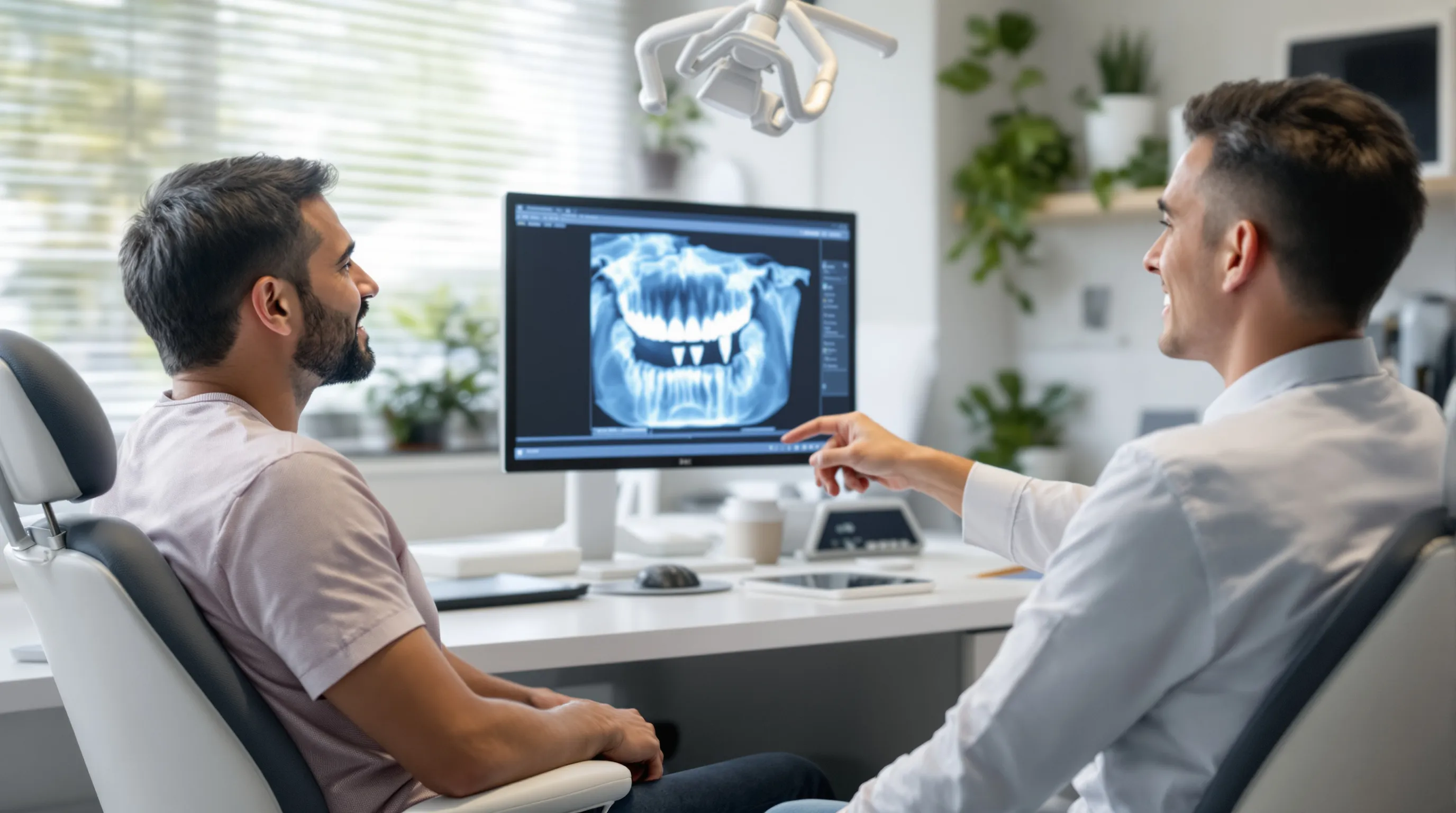
What will matter most for implant patients in the next 12-24 months?
Over the next 12-24 months, expect more packaged full-arch plans from consolidated clinics. The patients who fare best will judge plans on itemized parts, bone risk and long-term upkeep.
| Prediction | Weak signal | Why it matters | Source |
|---|---|---|---|
| More implant care flows through consolidated clinics that sell standardized, packaged pathways. | Clarivate's Medtech 360 report, which covers the North American implant market from 2019 through 2034, is tracking how DSO consolidation affects the standardization of implant procedures and patient access. According to Grand View Research, premium implants led price tiers at 46.1% share in 2025. | A standard protocol can speed care. It can also default patients to the same multi-implant plan, whether or not their own teeth could be kept. | Grand View Research (2026); Clarivate Medtech 360 |
| Long-term durability, not placement volume, becomes the real test of a provider. | A 2022 clinical paper cited benchmark implant success rates of 97% at 10 years and 75% at 20 years. The implant base built up across two decades of federal survey data is now aging into that window. | Plans that stack extra implants or grafts add more sites to maintain. Ask how a clinic handles repairs and replacements 10 to 20 years out. | Journal of Oral Medicine and Oral Surgery (2022); NHANES data |
| More patients seek independent second opinions and written necessity documentation for large implant plans. | The 2024 "Too Much Dentistry" debate argued that examining, diagnosing, planning and treating in one place limits outside oversight. | A separate clinician reading the same imaging is the most direct check when the practice that finds the problem also sells the fix. | JAMA Internal Medicine (2024), summarized by Gary Schwitzer |
Here is what most buyers miss. Rising implant volume is not proof of better care. It is a growing pipeline of future maintenance! A plan that promises a lifetime fix through more implants or more grafting may simply be adding more places for trouble to start later. Did you know that the benchmark numbers above drop the longer an implant is in service? That is exactly why the second decade, not the first appointment, is where a provider earns its reputation.
We hold this outlook loosely. It would change if insurers began paying for full-arch treatment as routine restorative care with necessity review, because a payer would then be asking the scope questions for you. It would also change if long-term studies showed 20-year implant survival holding near 10-year levels. Until either happens, the careful patient's best tools stay the same: the written diagnosis, the itemized quote and a second set of eyes.
What's Coming in the 12-24 months
Where full-arch implant selling heads next
Forecasts on how clinic consolidation, full-arch pricing and long-term implant outcomes will shape the implant plans U.S. patients are offered.
What shifts in implant plans and pricing
Use each forecast as a checkpoint when you compare an implant quote, seek a second opinion or weigh a clinic's treatment pathway.
Implant care will keep concentrating in dental clinics, which held 82.3% of end-use implant revenue in 2025. DSO consolidation will push more patients into standardized, packaged implant protocols over the next 12-24 months.
All-on-4 quotes will keep spanning a wide band around the $15,176 national average, from $11,640 to $27,500. Premium implants hold the largest price-tier share, so patients will increasingly ask clinics to itemize implant brand, material and any added implants.
Implant prevalence among U.S. adults with missing teeth rose from 0.7% in 1999-2000 to 5.7% in 2015-2016. As those implants age, more of them will reach the window where benchmark success falls from 97% at 10 years to 75% at 20 years, and repair and replacement will take a growing share of implant demand.
Criticism of dentistry's model, in which one practitioner diagnoses and treats, will lead to more independent second opinions and more necessity documentation for large implant plans. This will be strongest where health insurance pays only if the dentist shows medical necessity.
Small Clues Worth Watching Clarivate reports that dental practices are consolidating under DSOs and is tracking how that affects the standardization of implant procedures and patient access. CareCredit attributes All-on-4 price differences to material, extra implants and surgeon experience. Premium implants led price tiers at 46.1% share in 2025. In a 6-year series of 376 implants, 83% of failures were in the upper jaw and 42% followed a pre-implant sinus lift. Letters to JAMA Internal Medicine argued that examining, imaging, planning and treating in one place, often by the same practitioner, prevents external oversight.
Sources behind the implant forecasts
Each public source is listed with the single finding on implant markets, pricing or outcomes that a forecast draws on.
| Source | What it states | Forecasts it backs |
|---|---|---|
| Dental Implants Market Size & Share Report, 2026-2033 [Web source] | Dental clinics (including independent clinics and DSO-affiliated clinics) held 82.3% of end-use revenue share in 2025. “The global dental implants market size was valued at USD 5.6 billion in 2025 and is projected to reach from USD 6.0 billion in 2026 to USD 11.0 billion by…” Premium implants led the price tiers at 46.1% share in 2025. Direct sales led distribution at 61.2%. |
DSO clinics standardize implant pathways Full-arch prices stay wide and out of pocket |
| Dental Implants - Market Insights - North America - Clarivate [Web source] | Dental practices are consolidating under DSOs (dental service organizations). The report examines how this affects the standardization of implant procedures and patient access. “The North American dental implant market is expanding steadily, driven by an aging population, rising edentulism rates, and growing demand for long-term…” | DSO clinics standardize implant pathways |
| All-on-4® Dental Implant Cost and Procedure Guide - CareCredit [Web source] | National average cost of All-on-4® dental implants is $15,176, with a range of $11,640 to $27,500 (CareCredit, published April 24, 2026). “While All-on-4 dental implants can come with a significant price tag, for many patients, the long-term benefits outweigh the up-front cost.” Most insurance plans treat All-on-4 as cosmetic or elective and won't cover it. A plan that covers major restorative work might cover part of it. Health insurance may cover part if the dentist shows medical necessity. |
Full-arch prices stay wide and out of pocket Pressure grows for independent plan review |
| Dental Implant Adoption Trends in the U.S. Market Insights [Web source] | NHANES data: implant prevalence among U.S. adults with missing teeth rose from 0.7% (1999-2000) to 5.7% (2015-2016), an average annual increase of ~14%, driven largely by patients aged 65-74. “CAD/CAM, CBCT, and 3D printing have dramatically enhanced diagnostic precision and implant planning” | Long-term durability, not volume, becomes the test |
| Implant failure rate and the prevalence of associated risk factors: a 6 [Web source] | Benchmark success rates for dental implants are 97% at 10 years and 75% at 20 years. “The failure rate observed in this oral surgery unit is consistent with the other international studies, confirming the compliance with good clinical practices…” | Long-term durability, not volume, becomes the test |
| Overdiagnosis and overtreatment in dentistry [Substack / Newsletter] | dentistry's model of doing examination, radiographs, diagnosis, treatment planning and treatment "in 1 place, often by the same care practitioner," which "prevents external oversight of the entire process.". “Too Much Dentistry" authors: "Little progress has been made on using data from clinical trials to determine best practices for dental care.” | Pressure grows for independent plan review |
What would shift the implant outlook
These changes in insurance, clinic ownership or long-term outcome data would weaken or reverse the forecasts above.
The Fine Print
We are most confident in 62, though 62 could prove us wrong in the best way.
- DSO clinics standardize implant pathways. Buyers changing priorities, or regulators changing rules, hit that call first.
- Long-term durability, not volume, becomes the test. A source base that turns contrary would leave that as the forecast still standing.
Want a second look at the implant plan in your hands?
Bring your implant plan, imaging and quote to Imagine Advanced Dental Arts in Lawrenceville. We'll read it tooth by tooth and tell you plainly whether every line earns its place.
No pressure. No expiring discount. Every extra implant is one more site that has to hold up for decades, so we start with the tooth you have and ask whether the single-tooth option was ever really on the table.
Who are the best cosmetic and implant dentists in Lawrenceville, NJ, if case volume isn't proof?
The best provider is the one who sizes the plan to your mouth and stays with it. Forty-two years in the same Lawrenceville office means most of our cases finish here.
According to Grand View Research, dental clinics, including independent and DSO-affiliated clinics, held 82.3% of end-use implant revenue in 2025, and direct sales led implant distribution at 61.2%. Clarivate's Medtech 360 report fills in the rest of the picture: dental practices are consolidating under DSOs (dental service organizations), and Clarivate is tracking how that shift affects the standardization of implant procedures and patient access. An analysis of 2 sources shows that implant volume is tracked as a business measure, not a patient outcome. Neither market report is built to tell you whether a clinic's plans fit its patients. They measure revenue, sales channels and consolidation. Did you know that? Most "best provider" checklists skip right past it!
So here is the lens we suggest, a three-question volume check for any clinic that advertises how many implants it has placed:
- What is being counted? Implants placed, arches completed and patients treated are three very different numbers, and a single full-arch case can add several implants to the tally at once.
- Who does the count serve? A placement total is a marketing figure first and a quality signal a distant second.
- What does the count leave out? It says nothing about teeth that could have been saved, plans that were scaled back, or how the work holds up over the long haul.
Contrary to popular belief, a big placement number does not prove a clinic is careful. The reality is that it proves the clinic is busy. Though experience absolutely matters (nobody wants to be a surgeon's very first case!), experience and volume are not the same thing. A standardized, high-throughput pathway can move patients along efficiently, and that is genuinely useful. It can also steer patient after patient toward the same packaged plan, whether or not their own teeth could have been kept. Well, a plan built around a clinic's schedule could not be more wrong for someone who only needed one tooth replaced, a job a single dental implant or a dental bridge can often handle! As you can see, the busiest name in Mercer County is not automatically the best fit for you.
We want to be straight with you about the limits of the evidence. Nothing we reviewed counts how often single-tooth patients receive full-arch quotes, at high-volume clinics or anywhere else. What the evidence does show is where the money sits and which way the business is consolidating. That is reason enough to look harder at the plan in front of you.
Our own experience points the other way. Because most of our cases finish in one office rather than moving between specialists, the people who plan your implant are, most of the time, the same people who finish it. That kind of accountability is something no placement count can show you.
In practice, volume tells you about a clinic's business model. It does not tell you about your mouth. What this means for you is simple: judge the plan, not the billboard, and start with a careful smile analysis of the teeth you already have.
What does implant overtreatment look like on a real treatment plan?
Overtreatment is a plan bigger than your diagnosis: extra implants, extractions of teeth that could be saved, or stacked grafts that the imaging doesn't clearly justify.
The idea comes from outside dentistry, and it is a useful one. The CDC's guidance on breast cancer screening describes a risk every screening program carries: finding and treating something that would never have caused a problem. That is the general medical meaning of overtreatment, and we borrow it here strictly as an analogy. A mammogram is not a dental implant! But the logic travels well. When an exam reliably turns up something to fix, the real question is whether that something needed fixing at all.
Dentistry has had its own reckoning with the idea. In 2024, a medical journal opinion piece titled "Too Much Dentistry" took aim at cavity treatment, the push for 6-month (or even shorter) checkup intervals, and scaling and polishing. Letters in the debate that followed pointed to a structural problem: dentistry does examination, radiographs, diagnosis, treatment planning and treatment "in 1 place, often by the same care practitioner," which "prevents external oversight of the entire process." Notice that the list was about routine care. Implants cost far more, and the same structure applies to them.
So what does excess look like on paper? Here is how we'd read a plan:
| What you see on the plan | Why it's a red flag | What a right-sized plan shows instead |
|---|---|---|
| One missing tooth, but the quote is for a full arch | The scope jumped from a tooth to a jaw | A single implant, bridge or crown option priced side by side |
| Healthy or treatable teeth marked for extraction with no notes | Extractions nobody explained are extractions nobody justified | A written prognosis for each tooth, with the imaging behind it |
| Sinus lifts or bone grafts listed as standard line items | Every added site is another place a failure can start | Grafting tied to a specific, measured bone deficit |
| Premium components folded into one package price | You can't see what is driving the cost | An itemized quote for implants, abutments, prosthesis, grafting and sedation |
| A discount that expires at the end of the consult | Pressure replaces a decision | Time to think, plus records you can take to a second opinion |
Why do stacked add-ons matter so much? A 6-year clinical series published in 2022 followed 376 implants. Twelve were removed, in 11 patients, for an overall failure rate of 3.11%. Of the lost implants, 83% were in the upper jaw, and 42% had followed a pre-implant sinus lift. That doesn't prove the grafts caused the failures. It does mean each added procedure deserves its own reason. In practice, a sinus lift can be exactly right. The takeaway is that it should never be a default line item.
Then there's the money. According to CareCredit, the national average cost of All-on-4® dental implants is $15,176, with a range of $11,640 to $27,500. CareCredit says price varies with "the type of material used, whether you need extra implants and your surgeon's experience." Read that list again! Materials and extra implants are exactly where an upsell hides, and surgeon experience is the very thing volume marketing sells. CareCredit also notes that most insurance plans treat All-on-4 as cosmetic or elective and won't cover it, though a plan that covers major restorative work might cover part, and health insurance may cover part if the dentist shows medical necessity. What this means is simple. When a plan is oversized, you usually pay for the extra yourself.
Though a full-arch plan is the right answer for some mouths (and a life-changing one!), it should arrive as the conclusion of your diagnosis, never as the opening offer.
How can you sanity-check an implant plan before you sign?
Get the diagnosis in writing, ask why smaller options were ruled out, and check who designed the plan. Our training includes a DMD and residency, with honors in prosthodontics and oral reconstruction.
Why does that last point matter so much? Because an implant is only the root. The crown, bridge or full-arch prosthesis on top is what you chew with, smile with and live with every single day. A plan designed by someone trained in restoring teeth starts from that final result and works backward to the number of implants it truly needs. Let's look at how to put any plan, from any clinic, through its paces.
We call it the diagnosis-first checklist, and it takes about as long as a cup of coffee:
- Ask for the diagnosis before the procedure count. Which teeth are failing, and why? A good plan names the problem tooth by tooth before it names a number of implants.
- Ask what the smaller option looks like. Could a single implant, a bridge, a crown or gum treatment handle this? If it was ruled out, ask for the reason in writing.
- Ask for copies of your imaging. Your X-rays and 3D scans should travel with you, so another dentist can read the same evidence.
- Ask for an itemized quote. Implants, abutments, the final prosthesis, grafting and sedation should each have their own line.
- Ask who restores the implant and who maintains it. The surgeon, the restoring dentist and the person you call when something loosens years from now may be three different people.
- Get a second opinion from someone who isn't selling the plan. Bring everything above. A good plan survives a second look easily!
| Question to ask | Reassuring answer | Warning answer |
|---|---|---|
| Why can't this tooth be saved? | A specific reason you can see on your imaging | It's easier to start fresh, with no tooth-level reason |
| What would a single-tooth option involve? | A side-by-side comparison with the full plan | No alternative offered at all |
| Can I take my records to another dentist? | Yes, here are your images and notes | Hesitation, or a fee just to see your own scans |
| How long is this price good for? | Long enough to get a second opinion | Today only |
What about reviews and awards? They matter, just not for this particular job. We're thrilled to hold a 4.9 average rating from 587 Google reviews, and we were honored to be named "Practice of the Year." Still, no star rating or plaque, ours included, can tell you whether your plan is the right size! Credentials work the same way. Our team includes a Diplomate of the ABDSM, board certified in dental sleep medicine, which is wonderful news for snoring and sleep apnea care and says nothing about how many implants you need. In practice, match the credential to the procedure. The takeaway is simple: for an implant plan, ask about training in restoring and replacing teeth.
Now, a confession. We would love to hand you a number here, such as how often a second look at an outside plan ends with a smaller scope, or how our own single-tooth cases compare with our full-arch cases. Those counts aren't on record yet, so we won't guess at them. What that record would show, once collected, is how often a careful second opinion changes the plan. And that is exactly the question to ask any clinic, us included: how many of your implant patients leave with one tooth replaced, and how many leave with a full arch?
As you can see, none of this requires a dental degree. It only requires asking for reasons before you agree to procedures.
So how do you choose the best dental implant provider?
Choose the provider whose plan matches your diagnosis, not the one with the biggest number. The right plan explains every implant, every extraction and every graft in writing.
Let's step back for a moment. In roughly one generation, implants went from a rarity to a mainstream fixture of American dentistry, and clinics now carry the overwhelming share of that business. What a triumph for patients who wanted better ways to replace missing teeth! Though that success brought billboards and case counts along with it, the next chapter will be judged differently. As more of today's implants age into their second and third decades, the real test of a provider will be how the work holds up and who stands behind it. Every extra implant in a plan is one more site that has to pass that test.
That is the angle most "best provider" lists miss. Volume tells you who is busy. Proportion tells you who is careful.
So bring the plan. Bring the scans. Ask why each line is there, and listen closely to whether the answer is about your mouth or about the package.
Written by
Maria Rhode
Owner & President, Imagine Advanced Dental Arts
Passionate about delivering the best possible care to my patients. From my days in residency to owning a beautiful hi-tech dental office, I never stop learning and advancing myself and now my practice.
Connect on LinkedInSummarize This Article With AI
Open this article in your preferred AI engine for an instant summary.
Frequently Asked Questions
What else do patients ask about implant overtreatment?
Most questions come down to one test: does every implant, extraction and graft on your plan trace back to a written diagnosis? Here are the ones we hear most.
What is implant overtreatment?
Implant overtreatment is a plan larger than your diagnosis requires. It can mean extra implants, pulling teeth that could be saved, or grafting that the imaging doesn't clearly justify. The work itself may be well done. The problem is scope.
Is it overtreatment if a dentist recommends All-on-4 for one missing tooth?
Not automatically, but it needs a strong written reason. One missing tooth can often be handled with a single implant, a bridge or a crown. If a full-arch plan is on the table, ask which other teeth are failing and why, and ask to see it on your imaging.
Are high-volume implant clinics bad?
No! Clinics carry most implant revenue in the U.S., so you will likely meet a busy one. Volume simply isn't proof of fit. Judge the plan in front of you, not the number on the billboard.
Are sinus lifts ever unnecessary?
Some are essential, and some are added out of habit. A sinus lift adds bone under the sinus so an upper implant has something to hold. Ask for the measured bone deficit that justifies it before you agree.
Why are implants so much more common than they used to be?
Implant use grew steadily across two decades of federal survey data, driven largely by older adults. That growth is wonderful news for patients. It also turned case counts into a marketing tool, which is why proportion matters more than ever.
What should I bring to a second opinion?
Bring copies of your X-rays and 3D scans, the written diagnosis, and an itemized quote. A list of the teeth marked for extraction helps too. With those in hand, a second dentist can read the same evidence the first one did.
Does getting a second opinion mean I don't trust my dentist?
Not at all. A good plan holds up to a second look, and a confident dentist expects you to ask. It is your mouth and your money, after all!