

Quick Answer
Ask for a trial smile: a reversible mock-up built from a diagnostic wax-up and worn over unprepared teeth, so you can judge length, shape and shade before any enamel is removed.
Without one, you are signing off on permanent work from pictures. Johannesburg dentist Dr. Norman Cahi's workup before cosmetic treatment includes a full set of radiographs, a set of models and a digital smile design. Expect that kind of thoroughness! Our team even includes an ABDSM Diplomate, board certified in dental sleep medicine.
Key Points
- The practice-management publisher Rework describes a trial smile as temporary composite placed over existing teeth to simulate the proposed result, in an appointment of 45-60 minutes .
- Traditional veneers require removing 0.5 to 1.0 mm of enamel, which an October 2025 guide from a Franklin, Tennessee cosmetic practice says makes the process irreversible.
- Harvey Silverman, inventor of a preview veneer system, wrote in Dentistry Today in April 2026 that patients score the preview from 1 to 10 and go ahead at 8 or higher.
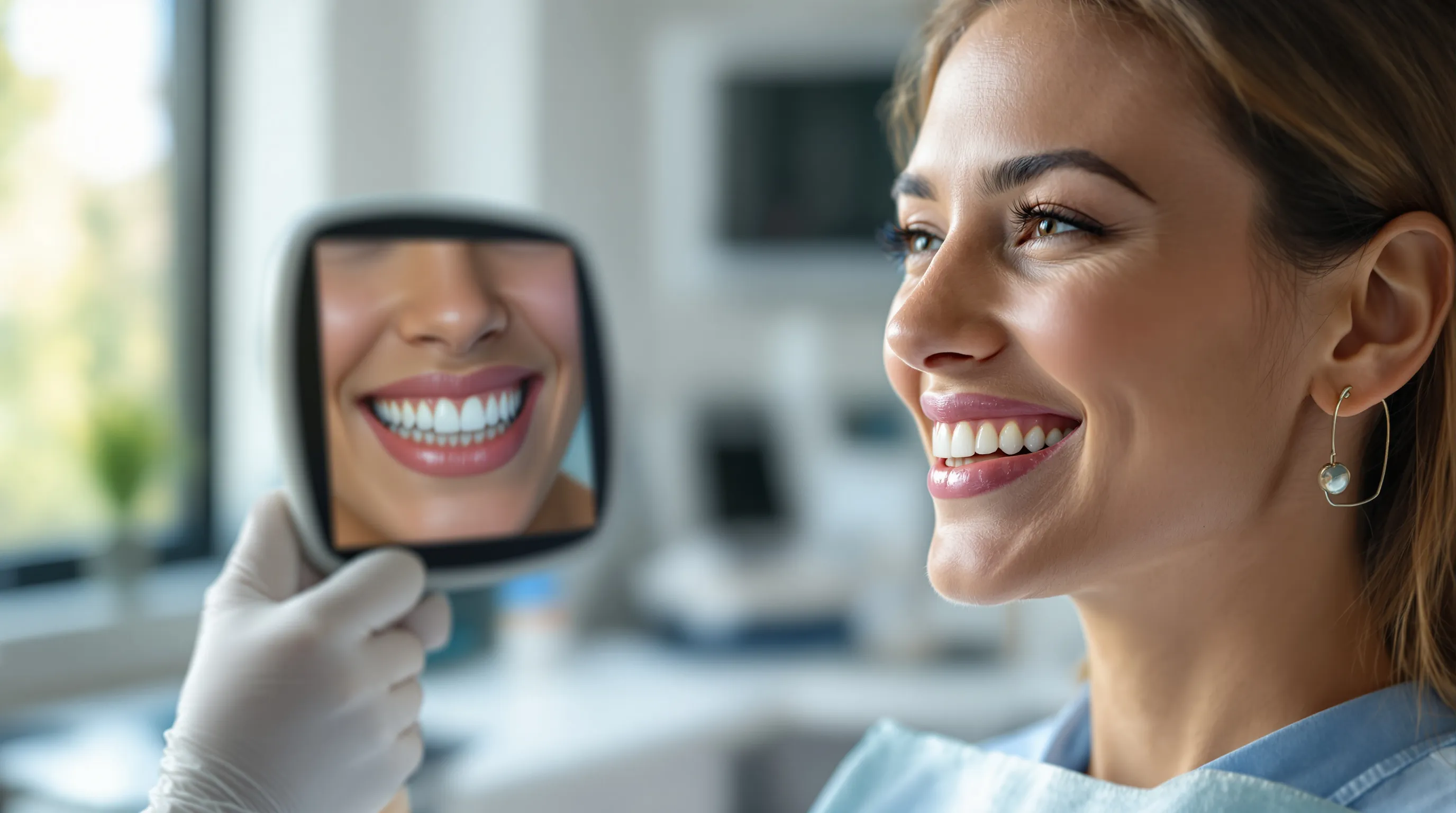
A trial smile lets you judge length, shape and shade on your own face before any prep begins.
Cosmetic dentistry keeps growing fast, with the global market projected to reach about USD 59.52 billion by 2034, yet the safest step in any makeover still costs no enamel at all.
Precedence Research, in a report updated in September 2026, expects the market to grow 8.53% a year from 2026 to 2034. North America was the largest region, with about 33.93% of revenue in 2024. That is a lot of new smiles! What is fueling it? The firm points to digital smile design, CAD/CAM, 3D printing and enhanced imaging, which it says make procedures more accurate and more personal.
Well, all that shiny technology still runs into one stubborn fact! Prep is permanent. So bring a few photos of smiles you admire, and a few you dislike, to your first visit, because they give the design a starting point long before anything is permanent. Cosmetic dentists also note that teeth lose volume with age, much as skin does, so the best preview looks fuller and fresher without looking fake.
Though choosing a cosmetic dentist can feel overwhelming, a few proof points help. Our patients have given Imagine Advanced Dental Arts a 4.9 average rating on Google, and the practice has been awarded Practice of the Year. Those honors matter, but your own test drive matters more! Next, see exactly what a trial smile is and why it belongs before the first cut.
A cosmetic smile plan can be test-driven before a single speck of enamel is touched, and it should be! A trial smile, shaped from a diagnostic wax-up and worn over your own teeth, lets you judge length, shape and shade in real life before anything permanent happens. Ask early how many teeth the plan covers, because each added tooth means more cost and, often, more enamel removed.
Why does this checkpoint matter so much? Start with the money. In 2024, the U.S. cosmetic dentistry market was valued at more than $12 billion a year and was growing about 8% annually. Verywell Health's 2025 veneer guide put 2024 porcelain prices at $500 to $2,500 per tooth and said cosmetic veneers are "rarely covered by dental insurance."
Then there is the enamel. No-prep veneers handle no more than one shade shift. Minimal preparation, the most used design, covers changes of up to 3 shades. A jump of three or more shades calls for maximum preparation, with 1.0 to 1.5 mm trimmed from the front of each tooth. Well, if a brighter shade is your main goal, ask whether whitening could narrow that jump before any prep is planned!
Questions this article answers
What is a trial smile, and why should it come before any enamel is removed?
A trial smile is a temporary composite copy of your planned new teeth, placed over your natural teeth without drilling, so you can wear and judge the design first.
Here is the order a careful cosmetic plan should follow:
- A smile analysis of tooth proportion, smile line and facial symmetry.
- A design of the new teeth, sculpted as a diagnostic wax-up or built on screen.
- A tooth-colored copy of that design, pressed over your unprepared teeth.
- Your verdict, and any changes, before a single bit of enamel is touched.
The practice-management publisher Rework describes the trial smile as temporary composite placed over existing teeth to simulate the proposed result, in an appointment of 45-60 minutes. Its guide recommends a mock-up for any patient considering a comprehensive case, placed "before final preparation," with "design approval documented." Did you know the first big step of a smile makeover can involve no drill at all? Contrary to the popular picture of veneers, the drill is supposed to wait its turn!
The design has to come from somewhere. A 2024 veneer guide from the dental lab Future Dental Studio begins with a smile analysis, then a shade choice that either matches the neighboring teeth or sets a completely new shade for a full makeover. The lab names the diagnostic wax-up, digital simulation and snap-on smiles as the preview tools that come before any tooth reduction. A wax-up is your new smile sculpted in wax on a model of your own teeth. Once it exists, it can be copied into composite and worn.
Cosmetic dentists who build smiles this way describe a fixed order. First comes a talk about expectations and what is realistic. Next, the ideal smile is designed. Only then are the procedures planned, and the patient sees the mock-up in the mouth even when the first version was made on a model. Prep comes later, never before. Combining 5 sources points to one sequence: analysis, design, preview, approval, and only then the permanent work.
Why so strict? Enamel does not grow back. Once it is reduced, the decision is made for good. A trial smile is the last moment when changing your mind costs nothing more than a little composite.
Though the preview is temporary, treat it like a draft you can mark up, pointing out any tooth that looks too long, too square or too bright while you are still in the chair. Our practice is certified in BOTOX Cosmetic and dermal fillers, so we never forget that the lips and lower face frame the teeth. A thorough cosmetic smile analysis and design should look well beyond the enamel. And once that composite is on your teeth, the real question begins: does it actually look like you?
Will a cosmetic dentist let you wear your new smile before any drilling starts?
Most explanations of a trial smile assume every cosmetic dentist offers one at the right moment. We read how dentists describe their own workflows, and the timing varies more than most patients would guess.
The plainest clue comes from a patient guide published in October 2025 by a cosmetic practice in Franklin, Tennessee. The guide describes a digital preview that patients approve on a screen, then adds that "some practices use temporary mock-ups you can try in your mouth to visualize the change." Some practices. In that guide, the wearable version is an extra.
Dentists also disagree about how much patients should see. A Houston cosmetic dentist, interviewed on a dentists' podcast in 2024, lets patients voice dislikes at three points: when they try on the mock-up, while they wear temporaries, and right before cementation. The same dentist said faculty at a live-patient veneer course in New York prefer not to show patients the result before cementation.
Timing matters as much. On a 2023 beauty podcast, a cosmetic dentist practicing between New York and Los Angeles described patients test-driving the new smile in temporaries, worn for a couple of weeks after the teeth are prepared, and called that phase key to predictability. The workflow also includes a mock-up the patient eventually sees in the mouth. By the temporary stage, though, the enamel is already gone.
Traditional veneers require removing 0.5 to 1.0 mm of enamel, the Tennessee guide notes, "making the process irreversible." Verywell Health, in a dentist-reviewed explainer, says porcelain veneers generally need temporaries between prep and placement, while no-prep veneers need none. If the first time you see the new smile in your mouth is in temporaries, your teeth have most likely already been prepped.
Where the line falls
- Digital design or wax-up: approved on a screen or a model.
- In-mouth mock-up: temporary composite over untouched teeth. The last fully reversible checkpoint.
- Preparation: 0.5 to 1.0 mm of enamel removed for traditional veneers.
- Temporaries: worn for a couple of weeks, sometimes called the test-drive.
- Try-in of the final veneers, then cementation.
How much enamel comes off is settled earlier, by the design you approve. A veneer prep guide that Kourosh Jadali wrote for Future Dental Studio, a dental lab in Agoura Hills, California, matches each prep design to how much the color and alignment are being changed.
| Prep design | What the guide uses it for | Reduction |
|---|---|---|
| No prep | No more than one shade shift, slight alignment correction | Stays in enamel |
| Minimal prep | Color changes up to 3 shades, medium misalignment | The guide's most used design |
| Maximum prep | Shade changes of 3 or more, major misalignment, redoing old veneers | 1.0 to 1.5 mm facial, 1.0 to 2.0 mm at the biting edge |
"A major shade change does not allow for no-prep veneers," Jadali writes, and the deepest preps leave "little to no enamel remaining, which can lead to poorer bond strength." Every request on the mock-up for a whiter shade or a straighter line is also a choice about how deep the prep will go.
Why would a practice build a preview at all? Partly because previews win cases. Rework, which publishes practice-growth guides for dentists, calls the trial smile "one of the most powerful conversion tools in cosmetic dentistry" and reports that practices using digital smile design tools see 30 to 50 percent higher cosmetic case acceptance. Harvey Silverman, the dentist who invented and holds the patent on the preview veneer system he describes, wrote in Dentistry Today in April 2026 that patients score his preview from 1 to 10 and go ahead at 8 or higher. Among its benefits he lists "higher case acceptance."
Both sources also say a preview prevents disappointment. Rework says patients who approved the design in advance "have dramatically lower dissatisfaction rates," but neither source publishes outcome figures. Approval also tends to go on the record. Rework advises keeping "design approval documented," and the Houston dentist has patients sign a waiver approving the makeover, which that dentist says has cut down on redos.
Read together, the accounts show the same appointment from both sides of the chair. For the practice, the mock-up is where a patient says yes, often in writing. For you, it is the last moment when saying no, or asking for less, costs only some chair time. Whether that moment exists, and whether it comes before the drill, depends on the dentist, so you may have to ask for it.
- At the consultation, ask whether you will wear the design in your mouth before any enamel is removed, and at which appointment.
- Ask how many chances you will have to object after prep. One dentist builds in three.
- If the plan has you first seeing the smile in temporaries, ask whether a mock-up over your untouched teeth can come first.
- For each change you ask for on the mock-up, ask which prep design it needs, how many millimeters of enamel that means, and whether a smaller shade change would let you keep more.
- Before you sign any design approval, give the mock-up your own score out of 10. If it falls below the 8 that one system's inventor uses as his bar, say so then.
How we checked this
We used a dentist's trade-journal article, a practice-growth guide written for dentists, a dental lab's prep guide, a consumer health explainer, a practice's patient guide and three podcast interviews with cosmetic dentists. None of the figures here are ours. The podcast accounts come from machine transcripts, so we paraphrased them rather than quoting. Each one describes a single dentist's workflow and cannot show how common that workflow is. Rework sells growth services to dental practices. Silverman holds the patent on the system he describes. We perform cosmetic dentistry ourselves, so we have a stake in this topic too. Still unknown: what share of practices offer a mock-up before prep, and whether previews measurably reduce patient dissatisfaction. None of our sources published outcome data.
- Rework, cosmetic dentistry revenue strategy guide, undated.
- Harvey N. Silverman, DMD, Dentistry Today article on a chairside preview veneer system, April 16, 2026.
- A Franklin, Tennessee cosmetic practice, guide to the no-prep veneer process, October 21, 2025.
- Friends in Beauty Podcast, episode 174 with a New York and Los Angeles cosmetic dentist, July 26, 2023.
- Verywell Health, dental veneers explainer reviewed by Edmund Khoo, DDS, January 8, 2025.
- Kourosh Jadali, Future Dental Studio, veneer prep design guide, April 8, 2024.
- Smile with Jamie podcast, interview with a Houston cosmetic dentist, June 19, 2024, from 20:23.
How can you tell whether a trial smile will look natural on your face?
Judge a trial smile the way other people will see it: in daylight, at talking distance, on video while you speak, and as part of your whole face.
Before-and-after photos are a poor guide here. On the Ageless Radiance Club podcast in 2021, cosmetic dentist Dr. Fadi Yassmin warned that a social-media before-and-after can hide 12 months of treatment and six or more procedures. A photo is a finished story with the hard parts cut out! The mock-up is different, because it is your face, your lips and your teeth, in real time. Yassmin's practice designs its mock-ups with digital smile design so that patients, men in particular, can see and gauge the result before treatment starts.
So what should you actually look at? Work through these checks while the composite is on:
- Two kinds of light. Look under the bright treatment lamp, then by a window or outdoors. A shade that looks right under one can look quite different under the other.
- Conversational distance. Put down the hand mirror. Nobody meets you nose to tooth, so judge it from where a friend would stand.
- Video while talking. Have someone record you chatting, laughing and reading a few long sentences aloud. Length and edges show up in motion in ways a still photo hides.
- Each tooth as an individual. Natural teeth are not clones. Small differences in shape and brightness are what make a smile believable.
- An honest score out of 10. Rate the preview, then say out loud what would raise the number.
One chairside preview system marketed to dentists builds the first two checks into its own protocol: the patient views the preview in operatory and natural light at conversational distance, rates satisfaction on a 1 to 10 scale, and the system treats a score of 8 or higher as its threshold for going ahead. Video earns its place too. Johannesburg dentist Dr. Norman Cahi, speaking on the Behind a Smile podcast in 2023, described recording videos of patients speaking as part of the assessment and sharing designs by mobile phone, so patients can reply asking for a tooth to be longer, shorter, wider or whiter.
Watch out for the too-perfect look. Cosmetic dentists who champion natural results argue that teeth which are unnaturally white and perfectly identical tend to look artificial, and that the best veneers copy the subtle color, texture and translucency of real enamel. Brighter is not automatically better. Shade is also where your neighboring teeth matter: if the preview makes your untouched teeth look dull by comparison, ask whether professional teeth whitening should come first.
Is a satisfaction score really a fair test of something as personal as a smile? Honestly, a number cannot tell you whether you still feel like yourself. What it does well is turn a vague doubt into a specific complaint someone can fix.
Aesthetic dentistry is subjective, after all, and being able to treat a tooth never means a dentist should. A low score is not a failure. It is the most useful thing you can carry into your next conversation with the dentist, the one about what has to happen before any preparation begins.
Who are the best cosmetic dentists in Lawrenceville, NJ, and what should you ask them before any prep?
The best cosmetic dentist for you has deep training in rebuilding teeth, such as prosthodontics and oral reconstruction, and lets you wear and approve your design before any prep.
Searching for the best dentist for veneers and smile makeovers in Mercer County? Reviews and smile galleries are a fine place to start. They cannot tell you how a practice protects healthy enamel, though. These questions can, so bring them to every consultation:
- Do you make a diagnostic wax-up and let patients wear a trial smile before any enamel is removed? A clear yes matters more than any glossy photo.
- How much enamel will this design need? Porcelain veneers call for the most reduction of any veneer type, while no-prep designs need little to none. Ask, too, whether tooth bonding or tooth-colored fillings could handle a smaller concern without veneers at all.
- Will the approved shade, shape and length be documented before prep? A written record protects both sides of the chair.
- Who carries the case from design to final placement? Hand-offs between offices are where a design can drift.
- What happens if the preview is not right? Changes should be welcome, and saying no should be allowed.
Documentation is not paperwork for its own sake. The practice-management guide from Rework even suggests a consent script for dentists: "This is the shade, shape, and length we're targeting. Does this capture what you're looking for?" Its authors explain why, too, noting that "the most common source of cosmetic dissatisfaction is a mismatch between what the patient imagined and what was delivered." Here is the twist, though. That same guide calls the trial smile "one of the most powerful conversion tools in cosmetic dentistry." Well, ask whether you can bring a trusted friend or family member to the try-in, since a second pair of eyes sees your smile the way everyone else will! One Chicago practice, Advanced Cosmetic & Implant Dentistry, tells cosmetic patients it is "Very important" to fill out a cosmetic questionnaire before their visit, and writing your goals down gives you a yardstick for judging the preview.
Training matters because a smile makeover is really a small reconstruction. At Imagine Advanced Dental Arts, our credentials include a DMD and residency with honors in prosthodontics and oral reconstruction, the branch of dentistry devoted to rebuilding teeth so they look and work like nature intended. Continuity matters just as much. Our forty-two years in the same Lawrenceville office mean most cases finish here rather than moving between specialists, so a design approved in our chair is usually completed in our chair too.
Listen closely to how each dentist answers. A vague reply is an answer too. And if the response to that last question on the list is a shrug, keep looking, because a preview is only worth wearing when you are free to change it.
Where is the trial smile headed, and what should you ask for next?
Expect the trial smile to become a documented approval step before any prep, and use it to test whether fewer teeth or thinner veneers already give you the smile you want.
Verywell Health reported in 2025 that no-prep veneers ran $800 to $2,500 per tooth in 2024 and typically last as long as conventional porcelain. The common assumption is that a mock-up exists to sell bigger cases. We expect previews to shrink some cases instead! Wear one, and a smaller plan with less enamel removed may already look natural.
Judging will also move to the whole face. Cosmetic dentists describe the smile as support for the lower third of the face, pairing gum lifting and Botox lip lowering with veneers for gummy smiles. Dental systems and equipment held about 21.94% of cosmetic dentistry product revenue in 2024, so previews should keep getting sharper.
At your smile analysis, ask one thing first: what would this look like on fewer teeth?
Summarize This Article With AI
Open this article in your preferred AI engine for an instant summary.
Frequently Asked Questions
What else do people ask about trial smiles and veneers?
Most questions come down to safety, cost, coverage and fit, and each answer points back to one habit: see and approve the design in your mouth before prep.
Does a trial smile damage my natural teeth?
No, and that is the beauty of it! A trial smile is temporary composite placed over your existing teeth to show the proposed result. Nothing is trimmed. You can still say no.
Which cosmetic option fits my case: composite, no-prep or porcelain veneers?
That depends on how much change you want and how long you want it to last. One 2025 consumer health guide reported composite veneers at $500 to $2,000 per tooth in 2024, lasting 5 to 7 years, while porcelain lasts 10 to 15 years, and up to 20 with good care. No-prep veneers need little to no enamel removal, though they cover fewer imperfections. Test the look on a trial smile before you pick the material.
Should I get a second opinion before veneers?
Yes, especially if nobody has offered you a preview! Ask whether a mock-up goes on before any final preparation, and whether your approval of the design is written into your chart. Well, if the answer is no, keep looking.
What if my gums show too much when I smile?
Cosmetic dentists describe gummy-smile correction in two parts. The gum is raised with a laser or a minor procedure, which lengthens the visible tooth. The lip is brought down with Botox or surgical lip lowering, and veneers are often added to change shape and color.
Will insurance help pay for veneers?
Coverage depends on why you need them. Veneers needed after an accident are more likely to be partly or fully covered than cosmetic ones. Ask the office to submit a pre-treatment estimate, also called a pre-authorization, which projects your out-of-pocket cost before you commit.
Where do you see patients, and how do I book?
We serve patients across New Jersey with four credentialed dentists and a 4.9-star rating from 565 Google reviews. Book through the Contact Us page on our website and ask for a smile analysis. Bring photos of smiles you love!
Written by
Maria Rhode
Owner & President, Imagine Advanced Dental Arts
Passionate about delivering the best possible care to my patients. From my days in residency to owning a beautiful hi-tech dental office, I never stop learning and advancing myself and now my practice.
Connect on LinkedIn