

Quick Answer
Monolithic zirconia, milled as one solid piece, rarely chips. Layered zirconia does, because its chewing surface is fired porcelain over the zirconia core. Ask which one you are getting.
That question carries a price tag. In a 2026 r/Dentists thread, one commenter put a single replacement zirconia crown at $900 to $1,400, depending on office and city, and more if the tooth needs a buildup once the old crown comes off. A chip you never get is a crown you never pay for twice!
Key Points
- A 2025 five-year study in Medicina tracked 1,143 zirconia restorations: monolithic zirconia survived at 100%, while layered zirconia survived at 95.8%, failing mainly through porcelain chipping.
- In a 2021 review of implant crowns summarized by Elegant Lab, veneered ceramic crowns chipped at 1.65% per year, against 0.39% for monolithic crowns.
- A 2026 pooled review by Pjetursson, Sailer and colleagues found five-year survival of 97.3% for veneered and 96.8% for monolithic zirconia, so the real difference shows up in complications.
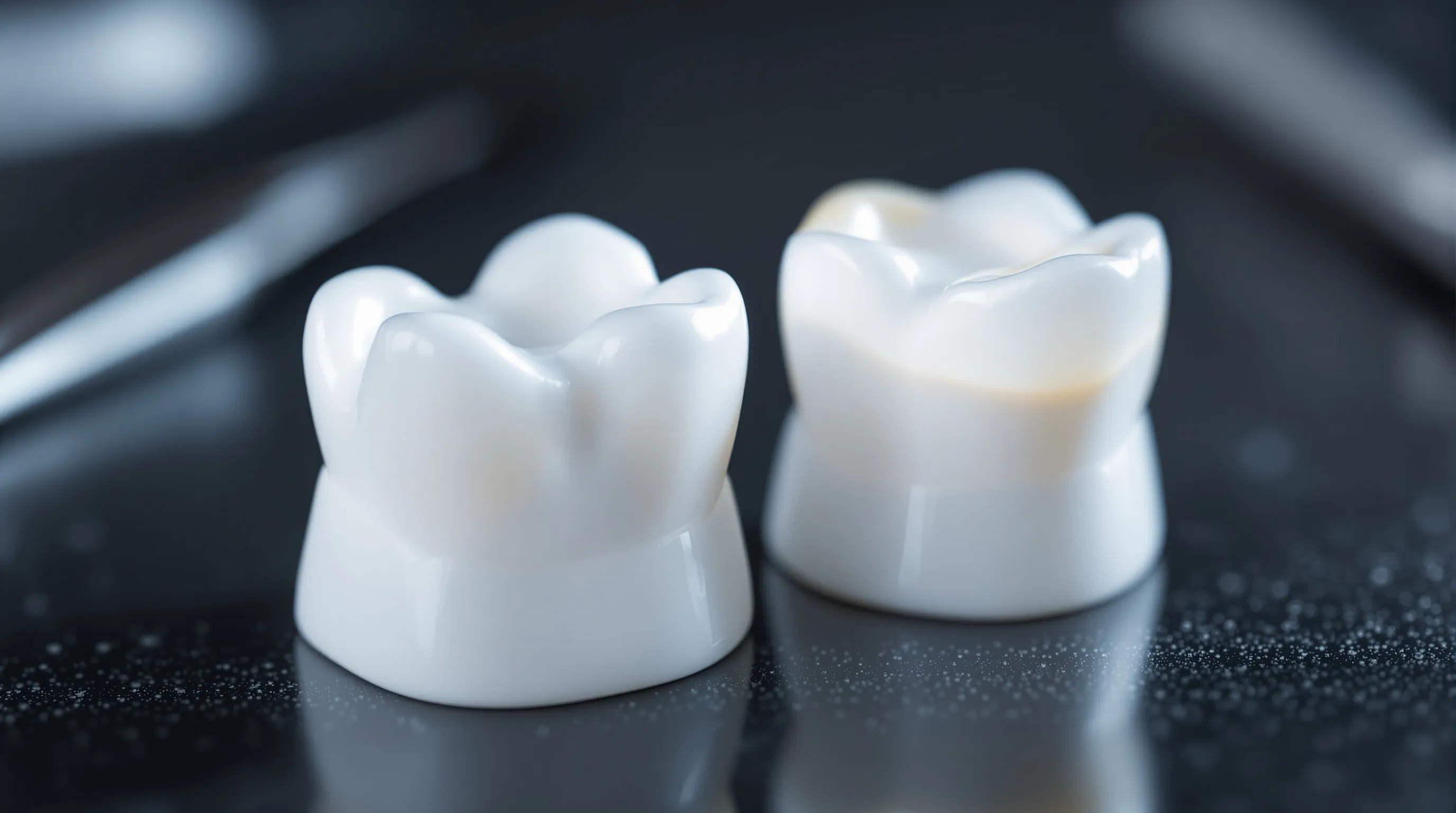
Two crowns, one name: the chip shows up in the porcelain layer, not the solid zirconia.
Did you know you can simply ask your dentist to write the exact crown build on your treatment plan? That one line tells you more than any brochure.
Did you know a crown can count as a success in one study and still be a headache in your mouth? Gary Fingerman of Elegant Lab, in an October 2026 summary of crown research, drew the line plainly: "A chip that can be repaired or polished is a complication, not a failure." Well, that tidy phrase hides a lot of extra dental visits! The same summary pointed to NHS England and Wales records covering 47,474 crown placements, where 68% of all-metal crowns needed no further work at 10 years, against 48% of all-porcelain crowns. Porcelain is beautiful. It is also the part that tends to need attention.
Though a crown quote rarely spells it out, you are always free to ask what sits on the biting surface. The research section below walks through how often each kind chips and why. That is why two patients who both say they have zirconia crowns can tell completely different stories about them.
Patients have given Imagine Advanced Dental Arts a 4.9 average rating from 587 Google reviews, and the practice has been named Practice of the Year, so we take the questions behind a crown quote seriously. The sections below walk through how each zirconia is built, why dentists still reach for layered crowns, and how tooth position should steer the choice, starting with the one detail most quotes leave off the page.
Picture two crowns on a lab bench, both labeled zirconia. One is a single carved block of white ceramic. The other hides that same block under a fired skin of porcelain! They share a name, but they do not share a track record, and that split is exactly where most chipping stories begin.
Did you know the gap shows up plainly in patients' mouths? A 2025 five-year retrospective study in Medicina, led by Dan Lolos and colleagues in Romania, tracked 1,143 zirconia restorations (144 monolithic and 999 layered) and found that monolithic zirconia survived at 100%, while layered zirconia survived at 95.8%. Well, that is no coin flip! Back in 2015, porcelain veneered over zirconia carried a reported fracture rate of 6% to 25% after three years, higher than porcelain fused to metal. On implants, 2.1% of veneered zirconia crowns failed from material fracture at 5 years, against 0.2% of metal-ceramic crowns.
Though those figures come from research clinics far from Mercer County, the same two crowns are on offer in every New Jersey practice. So what should you do with that? Keep reading, because the sections below turn those numbers into plain questions you can bring to your next appointment.
Are all zirconia crowns built the same way?
No. A monolithic zirconia crown is milled as one solid piece, while a layered zirconia crown is a zirconia shell wearing a coat of hand-fired porcelain.
Before anything else, run through these quick checks with your dentist:
- Ask whether the crown is monolithic or layered with porcelain.
- Ask which tooth it is going on, front or back.
- Mention whether you clench or grind your teeth.
Let's look at the numbers first! A 2025 study in Medicina put zirconia's flexural strength at 900 to 1,200 MPa, while the feldspathic porcelain used to veneer it measured just 62 to 90 MPa. Those two figures tell the whole story. One material is the steel beam. The other is the decorative tile fired onto it.
Though zirconia earned the nickname "ceramic steel," the earliest zirconia crowns were rarely bare zirconia. Conventional zirconia was dull white and opaque, so labs covered the core with porcelain to make it look like a living tooth. In 2015, a review in the journal Materials by Alvaro Della Bona and colleagues at the University of Passo Fundo found that one of the most important reasons monolithic zirconia was introduced at all was porcelain fracturing off those veneered crowns. Well, so much for the pretty coat! The industry built a second kind of zirconia crown largely to escape the weak spot in the first.
The common assumption is that a zirconia crown is zirconia from the inside out. For a layered crown, that simply is not true, because the surface you chew on is porcelain. Porcelain is brittle, with a fracture resistance similar to tooth enamel, and lab research on veneered crowns has found that large chips may peel away at the boundary with the core but generally do not enter the zirconia itself. One clinic that markets monolithic crowns puts the contrast bluntly: with no separate porcelain layer on top, there is "nothing to chip away." Even a practice that places layered crowns concedes in its patient guide that the porcelain coat can compromise biting and chewing strength in exchange for a more natural look.
Want to check your own quote? Look for whether it names a solid zirconia product like BruxZir or a porcelain-layered one like Lava, as one dentist explained in a 2015 r/Dentistry thread. For you, the label on the quote matters less than the build. Not sure which build is already in your mouth? Ask the office that placed it to check your chart, and see why a zirconia failure is not always about cracking.
After forty-two years in the same Lawrenceville office, most of our cases finish here rather than moving between specialists, so the question of which zirconia went on which tooth never gets lost in a referral shuffle. If you are still deciding where to have that conversation, our guide to choosing a dentist near West Windsor walks through what to check before you book. And once you know your crown has a porcelain skin, the next question is obvious: why does that skin give way under a bite the core shrugs off?
How likely is a zirconia crown to chip, and where does the chip start?
Zirconia is sometimes called "ceramic steel." Yet the porcelain on veneered zirconia restorations has fractured at rates of 6% to 25% after three years. The explanation sits in a layer few patients ask about.
A 2015 review from the University of Passo Fundo in Brazil found that rate higher than the one reported for porcelain-fused-to-metal crowns, the older standard. The two most common failures it named are chipping, a break inside the veneering porcelain, and delamination, a split where porcelain meets zirconia. The review also gives the porcelain fracture rate as one of the most important reasons monolithic zirconia, milled with no porcelain at all, was introduced.
Why the porcelain? In a 2012 paper, materials scientists at NYU's College of Dentistry and the National Institute of Standards and Technology laid out the mechanics. Plain zirconia is too opaque to look natural, so it is usually veneered with porcelain, and that "introduces a weak link." In their words, "Porcelain is brittle, with fracture resistance similar to that of tooth enamel," and residual stresses left over from firing make it worse. Large chipping cracks, they add, may peel the porcelain away at the boundary but "generally do not enter the core itself."
Clinical reviews show the same split. In a 2021 review of implant crowns, summarized by dental laboratory CEO Gary Fingerman, crowns with veneering ceramic chipped about 4.2 times as often as monolithic ones.
The clearest side-by-side comparison is a five-year retrospective study of 1,143 zirconia restorations by Romanian dental researchers, published in Medicina in 2025. All 144 monolithic restorations survived. The 999 layered ones had 95.8% survival, and their failures were mainly chipping, clustered around one design detail.
1.5 mm
Layered failures in the study clustered where the unsupported porcelain was more than 1.5 mm thick, meaning porcelain built out with no zirconia frame beneath it. The authors stress "the importance of maintaining adequate support for the ceramic layer."
Even a 95.8% survival rate understates chipping, because a chipped crown that still works counts as a survivor. A 2018 review of implant crowns, every one of them veneered zirconia, found 97.6% survival at five years, yet only 83.8% stayed free of every complication. "Survival rates sit close together; complications do not," Fingerman writes.
People who make crowns report the same pattern from their own work. "I used to work in a dental lab and we would have too many pfz crowns returned due to ceramic shearing," one former lab worker wrote in a 2023 forum thread for dentists. PFZ is porcelain fused to zirconia, the layered crown. Another wrote, "Lots of us have transitioned away from PFZ for molars." The same thread includes a dissent: a practice owner who prefers layered crowns on back teeth reportedly says the porcelain bond has improved and that she has had no fracture issues. Forum posts are individual accounts and cannot set a rate.
Monolithic zirconia's cleaner record has caveats of its own. Its clinical record on natural teeth is short: one review found a mean follow-up of 1.07 years. On implants, monolithic crowns had the highest screw-loosening rate in the 2021 review, 2.25% a year. Hardness cuts both ways too. On the Dental Digest podcast in 2022, a speaker described testing by Nate Lawson's group at the University of Alabama at Birmingham. Once zirconia had been adjusted, polished and reglazed, it wore opposing teeth as e.max or enamel does. Only zirconia taken straight from the oven and heavily polished was gentle. And the more translucent grades made for front teeth give up strength. A dental supplier warns that "sacrifices in strength can occur if esthetics are pushed too far."
So the word zirconia covers two crowns that tend to fail in different places. In a layered crown, the chipping risk lives in the porcelain skin and depends on how well the zirconia underneath supports it. A monolithic crown removes most of that risk, and the open questions move to opposing-tooth wear, implant screws and long-term results that remain unstudied.
- If a layered crown is planned for a back tooth, ask how much porcelain will sit without zirconia directly beneath it, and whether the frame is shaped to support it.
- When a brochure or study quotes a survival rate, ask whether it also reports how many crowns stayed free of complications such as chipping.
- If a layered crown chips, ask whether the break stays in the porcelain and whether it can be smoothed or repaired before you decide on a replacement.
- If you are offered monolithic zirconia, ask which grade it is, a high-strength grade or a more translucent one, and whether it will be polished again after any bite adjustment.
- For a monolithic crown on an implant, ask how the screw connection will be checked at follow-up visits.
How we checked this
We read a materials review, a laboratory study of chip resistance, a five-year clinical study, a dental laboratory's summary of systematic reviews, a dental podcast, a supplier's clinical guide and a dentists' forum thread. None of the figures come from our own practice. The chipping rates and the 2018 implant figures come to us through a dental lab CEO's summary, not the original reviews, and that lab sells crowns. The 1,143-restoration study was retrospective, mixed single crowns with bridges, and had a much smaller monolithic group. Forum posts are individual accounts. We place zirconia crowns, so we have a stake in this topic. Still unknown: how monolithic and translucent zirconia hold up over many years on natural teeth, because the long-term studies do not exist yet.
- Della Bona, Pecho and Alessandretti, University of Passo Fundo, review of dental zirconia in Materials, August 2015.
- Zhang, Chai, Lee and Lawn, NYU College of Dentistry and NIST, study of chipping in veneered and graded zirconia, March 2012.
- Lolos and colleagues, five-year study of 1,143 zirconia restorations, Medicina, January 2025.
- Gary Fingerman, Elegant Lab, summary of crown survival by material, October 2026.
- r/Dentistry, forum thread on porcelain-fused-to-zirconia crowns, January 2023.
- Dental Digest Podcast, episode 109 on zirconia, February 2022.
- Safco Dental Supply, guide to common zirconia crown problems, September 2025.
If layered zirconia chips more, why do dentists still choose it?
Because survival studies count any crown still in the mouth, layered zirconia looks nearly as durable as monolithic, and its porcelain still wins on looks for front teeth.
Here is the twist that surprises patients. A 2026 pooled review by Pjetursson, Sailer and colleagues, covering 64 studies, estimated five-year survival of 97.3% for veneered zirconia and 96.8% for monolithic zirconia on natural teeth, and the authors called the results comparable. So is the porcelain worry overblown? Not quite!
The catch lives in one word. "Survival" means the crown is still in the mouth, even if it was repaired along the way. Did you know you can ask your dentist which of those two numbers a crown brochure is quoting? Gary Fingerman of Elegant Lab, summarizing that body of research, put it neatly: "Survival rates sit close together; complications do not." In a 2021 review of implant crowns, veneered ceramic crowns chipped at 1.65% per year, against 0.39% for monolithic crowns. And for zirconia single crowns overall, a 2026 meta-analysis reported just 46.1% pooled success over 10 years, even with survival far higher.
So ask what a chip repair would involve. The research section above walks through these findings.
Though the chipping record is real, layered zirconia keeps a loyal following for honest reasons. Dentists value how its slightly more opaque core can mask a dark, discolored tooth underneath, and some prefer it because it needs less trimming on the tongue side of a front tooth than a glass ceramic does. Labs that sell both types still steer layered zirconia toward front teeth where translucency matters most. Beauty is a legitimate goal in the smile zone!
The practitioners themselves draw the line by tooth position. In a 2023 r/Dentistry thread, a self-identified lab tech said porcelain-fused-to-zirconia works best for "the 4's and forward (maybe the 5 depending on the patient?)" because those teeth are more about appearance than chewing. A former lab worker in the same thread recalled "too many pfz crowns returned due to ceramic shearing." Even so, one practice owner in that discussion insisted the porcelain-zirconia bond had "improved drastically in the last 3 years" and reported no fracture issues of her own.
We read that disagreement as useful, not confusing. The evidence does not say layered zirconia is a bad crown. It says layered zirconia is a front-of-mouth crown that gets into trouble when it is asked to do a molar's job. If you are comparing offices and want to know what else to ask, our guide to choosing a dentist near Plainsboro covers the checks worth making before you book, and the tooth-by-tooth question comes next.
How do you choose the right zirconia crown for your tooth and bite?
Match the zirconia to the tooth: monolithic for molars and grinders, carefully supported layered or high-translucency zirconia for visible front teeth, after checking your bite and night habits.
Did you know the same crown can be a smart choice on one tooth and a risky one two teeth over? Position changes everything. Back teeth do the crushing, and front teeth do the smiling, so the material that wins on one side of the mouth can lose on the other.
| Tooth position | Main job | Zirconia type usually suggested | Chipping consideration |
|---|---|---|---|
| Molars (back teeth) | Heavy chewing | Monolithic, high-strength zirconia | No porcelain skin to chip |
| Premolars | Chewing and some smile display | Monolithic, or layered when looks lead | Depends on bite force and how much shows |
| Front teeth | Appearance, biting | High-translucency zirconia or carefully supported layered zirconia | Porcelain can chip under grinding or uneven contact |
| Any tooth in a heavy grinder | Withstanding night forces | Monolithic zirconia | Grinding raises chipping risk for porcelain |
That pattern lines up with what the industry itself recommends. One dental supplier's clinical guide advises high-translucency zirconia for visible front teeth and high-strength zirconia for back teeth under heavy load, and it warns that newer translucent grades can lose strength if esthetics are pushed too far. A dental clinic's patient guide goes further, recommending monolithic zirconia for molars and heavy-bite zones to minimize chipping. Well, both of them sell crowns, but on this point they agree with the lab benches and the clinical studies!
What raises your own chipping risk? The same guides point to a short, familiar list:
- Grinding or clenching, especially at night.
- An uneven bite that concentrates pressure on one spot of the crown.
- Chewing ice, hard candy, nuts, or pens.
- A blow to the mouth.
- Choosing a porcelain-layered crown for a tooth that does heavy work.
Notice that only one of those is about the crown. The rest are about you. That is good news, because most of them can be checked before the crown is ever made.
Night-time habits deserve real attention here. Our team includes a Diplomate of the American Board of Dental Sleep Medicine, board certified in dental sleep medicine, and that training includes a DMD and residency with honors in prosthodontics and oral reconstruction, the branch of dentistry devoted to restoring teeth and bites. In our experience, those two lenses together make it natural to ask what your jaw does after dark before recommending what goes on your molar.
Whatever the material, the decision should be made tooth by tooth and bite by bite, never by the word "zirconia" alone. Our page on choosing the right cosmetic and restorative treatment walks through how those trade-offs play out across crowns, veneers, and bonding, and the last piece of the puzzle is what to do when a crown has already chipped.
What should you ask before your next zirconia crown?
Ask whether the crown will be monolithic or layered, and whether porcelain will cover any surface you bite on. Write the answer down so you can compare it with any second opinion.
In the 2025 five-year study above, not a single monolithic crown failed, while the layered crowns broke mostly at their porcelain. Though it can feel awkward, it is fair to ask how the crown's biting surface will be polished before you leave the chair. On a 2022 episode of the Dental Digest Podcast, the guest described work from Nate Lawson's group at the University of Alabama at Birmingham: once zirconia was adjusted, polished and reglazed, it wore opposing teeth just like e.max or enamel. Only zirconia taken straight from the oven and heavily polished stayed gentle on opposing teeth in a chewing machine. So the finish on your crown matters too!
Did you know the next chapter may blur the line between the two crowns? Back in 2012, researchers found graded, glass-infiltrated zirconia resisted chipping more than 4 times better than porcelain-veneered zirconia. Dentistry has come a long way from simply firing porcelain over a white core. Well, the porcelain skin is still where the chips live, and our advice is to ask about it by name, right alongside which tooth it is going on and how hard you clench at night.
Summarize This Article With AI
Open this article in your preferred AI engine for an instant summary.
Frequently Asked Questions
What else do people ask about zirconia crowns?
Most questions come back to one detail: whether porcelain is fired over the zirconia. Knowing that changes what to expect from chipping, tooth preparation and repairs.
Is PFZ the same thing as a zirconia crown?
Not quite! PFZ, or porcelain fused to zirconia, is a layered crown: a zirconia core wearing a veneer of porcelain. A monolithic zirconia crown is zirconia all the way through, with no porcelain skin to chip.
Do dentists still put layered zirconia on molars?
Fewer seem to. In a 2023 r/Dentistry thread, one dentist wrote, "Lots of us have transitioned away from PFZ for molars." Another said PFZ "is only useful if you are in the anterior and you need to block out a dark tooth." Well, that is a pretty clear vote!
Does a monolithic zirconia crown need less tooth removed?
Often, yes. A commenter in that same thread suggested reducing the tooth 1 to 1.5 mm for monolithic zirconia, and the dentist asking understood going monolithic as the more conservative prep.
Can a small chip just be smoothed?
Sometimes. When a chip can be polished and no porcelain between the teeth is lost, leaving the crown alone is often wiser, because every round of drilling risks complications such as a root canal.
Where can you have a zirconia crown checked near Lawrenceville?
Imagine Advanced Dental Arts serves patients across New Jersey with four credentialed dentists and a 4.9-star rating from 565 Google reviews. Reach us through our contact page, and bring any notes from the office that placed your crown.
Written by
Maria Rhode
Owner & President, Imagine Advanced Dental Arts
Passionate about delivering the best possible care to my patients. From my days in residency to owning a beautiful hi-tech dental office, I never stop learning and advancing myself and now my practice.
Connect on LinkedIn