

Quick Answer
An implant checkup should include gentle probing, a bone-level X-ray compared against the one taken on crown day, a bite check and a crown inspection, not just a cleaning.
Without that baseline X-ray, early bone loss has nothing to be measured against. Ask for it by name! Families choosing one office for adults and children can ask the same thing: will these records stay in one place for years? Even careful private practices see the occasional implant fail. The comparison is what catches trouble early.
Key Points
- In a 2020 Materials study by Montemezzi and colleagues, probing depth and marginal bone loss increased over time in both implant groups, from the 12-month to the 24-month checkup.
- On the Dentistry Made Simple podcast, the Froum and Rosen system calls peri-implantitis early at a probing depth of four millimeters or more with under twenty five percent bone lost.
- FDA recalls Z-1995-2026 and Z-1994-2026 covered Straumann n!ce full-arch restorations with an incorrect screw seat interface, and offices were told to schedule affected patients for a replacement.
Watch the 1-minute version
The same article in 50 seconds. Watch on the Imagine Advanced Dental Arts YouTube channel
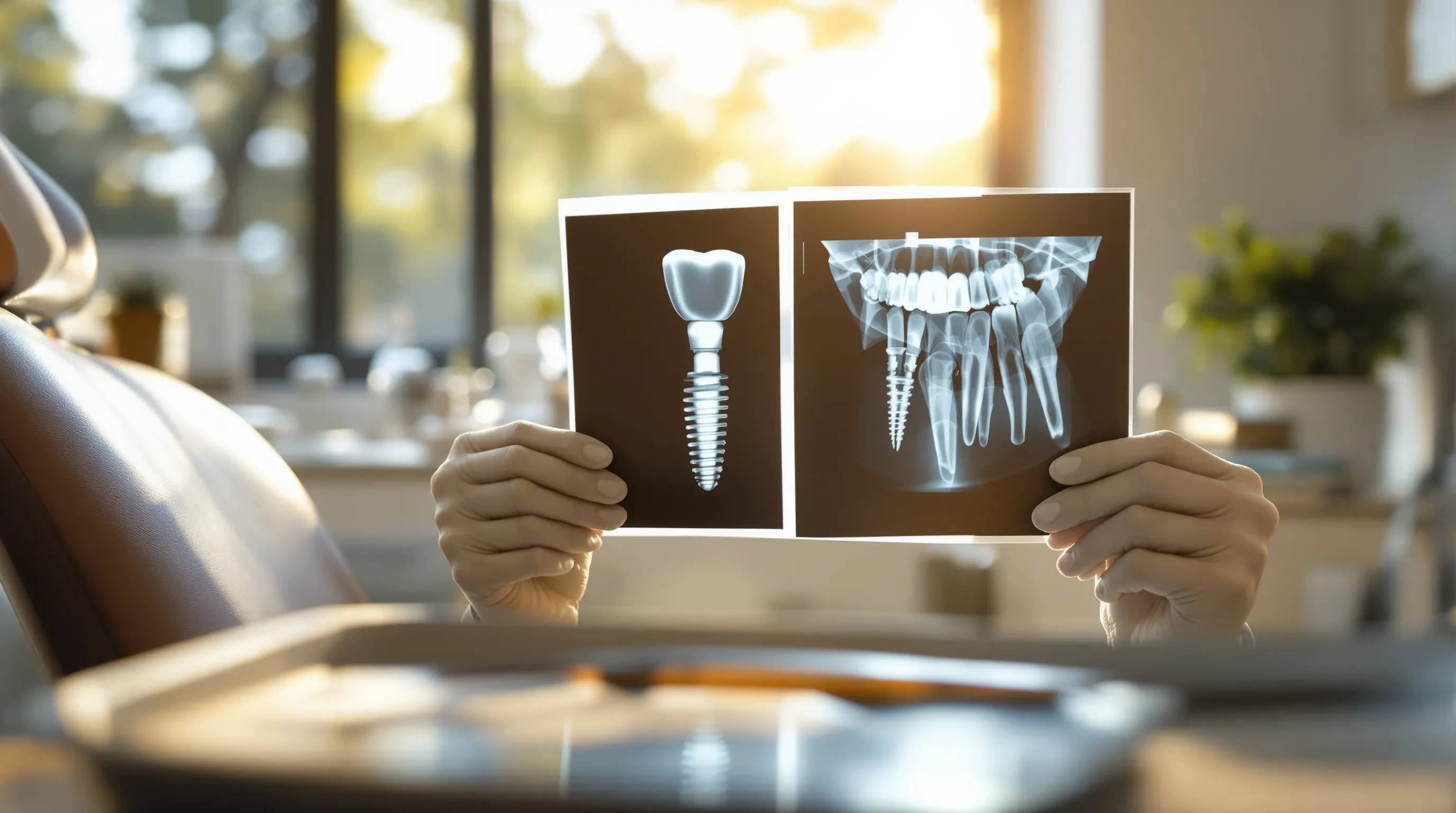
An implant checkup compares today's bone level with the X-ray taken when the crown was placed.
Even careful private practices see the occasional implant fail, so the right family office keeps adult and child records under one roof, ready for comparison years later.
Did you know that a dentist interviewed on the Very Dental podcast in 2022 said 2 of the 150 implants placed in private practice had failed? That is a tiny number! The same guest's training clinic placed almost 4,000 implants in 2021, and it tracked every failure against the published research. Numbers like those only mean something because someone wrote them down. The research section below walks through what those records should show.
Here is an honest trade-off. A high-volume clinic racks up repetitions on thousands of strangers, while a family practice racks up years of history on the same mouth. Both count.
That is why a common search, which family practices near Princeton, New Jersey are top rated, deserves a sharper follow-up question. Does the office keep the X-ray taken the day your crown went in? Can it read today's probing numbers against readings from years ago? In a two-year trial comparing two implant neck designs, average probing depths came in at 3.01 mm and 3.23 mm, a gap smaller than half a millimeter. When you call, ask whether the office keeps every X-ray on file for as long as you remain a patient.
Records matter for the hardware, too. Ask any office you are considering how it would reach you if a part in your mouth were ever recalled.
Picture two implant crowns, side by side, each one gleaming and comfortable. One sits on bone that has held perfectly still since the day it was placed. The other sits on bone that has been slipping away a sliver at a time. From the outside? They look identical!
That is the puzzle a real implant checkup exists to solve. A cleaning can make both crowns sparkle, but it cannot tell them apart, and the research section below walks through what can. Even the hardware deserves attention. When the FDA's public recall data was last updated on November 5, 2026, the root cause behind a screw seat defect in one full-arch restoration was still listed as "Under Investigation by firm."
Implants are remarkably dependable. In 2022, one high-volume implant clinic reported that its tracked failures ran about 3 to 5%, in line with the published literature. Dependable is not the same as maintenance-free, though. For Ewing patients, the practical first step is simple: find the date your crown was placed and the office that holds that day's X-ray.
Ready for an implant checkup that measures, not just polishes?
Bring your old X-rays, or let us start a fresh baseline today, and leave knowing exactly how the bone, gums and crown around your implant are doing.
Ewing neighbors, it is a short drive to Lawrenceville. Your probing readings, your bite and your restoration's name all go on the record, ready for next year's comparison.
Why does an implant checkup matter so much for Ewing patients in 2026?
Implant trouble can begin in the hardware as well as the gums, so a true implant checkup inspects bone, gum tissue, bite and the restoration itself, not just plaque.
Before we get into the details, here is what a proper implant visit should cover, in order:
- Gentle probing around each implant, with every reading written into your chart.
- A bone-level X-ray, compared side by side with the one taken the day your crown went in.
- A bite check to see how the implant crown meets the teeth around it.
- A crown and connection inspection, looking at the surface, the contours and the fit between restoration and implant.
Why the fuss about that last step? Let's look at a story from this very year. On or about March 27, 2026, Straumann USA LLC began notifying dental offices by phone, letter and email about its n!ce Zr, HT, Full-arch Restoration. The FDA classified it as recall Z-1995-2026, and the agency's record states the reason in five plain words: "Includes an incorrect screw seat interface." Only 6 units were affected! Even so, the FDA record instructs offices that, once a new restoration is available, they should "schedule the patient to replace the restoration." The root cause? Still listed as under investigation by the firm.
A look at 4 details in that one record (the defect, the tiny quantity, the open root cause and the instruction to bring patients back) shows something patients rarely hear. The part in your mouth has a paper trail. Someone has to follow it.
The common assumption is that a cleaning and an implant checkup are the same appointment. Well, here is a question worth asking when you book: will this visit include an implant exam, or only a cleaning? A polish and a floss will never tell anyone whether a screw-retained bridge is seated the way it should be. Gum health is only half the story.
That is exactly where restorative training earns its keep. Our doctor's DMD and residency came with honors in prosthodontics and oral reconstruction, the branch of dentistry devoted to the teeth that sit on top of implants, so the crown and its connection are home turf for us. Patients have noticed the care, too, giving us a 4.9 average rating from 587 Google reviews. If you wear a full-arch bridge, our guide to All-on-4 and full-arch dental implants walks through how those restorations are built and held in place.
And the single most useful tool in the whole visit is one many Ewing patients never think to ask about: an old X-ray from the day the crown was placed.
What does an implant checkup catch that a cleaning can miss?
In one two-year study, almost every implant survived. Around those same implants, though, gum pockets and bone loss both crept upward, and scheduled measurements recorded it.
The study, published in 2020 by Montemezzi and colleagues, followed 122 implants in 97 patients who started with no gum disease. Every patient was "monitored through clinical and radiological checkups" at 12 and 24 months. At two years, 96.61% of implants had survived in one group and 95.82% in the other. Yet "probing depth and marginal bone loss tended to increase over time" in both groups.
Survival is the number a patient hears. The slow change underneath is what a checkup is for. The trial lasted only two years and covered back teeth in healthy mouths, so it cannot say how far that change goes over decades. It does show the checkup's job: take two measurements on a schedule and compare each with the last.
Dentists use those same two measurements to judge severity. On the Dentistry Made Simple podcast in June 2026, the hosts explained the Froum and Rosen system, which grades peri-implantitis, the infection that destroys bone around an implant, by combining pocket depth with the share of bone already lost.
| Stage | Probing depth | Bone lost |
|---|---|---|
| Early | 4 mm or more | Less than 25% |
| Moderate | 6 mm | Up to half |
| Advanced | 8 mm | More than 50% of the implant's length |
A percentage needs a starting point. A 4 mm pocket means one thing when nearly all the bone remains and another when a quarter is gone, and only an earlier X-ray can tell them apart. Without one, the dentist sees the pocket but cannot stage it.
Probing matters more around an implant than around a natural tooth. On a tooth, collagen fibers attach into the root. An implant offers them nothing to attach to, so the fibers "run parallel to the titanium," one host explained, and no built-in seal forms. The tissue also has a poorer blood supply.
"If you do not probe gently, you're going to miss the early inflammatory changes entirely."
Co-host, Dentistry Made Simple podcast, 2026
The early change the probe looks for is mucositis, inflammation in the soft tissue only, which the podcast called "the window of opportunity." Ignored bleeding is one way it turns into peri-implantitis. With more than half the bone gone along the implant, or any movement, "regeneration is impossible," and removal is all that is left. Kate, a hygienist, put it plainly in a patient video from an implant and periodontal clinic: "you cannot replace that bone once it is lost."
The crown or bridge needs a look too. The same podcast cited a striking figure: "Forty eight percent of implants presenting with advanced peri implantitis were restored in a way that offered the patient absolutely no capability for proper oral hygiene." The barriers it named are design choices: ridge laps, closed embrasures and bulky flanges on fixed bridges. The hosts did not name the study, so treat the figure as a warning sign whose precision we cannot check. If floss cannot reach the implant, home care cannot either.
The hardware gets checked against your records. In March 2026, Straumann USA started two recalls of full-arch restorations from its n!ce line, one of six units and one of five, because each "includes an incorrect screw seat interface." The FDA posted both on April 29. At the November 5 update, the root cause was still "Under Investigation by firm." For units already fitted, the instruction was to have a new one made and "schedule the patient to replace the restoration," which a practice can do only if it knows what each patient has. New Jersey was not on the distribution list.
How often do implants get infected? The sources disagree. A Houston dental practice writes that about 10% of implant patients develop peri-implantitis within a decade. Implant surgeon Daniel Buser, speaking this month on Straumann's ProTalk podcast, described "an exploding prevalence of infections" of 15% to 25%. Neither figure gives your own risk, and both sources have a stake in implants. Both treat infection as common enough that a checkup must look for it.
Seen side by side, each part of an implant checkup is a comparison. Today's pocket depth is checked against the last reading. Today's bone line is checked against your first X-ray. The crown or bridge is checked for whether you can clean it and against the record of what it is. A cleaning removes what built up since your last visit. An implant checkup measures what has changed since your first.
Five things to ask at your next implant visit
- Ask for the probing depth at each implant to be recorded, and how it compares with your last reading.
- Ask how much bone has been lost since your first implant X-ray, and which stage, if any, your readings fall into.
- Tell your hygienist if the gum around an implant bleeds when you brush or floss.
- Ask whether floss or a small brush can pass under your crown or bridge, and if it cannot, whether the shape can be changed.
- If you have a full-arch restoration, ask which product it is and whether it has been part of any recall.
How we checked this
We used a peer-reviewed two-year implant trial, two FDA recall records, a June 2026 dental education podcast, a November 2026 interview on a manufacturer's podcast, a clinic's patient video and a Houston dental practice's blog. No figures in this section come from our own records. The trial covered only two years, healthy patients and back teeth. The podcast hosts are not named in the transcript, and they did not say which study the hygiene-access figure comes from. Buser spoke on Straumann's podcast, and Straumann makes the recalled products. The Houston blog and our practice both place and restore implants and charge for checkups. Still unknown: how often peri-implantitis really occurs, since our sources disagree; whether the changes seen in the trial keep going after two years; and what caused the recalled defect.
- Montemezzi P. et al., two-year trial of implant neck designs, Materials, February 2020.
- U.S. Food and Drug Administration, recall Z-1995-2026 record, posted April 29, 2026, updated November 5, 2026.
- U.S. Food and Drug Administration, recall Z-1994-2026 record, posted April 29, 2026, updated November 5, 2026.
- Dentistry Made Simple, podcast episode on peri-implantitis, June 2026.
- Daniel Buser on Straumann ProTalk, podcast on hybrid implant design, November 2026.
- CIPC Belconnen, hygienist video on implant care, May 2016.
- Houston dental practice blog, article on long-term implant maintenance, February 2025.
Why does the X-ray from your crown day matter so much?
Bone loss only shows up when today's X-ray is compared with the one taken at crown placement. After forty-two years in the same Lawrenceville office, most cases finish here rather than moving between specialists.
Here is the tension at the heart of every implant checkup. Ask whether your new office will take its X-ray the same way as the old one, so the two films can be lined up. Did you know that an X-ray on its own is just a snapshot? Here is a practical step: before your first visit at any new office, ask your previous dentist to send the X-ray taken on crown day.
A 2020 prospective study by Montemezzi and colleagues, published in Materials, shows why. The team followed 122 implants in 97 patients through clinical and radiological checkups at 12 and 24 months. In that 2020 study, survival was excellent for both implant designs they compared, 96.61% versus 95.82%. And yet probing depth and marginal bone loss tended to increase over time in both groups, from the 12-month visit to the 24-month visit. In 2020, the team measured average bone loss at .92 mm in one group and 1.06 mm in the other.
Look at the size of those numbers. They are fractions of a millimeter! No dentist can eyeball a change that small on one film. It takes two films, taken the same way, months or years apart.
The research section above walks through these findings. Those are two different questions. Survival asks whether the implant is still there; the bone-level comparison asks whether it is quietly heading somewhere you would rather it did not go.
That is why the X-ray from the day your crown went in is so precious. It is the starting line. If you have moved offices more than once, ask each one for its earliest implant X-ray and bring them all together.
Switching dentists is where that chain most often snaps. A new office can take a beautiful X-ray on your first visit, but without the baseline, it has nothing to measure against. We cannot tell you how often transferring patients arrive without one, because we have not counted it; we can tell you that when it happens, the comparison simply starts over. If you are weighing a move to a new practice, our checklist for choosing a dentist near West Windsor covers what to ask before you book.
Keeping care under one roof helps, too. Our team includes a Diplomate of the ABDSM, board certified in dental sleep medicine, one more kind of care that does not require your chart to travel across Mercer County. Fewer handoffs mean fewer lost films.
One San Diego practice, The Dental Express, lists 3D CBCT imaging at $100 to $350 in its own 2026 fee guide, so ask up front whether baseline imaging at a new office is part of your visit fee.
What should you walk out of every implant visit knowing?
Leave every implant visit with probing readings recorded, an X-ray compared against your baseline, and the name of your restoration on file. That standard is what our Practice of the Year award should mean.
Why the name of the restoration? Because the FDA posted a second recall the same spring, and it shows exactly how a patient gets found. Recall Z-1994-2026 covers the Straumann n!ce PMMA Full-arch Restoration, a screw-retained bridge, Article 010.0304, with the same screw seat problem as its zirconia cousin. The agency's record lists 5 units. For any already in use, dental offices were told to contact Straumann to organize a remake, and then, in the record's own words, "schedule the patient to replace the restoration."
Think about what that instruction quietly assumes. It assumes your dental office knows which bridge is in your mouth. It assumes they can reach you. And it assumes you will come back!
Here is some good news for our neighbors. The FDA lists distribution of that bridge to AL, AZ, FL, HI, LA, MD, OH and VA, and New Jersey is not on the list. Still, the lesson travels far beyond eight states. Before you leave, ask for the name of your restoration and a copy of today's X-ray for your own files.
So what does a well-kept implant record hold? Here is what we would want in any Ewing patient's chart:
- The implant brand and the restoration type, single crown, bridge or full arch.
- The date the crown or bridge was placed, with the X-ray taken that day.
- Probing readings from each visit, so changes can be tracked over time.
- Notes on the bite and any wear, chips or loosening.
Then comes the rhythm of visits. A hygienist named Kate, teaching implant care for the CIPC Belconnen implant and periodontal clinic, puts the recommendation plainly: "It is important to also have regular annual checks to check and monitor the health of your implant." She also explains the stakes. When plaque inflammation eats into the bone that holds an implant, "you cannot replace that bone once it is lost."
That one line changes everything. Bone loss is not a cavity to fill later. Catching it early is the whole game.
Kate closes with a sentence we love: "Remember we can't treat problems we don't know about." If you are comparing offices around Mercer County, our guide to four checks before you book a dentist near Hamilton pairs nicely with this list. And once the record is in place, the next question is how the gum around each implant actually gets measured.
Where does implant care go from here?
Implant checkups are becoming measurement visits: recorded probing, X-rays compared against a baseline, and a close look at the hardware, all aimed at catching trouble while it is still reversible.
The clinical teaching is already there. On the Dentistry Made Simple podcast, the Froum and Rosen system is described as calling peri-implantitis early at "a probing depth of four millimeters or more, but less than twenty five percent of the bone" lost. Notice what that requires. The research section above walks through these findings. One more line from that episode says it all: "reversible mucositis is the window of opportunity. It must be caught early through mandatory gentle probing."
Not long ago, an implant was judged a success simply for staying put. Now the next step is yours: before you leave each visit, ask your office to note when your next implant X-ray is due. As you can see, we have come a long way! So keep that first X-ray, ask for your probing numbers, and make the next comparison count.
Summarize This Article With AI
Open this article in your preferred AI engine for an instant summary.
Frequently Asked Questions
What else do Ewing patients ask about implant checkups?
Most questions come back to the same few worries: what gets measured, what the numbers mean, and what to do when old records are missing. Here are straight answers.
Is an implant checkup different from a regular dental cleaning?
Yes! A cleaning removes plaque. An implant checkup also measures: gentle probing around the implant, an X-ray compared against your baseline, a bite check and a look at the crown and its connection.
What if my old dentist never gave me a baseline X-ray?
Then today's X-ray becomes your new starting line. The comparison simply begins now, so ask for a copy and keep it safe. Every future visit gets measured against it.
What probing numbers around an implant are a warning sign?
Peri-implantitis is an infection that destroys bone around an implant. In the Froum and Rosen grading, moderate disease means a probing depth of six millimeters with up to half the bone gone, and advanced disease means an eight millimeter pocket with more than half the implant's length unsupported. Lower readings caught early are far easier to manage.
Does a little bleeding around my implant matter?
It does. Peri-implant mucositis is gum inflammation around an implant that can still be reversed. Ignored bleeding, or cement trapped under the crown edge, can let it progress into irreversible peri-implantitis.
How would I know if my implant restoration was recalled?
Through your dental office. In its 2026 Straumann n!ce recall records, the FDA told offices to examine inventory, quarantine affected units, and arrange remakes for any already used. Ask which product you wear.
Where can Ewing patients book an implant checkup?
Our practice serves patients across New Jersey with four credentialed dentists, just a short drive from Ewing in Lawrenceville. Book through our contact page at imaginedentalarts.com/contact-us, and bring any old X-rays you have.
Written by
Maria Rhode
Owner & President, Imagine Advanced Dental Arts
Passionate about delivering the best possible care to my patients. From my days in residency to owning a beautiful hi-tech dental office, I never stop learning and advancing myself and now my practice.
Connect on LinkedIn