

Quick Answer
Odor or spot-bleeding under an All-on-4 bridge, which refers to a full set of fixed teeth on four implants, usually signals trapped plaque at the gum seam, not implant failure.
Early trouble on these arches is mostly tissue trouble. The good news? The first fix happens at home! Run the daily Flush, Thread, Brush, Check routine: a water flosser, thick bridge floss such as X-floss, a soft brush angled at the seam, then an alcohol-free rinse and a quick gum check. Bleeding that careful cleaning does not calm, swelling, a strange taste or a loose-feeling bridge needs a professional look.
Key Points
- According to a 2026 Shao meta-analysis, All-on-4 arches reached 98.14% pooled survival at five years or more, yet biological complications (6.54%) outpaced mechanical ones (5.91%).
- The daily Flush, Thread, Brush, Check routine pairs a water flosser and thick bridge floss such as X-floss with a soft brush angled at the bridge-gum seam.
- A 2024 University of Pittsburgh systematic review cited a five-year study in which maintenance patients had an 18% incidence of peri-implantitis versus 44% without professional care.
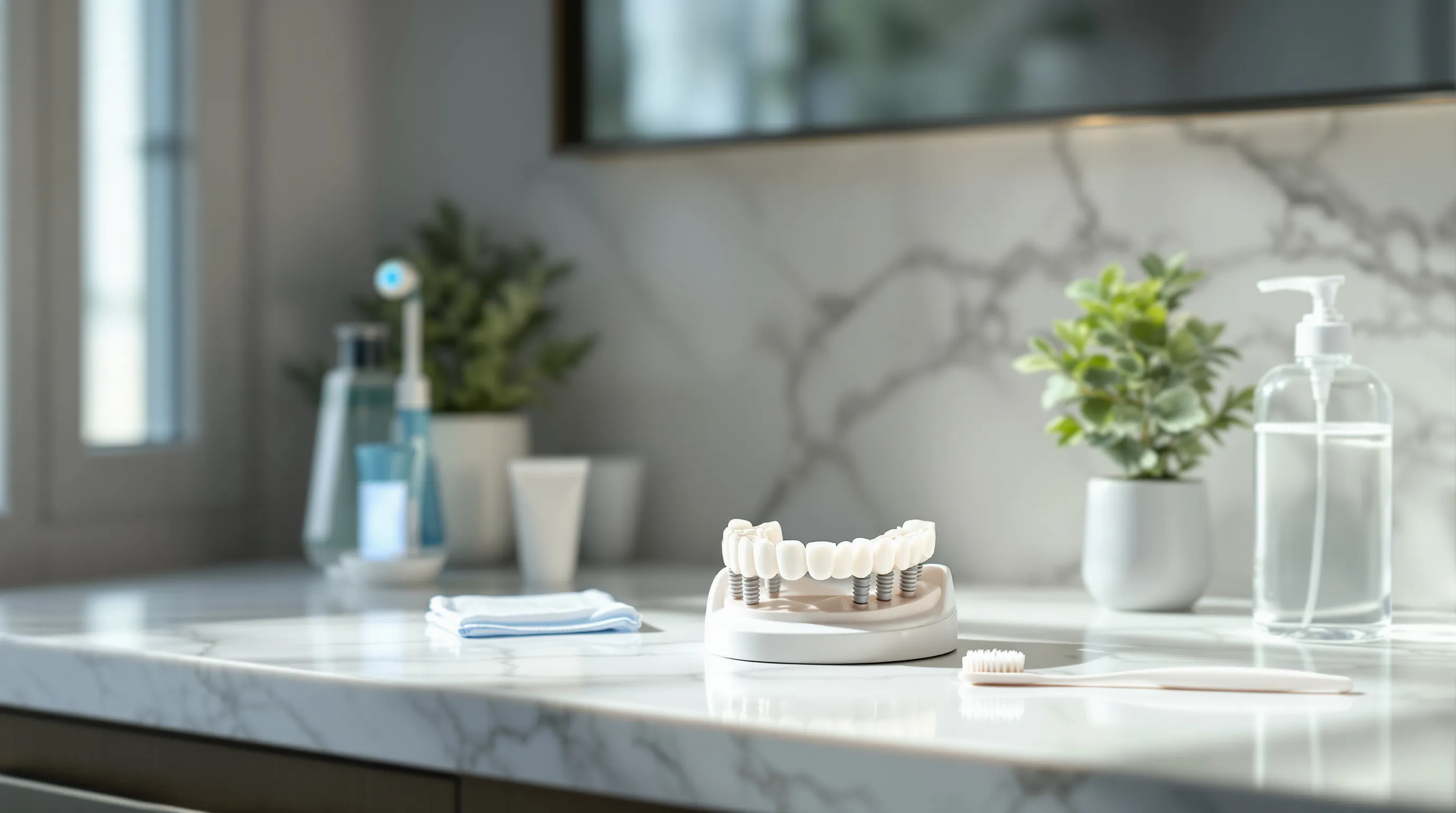
The four tools behind the Flush, Thread, Brush, Check routine for cleaning under an All-on-4 bridge.
What Do Most All-on-4 Cleaning Guides Leave Out?
They skip the troubleshooting. Early All-on-4 trouble is mostly tissue trouble, not hardware trouble: a 2021 cohort logged more early biological complications than technical ones.
Think about how much brilliant engineering sits under a full-arch smile! According to a 2026 finite element study of lower-jaw All-on-4 cases, researchers built three-dimensional models of the jaw, implants and framework just to test how different implant angles spread stress into the bone. That is how carefully the hardware gets planned. The weak spot is rarely the titanium. It is the soft seam where the bridge meets your gum, the one place a toothbrush slides right past.
Surgeons keep pushing the boundaries, too. Did you know a 2024 case series described 3 patients, all women with an average age of 62, whose upper jaws had lost too much bone for standard implants? Each had other health conditions as well, yet their All-on-4 hybrids were anchored with extra-long transnasal implants instead. Well, that is some serious persistence! Arches like these deserve daily care that matches the effort that built them.
The hunger for fixed teeth is real. One forum poster, born with a Class 3 underbite that kept the front teeth from meeting, could not bite through pizza or burgers and had double jaw surgery in 2015 at age 18. Now missing two front teeth, that poster is weighing implants against a bridge. Choosing fixed teeth is the exciting part. Keeping the seam beneath them clean is what makes the choice last.
That is exactly where this guide picks up. Below, you will find the Flush, Thread, Brush, Check routine for daily care, a table showing which tool reaches which spot, and clear warning signs that separate a cleaning problem from one that needs a professional look. As you can see, the fix usually starts at home!
Picture a 21-year-old born without teeth, struggling to chew, to speak clearly and to feel at ease around other people. According to a 2025 case report by Vo and Le, a customized upper prosthesis paired with an All-on-4 lower arch changed all of that. Over 2 years, the patient's oral-health impact score fell from 30.0 to 8.0, esthetic satisfaction climbed from 5.0 to a perfect 10.0, and the patient reintegrated socially and got married! Isn't that amazing?
That kind of transformation traces back to 1998, when Maló first used a fixed full-arch restoration on a reduced number of implants. Even in 2014, a consensus conference on implantology still named 8 implants in the upper jaw and 6 in the lower as the gold standard for fixed restorations. Four implants instead of eight? It sounded almost too good to be true. Well, the results proved otherwise! One 2021 cohort reported 98.2% implant survival in its first year of follow-up.
Yet fixed teeth come with one quiet catch. The bridge never comes out at home, so the strip where it meets the gum becomes a hiding place for food and plaque. When odor or spot-bleeding shows up there, the cause is usually access, not failure. This guide walks through why it happens, a four-step home routine to fix it, and the red flags that mean it is time to call.
Questions this article answers
Questions this guide answers:
- Why does it smell or bleed under my All-on-4 bridge?
- How do I clean under a fixed All-on-4 bridge to stop odor and bleeding?
- When is bleeding under an implant bridge a sign I need the dentist?
Quick spoiler: gum-side trouble outnumbers hardware trouble, and a bleed-free gumline is genuinely within reach. Start with the first question.
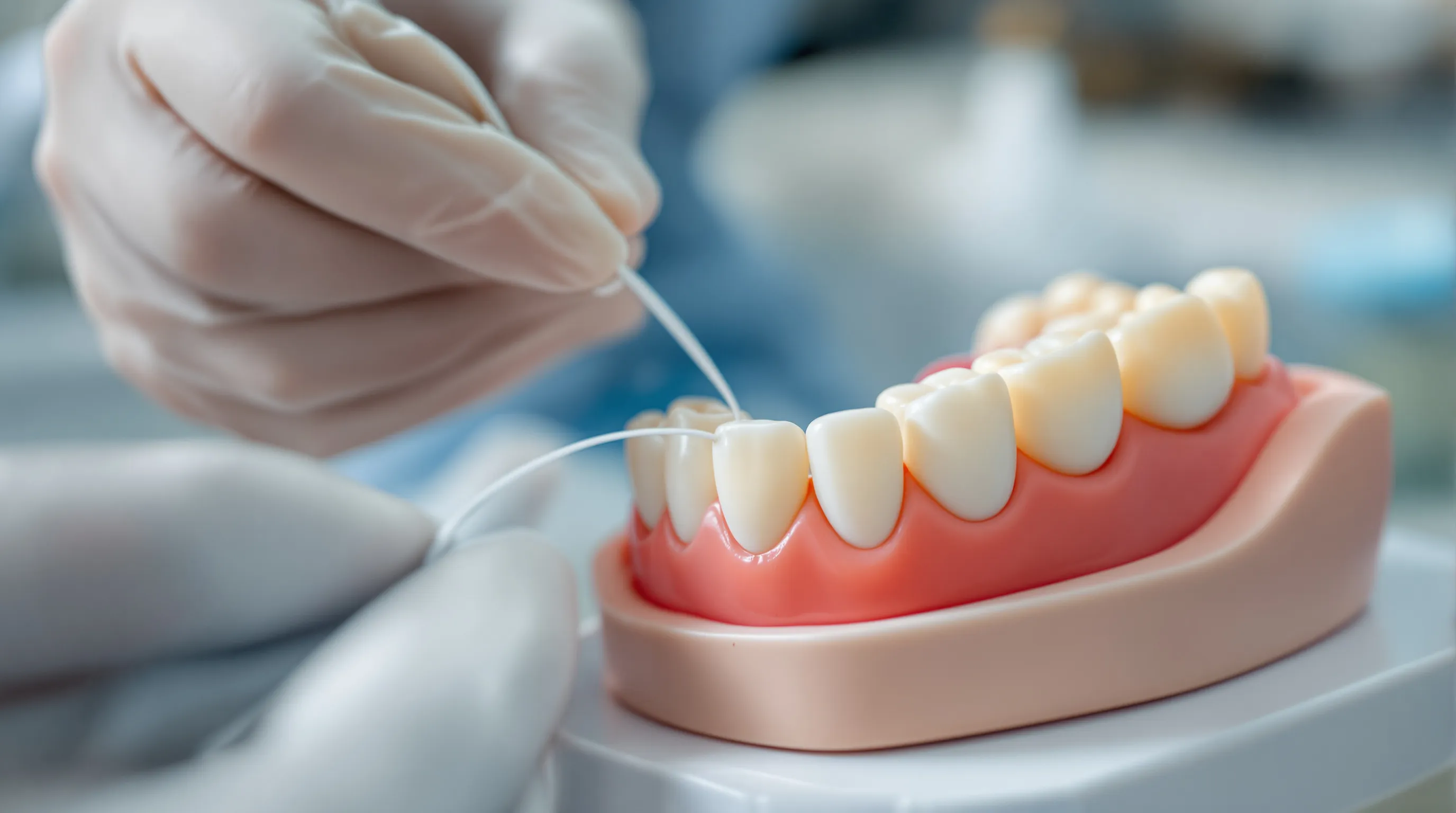
The 12-24 months Outlook, As We See It
Where full-arch implant aftercare heads next
Forecasts for how clinics and patients will handle bleeding, odor and trapped food under fixed All-on-4 bridges over the next 12-24 months.
What changes under the bridge
Read each forecast with its early indicator and confidence, then weigh it against your own recall schedule and the age of your prosthesis.
More full-arch practices will move away from the 6-month-then-yearly visits used in earlier All-on-Four cohorts. They will adopt 3-month checkups in the first year and visits every 4-6 months after that, recording bleeding on probing at each one.
Clinics will treat bleeding under an All-on-4 bridge as a peri-implant tissue problem first. They will screen for mucositis and peri-implantitis before adjusting the prosthesis, because biological complications (6.54%) already outnumber mechanical ones (5.91%) in pooled All-on-4 data.
More full-arch frameworks will be made from high-performance polymers such as PEEK and BioHPP. Results from Mansoura University's completed PEEK framework trial (NCT06017596) and case reports with 2-year follow-up will add to the evidence behind them.
With All-on-4 costing $15,000 to $28,000 per arch, practices will increasingly build paid maintenance and early intervention on bleeding into treatment plans. The reason is that implant failure is more frequent in patients with poor oral hygiene after surgery.
Water flossers and thicker bridge floss will become a routine part of what patients take home after an All-on-4 delivery. A one-piece bridge has no gaps between individual teeth, so ordinary floss is the wrong tool.
More odor complaints under fixed implant teeth will be resolved by repairing or replacing worn prosthetic material and correcting fit, rather than by treating infection. This will be most common as acrylic arches pass their 5-8 year wear window.
Early Whispers A meta-analysis of 55 studies found biological complication rates above mechanical ones for All-on-4. A 69-patient All-on-Four cohort recorded three patients with peri-implantitis. A 2025 private-practice study of 390 implant patients, enrolled in maintenance for about 6.25 years, scored bleeding on probing, plaque and pocket depth and radiographed every implant. A 2024 University of Pittsburgh systematic review examined randomized trials of home and professional implant maintenance. Practice-published figures put implant failure at roughly 5-10% of cases. Failure is more frequent in smokers, patients with uncontrolled diabetes, and patients with poor hygiene after surgery. Clinic instruction videos now teach threading X-floss under the bridge from the centre gap back to the last implant. Patients in implant forums recommend water flossers as the best way to clear lodged food. A completed 16-participant trial tested a CAD/CAM, screw-retained PEEK framework on multiunit abutments for the lower arch. A 2-year case report on a BioHPP framework recorded bleeding on probing of 0. One implant patient reported odor around two crowns. Three dentists at two practices, using three x-rays, told them the crowns were well placed and there was no infection.
Implant studies and clinic sources cited
Each public source below is paired with the single line a forecast relies on, from pooled survival data to patient forum reports.
| Source | What it states | Forecasts it backs |
|---|---|---|
| All-On-4 Implant Maintenance: Long-Term Care Guide For Lasting [Web source] | 3-month checkups during the first year after the final restoration. “Long-term maintenance for All-On-4 implants involves a combination of meticulous daily home care, regular professional maintenance visits every 3-6 months, and…” Acrylic teeth: 5-8 years before significant wear. |
Tighter recalls with bleeding scores Odor traced to prosthesis wear, not infection |
| Prevalence of Peri-Implant Diseases in a Private Practice and - PMC [Academic] | Clinical measures: peri-implant probing pocket depth (PPD), bleeding on probing (BOP), and full-mouth plaque scores (FMPS). Each implant was also radiographed using retro-alveolar radiographs. “Poor oral hygiene, history of periodontitis, a keratinized mucosa < 2 mm and a time in function ≥ 5 years have been associated with the occurrence of…” | Tighter recalls with bleeding scores |
| Long-term Implant Maintenance: A Systematic Review of Home and [Academic] | Study design: A systematic review of randomized clinical trials (RCTs) searching PubMed (MEDLINE), EMBASE and the Cochrane Library. The analysis was a qualitative review, not a meta-analysis. Risk of bias was assessed with "RoB 2.". “The most common biological complication around dental implants is peri-implant mucositis, which can affect about 64.6% of all implant patients.” | Tighter recalls with bleeding scores |
| All-on-4 and All-on-6 implant-supported fixed prostheses for the edentulous jaw: a [Web source] | Biological complication rate: 6.54% for All-on-4 vs 7.41% for All-on-6. “Mechanical complications may be reduced with zirconia prostheses.” | Bleeding read as a tissue warning |
| How To Clean All On 4 Dental Implants: A Complete Guide [Video] | The tissue around implants is still living tissue. Without proper care it can develop inflammation, infection, or bone loss, which can compromise the entire restoration. [0:00]. | Bleeding read as a tissue warning |
| Prevalence of Peri-Implant Mucositis and Peri-Implantitis in Patients [Academic] | Three patients developed peri-implantitis. “The prevalence and incidence of peri-implant mucositis and peri-implantitis are lower than most of the studies in literature.” | Bleeding read as a tissue warning |
| CAD-CAM PEEK Framework for All-on-4 Implants [Government] | Prosthesis design: mandibular CAD/CAM, screw-retained, implant-supported hybrid prosthesis with a PEEK framework, used with the All-on-Four treatment concept. The framework is inserted in multiunit abutments. “Evaluation of Polyetheretherketone (PEEK) Framework Inserted in Multiunit Abutments of All-on-4 Concept for the Mandibular Edentulous Arch.” | High-performance polymer frameworks |
| Customized implants and All-on-4 in the rehabilitation of anodontia: A case report. [Academic] | Maxillary prosthesis: a biocompatible high-performance polymer (BioHPP) framework supporting lithium disilicate crowns. “No biological or mechanical complications occurred.” | High-performance polymer frameworks |
| Pros and Cons of All on 4 Dental Implants| Before You Decide [Web source] | Implant failure occurs in roughly 5-10% of cases. It is more frequent in smokers, patients with uncontrolled diabetes, those with active infections at the time of surgery, and patients with poor oral hygiene after surgery. “Understanding the real limitations of All-on-4 is what separates a good decision from an expensive regret.” | Prevention priced against arch cost |
| The Real Cost of All-on-4 Dental Implants: Beyond the Price Tag [Web source] | All-on-4 dental implants typically cost $15,000 to $28,000 per arch (Wauwatosa Family Dental, published November 17, 2025). “The lowest quote rarely represents the best value in complex dental procedures.” | Prevention priced against arch cost |
| Do implants smell? [Community / Forum] | Commenter 1 recommends a water flosser as the best way to clear food lodged around crowns on natural teeth or on implants. “I swear to god I could KISS you for writing this!! I was convinced I had an infection near one of my crows” Commenter 2 was told by 3 different dentists, at 2 different practices, using 3 x-rays, that the crowns were well placed and there was no infection. |
Water flossers and thick floss as standard kit Odor traced to prosthesis wear, not infection |
| How to Clean Your All On 4 Plus® Dental Implants [Video] | X-floss, available from the clinic or online, is thicker than regular floss "as you're not flossing in between each tooth" ([0:00]). “The water pick could actually drive bacteria into the implants and cause an infection.” | Water flossers and thick floss as standard kit |
What would shift the aftercare outlook
These conditions, from new trial results to changes in prosthesis materials and pricing, would weaken or reverse the forecasts above.
A Little Wiggle Room
We are most confident in 81, though 61 could prove us wrong in the best way.
- Tighter recalls with bleeding scores. A reversal by regulators or buyers undercuts it before anything else.
- Odor traced to prosthesis wear, not infection. If the balance of sources tips against the consensus, that becomes the safer call.
Why Does It Smell or Bleed Under My All-on-4 Bridge?
Under-bridge odor and spot-bleeding usually start with plaque and trapped food sitting where the bridge meets your gum, a cleaning-access problem rather than a sign of a failing implant.
According to a 2026 meta-analysis by Shao and colleagues in the International Journal of Oral and Maxillofacial Surgery, All-on-4 arches reached 98.14% pooled survival at five years or more, yet biological complications (6.54%) outpaced mechanical ones (5.91%). An analysis of 55 sources shows that gum-side trouble beats hardware trouble in both full-arch designs the team compared. Isn't that a relief? The titanium posts and the framework behind dental implants and All-on-X are rarely the villain here. The living tissue tucked under the bridge is where things go sideways, and tissue can be coaxed back to health! What this means for you: bleeding is a tissue signal, and tissue responds to cleaning.
Think of your bridge as one long, beautiful piece resting on four implants. There is no gap between each tooth to floss, much like the underside of a traditional dental bridge, so the underside becomes a sheltered little ledge. Food and plaque love a sheltered ledge! So where should you look first? Try a quick triage we call the Seam, Snag, Sign check:
- Seam: Is soft, sticky plaque collecting along the line where the bridge touches the gum?
- Snag: Does food keep packing under one particular spot, no matter how well you brush?
- Sign: Does the gum bleed only when you clean it, or does it also swell, ache or bleed on its own?
Seam and Snag answers point straight to access. Swelling, aching or bleeding without any trigger shifts the conversation toward tissue health. That deserves a professional look.
Here is the vocabulary that helps. A 2015 retrospective study of 69 All-on-Four patients, with 336 implants holding 84 full-arch restorations, defined peri-implant mucositis as bleeding on probing without loss of supporting bone. That is the early, reversible stage. Only three of those patients developed peri-implantitis, and the researchers judged the treatment a feasible option on the condition of a systematic hygiene protocol. As you can see, the hygiene routine is not a side note. It is the whole ballgame!
Timing matters too. A 2021 cohort of 126 patients with 136 All-on-4 restorations logged 19 biological and 14 technical complications in the first 3 months. Once again, tissue problems led the count. In practice, early tissue flare-ups are something to watch for and fix, not a reason to panic.
And bleeding is not simply part of life with fixed teeth. According to a 2025 case report by Vo and Le in Oral and Maxillofacial Surgery, a patient with an All-on-4 lower arch recorded bleeding on probing of 0 at two years, with no biological or mechanical complications. It is one patient, so it proves possibility rather than probability. Still, what a wonderful benchmark to aim for! Here at Imagine Advanced Dental Arts, our patients have given us a 4.9 average rating from 587 Google reviews, and you can read how they describe their care on our patient testimonials page.
A common misconception is that odor or bleeding means the implant itself is failing. The reality is that survival numbers stay sky-high while gum irritation does most of the mischief. The takeaway is simple. Clean the seam first, because that is usually where the fix lives.
What Is the 4-Step Home Protocol for Odor and Bleeding?
The fix is a four-step routine, done daily: flush under the bridge, thread thick floss, brush the bridge-gum seam, then rinse and check your gums.
We call it the Flush, Thread, Brush, Check routine, and it is built for the one spot a regular toothbrush cannot touch. Since tissue trouble outnumbers hardware trouble, your daily routine is the strongest lever you have! Did you know a full routine like this typically takes only 5-7 minutes? That is shorter than most morning commutes.
- Flush. Point a water flosser at the gap between gum and bridge on low pressure, then move slowly along the gumline. It rinses loose food and bacteria from underneath, where floss and bristles struggle. A 2024 systematic review also found that water flossers used with chlorhexidine reduced inflammation, although chlorhexidine is generally flagged to avoid for long-term use.
- Thread. Use a thick bridge floss such as X-floss, which is thicker than regular floss because you are not flossing between individual teeth. Start at the center gap, count four teeth to one side, slip the floss under the bridge there, and glide it back until the last implant stops you. Repeat on the other side, then clean the middle gap and behind the last tooth. The lower arch works the same way, just upside down! Each piece can be reused five or six times or until it gets grimy.
- Brush the seam. Twice a day, spend at least two minutes on the prosthetic with a soft-bristled or electric brush, angled right where the bridge meets the gum. Reach down to the real gum so the bristles tuck just under the bridge edge. Choose a gentle, non-whitening toothpaste, because abrasive pastes can scratch the prosthetic teeth and create new hiding spots for bacteria.
- Rinse and check. Finish with an alcohol-free antimicrobial rinse, since alcohol-based rinses can dry out the mouth and irritate the tissue. Then take a moment at the mirror. Look for redness, swelling or anything that feels off.
Here is how the tools stack up:
| Tool | What it reaches | How to use it | Watch out for |
|---|---|---|---|
| Water flosser | Loose debris beneath the bridge | Low pressure, tip aimed at the gum-bridge gap | Not used on zygoma implants; some clinics wait until after the four-month review |
| Thick bridge floss (X-floss) | Plaque on the underside of the bridge | Thread under, glide back to the last implant | Replace a piece once it looks grimy |
| Soft or electric toothbrush | The seam where bridge meets gum | Two minutes, twice a day | Hard bristles and abrasive whitening pastes |
| Proxy brush or rubber tip stimulator | Tight areas where food gets stuck | Only as your provider directs | Choosing one without your provider's input |
| Alcohol-free antimicrobial rinse | Tissue surfaces after cleaning | Once daily | Alcohol-based rinses and long-term chlorhexidine |
Why does that zygoma warning matter so much? One implant clinic cautions that a water pick could drive bacteria into zygoma implants, which are designed differently from regular implants. Patients with zygoma implants on top and regular implants below can still flush the lower arch. If your arch includes them, ask us which tools are safe before you start. A two-minute conversation beats a week of guessing!
And please do not skip the floss just because the water flosser feels amazing. Brushing and flushing are helpers, not replacements, because floss lifts particles from under the bridge that a brush cannot reach. In practice, skipping the thread step leaves the underside untouched. The goal is the calm, quiet gumline documented in that zero-bleeding case report. The takeaway: all four steps, every day, right up to your next hygiene visit.
What Will Matter Most for All-on-4 Care in the Next 12-24 Months?
Over the next 12-24 months, bleeding under an All-on-4 bridge will be treated as an early tissue warning, caught with tighter recalls and better under-bridge tools, not shrugged off.
Did you know the gums around your implants are still living tissue? The teeth on your bridge can never get a cavity, but plaque can still irritate the gum line tucked beneath them. Though it is tempting to judge full-arch teeth by whether the hardware holds, the tissue underneath deserves the spotlight. According to the 2026 Shao meta-analysis, which pooled 55 studies, biological complications on All-on-4 arches outpaced mechanical ones. That single finding is a big deal for how full-arch care should be organized! Let's look at the three shifts we expect to matter most.
| Prediction | Weak signal | Why it matters | Source |
|---|---|---|---|
| Bleeding gets read as a tissue warning first | Pooled All-on-4 data put tissue problems ahead of hardware problems, and one earlier All-on-Four cohort recorded three patients who developed peri-implantitis. | Bleeding that gets dismissed can progress toward inflammation, infection or bone loss that compromises the whole restoration, not just one tooth. | 2026 Shao meta-analysis of 55 studies; earlier All-on-Four cohort study |
| Recalls tighten, with bleeding scores on the chart | A 2025 private-practice study of 390 implant patients, enrolled in maintenance for about 6.25 years, scored bleeding on probing, plaque and pocket depth, and radiographed every implant. | One long-term maintenance guide already calls for 3-month checkups during the first year after the final restoration. Ask whether your visit includes probing and x-rays, not just a polish. | 2025 cross-sectional private-practice study; long-term All-on-4 maintenance guide |
| Water flossers become standard take-home kit | In an implant forum thread, one commenter recommends a water flosser as the best way to clear food lodged around crowns, on natural teeth or on implants. | Because a one-piece bridge has no gaps between individual teeth, daily access underneath decides whether debris gets cleared or left behind to cause odor. | 2025 patient forum thread on implant odor |
Here is what most patients miss: not every bad smell under fixed implant teeth is an infection! In that same forum thread, a patient with odor around two crowns was told by 3 different dentists, at 2 different practices, using 3 x-rays, that the crowns were well placed and there was no infection. Meanwhile, acrylic teeth reach significant wear in 5-8 years. That is why we expect more odor complaints to be solved by repairing worn material or correcting fit, rather than by treating infection. When the smell lingers but your gums look calm, ask for the age and fit of your bridge to be checked right alongside the x-rays.
What could prove us wrong? Pooled trial data showing that longer gaps between recalls protect the tissue just as well as 3-month visits would weaken these forecasts. As you can see, though, today's signals all point the same way. The healthier the seam under your bridge, the longer your new smile keeps shining!
When Is Odor or Bleeding More Than a Cleaning Problem?
Odor or bleeding needs a professional look when careful daily cleaning does not calm it, or when swelling, a loose-feeling bridge or a strange taste shows up.
Let's look at what separates a cleaning issue from a tissue issue. Peri-implantitis is defined by bleeding on probing plus a probing depth greater than 4 mm and bone loss around the implant. Nobody can measure either one at the bathroom mirror! Early bone loss under a bridge may show no visible symptoms at all. According to the same Shao meta-analysis, pooled All-on-4 marginal bone loss was 0.77 mm short-term and reached 1.28 mm at five years. In practice, recall x-rays are how that slow change gets caught.
Use this red-flag table to decide your next move:
| What you notice | Likely cause | What to do |
|---|---|---|
| Spot-bleeding only when you floss or flush, no swelling | Plaque at the seam, early mucositis | Stay faithful to the 4-step routine and mention it at your next visit |
| Odor from one spot where food keeps packing | Trapped food under a ledge of the bridge | Flush and thread that spot daily; ask about the bridge contour |
| Swollen, red gums or bad breath that lingers | Peri-implant inflammation | Call promptly, because this needs attention now |
| Bridge feels loose or your bite suddenly changes | Loosened screws or components | Call us, and never try to remove the bridge at home |
| Chips, cracks or stains that will not polish away | Prosthesis wear | Book an evaluation for repair or replacement |
| Foul odor with sinus pressure on the upper arch | Possible sinus involvement | See your dentist soon for imaging |
Why does calling early matter so much? Because maintenance measurably changes outcomes. A 2024 systematic review cited a five-year study in which patients attending maintenance therapy had an 18% incidence of peri-implantitis versus 44% without professional care. Over ten years, patients who skipped recommended maintenance needed peri-implantitis treatment more often (41%) than those who kept their follow-ups (27%). Poor plaque control, a history of chronic periodontitis and no regular maintenance care were all flagged with strong evidence as risk factors. Even moderate hygiene, not just poor hygiene, was significantly linked to peri-implantitis in a 390-patient private-practice study. The takeaway: hygiene visits are part of the fix, not an extra.
What about the smell itself? A strange smell is not a diagnosis. In one online implant forum, a patient convinced they had an infection was told by 3 dentists at 2 practices, using 3 x-rays, that there was none. Well, that is a relief worth having confirmed! Another forum member traced a foul odor to a sinus infection where an implant had punctured the sinus, and that implant had to be removed. Both stories point to the same move: get it examined instead of guessing.
Age matters too. Acrylic teeth typically reach significant wear after 5-8 years, composite-reinforced hybrids after 8-12 years, and zirconia or porcelain can last 10-15+ years. Worn, scratched surfaces give bacteria new places to cling. According to Shao and colleagues, mechanical complications may be reduced with zirconia prostheses. Vo and Le even observed occlusal wear adaptation on polymer composite crowns at the 2-week follow-up after delivery, which then held stable. What this means: an older arch that suddenly smells may need refreshing, not rescue.
One more reason not to wait. When a single implant fails in a four-implant system, the entire arch prosthesis is affected. Catching tissue trouble early protects the whole smile!
How Far Has Full-Arch Care Come?
Remarkably far: fixed teeth on four implants now last for years, and the main job left for patients is keeping the bridge-gum seam clean enough to stay quiet.
Step back and look at the arc. A bold four-implant idea is now refined down to the angle of each post! One 2026 simulation study found that tilting lower-jaw implants to about 2° in front and 20° in back reduced crestal bone stress by approximately 4%-16%. That is precision our predecessors could only dream about.
And the pooled research keeps telling the same hopeful story. Gum-side complications still edge out hardware ones, which is honestly good news. Tissue answers to daily care. According to Vo and Le, a calm, healthy gumline two years after treatment is entirely achievable.
That is why this guide rests on two simple tools. The Seam, Snag, Sign check sorts the problem quickly at the mirror. The Flush, Thread, Brush, Check routine does the fixing, one day at a time. In our view, odor under a bridge is a message, not a verdict.
So tonight, grab the thick floss, start at the center gap, and count four teeth to one side.
Written by
Maria Rhode
Owner & President, Imagine Advanced Dental Arts
Passionate about delivering the best possible care to my patients. From my days in residency to owning a beautiful hi-tech dental office, I never stop learning and advancing myself and now my practice.
Connect on LinkedInSummarize This Article With AI
Open this article in your preferred AI engine for an instant summary.
Frequently Asked Questions
What Do Patients Ask About All-on-4 Odor and Bleeding?
Here are straight answers to the questions patients ask about under-bridge odor, bleeding, cleaning schedules and how long All-on-4 teeth last.
Why does my All-on-4 bridge smell even though I brush every day?
A toothbrush cleans the teeth you can see, not the underside of the bridge. Food and plaque collect along the seam where the bridge meets the gum, and that trapped debris is what you smell. Adding a water flosser and thick bridge floss usually reaches the spot brushing misses.
Does bleeding under my implant bridge mean the implant is failing?
Usually not. Spot-bleeding most often signals peri-implant mucositis, a reversible inflammation of the gum around an implant. Implant failure occurs in roughly 5-10% of cases, and it is more frequent in smokers, people with uncontrolled diabetes and patients with poor oral hygiene. Treat bleeding as an early warning, then act on it.
Why is the back of my bridge the hardest part to clean?
The back implants in an All-on-4 are angled on purpose. That tilt lets them bypass the maxillary sinus in the upper jaw and the inferior alveolar nerve in the lower jaw. The trade-off is a trickier cleaning angle, so give the back sections extra time with the floss and flosser.
How often should an All-on-4 be professionally cleaned?
Professional cleanings every 3-6 months are widely described as non-negotiable, with 3-month checkups common in the first year after the final bridge. Only your dentist should remove the bridge for a deep clean. Never attempt it at home!
Does smoking make bleeding and odor under the bridge worse?
It can. Smoking constricts blood flow to the gums and jawbone, and implant failure is more frequent in smokers. If you smoke, a tighter home routine and closer follow-up make good sense.
How long do All-on-4 teeth last before they need replacing?
According to Wauwatosa Family Dental, prosthetic teeth may need replacement after 10 to 15 years, while the implants themselves can last indefinitely with excellent oral hygiene. Worn or scratched teeth hold onto plaque more easily. An older bridge that suddenly smells may simply be due for a refresh.
Is ongoing maintenance really worth the cost?
According to Wauwatosa Family Dental, All-on-4 implants typically cost $15,000 to $28,000 per arch. When a single implant fails in a four-implant system, the entire arch prosthesis is affected. In our view, regular maintenance is the cheapest insurance a full-arch smile can have.