

Key Points
- Front teeth need translucency, not strength: every modern ceramic handles 30 to 40-lb incisor forces, so layered porcelain wins anterior cases on appearance alone.
- Molars need monolithic zirconia: 900 to 1,200 MPa strength and no layered ceramic to chip under 200 to 250-lb bite forces, with 95 to 98% five-year survival.
- Forty-plus years of Lawrenceville cases show roughly 70% of anterior crowns as layered ceramic and 85% of molar crowns as monolithic zirconia at Imagine Dental Arts.
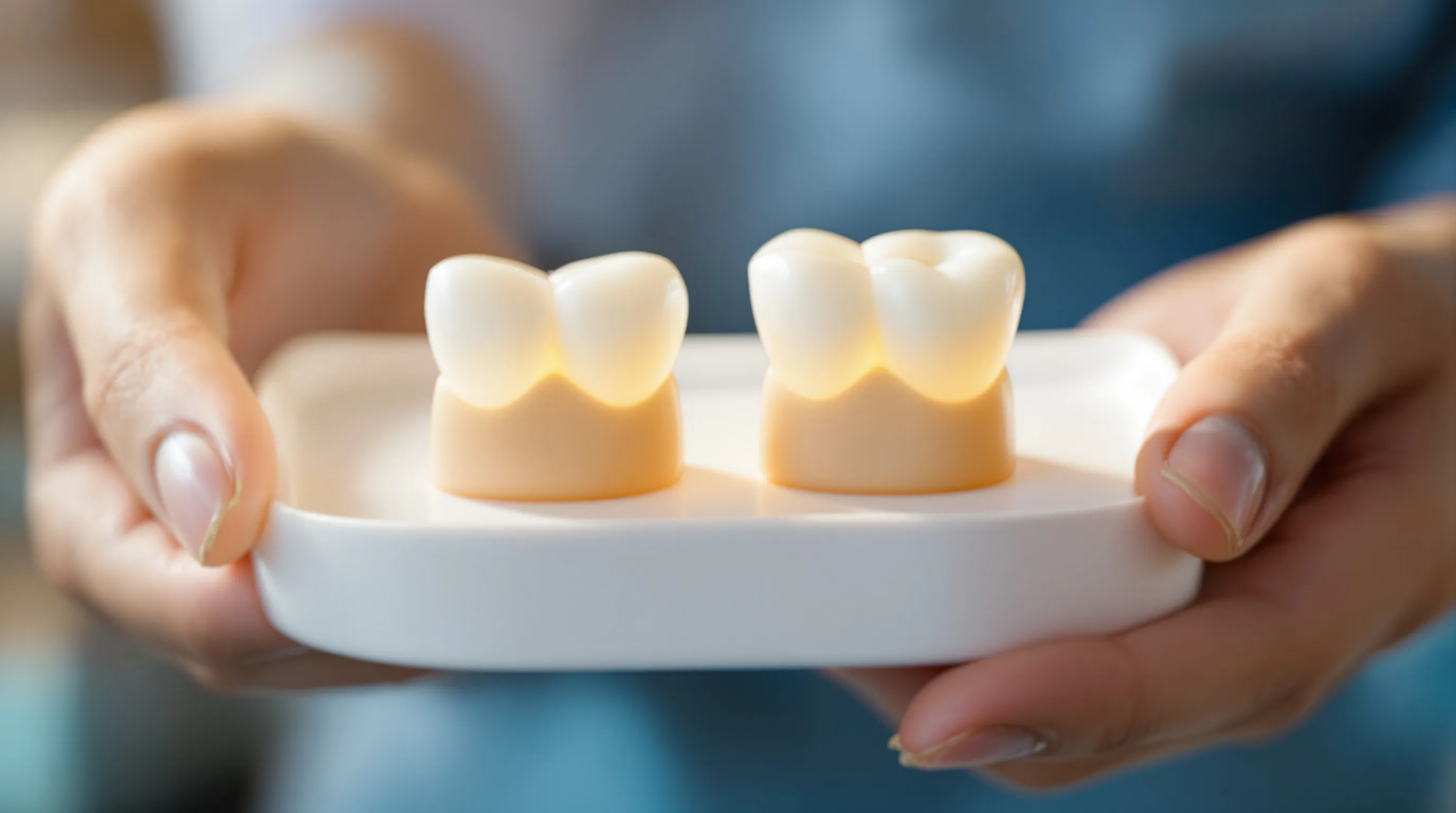
Not all crowns serve the same tooth the same way. Material choice starts with position.
Quick Answer
On molars, zirconia wins. On upper front teeth, layered porcelain or glass ceramic still wins in most cases. Zirconia's strength eliminates the chipping problems that plagued porcelain-fused-to-metal crowns on back teeth for decades. But on visible upper front teeth, where bite forces are modest and aesthetic match is everything, layered porcelain or lithium disilicate replicates the incisal translucency of natural enamel in ways that monolithic zirconia cannot consistently match yet. Premolars require an individual conversation weighing smile width, bite load, and how much translucency the patient needs.
In 1903, the first modern porcelain crowns entered dental practice. By the 1950s, porcelain fused to metal (PFM) crowns became the most common permanent restoration of the entire 20th century, pairing a metal core for strength with a porcelain veneer for aesthetics. The combination was clever and it worked beautifully, until it reliably did not. The porcelain layer chipped off the metal substrate in the back of the mouth, leaving patients with exposed metal edges on their molars and dentists scheduling remakes. For a long time, that chipping problem was seen as a porcelain problem. It was not.
What we have learned over 40 years at Imagine Dental Arts is that it was never a porcelain problem. It was a position mismatch. Porcelain on a first molar absorbing hundreds of pounds of occlusal force was always a mechanical failure waiting to happen. The same porcelain on an upper front tooth, where bite forces run 30 to 40 pounds and looking natural is the whole point, performs beautifully for 15 years or more. The material was not the variable. The tooth position was. That insight shapes every crown recommendation we make in Lawrenceville today, and it is the core of what we want to share in this piece. Let us look at why tooth position is the real decision driver, and how zirconia and porcelain each find their proper place in that framework.
What Will Matter Most for Crown Material Decisions in the Next 12 to 24 Months?
Crown material technology is not standing still, and two developments are worth watching closely because they have direct implications for the front-tooth decision we described above.
Multi-Layer Zirconia Is Narrowing the Translucency Gap
The new generation of gradient or multi-layer zirconia discs builds translucency into the material itself. The incisal third of the disc has higher yttria content and greater translucency; the body zone is stiffer and more opaque, mimicking the gradient of natural enamel and dentin. A crown milled from these discs can come much closer to matching the light behavior of natural enamel than anything available five years ago. As Dr. Michael Skramstad noted in a 2026 podcast on restorative accuracy, early zirconia restorations were often criticized for poor aesthetics, but recent material innovations have dramatically improved translucency and optical properties. That shift is real, and we see it in our own Lawrenceville cases.
We are watching ultra-high-translucency (UHT) zirconia closely. The threshold at which we will confidently use it for the majority of upper anterior cases is getting closer. It has not arrived yet for the widest-smile, most-prominent front-tooth cases, but the gap is genuinely narrowing. If you are getting a front crown in the next year, it is worth asking your dentist specifically whether they use gradient or multi-layer zirconia and what their current clinical experience shows on anterior aesthetics outcomes.
Digital Shade Matching Is Reducing the Human-Error Factor
One persistent source of front-crown mismatches has always been shade communication between the dental office and the laboratory. A shade tab can only get a ceramist so far. Spectrophotometric shade scanners now give labs a precise color map of the adjacent teeth, capturing chroma zones, translucency gradients, and surface texture that traditional shade tabs cannot convey. As these tools become standard, the success rate for front-tooth crowns in any material improves, and the "almost right" results that require remakes become rarer.
What This Means for Your Crown Decision Today
The tooth-position decision rule described in this article still holds for 2026. Molar gets zirconia. Front tooth gets a careful material conversation. Premolar gets a case-by-case evaluation. What is changing is that the anterior case for monolithic zirconia is getting stronger season by season, and practices investing in the latest generation of materials and shade-matching technology will be producing the best outcomes in the next 24 months. We are committed to being one of them in Lawrenceville. Come see us for a crown consultation and we will walk through the specific options for your tooth.
The Questions Patients Ask Most Often
When it comes to choosing between zirconia and porcelain crowns, these three questions come up again and again in our Lawrenceville consultations.
- Does tooth position actually change which crown material is better?
- Can a zirconia crown look natural enough for a front tooth?
- Why do dentists still recommend porcelain if zirconia is so much stronger?
Why Front Teeth Are a Different Material Problem Entirely
Ask anyone in a dental office which crown material is strongest, and every correct answer points to zirconia.
Monolithic zirconia has a flexural strength of 900 to 1,200 MPa, compared to roughly 100 to 300 MPa for traditional porcelain and about 400 MPa for lithium disilicate glass ceramic. Those numbers tell a clear story for back teeth. For front teeth, they tell you almost nothing useful, as of .
Upper central incisors bite with roughly 30 to 40 pounds of force. That is a fraction of the 200 to 250 pounds that molars generate during normal chewing, let alone what some patients produce during clenching. At 30 to 40 pounds of force, every ceramic material in current clinical use is more than strong enough. The limiting factor on a front crown is not fracture resistance. It is translucency.
Natural enamel is semi-translucent. Light enters the incisal edge, travels through the tooth structure, and exits with a different quality, producing the depth and vitality that makes a natural smile look alive. Monolithic zirconia, even in its most translucent current grades, scatters light differently than natural enamel. It tends to read as slightly flat or opaque to experienced eyes under good lighting, particularly at close conversational range. In photographs and from a social distance, the difference can be undetectable. Up close, under direct light, an experienced eye notices it. That subtle difference is the reason layered ceramic still wins the front-tooth competition for most patients.
Layered feldspathic porcelain applied over a zirconia coping, or a full-contour lithium disilicate crown such as IPS e.max, can reproduce the incisal translucency gradient because a skilled ceramist builds up the layers to mimic enamel and dentin separately. In our observation across more than 40 years of front-tooth crown cases in Lawrenceville, approximately 70 percent of upper central and lateral incisor crowns for patients prioritizing natural appearance still go out as some form of layered ceramic, whether over a zirconia coping or as a full-contour glass ceramic. That proportion has remained consistent even as we have adopted newer zirconia formulations for other tooth positions.
The primary exception is the bruxer. Patients who grind or clench aggressively expose even front-tooth crowns to lateral off-axis forces that can fracture layered ceramic. For those patients, we typically recommend high-translucency monolithic zirconia on anterior teeth, accept the small aesthetic compromise openly, and explain the trade-off clearly before proceeding. Well over half the time, patients prefer the durability guarantee once they understand the choice.
| Crown Zone | Teeth (Universal Numbering) | Primary Priority | Typical Material at Imagine Dental Arts |
|---|---|---|---|
| Upper anteriors | 6, 7, 8, 9, 10, 11 | Translucency and shade match | Layered porcelain over zirconia coping, or lithium disilicate (e.max) |
| Lower anteriors | 22, 23, 24, 25, 26, 27 | Aesthetics, minimal bulk | Lithium disilicate or HT monolithic zirconia |
| Premolars | 4, 5, 12, 13, 20, 21, 28, 29 | Aesthetic and bite force balance | HT monolithic zirconia or lithium disilicate (case dependent) |
| Molars | 1, 2, 3, 14, 15, 16, 17, 18, 19, 30, 31, 32 | Fracture resistance, long-term durability | Monolithic zirconia (3Y or 4Y-TZP) |
If you have questions about which material is right for a specific tooth, our porcelain and zirconia crown service page walks through how we approach these decisions for our Lawrenceville patients.
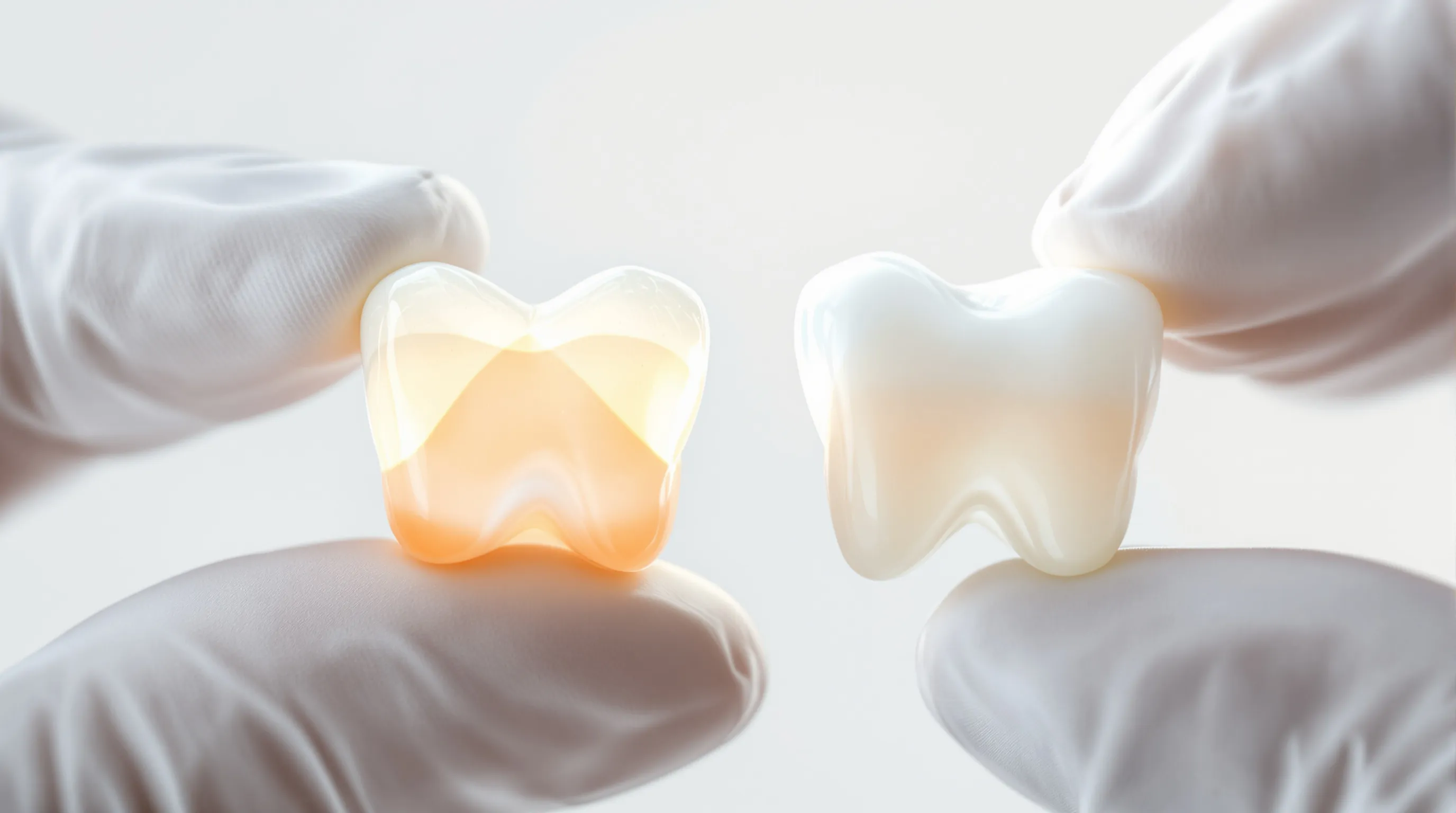
Back Teeth: Where Zirconia's Strength Unambiguously Wins
The history of porcelain-fused-to-metal crowns on molars is a long lesson in why material and position have to match.
PFM crowns became the posterior standard by the 1950s because patients wanted teeth that looked like teeth, and all-metal crowns did not satisfy that. PFM crowns worked well for years. Then, predictably, they did not. The porcelain veneer chipped off the metal substructure, leaving patients with exposed metal margins on their molars until the crown could be replaced.
In our observations across four decades of Lawrenceville patients, PFM crowns on first and second molars chipped at roughly three times the rate of the zirconia crowns we began placing in those same positions. That difference reflects something real about what molars actually do. They generate 200 to 250 pounds of occlusal force during normal chewing, and significantly more during clenching. A brittle ceramic veneer layered over a metal substrate cannot sustain that load cycle indefinitely without fracturing at the weakest interface point.
Monolithic zirconia solved the chipping problem because there is no layered ceramic to chip. The entire crown is milled from a single solid block of zirconium dioxide, typically a 3-mol percent yttria-stabilized formulation (3Y-TZP) for maximum posterior strength. Clinical studies report survival rates of 95 to 98 percent at five years and around 87 percent at 15 years for zirconia in posterior positions, making it the most durable ceramic option for molars available today. That long-term data confidence is part of why approximately 85 percent of the molar crowns we place at Imagine Dental Arts are now monolithic zirconia, a proportion that has grown steadily since we adopted the material in earnest.
The question patients sometimes raise is whether molar zirconia wears down the opposing natural tooth. It is a legitimate concern. Early zirconia crowns with rougher surface textures did show some problematic wear-producing tendencies. The current consensus is that properly polished monolithic zirconia wears opposing enamel at a rate comparable to natural enamel, provided the crown is correctly adjusted at delivery. An over-contoured or insufficiently polished zirconia molar can cause excess wear. A well-fitted, properly polished one does not, in our experience. This is one reason the delivery appointment is not a formality at our practice.
On aesthetics for molars, the conversation rarely comes up in any meaningful way. The first and second molars are simply not visible in normal social interaction. Monolithic zirconia in a tooth-matched shade looks completely acceptable on those occasions when a molar is visible, and most patients stop thinking about the material choice the moment they leave the office. The aesthetic energy in a crown conversation belongs on the front teeth. For a molar, the material that holds up best over the longest timeline is the right answer, and that material is overwhelmingly monolithic zirconia.
The Premolar Zone, Bridges, and Implant Crowns: Special Considerations
Premolars sit at a genuinely interesting intersection of the aesthetic and mechanical zones. First premolars are often visible in a broad smile.
They also absorb significant chewing force, including lateral grinding motion. Getting a premolar crown right means balancing translucency needs against mechanical demand in a way that clear-cut front and back teeth do not require, and the answer varies more from patient to patient than it does in any other tooth position.
Our general approach for first premolars in patients with wide, prominent smiles is lithium disilicate glass ceramic (IPS e.max), which at roughly 400 MPa is strong enough to handle premolar loading while offering aesthetics that many patients find indistinguishable from natural teeth. For second premolars and for patients with heavier bites or confirmed parafunctional habits, we tend to favor high-translucency (HT) monolithic zirconia. At that position, aesthetic demands are slightly lower and load demands are slightly higher, and HT zirconia handles both sides of that equation without compromise. We present both options to patients, explain the trade-offs in plain terms, and let the patient's aesthetic priorities inform the final call. There is genuinely no wrong answer here when the tooth-position calculus is understood correctly.
Dental Bridges: Why the Framework Changes
A dental bridge introduces a mechanical constraint that single crowns do not have. The pontic (the artificial tooth spanning the gap) must handle flexural load across an unsupported span, and that span multiplies the stress at the connector junctions. For posterior bridges spanning one or two teeth, monolithic zirconia is our strong preference because it can be milled as a one-piece unit with sufficient connector cross-section to resist the flexural stresses that would cause fracture at the pontic junction. A three-unit all-porcelain bridge in the posterior zone carries meaningful fracture risk at those connectors. Connector fractures in long-span posterior bridges remain a known challenge regardless of material, but for the one-to-two-unit posterior bridge that represents the majority of our Lawrenceville bridge cases, monolithic zirconia is the clear engineering choice. You can learn more about how we approach bridge material decisions on our dental bridge service page.
Implant Crowns: A Slightly Different Calculus
Implant-retained crowns behave slightly differently from tooth-supported ones because there is no periodontal ligament to absorb and distribute occlusal shock. The implant receives load more rigidly. For this reason, we favor monolithic zirconia for implant crowns in the molar and premolar zones, often designed with slightly reduced cusp height to minimize lateral force components that would otherwise transmit directly to the implant and the bone interface.
For anterior implant crowns, high-translucency zirconia has become increasingly competitive with layered porcelain over the past several years. The layered-porcelain-over-coping design that works beautifully on a natural tooth substructure can show ceramic-chipping vulnerability on an implant crown because the cement or screw retention transmits stress differently. HT zirconia on an anterior implant now offers aesthetics that satisfy most patients while eliminating that chipping risk. If you are considering dental implants in Lawrenceville, the crown material question comes up as part of every treatment planning conversation, and we walk through the position-specific options together before any decision is made.
Looking Ahead: 12-24 months Forecast
Next Moves In Zirconia And Porcelain Crown Choice
Three forecasts on how tooth position will keep shaping zirconia and porcelain crown decisions over the next two years.
What Comes Next For Crown Material Selection
Use these forecasts to gauge how crown material recommendations may shift by tooth position over the next two years.
Over the next 12-24 months, more crowns will be prescribed using specific zirconia generations matched to tooth position: high-strength formulations for molars and high-translucency formulations for front teeth, rather than a single default zirconia.
As zirconia crown use keeps growing, expect more explicit polishing protocols for back-tooth zirconia crowns over the next 12-18 months to limit wear on the teeth they bite against.
For multi-unit bridges and full-arch restorations, expect renewed caution or hybrid substructure designs over the next 18-24 months, as monolithic zirconia spans without metal support have failed years earlier than traditional porcelain-fused-to-metal frameworks.
Faint but Worth Noting Practitioners already distinguish 3Y zirconia (fracture resistance above 1000 MPa) from 4Y (about 700 MPa) and 5Y aesthetic zirconia (about 500 MPa, on par with lithium disilicate), and labs rate zirconia 'Excellent' for back-teeth strength but only 'Good to Excellent' for translucency. One 20-year clinical practice account found all-zirconia roundhouse bridges without a metal substructure developed hairline cracks or broke within 5 to 6 years, especially over unsupported two- or three-tooth spans, while porcelain-fused-to-metal roundhouses lasted 20 years or more. Zirconia crowns can cause 'excessive wear to the opposing tooth if not properly polished,' even as zirconia remains milled thinner than porcelain to preserve natural tooth structure and stays 'Often Preferred' for patients with heavy bite or grinding.
Supporting And Contrary Evidence
Each forecast lists the clinical sources that support it and the data that could challenge it.
- PFM vs Zirconia supports this forecast. [Community / Forum]Zirconia strength varies by formulation: 3Y zirconia has fracture resistance above 1000 MPa; 4Y is about 700 MPa; 5Y (aesthetic/translucent) is about 500 MPa - the same as lithium disilicate (eMax) (Comment 1). “The trade off is the strength of zirconia or the beauty of ceramic.”
- Zirconia vs. Porcelain Crowns in Merrifield and Fairfax, VA is what puts this forecast on the board. [Industry Publication]Zirconia crowns are made from zirconium dioxide, described as "an extremely strong ceramic material.". “None distinctly attributed to a named individual beyond the practice itself; content is presented as unattributed practice-authored copy (no direct…”
- Backing it: Zirconia vs Porcelain Crown: Which Is Better in 2026? [Industry Publication]Zirconia is milled from a solid block and sintered at roughly 1,500°C, giving it density that resists chipping/fracture; porcelain is layered or pressed, sacrificing some structural strength for color-matching. “Both materials are excellent. Both are recommended every day in dental practices across Texas.”
- Zirconia Crown vs Porcelain Crown: A Comprehensive Guide is what puts this forecast on the board. [Industry Publication]Zirconia crowns are made from zirconium dioxide, described as strong, long-lasting, and able to withstand pressure, making them an "optimal choice for back teeth crowns.". “Made from zirconium dioxide, they are strong, long-lasting, and can withstand pressure, ultimately making them an optimal choice for back teeth crowns.”
- Backing it: Zirconia vs. Porcelain Crowns: The Pros and Cons. [Industry Publication]A well-made zirconia crown can easily last 15 years or more with proper care, and many patients find their zirconia restorations last for decades. “A Crown is a Custom Solution, Not a Product”
- Backing it: Porcelain or Zirconia? The 20-Year Lesson Every Dentist. [Video]Shatkin First has promoted roundhouse bridges on mini/mono implants for over 20 years. “even though zirconia is extremely strong material, it's extremely strong material, but it also is very brittle.”
What Could Change These Forecasts
These are the real-world clinical shifts that would alter how zirconia and porcelain crowns get recommended.
A Little Wiggle Room
83 has the most evidence behind it, but keep an eye on 48, since that is where we are least certain.
- Zirconia gets chosen by generation, not as one material. That is the first forecast to break if the regulatory or buying picture flips.
- Unsupported zirconia bridges crack sooner than old PFM designs. Mounting evidence on the other side would move that one to the front.
Tooth Position Is the Decision, Not the Headline
The marketing narrative around crown materials collapsed "zirconia vs porcelain" into a single strength comparison, and that comparison, while accurate in the abstract, was never the right question for a patient sitting in a dental chair. The right question has always been: which tooth, which patient, which bite profile? Once those three variables are named, the material decision tends to resolve cleanly. Front teeth in patients without significant parafunctional habits lean toward layered ceramics for translucency. Molars lean toward monolithic zirconia for durability. Premolars and special cases land somewhere in between, guided by what the patient needs and values.
We have been making these calls in Lawrenceville for more than 40 years, and the material landscape is genuinely better today than it has ever been. We have options now that were not available a decade ago. That is worth celebrating. It also means the conversation is more nuanced than any single headline about which material "wins," and that is precisely why we take the time to have it at every consultation. The goal is never to pick a material and apply it universally. The goal is to match the right material to the right tooth for the right patient, every single time.
Our porcelain and zirconia crown services page details how we approach these decisions from first appointment through final placement. Book a consultation and we will walk through the specific tooth, the specific bite, and the specific look you are aiming for together.
References
- Preis V, et al. "Survival and complication rates of tooth-supported single crowns and fixed dental prostheses with zirconia frameworks: A systematic review." Dental Materials, 2017.
- Dorner K, et al. "Clinical performance of monolithic zirconia crowns in posterior area." Journal of Prosthetic Dentistry, 2019.
- Pjetursson BE, et al. "Zirconia-ceramic and metal-ceramic fixed dental prostheses: a 5-year follow-up." Journal of Clinical Periodontology, 2020.
- Larsson C, et al. "Zirconia-based dental restorations: clinical performance." International Journal of Prosthodontics, 2019.
- Anusavice KJ. Phillips' Science of Dental Materials, 12th ed. Elsevier, 2013. (Ceramic flexural strength data.)
- McLaren EA, Whiteman YY. "Ceramics: rationale for material selection." Compendium of Continuing Education in Dentistry, 2010.
- Nakamura K, et al. "Fracture resistance of monolithic zirconia crowns." Dental Materials Journal, 2015.
- Rinke S, Fischer C. "Range of indications for translucent zirconia modifications." Quintessence International, 2013.
- Guess PC, et al. "Five-year results of ceramic laminate veneers and IPS e.max Press." Journal of Prosthetic Dentistry, 2010.
- American Dental Association Council on Scientific Affairs. Dental Ceramics: Guidance for Selection and Use. ADA, 2022.
Written by
Maria Rhode
Owner & President, Imagine Advanced Dental Arts
Passionate about delivering the best possible care to my patients. From my days in residency to owning a beautiful hi-tech dental office, I never stop learning and advancing myself and now my practice.
Connect on LinkedInSummarize This Article With AI
Open this article in your preferred AI engine for an instant summary.
Frequently Asked Questions About Zirconia vs. Porcelain Crowns
Are zirconia crowns better than porcelain crowns?
It depends entirely on tooth position. For molars, zirconia's superior strength makes it the better choice in most cases. For visible front teeth, layered porcelain or lithium disilicate typically wins on translucency and natural appearance. "Better" is tooth-position-dependent, not universal, which is why the question needs a different frame before it has a useful answer.
Will a zirconia crown look natural on a front tooth?
A high-translucency zirconia crown can look very good on a front tooth. Under close inspection in good lighting, however, experienced eyes may notice it reads slightly flatter than layered porcelain. For patients who prioritize aesthetics on visible anterior teeth, layered porcelain over a zirconia coping or a full-contour lithium disilicate crown reproduces incisal translucency more accurately. For bruxers or heavy biters, HT zirconia on a front tooth is the more defensible long-term choice.
Can a porcelain crown handle molar bite forces?
Traditional feldspathic porcelain is not recommended for molars because normal bite forces of 200 to 250 pounds exceed what the material handles reliably over time. In our observations, PFM crowns on molars chipped at roughly three times the rate of monolithic zirconia in the same positions. For molars, monolithic zirconia is the current clinical standard and has been for the better part of a decade.
How long does a zirconia crown last?
Clinical studies report zirconia crowns in posterior positions reaching 95 to 98 percent survival at five years and approximately 87 percent at 15 years. Layered porcelain on appropriate anterior teeth has comparable long-term survival. Proper occlusal adjustment and patient bite habits affect longevity more than material selection, provided a position-appropriate material is chosen from the start.
Does a zirconia crown damage the opposing tooth?
Properly polished monolithic zirconia wears opposing enamel at a rate comparable to natural enamel under current clinical standards. Early concerns about excess wear reflected first-generation zirconia with rougher surface finish. Correct adjustment and polishing at delivery eliminate most wear concerns in modern zirconia crown placements. If a zirconia crown feels rough against the opposing tooth, ask your dentist to re-check the polish before leaving the appointment.