

Quick Answer
Clear aligners are removable, nearly invisible trays that suit mild to moderate crowding, gaps and bite problems. Braces remain stronger for extraction cases, skeletal issues and big multi-direction tooth movements.
For those milder cases, a 2024 consumer roundup reported aligner success rates of 80% to 90%, with treatment taking 6 to 18 months against 16 to 24 months for metal braces. Honestly? The better tool is the one you will actually wear. And if you need a Lawrenceville office that treats both adults and children, a family practice can straighten the teen and the parent in the same chair.
Key Points
- The U.S. Food and Drug Administration's 2026 guidance says clear aligners are commonly used for mild to moderate orthodontic issues, while more complex conditions may require traditional braces.
- ConsumerAffairs reported in 2024 aligner success rates of 80% to 90% for mild to moderate cases, with treatment taking 6 to 18 months against 16 to 24 months for metal braces.
- A 2025 survey of orthodontists in Croatia found 1 in 2 aligner cases needed a refinement round, so ask how extra trays are handled before you commit.
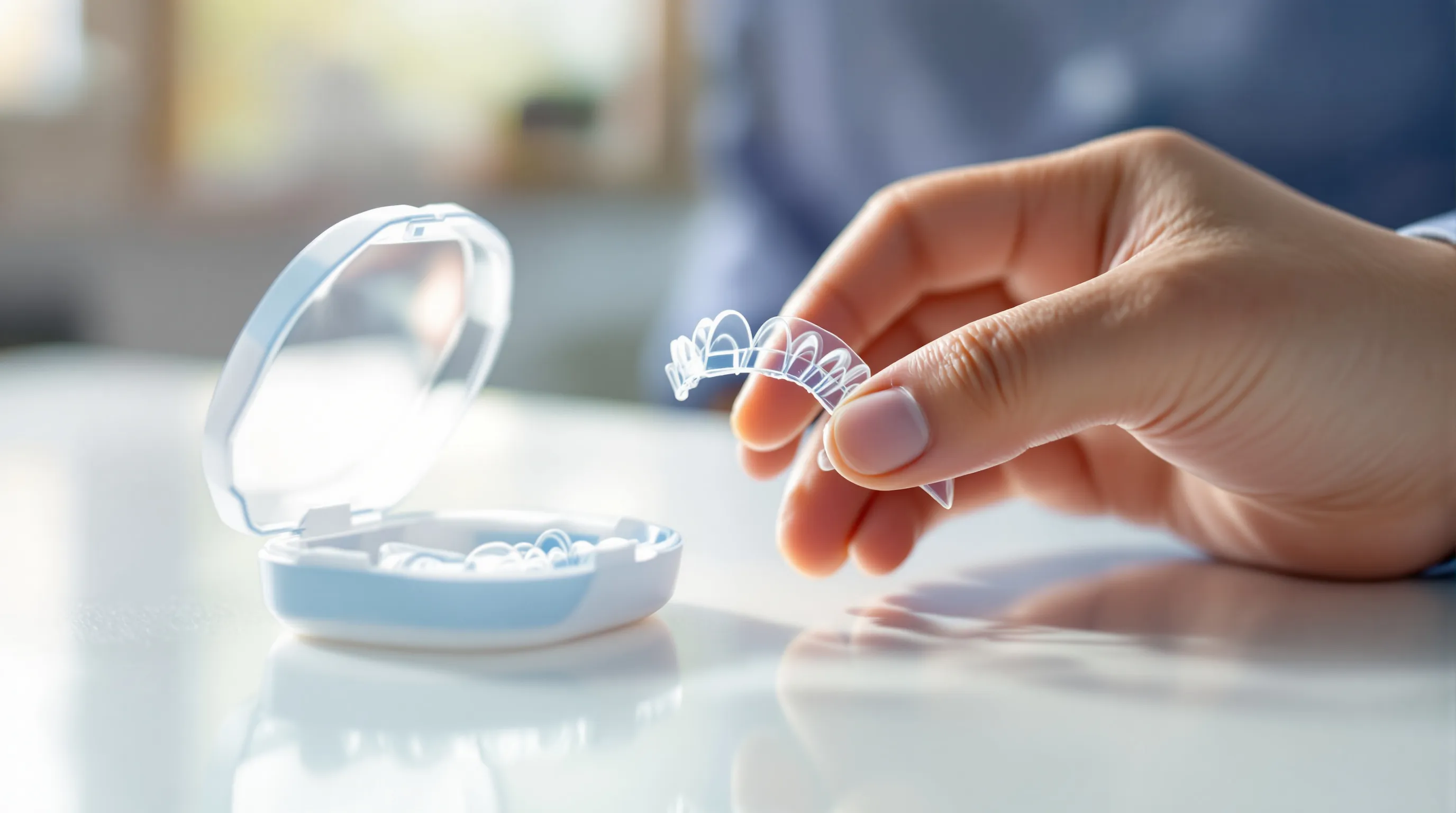
Clear aligners are removable trays, which is both their biggest perk and their biggest responsibility.
Look for a family practice that offers clear aligners. Aligners began as an orthodontist-only product and later opened to general dentists, so parents and teens can straighten up under one roof.
Did you know a clear aligner is really just a thin, custom-made tray? A 2023 review in the Journal of Orthodontic Science explains that aligners are usually made from flexible materials like polyurethane or ethylene vinyl acetate, each one shaped to guide your teeth a little closer to their planned spots. Small bumps called attachments (power ridges or buttons) are often bonded to certain teeth so the trays can grip and push in the right direction. The same review sums up the perks: aligners are "virtually invisible, comfortable to wear, and removable for eating and brushing." Pretty amazing for a piece of plastic!
And this is not just a teen thing. In 2024, one in three orthodontic patients were adults. What decides whether you qualify is the health of the bone and gums holding your teeth, not the year on your driver's license. A mom fixing a shifted front tooth and her middle schooler fixing crowding can share the same waiting room.
A real family dental home goes beyond straight teeth, too. Our team includes a Diplomate (ABDSM), board certified in dental sleep medicine, and is certified in BOTOX® Cosmetic and dermal fillers. Snoring dad. Aligner-wearing teen. Grandma's checkup. One Lawrenceville address. The review's authors predict that "the future of Clear Aligner Therapy looks bright," and the sections below show exactly where that bright future still hands the job back to braces.
Picture a mouthful of stainless steel in a yearbook photo. For generations, that was simply the price of a straight smile. Then, in the year 1999, Align Technology introduced Invisalign, the first commercial clear aligner system, and earned FDA clearance for it in 2000. At first only orthodontists could offer it. Later, general dentists could too. What a change!
So do patients actually prefer the trays? In 2025, a Virginia Commonwealth University survey of 394 orthodontic patients found that significantly more braces wearers wanted to switch to aligners than the other way around (p < 0.0001). Most patients going through a second round of treatment chose aligners, including most who first wore braces. Here is the twist. Braces wearers believed braces gave the better result, while aligner wearers believed the results were about equal.
Specialists are split, too. In a 2025 survey of Croatian orthodontists, 52.6% rated aligners superior to fixed braces, yet the study's authors concluded aligners are still not seen as producing better outcomes. Preference is clear. Proof of superiority is not. That gap is exactly where a Lawrenceville patient's real decision begins.
Questions this article answers
What are your invisible braces options in Lawrenceville, NJ?
Lawrenceville patients choosing invisible braces pick among ceramic braces, lingual braces and clear aligners, with classic metal braces as the fourth path. All four straighten teeth; the daily routine is what differs.
Before you book, sort your priorities with a few plain questions:
- Do you want something nobody notices at a meeting or in family photos?
- Can you keep a removable tray in your mouth for most of the day?
- Would you rather have an appliance that works without any daily decision?
- Are you willing to give up hard and sticky foods for the whole treatment?
The Informed Patient Podcast, in its 2026 episode on adult orthodontics, describes "about four main paths today": traditional metal braces, ceramic braces, lingual braces and clear aligners. Ceramic braces use tooth colored or clear brackets, which the hosts call "way less noticeable than metal." Lingual braces sit entirely behind the teeth and are "practically invisible" from the outside. Clear aligners are removable trays that, in the hosts' words, "only work if you wear them 20 to 22 hours a day." They sum up the whole choice as "maximum force and certainty versus, let's say, maximum discretion and flexibility." What a perfect way to put it!
The common assumption is that "invisible braces" means one product. Well, that could not have been more wrong! Two of the four paths are still braces, just cleverly disguised.
| Path | How it looks | Removable? | Daily routine |
|---|---|---|---|
| Metal braces | Stainless steel brackets and wire | No | Skip hard, crunchy and sticky foods |
| Ceramic braces | Tooth colored or clear brackets | No | Same food limits as metal |
| Lingual braces | Hidden behind the teeth | No | Can take a bit longer to get used to |
| Clear aligners | Nearly invisible plastic trays | Yes | Out to eat, back in right after |
Comfort is where aligners really shine. One clear aligner provider's patient guide points to a study of 100 orthodontic patients in which aligners scored 8.7 out of 10 for aesthetics against 5.4 for braces, and 8.2 versus 4.9 for comfort, with treatment effectiveness described as statistically similar. An aligner maker's own guide admits a new tray can bring tightness for 1-2 days, and says braces carry a higher chance of sores on the inner lips and cheeks. A comparison of 5 sources shows the same split again and again. Fixed braces ask nothing of your willpower. Aligners ask a lot of it, and hand your whole menu back in return.
That trade matters more than looks. Many families driving in after reading what to check before booking a dentist near West Windsor arrive focused only on appearance. Our forty-two years in the same Lawrenceville office mean most cases finish right here, rather than bouncing between specialists, so the path you start on is usually the one you finish with us. Which path fits, though, depends less on taste than on what your bite actually needs.
Who qualifies for clear aligners, and who still needs braces?
Clear aligners work well for mild to moderate crowding, gaps and bite problems. Severe crowding that needs extractions, skeletal jaw problems and big multi-direction moves still belong to fixed braces.
The U.S. Food and Drug Administration, in its 2026 consumer guidance, says clear aligners are commonly used for mild to moderate orthodontic issues, including crowded teeth, gaps between teeth and bite problems. The agency adds that more complex conditions may require traditional braces or other treatments, and that aligners "may not be appropriate for every patient." Evaluation, the FDA says, should happen with a dentist or orthodontist, preferably in person.
A 2023 review in the Journal of Orthodontic Science draws the line even more sharply. Its authors say aligners should not be used for severe crowding or spacing that requires extractions, for complex jaw discrepancies or skeletal issues, or when teeth must travel a long way in several directions. In those cases, they warn, "CAT is likely not going to be strong enough." And yet, did you know the very same review shows a severely crowded 12-year-old straightened with aligners in 16 months? The deciding detail appears to be whether any teeth had to come out.
Specialists behave exactly the way that guidance predicts. In a 2025 survey of 180 orthodontists in Croatia, 88% used aligners, yet aligners made up only 10% of their yearly cases, and mild to moderate crowding was the main reason to reach for them. Adults were the bigger aligner group at 57.9%. Half of all cases needed a refinement, meaning an extra round of trays to finish the job.
Not everyone draws the line in the same place. An orthodontist who lectures for an aligner brand argued on a 2025 podcast that aligners now handle deep bites, severe crowding, severe spacing and crossbites. That clinician also pointed to a study in which cases that typically take about two years in braces finished in about 18 months with aligners.
So who qualifies? Your bite decides first. Your habits decide second. A crowded smile with healthy roots and gums is a wonderful aligner candidate, while a skeletal overbite usually is not.
Children add one more wrinkle. One orthodontic practice says most kids between 9 and 14 are at an ideal stage to begin, because permanent teeth are coming in. That same practice saves aligners for older kids and teens who can wear them most of the day, and leans toward braces for younger children and complex cases. Families comparing offices across the county, including those reading our notes on choosing a dentist near Plainsboro, should expect an honest answer on this point, even when the answer is braces. Getting that answer means asking the right questions at the very first visit.
Are clear aligners really cheaper and faster than braces?
Clear aligners have a reputation: they cost more than braces, finish twice as fast, and are planned so precisely by software that the first set of trays does the whole job. We checked all three.
We started with price. The author of a Texas dental practice's blog described a common assumption: "Most people, including myself, walked into their first orthodontic research convinced that clear aligners were the pricier option. It's a fair assumption, but it's not accurate." For the most part, published fee ranges agree with that author.
Aligners and braces cover nearly the same price ground. Lingual braces are the most hidden option, and they cost the most. The ranges are not identical, though. An American Dental Association fee survey, cited by the Texas practice, puts the lowest aligner fee at $4,000, compared with $3,000 for braces. An orthodontic team in another practice named the bigger factor: "Your specific orthodontic needs dictate the final price more than the type of appliance you choose." The insurance ceiling in the chart applies "regardless of whether you choose aligners or braces," the Florida practice wrote.
The speed claim holds up less well. The line that aligners straighten teeth "usually in 6 to 12 months compared to 18 to 24 months for other options" appears in one orthodontic practice's guide for parents, and the guide cites no study for it. The FDA takes a more cautious view: "How long your treatment takes will depend on how much your teeth need to shift." The Florida practice's own figures show the overlap. Its complex aligner cases take 18 to 24 months, which falls within its braces range. Even the strongest speed evidence we found, an NIH study cited on a podcast by an Atlanta orthodontist who lectures on one aligner brand, describes a gap far smaller than half the time, and the orthodontist never named the study.
The weakest part of the reputation is the first set of trays. Researchers affiliated with the University of Zagreb sent a survey to 180 orthodontists in Croatia and published the results in December 2025. Respondents said refinement, an extra round of aligners after the first series, was performed in half of cases. Two-thirds said they change the software's digital treatment plan, most often the final tooth positions.
1 in 2
Aligner cases that needed a refinement round, according to a 2025 survey of orthodontists in Croatia. The first series of trays often does not finish the job.
An industry insider gives a similar number. John Nabors, who runs an aligner company that sells to dental practices, told a 2025 orthodontic marketing podcast that most competitors' refinement rates are "closer to fifty percent." He says his own system's rate is around ten percent, and that is a sales claim. The Croatian orthodontists were also split on whether aligners beat braces: 52.6% said they do. All of this explains why the FDA treats aligners as prescription devices. It "has not authorized clear aligners that are sold directly to consumers without a prescription and supervision by a dentist or orthodontist."
Many people worry most about their own discipline. A 2025 Virginia Commonwealth University thesis surveyed 394 patients in active treatment, 206 with aligners and 188 with braces. It found "no significant difference between expected and actual patient compliance with aligner treatment." Satisfaction was high with both options. Each group thought well of its own appliance, but more braces patients said they would switch to aligners than the other way around. Patients reported their own wear, and nobody measured the hours.
Lined up, the findings make the choice of appliance the smaller decision. Price follows the case. Timing follows how far the teeth must move. The first set of trays is often a draft that a clinician revises, and the plan works only for a patient who keeps wearing it.
- Ask for quotes on both aligners and braces for your own diagnosis, then check your plan's lifetime orthodontic maximum, because it applies either way.
- Ask for your expected treatment time as a range based on how far your teeth need to move. Until a clinician has examined you, treat any 6 to 12 month figure as a best case for simple movement.
- Ask how often the dentist's aligner patients need a refinement round, and whether a clinician reviews and edits the software plan before the trays are made.
- If someone offers aligners without an in-person exam, search the FDA's 510(k) database under product code NXC. A company that calls itself "FDA-registered" has only listed its facility and products with the FDA.
How we checked this
We used FDA consumer guidance, a peer-reviewed survey of Croatian orthodontists, a VCU master's thesis, blogs from four orthodontic and dental practices, and two podcasts. None of the figures here come from our own practice. Practices that sell treatment published the price ranges, and we saw the ADA fee survey only as one practice cited it. The NIH study on treatment time was never named. The Croatian survey covers one country and relies on what orthodontists reported. The VCU findings are self-reported from two sites, and the full thesis is embargoed until May 2027, so we read only its abstract. The aligner executive and the Atlanta orthodontist both have commercial ties to aligners. We offer invisible braces options too, so we also have a stake in this answer. We still don't know how refinement rates or fees in Lawrenceville compare with these figures, because none of our sources measured them.
- U.S. Food and Drug Administration, consumer guidance on clear dental aligners, September 2026.
- University of Zagreb affiliated researchers, survey of Croatian orthodontists on aligner use, December 2025.
- Virginia Commonwealth University, thesis surveying 394 orthodontic patients, 2025.
- Brockway Orthodontics, clear aligners versus braces cost guide, December 2025.
- Aransas dental practice, blog post on aligner costs, October 2026.
- Dischinger & Sessions Orthodontic Team, article on braces and aligner costs, April 2026.
- Smokey Point Orthodontics, guide for parents on aligner costs, June 2026.
- John Nabors on Ortho Marketing Live, podcast transcript, February 2025, at 7:55.
- Moments with Marianne, podcast episode with an Atlanta orthodontist, November 2025, at 2:57.
What should you ask at an invisible braces consultation in Lawrenceville?
Ask about candidacy, timeline, refinements, what the fee covers, insurance and retainers. A Practice of the Year office like Imagine Advanced Dental Arts should answer each one plainly.
Bring these six questions to your first visit, and write the answers down:
- Am I a true aligner candidate? Ask how complex your bite is, and whether braces would finish it more predictably.
- How long will my treatment take? Ask how often cases like yours need refinement trays, and how that changes the finish date.
- What does the fee include? Records, X-rays, scans, refinement trays and retainers should all be spelled out.
- How will my insurance apply? Ask whether your plan has a lifetime orthodontic maximum and how it treats aligners.
- What if my plan changes midway? Ask what switching appliances would cost and how much time it adds.
- Who designs and checks my plan? Ask who reviews your progress in person, and whether your care stays under one roof.
Why push on fees? One orthodontic team warns patients to steer clear of clinics that tack on hidden charges for X-rays, emergency visits or post-treatment retainers. The same team notes that many dental plans cover orthodontics up to a lifetime maximum, whether you choose braces or aligners. They also caution that switching from braces to aligners midstream means removing the brackets, new digital scans and a fresh set of trays, which "will almost certainly increase your total cost and extend your treatment time." Well, nobody wants that surprise! As that team puts it, "Cheaper does not always equal better value if the treatment fails to deliver a healthy, lasting result."
Ask early. Surprises cost more later.
Reviews are worth a look too, though they measure something different from clinical skill. Our 4.9 average rating from 587 Google reviews tells you how Lawrenceville patients feel about the way they were treated, start to finish. Training tells you about the bite itself. Our team's DMD and residency training, with honors in prosthodontics and oral reconstruction, matters when trays have to fit around existing crowns, bridges or worn teeth. That is not a small detail for adults!
Comparing several offices in Mercer County? Our checklist of four checks before booking a dentist near Hamilton pairs nicely with the six questions above. Whichever office you pick, the answer to question one should come from a real exam, with X-rays and a scan of your bite in hand, before anyone quotes a price or prints a single tray.
So which should you choose, clear aligners or braces?
Choose aligners if your case is mild to moderate and you will truly wear them all day. Choose braces if your bite is complex or daily discipline worries you.
As you can see, the trays have come a long way from novelty to everyday tool. A 2024 statistics roundup reported that by 2023, aligners from the first maker alone had treated 17 million people, including 4.5 million teens. Amazing! Still, braces are not going anywhere. Wear time remains the make-or-break factor, and podcast hosts discussing adult treatment called noncompliance "the number one reason clear aligner treatment fails or just takes longer than expected."
One rule never changes. The FDA states it has not authorized any clear aligners sold directly to consumers without a prescription and supervision by a dentist or orthodontist. You can check any product yourself in the agency's 510(k) database under product code NXC. Then bring your questions, and your smile, in for a real exam.
Summarize This Article With AI
Open this article in your preferred AI engine for an instant summary.
Frequently Asked Questions
What else do people ask about invisible braces in Lawrenceville?
Most questions come down to age, time, cost, insurance and keeping results. Healthy gums matter more than birthdays, and every finished case needs a retainer afterward.
Am I too old for clear aligners?
Probably not! On a 2026 episode, The Informed Patient Podcast put it plainly: "We're seeing successful treatments for people in their 60s and 70s." What counts is healthy teeth and gums with no active gum disease. Age is just a number here.
How long does adult treatment take?
The same podcast says adult treatment "typically lasts anywhere from 12 to 24 months." Adult bone is fully developed and denser, so teeth can take a bit longer to move. Your exact timeline depends on your bite.
How much do invisible braces cost?
The podcast hosts put metal braces at $3,000 to $5,000 for a moderate case, with lingual braces and aligners "from $4,500 up to $8,000 or even $9,000 for more complex cases." We can't quote a fair Lawrenceville price without seeing your teeth first. Here's an honest trade-off, though. Braces cost less and work around the clock with zero discipline required, while aligners ask you to pay partly in daily habits.
Will insurance help pay for it?
Often, yes. More plans now cover adult orthodontics, especially when treatment is "deemed medically necessary," and many practices offer monthly installments. You usually don't need a referral.
My teeth shifted after braces as a teen. Now what?
That drift is called orthodontic relapse, and it's one of the most common reasons adults come back. Aligners can often handle a mild relapse. This time, plan for a retainer "forever," as the podcast hosts say.
How do I book a consultation?
Reach out through our contact page. Our four credentialed dentists serve patients across New Jersey, right from our Lawrenceville office.
Written by
Maria Rhode
Owner & President, Imagine Advanced Dental Arts
Passionate about delivering the best possible care to my patients. From my days in residency to owning a beautiful hi-tech dental office, I never stop learning and advancing myself and now my practice.
Connect on LinkedIn