


Your All-on-4 dental implants are one of the most life-changing investments in modern dentistry, but they are not a "fix it and forget it" solution. The patients who protect their smile for decades follow a specific cleaning cadence: twice daily at home and at minimum every six months professionally. This guide covers exactly what that looks like, what your hygienist does at those visits that you simply cannot replicate at home, and why the stakes for getting it right are higher than most people realize.
Questions this article answers
- How often should I clean at home?
- How often do I need professional All-on-4 maintenance?
- Does the prosthetic bridge need to be removed at cleaning visits?
Quick Answer
The Short Answer: Clean your All-on-4 implants twice daily at home: brush the prosthetic surface and gum-replacement material, floss under the bridge (not between teeth) with threader floss, and rinse with a water flosser. Professionally, visit your dentist every six months at minimum, with quarterly visits if you have gum disease history or bruxism. Most patients benefit from annual prosthetic removal for a full deep-clean and screw-torque inspection.
Quick Answer
There is a moment I see again and again in my practice that never gets old. A patient settles into the chair after their All-on-4 implants have fully healed, they flash their brand-new smile, and the look on their face is pure joy! Years of missing teeth, of hiding in photos, of avoiding certain foods: all of it, gone. It is one of the most rewarding things I get to witness as a dentist. And then comes the next question, almost without fail: "So how do I take care of these?" Well, that is exactly what we are here to talk about. Because that beautiful smile deserves a care routine that keeps it beautiful for life, and it all starts with understanding the right cleaning cadence.
How Often Should You Clean Your All-on-4 Implants at Home?
Did you know that the number one question I hear from patients who just got their All-on-4 implants placed is not about eating or speaking, it's about cleaning? And I love that! It tells me you're already thinking like someone who wants this investment to last a lifetime.
The answer is beautifully simple: twice a day, every single day. Morning and night, no exceptions. I tell every patient in my chair the same thing: if you are not cleaning your All-on-4 implants at least twice daily, you are putting your investment at serious risk, as of .
Think of it this way. Your All-on-4 prosthesis is permanently fixed in your mouth, which means bacteria, food particles, and plaque are collecting around it all day long, just as they would around natural teeth. The difference is that you cannot remove the bridge yourself to clean it. The twice-daily routine is your only line of defense between those sessions.
Some patients tell me they clean once a day and wonder if that's okay. It is not enough. Bacteria do not take a day off. In the space between the bridge and your gumline, conditions can become very favorable for the kind of buildup that leads to peri-implantitis, a serious infection around the implant. That is not something you want to discover six months into ownership of a $25,000 smile. And if you eat a large or sticky meal, a midday rinse or quick water-flosser pass is a wonderful bonus habit to build.
What Does the Daily All-on-4 Cleaning Routine Actually Look Like?
Here is where things get interesting, because cleaning your All-on-4 is genuinely different from cleaning natural teeth, and most people don't realize that until they're standing at the bathroom sink wondering what to do.
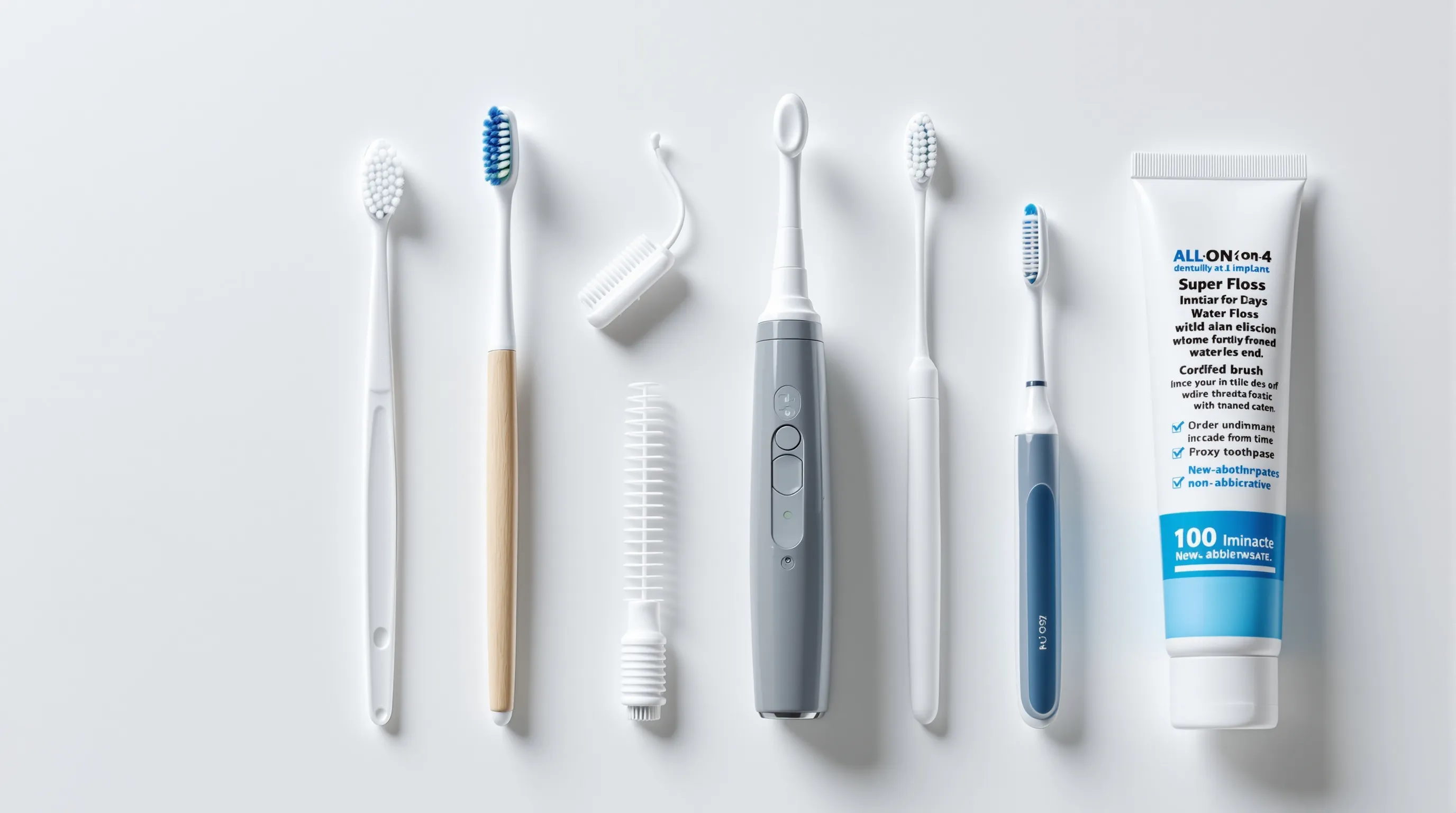
The most important mindset shift: you are not flossing between teeth, you are flossing under the bridge. That gap between the prosthetic arch and your gumline is where bacteria hide. A regular piece of floss won't reach it. You need a super floss with a stiff threader end to slide underneath and sweep from end to end. Use a non-abrasive toothpaste: gritty or whitening pastes act like fine sandpaper on your prosthetic, scratching the surface and inviting stains over time.
| Tool | Purpose | Frequency |
|---|---|---|
| Soft-bristled toothbrush | Brush prosthetic surface and pink gum-replacement material | Twice daily |
| Super floss / threader floss | Clean under the bridge where brushes cannot reach | Twice daily |
| Water flosser | Flush debris from under the arch and around implant sites | Daily (or after meals) |
| Proxy brush | Clean around individual implant sites and hard-to-reach gaps | Daily |
| Non-abrasive toothpaste | Gentle cleaning without scratching prosthetic material | Twice daily |
The water flosser is a game-changer. Some patients find they love using it after every meal, and I say: go for it! As one experienced implant dentist put it, think of the brush as a sponge-scrub, and the water flosser as the rinse. You need both to really get the job done.
How Often Should You Visit the Dentist for Professional All-on-4 Cleaning?
At home you handle the daily work. But professional maintenance is a whole different story, and this is where I see patients try to shortcut their way into trouble.
The standard recommendation is every six months, and I stand firmly behind that. Some providers push quarterly visits for patients with a history of gum disease, bruxism (teeth grinding), or other risk factors that make peri-implant complications more likely. For those patients, three to four professional visits per year is not overkill. It is smart stewardship of a major investment.
Here is what a professional All-on-4 maintenance visit typically includes:
- Imaging: X-rays to evaluate bone levels around each implant, watching for early bone loss
- Clinical exam: Probing around each implant site to assess tissue health
- Screw-torque check: Verifying the screws connecting the prosthetic to the implants are at the correct tension
- Professional cleaning: Removal of calculus and biofilm using implant-safe instruments that would damage titanium if used incorrectly
- Prosthetic inspection: Checking for cracks, wear, or signs the bridge material needs attention
One experienced All-on-4 owner shared that their annual maintenance visit: which included full removal, deep clean, and screw inspection, cost around $400 to $500. After four years, none of the screws had needed replacement. That is an exceptional long-term outcome, and it started with showing up consistently.
What Does the Hygienist Do at an All-on-4 Cleaning That You Cannot Do at Home?
This is one of my favorite questions, because the answer really underscores why professional maintenance is non-negotiable, not just something to do when you remember.
At home, you remove soft plaque and food debris from the surfaces you can reach. But over time, plaque mineralizes into calculus (tartar), a hard deposit that no amount of brushing or water-flossing can remove. That is where your hygienist comes in.
For All-on-4 patients, a well-trained hygienist uses implant-specific instruments: implant-safe Cavitron inserts, titanium scalers, and agents like HYBENX that will not scratch the titanium implant surfaces the way standard metal scalers would. If the prosthetic is removed for the visit, the bridge itself may be cleaned in an ultrasonic bath with a stain and tartar removal solution, getting surfaces clean that no in-mouth tool can ever reach.
There is also a scope-of-practice nuance patients should understand. In some states, Washington is one documented examplea hygienist may not be permitted to remove and re-torque an All-on-4 prosthetic. That step is reserved for the dentist. In Texas, the dentist handles removal while the hygienist cleans the exposed implant sites. This means your maintenance visit may involve both your hygienist and your dentist in the same appointment, depending on where you live.
At Imagine Advanced Dental Arts, every All-on-4 patient gets instruments matched to their specific implant system. The expertise of your provider matters enormously here.
Does Your All-on-4 Prosthetic Bridge Need to Be Removed for Cleaning?
Ah, this is where the implant community gets passionate! Spend any time in All-on-4 forums and you will find this debate going strong.
Both camps have a genuine point, and I think it is worth understanding both sides.
The case for annual removal: Many experienced patients and implant specialists recommend having the bridge removed at least once a year. The reason is straightforward: there are surfaces underneath the prosthetic that a hygienist simply cannot reach with it in place. Removal allows complete inspection of the implant connections, screw integrity, and the tissue health directly at each implant site. One patient with four years of experience shared that their annual removal and deep-clean appointment cost around $400 to $500: and in four years, none of the screws had needed replacement. That is excellent value relative to the cost of the restoration itself.
The case against routine removal: Some long-time patients and providers argue that if home care is excellent and tissue is healthy, routine removal adds risk without proportional benefit. Every removal carries a small possibility of stripped screws or connection issues. One patient with 15 years of implant experience noted that with daily floss, a water pick, and an electric toothbrush, the prosthetic stays clean in-place and removal has become unnecessary.
My clinical view: the right answer depends on the individual. What I know for certain is that assuming removal is never necessary is the most dangerous position of all, because problems underneath the bridge tend to be invisible until they have been developing for quite some time.
What Happens If You Neglect Your All-on-4 Cleaning?
I am going to be very direct here, because I think it's the most caring thing I can do.
The consequences of neglecting All-on-4 cleaning are serious, and largely irreversible once they progress far enough.
The primary risk is peri-implantitis, an infection of the tissue and bone surrounding the implant. Think of it as gum disease around an implant, and it is both painful and destructive. When bacterial buildup in the space beneath your bridge reaches a critical level, it attacks the bone holding your implants in place. When you lose that bone, you can lose the implants themselves.
How quickly can things go wrong? One patient shared their experience publicly: pain and swelling just days after placement was dismissed as normal healing, but turned out to be a serious bone infection. Three of their four implants ultimately failed, requiring emergency bone scraping, a bone graft, and a six-month healing wait before the whole process could begin again.
The financial stakes are equally real. A full-arch All-on-4 restoration typically costs $15,000 to $25,000 per arch. Implant failure and replacement can add $10,000 or more on top of that: not counting the time, discomfort, and emotional toll of starting over.
The good news? Consistent twice-daily home care and twice-yearly professional maintenance make peri-implantitis exceptionally rare. Cleaning is not optional. It is what protects the entire investment.
Your Daily All-on-4 Cleaning Routine: Step by Step
- Wet a soft-bristled toothbrush and apply a small amount of non-abrasive, non-whitening toothpaste.
- Brush the prosthetic surface in small circular motions, including the pink gum-replacement material: front, back, and along the gumline.
- Thread your super floss under the bridge at the center gap. Work from one end of the arch to the other in a gentle back-and-forth motion, then repeat on the opposite side.
- Use a proxy brush to clean around each implant site and any hard-to-reach gaps along the arch.
- Run your water flosser under the bridge at low-to-medium pressure, sweeping from one end of the arch to the other.
- Rinse thoroughly with water or a clear, non-staining mouth rinse.
Repeat morning and night. Optional: run the water flosser after any large or sticky meal for best results.
Before
Consistent Cleaning vs. Neglect: What the Difference Looks Like
After
| Without Consistent Cleaning | With Twice-Daily Routine + Bi-Annual Professional Care |
|---|---|
| Calculus buildup under the bridge within weeks | Tissue stays healthy and pink between visits |
| Persistent bad breath from bacterial accumulation under the arch | Fresh breath and clean feel maintained day after day |
| Peri-implant tissue inflammation and bleeding | Stable bone levels confirmed at each imaging check |
| Risk of peri-implantitis progressing to implant failure | Long-term implant survival rates remain in the high-90% range |
| Prosthetic staining and surface scratching from abrasive products | Bright, stain-resistant appearance maintained over time |
What Will Matter Most for All-on-4 Maintenance in the Next 12-24 Months?
In my experience watching this field evolve, I believe we are at a turning point in how the profession approaches full-arch aftercare, and patients who understand these shifts will be better positioned to protect their smiles.
The biggest trend I am watching is the professionalization of the maintenance recall schedule. Right now, how often patients come in for professional cleaning varies wildly: not because the clinical evidence is unclear, but because providers haven't converged on a single standard the way they have for other procedures. The direction it's moving is toward more frequent recall visits for full-arch implant patients than for patients with natural teeth. I expect twice yearly to become a hard floor, with quarterly becoming the standard for anyone with risk factors like a smoking history, bruxism, or prior gum disease.
The second shift I'm watching is access to prosthetic removal. Whether your hygienist can legally remove and re-torque your bridge depends entirely on your state, and that creates real inconsistencies in the care patients receive. States are sorting out scope-of-practice rules for implant prosthetics, and those decisions will affect the cost and logistics of your maintenance visits over the next few years.
Finally, the home-care market is evolving quickly. Specialized floss, clinic-branded irrigator tips, and brushing tools designed specifically for full-arch prosthetics are becoming more widely available, and making it easier for patients to do the right thing daily. That is genuinely good news for long-term outcomes.
Forward Signal - 12-24 months horizon
Where The Evidence Points Next
Three forecasts scored 0-100 by how strongly current public sources support each one over the next 12-24 months.
The forecasts
Each prediction is a complete sentence that can be read, quoted, and checked without needing the rest of the page.
Full-arch implant care will settle toward a standard professional maintenance rhythm - broadly twice yearly, tightening to quarterly for higher-risk patients - anchored to professional-body guidance rather than clinic-by-clinic improvisation. Visits will increasingly bundle imaging to evaluate bone and implant health, not just cleaning.
A recurring consumables market tailored to full-arch restorations will expand, built around specialized tools such as thicker threader floss, water flossers, and proxy brushes sold directly by clinics and online, creating a subscription-like spend layered on top of professional maintenance.
Access to prosthesis removal - not daily hygiene - will define the maintenance market. Providers who can legally and affordably remove, clean, and re-torque fixed arches in-house will win share, while patients in restrictive states or those facing four-figure screw-replacement charges will delay or skip professional removal.
Weak signals watched: Practitioners are already citing the American College of Prosthodontists position statement and a British Dental Journal article, and clinicians describe twice-yearly professional maintenance with bone-and-implant imaging as the emerging default. In Washington a hygienist reports a hard no on removing and re-torquing arches, removal authority varies by state, and one US office quoted around $1,000 to replace all 12 screws after a removal. Branded X-floss is already sold directly from the clinic and online, is reused five or six times, and one packet lasts four to six months, while clinicians recommend specific soft brushes, water flossers, and proxy brushes for the pink gum-replacement areas.
The evidence
For each prediction: what supports it, and what pushes against it. Both sides are shown for every forecast.
- All on four maintenance supports this forecast. [Community / Forum]
- Cleaning All-on-4 Dental Implants: Products & Demo supports this forecast. [Video]
- How To Clean All-On-4 Permanent Implant Dentures. Maintain Fixed supports this forecast. [Video]
- If you could go all-on-4 or snap-in dentures which would you pick? is the clearest counter-signal. [Community / Forum]
- For those who have full mouth implants is the clearest counter-signal. [Community / Forum]
- How to Clean Your All On 4 Plus® Dental Implants supports this forecast. [Video]
- Cleaning All-on-4 Dental Implants: Products & Demo supports this forecast. [Video]
- How To Clean All-On-4 Permanent Implant Dentures. Maintain Fixed is the clearest counter-signal. [Video]
- All on 4 removal to clean implants supports this forecast. [Community / Forum]
- For those who have full mouth implants supports this forecast. [Community / Forum]
- What if I neglect cleaning my all-on-4 implants? is the clearest counter-signal. [Community / Forum]
- How To Clean All-On-4 Permanent Implant Dentures. Maintain Fixed is the clearest counter-signal. [Video]
Where we could be wrong
These forecasts assume current trends continue. The scenarios below would meaningfully change them.
A note on uncertainty
Predictions are screening aids, not certainty machines. The strongest signal here (63/100) still has counter-evidence, and the contrarian signal (52/100) reflects real disagreement among sources.
- If regulators or buyers move in the opposite direction, Maintenance cadence consolidates would weaken first.
- If the source mix shifts toward stronger contrary evidence, Removal access and cost become the real bottleneck could become the more durable forecast.
Key Takeaways
Key Takeaways
- Clean at home twice daily: morning and night, no exceptions
- Use the right tools: soft-bristled brush, threader floss, water flosser, and proxy brush
- Floss under the bridge, not between teeth. The technique is completely different from natural teeth
- Professional cleaning every 6 months at minimum; quarterly for patients with gum disease history or bruxism
- Annual prosthetic removal for deep cleaning and screw inspection is the right call for most patients
- Neglect is expensive, peri-implantitis and implant failure can cost $10,000 or more to fix
- Always use non-abrasive toothpaste and a clear mouth rinse to protect the prosthetic surface long-term
When I think about All-on-4 implants, I think about the transformation they represent: not just for a person's smile, but for their confidence, their ability to eat what they love, and the way they show up in the world. That transformation is worth protecting! And the beautiful truth is that protecting it really comes down to two things: five to ten minutes of focused cleaning twice a day at home, and showing up for your professional maintenance visits at least twice a year. That is a very small investment of time relative to the decade or more of joy a well-maintained restoration can give you.
At Imagine Advanced Dental Arts, I work with every All-on-4 patient to make sure they leave not just with a beautiful smile, but with the knowledge and confidence to take care of it for the long haul. The best dental outcome is the one that lasts, and it lasts when we take care of it together.
Ready to make sure your All-on-4 implants are getting the professional care they deserve? Schedule your maintenance visit at Imagine Advanced Dental Arts, I would love to check in on your smile and make sure everything is healthy and strong.
Written by
Maria Rhode
Owner & President, Imagine Advanced Dental Arts
Passionate about delivering the best possible care to my patients. From my days in residency to owning a beautiful hi-tech dental office, I never stop learning and advancing myself and now my practice.
Connect on LinkedInFrequently Asked Questions
Can I use an electric toothbrush on my All-on-4 implants?
Yes, and it's actually a great choice! An electric toothbrush delivers a more consistent cleaning motion than manual brushing. Just use a soft brush head; medium or firm bristles can be too abrasive on both the prosthetic material and the tissue around each implant site.
Is a water flosser enough on its own, or do I still need to floss under the bridge?
You still need to thread floss underneath the bridge. A water flosser is excellent for flushing loose debris and rinsing under the arch, but it cannot dislodge the sticky plaque that adheres to surfaces the way a threader floss can. Think of the flosser as your final rinse, not your primary cleaner.
What happens if I skip my six-month professional cleaning?
Calculus (hardened tartar) builds up in areas your home tools can't reach. Over time that triggers peri-implant inflammation and bone loss. At Imagine Advanced Dental Arts I always take imaging at these visits, so we catch early bone changes before they become serious, something that simply cannot happen if you're not coming in.
How do I know if something is wrong under my bridge?
Watch for persistent bad breath that doesn't resolve with cleaning, bleeding or redness around implant sites, pressure or pain when biting, or any looseness in the bridge. Any of these warrants a call to your dentist right away, don't wait for your next scheduled visit.
Does whitening toothpaste work on All-on-4 prosthetics?
No, and using it can cause harm. Whitening agents don't work on prosthetic material, and the abrasives in whitening pastes scratch the bridge surface over time, making it more prone to staining. Stick with a gentle, non-abrasive toothpaste and a clear mouth rinse.
Summarize This Article With AI
Open this article in your preferred AI engine for an instant summary.