

Quick Answer
Ewing families should choose a dental home that can see a baby by age 1, handle adult and cosmetic care like veneers under one roof, and explain costs plainly before any work begins.
Cost is not a side issue. CareQuest Institute research shows the out-of-pocket gap between the poorest and wealthiest households has kept widening. So before booking, read the reviews, ask how many doctors share the schedule, and listen to how a treatment plan gets presented at the very first visit.
Key Points
- The American Dental Association, the American Academy of Pediatric Dentistry and the American Academy of Pediatrics recommend a dental home by age 1, or within six months of the first baby tooth.
- A 2012 paper in the Journal of International Society of Preventive and Community Dentistry found the baby's cavity-causing bacteria matched the mother's in about 71% of mother and infant pairs.
- The CareQuest Institute reported that in 2021 the poorest US families paid 7.4 times more out of pocket for dental care than high-income families.
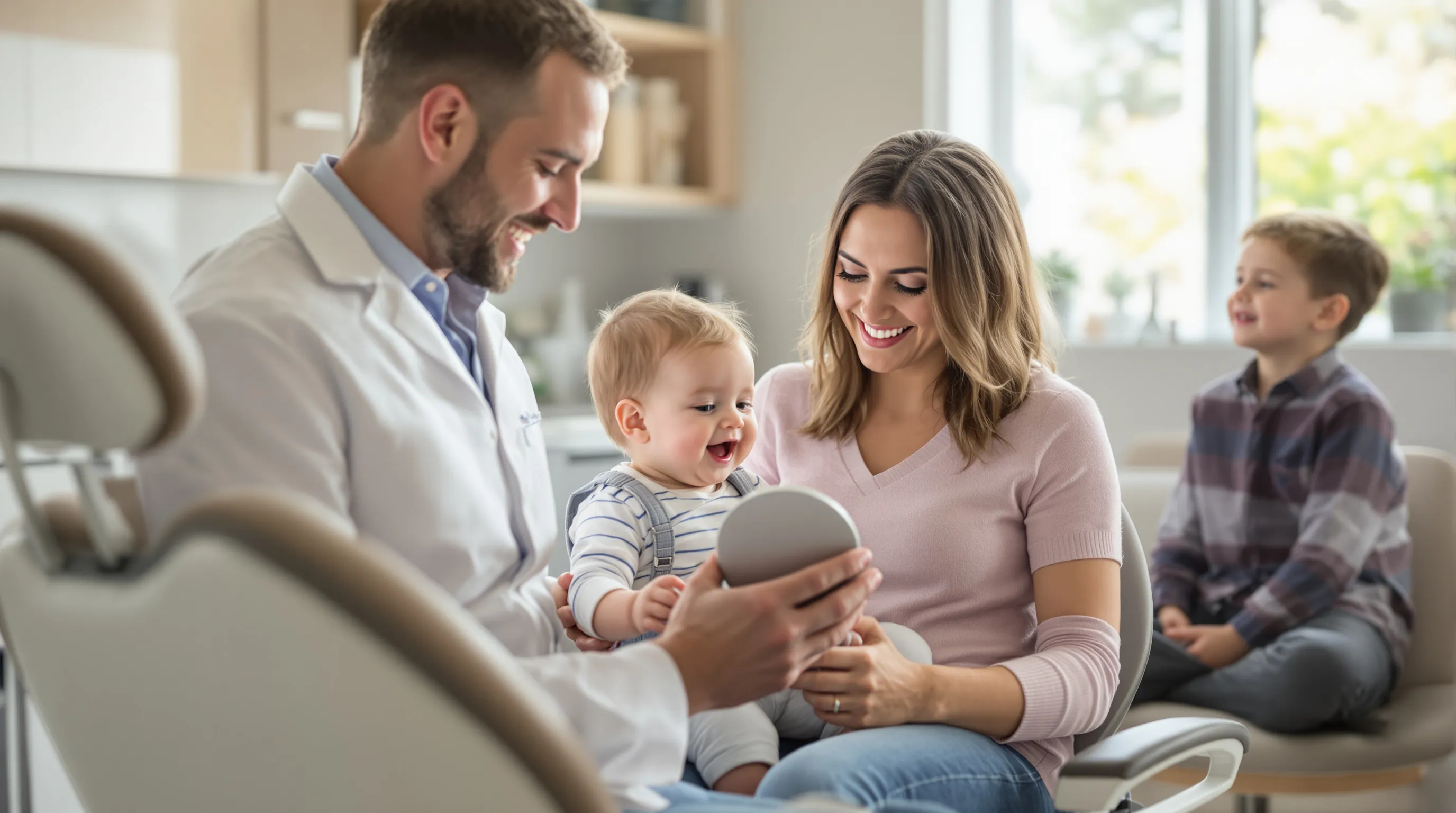
One dental home can care for every generation, from a toddler's first checkup to a parent's cosmetic visit.
The best choice is a dentist your whole family can afford to keep, because in 2021 the poorest US families paid 7.4 times more out of pocket for dental care than high-income families.
That gap has been growing, not shrinking. The CareQuest Institute's 2024 analysis showed the same comparison stood at 5.5 times in 2007. Its numbers on visits were just as striking: about 25% of people in poorer households had seen a dentist in the prior year, against about 55% in wealthier ones. Then, in 2023, an estimated 12 million children and adults lost Medicaid dental coverage when the COVID-19 public health emergency expired. The same research estimated that more than 68 million US adults had no dental insurance at all.
Why does this matter for a smile makeover? Because cost shapes who keeps coming back. A beautiful set of veneers means little if the checkups that protect them get skipped!
Families across Mercer County are asking sharper questions now. Who are the best cosmetic dentists in Lawrenceville? Which office treats both adults and children? Those searches are really one question in disguise. Can a single office handle a teenager's crooked smile, a parent's chipped front tooth and a toddler's very first visit, all without a surprise bill at the front desk? That is a lot to ask of one practice. It is also exactly the right thing to ask, and it starts with what a family should expect from the very first appointment.
Finding a dentist in Ewing, NJ is really about finding a dental home: one office that knows your family's teeth from a toddler's first checkup to a grandparent's crown. The American Dental Association, the American Academy of Pediatric Dentistry, the American Academy of Pediatrics, the American Association of Public Health Dentistry and the Academy of General Dentistry all recommend that a child set up that home by age 1 or within six months of the first baby tooth coming in. Why so early? The youngest mouths are where the trouble has been growing.
A 2010 pediatric review by Ramos-Gomez and colleagues pointed to a 2007 CDC report with a striking split. Tooth decay had declined significantly among school-aged children since the early 1970s. Yet caries rates in children aged 2 to 5 had increased! Did you know the same review noted that infants can test high for cavity-causing bacteria before their first tooth even breaks through? That is a sobering picture.
Here is a good first question to put to any Ewing dentist you call: will you see a one-year-old, and can the same team care for the parents too? Preschool checkups typically cost considerably less than emergency room treatment or extensive work done under sedation, and that gap is the first reason to start early. The next question is what a lifelong office actually has to offer each person who walks through its door.
Questions this article answers
Why does choosing a dental home matter so much for Ewing families?
Because one practice may care for your family from a baby's first tooth to an adult's crown, trust matters most; our Lawrenceville office holds a 4.9 average from 587 Google reviews.
Before you book anything, sit down with your family and run through these four checks:
- Ask whether the office sees babies, teens, parents and grandparents alike.
- Ask which treatments are done in-house and which get sent across town.
- Read the reviews for patterns about kindness, honesty and pressure, not just the star count.
- Check whether the drive and the hours fit school pickups and work shifts.
Why start with the whole family? The Illinois Department of Public Health says it plainly in its guidance for pediatric providers: "To ensure a lifetime of good oral health, children need to establish good oral health habits and a dental home early in life." The same guidance tells providers to help parents identify a dental home for themselves and their child at 12 months of age, or sooner when decay is already present or the child is at high risk. The agency also urges families to set up a dental home for the adults, because a parent's oral health shapes a child's risk of cavities. That is a household decision. It is not a solo errand.
The common assumption is that each person picks a dentist alone, whenever a tooth starts to ache. Well, that idea could not have been more wrong! A review of 4 sources behind this section, from state health guidance to our own patient feedback and team credentials, also raises a question worth asking any office: will the same team see the parents as well as the kids?
Range is part of that trust. At Imagine Advanced Dental Arts, our credentials include a DMD and residency with honors in prosthodontics and oral reconstruction, along with certification in BOTOX Cosmetic and dermal fillers. So a parent's worn bite and a cosmetic touch-up can be planned in the same building. No new intake forms. No starting over.
A candid aside: star ratings and diplomas cannot tell you how a dentist will treat your nervous eight-year-old on a rainy Tuesday afternoon. Only a visit settles that, which is why the first appointment deserves as much attention as the search itself.
Neighbors in other Mercer County towns wrestle with the same questions, and our guide to choosing a dentist near West Windsor walks through a similar set of checks for that community. But before any checklist can work, it helps to know what actually separates a true dental home from an office that simply has an open chair and a drill.
What makes an office a true dental home, and where does the idea get messy?
A true dental home coordinates every part of your care; after forty-two years in the same Lawrenceville office, most of our cases finish here rather than moving between specialists.
The idea has a proud history. A 2012 paper in the Journal of International Society of Preventive and Community Dentistry traced how the American Academy of Pediatric Dentistry first adopted its dental home policy in 2001 and revised it in 2004. The paper quotes the academy's definition: "The dental home is the ongoing relationship between the dentist and the patient, inclusive of all aspects of oral health care delivered in a comprehensive, continuously accessible, coordinated, and family-centered way." Ongoing. Coordinated. Family-centered. Those three words carry the whole promise!
Here is the friction. That same definition says a dental home includes referral to dental specialists when appropriate. Referrals are sometimes exactly right. Yet every handoff means a new office, a new set of records and new faces for a child who may already be nervous. For a busy Ewing household juggling school and work, each extra address is one more thing that can slip off the calendar.
The stakes start early, too. A 2010 review led by Francisco Ramos-Gomez called early childhood caries the most prevalent chronic childhood disease in the United States, five times more common than asthma and seven times more common than hay fever. Even so, the authors conceded that infant oral care and a dental home by the first tooth "has not yet become the standard of care in clinical practice." Guidance and real life had drifted apart. Families were left to close that gap on their own.
What does that mean for you? One question sorts this out quickly: when your child, parent or grandparent needs a specialist, who makes the referral, and who follows up afterward? Fewer handoffs mean fewer dropped threads.
Some needs reach well beyond teeth. Our team includes a Diplomate of the American Board of Dental Sleep Medicine, board certified in dental sleep medicine, so a parent's loud snoring can be evaluated in the same building where the kids get their cleanings. That is coordination families can actually feel.
Families just across the river weigh the same tradeoffs, and our guide to choosing a dentist near Yardley lays out similar questions for that side of the Delaware. Still, a definition only goes so far, and the harder question is whether research can show what a dental home actually does for an entire family over time.
What does a real dental home ask of a family, and of its dentist?
Dentists use the phrase "dental home" freely, and so do we. We traced it back to the groups that wrote it, and the definition asks for something most dentist checklists leave out.
The American Academy of Pediatric Dentistry adopted its dental home policy in 2001 and last revised it in 2018. In its widely quoted form, the definition calls a dental home "the ongoing relationship between the dentist and the patient," with care delivered in a "comprehensive, continuously accessible, coordinated, and family centered way." It also "includes referral to dental specialists when appropriate."
Read closely, the standard measures how well care stays connected over time. Handling most treatment in one building meets part of the test. The referral clause also asks a dentist to recognize when a case belongs elsewhere and to keep the plan coordinated when it goes. The academy's current wording adds two ideas patients echo later: care should be "compassionate," and families should get it whatever their "financial circumstances."
"Family centered" turns out to be meant literally. In a 2010 review, Francisco Ramos-Gomez of the UCLA School of Dentistry and colleagues reported that a caregiver's levels of mutans streptococci, one of the main bacteria behind decay, relate directly to the child's levels and to how many cavities the child gets. Infants have tested with high levels "even before the eruption of their first tooth," they wrote. A 2012 review by dentists at The Oxford Dental College in Bangalore put a number on the link.
About 71%
In approximately 71% of mother and infant pairs, the infant's strains of the decay-causing bacterium Streptococcus mutans appear identical to the mother's. Source: Girish Babu and Doddamani, 2012.
Public health guidance follows the same biology. The Illinois Department of Public Health instructs pediatric providers: "Help the parent/caregiver identify a dental home for themselves and their child." Read that way, a family dental home also covers the adults' own checkups.
Timing is where families often fall behind. The Illinois guidance sets the first visit "within six months of the eruption of the first tooth or by age 1 year, whichever comes first." The 2012 review says children pick up S. mutans at an average age of about 2. Many families come later still. In a 2017 video, Dr. Ray Stewart, a UCSF pediatric dentist, said "a lot of times parents don't get them in until they're three or four sometimes even 5 years old." He was describing his own practice. The 2010 review put it more broadly: a dental home by age 1 "has not yet become the standard of care in clinical practice."
Starting early also tends to cost less. The UCLA team wrote that comprehensive visits for preschoolers cost "considerably less than the cost of emergency room treatment or extensive restorations requiring sedation." A pediatric practice's website cites a Journal of Pediatrics study that found 40 percent lower dental costs over the first five years for children seen before age one. We could not check the study.
Patients use plainer words, but they describe much the same relationship. In a 2026 Reddit thread, a northeast New Jersey patient nearing 50, with money and insurance, gave up on one office after a large bill: "The only thing 'high level' about that practice is their costs." The same poster suspected its five-star reviews were paid. Another commenter recommended a dentist who "is honest and doesn't do unnecessary work." In a 2024 New Jersey thread, a 25-year-old returning to the dentist feared being "lectured and judged." One reply reported, "they weren't judgmental." Another commenter drives "almost an hour" to keep a practice found after a previous dentist "had been shady about some financial stuff."
Individual posts cannot show how common any experience is. They do show what people mention when they explain why they stayed: honesty, clear explanations and no shame about years away.
The policy and the posts end up asking for the same thing: a compassionate, coordinated relationship that lasts. The research adds a step few checklists include. For a family, that relationship should include the parents and should begin by a child's first birthday.
Four checks before you commit
- Ask any practice, us included, how it handles the care it does not do itself: who it refers to, and how the plan and records come back to your regular dentist.
- Book the parents' own checkups and cleanings as part of the family plan, since a caregiver's bacteria shape a child's risk.
- Schedule a child's first visit by the first birthday or within six months of the first tooth, and ask whether the practice sees children that young or which pediatric dentist it works with.
- Read reviews for words like honest, explained and no judgment, and on a first visit notice whether a treatment plan comes with reasons and options.
How we checked this
We read two peer-reviewed reviews on infant oral health, the American Academy of Pediatric Dentistry's dental home policy, state public health and child welfare guidance, a UCSF teaching video, a pediatric practice's website and two New Jersey Reddit threads. None of the figures here are ours. An Arizona child welfare policy says the academy sets the dental home at 6 months of age, but the academy's own policy says no later than 12 months, so we used the academy's wording. The 40 percent cost figure is secondhand. The age 3 to 5 pattern comes from one dentist's experience, and the Reddit posts are individual anecdotes. A 2023 scoping review found that only 5 of 76 dental care program studies measured family-level outcomes, so it is still unclear how much a whole-family dental home improves results for the family. We are a dental practice that hopes families stay with us for years, so we have a stake in how this question gets answered.
- Ramos-Gomez and colleagues, review of infant oral health and the dental home, October 2010.
- Girish Babu and Doddamani, review of the dental home concept, Journal of International Society of Preventive and Community Dentistry, 2012.
- American Academy of Pediatric Dentistry, policy on the dental home, last revised 2018, retrieved November 9, 2026.
- Illinois Department of Public Health, guidelines for pediatric health care providers, undated.
- Arizona Department of Child Safety, dental and orthodontic service policy, revised May 2026.
- UCSF Oral Health Alliance, video of a first dental visit, July 2017.
- Yarmosky Pediatric Dentistry, page on the year one dental home, August 2017.
- Ghoneim and colleagues, scoping review of dental care programs, January 2023.
- Reddit r/newjersey, thread on non-judgmental dentists, July 2024, and thread on dentist recommendations, June 2026.
What should families actually trust when the research runs thin?
Trust signals you can check yourself: honest treatment plans, care that stays under one roof, and outside recognition, like the Practice of the Year award our office received.
Here is a surprising gap. In 2023, a scoping review from the University of Toronto's Faculty of Dentistry sifted 65,887 studies down to 76 that tested real dental care programs. The good news? 57% of those studies reported a significant improvement in at least one outcome, most often less tooth decay. The catch is that only 5 of the 76 measured what happened to whole families. The authors wrote that "evidence to show the impact on family-related outcomes remains limited and requires attention in future research."
So no study will rank the dentists near Ewing for you. That job falls to you. And honestly, that is fine!
Real patients already know which signals count. In a 2026 thread on the New Jersey subreddit, one patient approaching their 50s said they had both money and dental insurance, yet had been let down by dentists in Bloomfield, Nutley, Caldwell and West Caldwell. Their verdict was blunt: "I'm tired of shoddy work and band-aid approaches that everyone seems to do nowadays." The replies did not praise fancy equipment or long menus. One commenter's highest compliment for their own dentist was simple: "Is honest and doesn't do unnecessary work." Another had stayed with the same family practice since childhood.
Contrary to what many glossy websites suggest, the sharper question for any practice is a plain one: who will see each member of your family, and will that same dentist follow them from visit to visit? Practice-written checklists online tend to repeat the same basics, such as broad services, good reviews, comfort for anxious patients and easy scheduling. Those basics matter. But the offices writing them are also the ones being judged, so treat them as a starting point rather than proof.
What should you weigh instead? Look for honesty about what treatment is truly needed. Look for a relationship that lasts. And look for recognition that comes from outside the building, the way our Practice of the Year award did for us, rather than only from a practice's own marketing.
Neighbors to the south ask the same questions, and our guide to choosing a dentist near Hamilton covers a parallel set of checks for that township. For Ewing parents with little ones, though, the very first test of a dental home arrives much sooner than most people expect, usually before a child can even say the word "dentist."
Where is the family dental home headed next?
The family dental home is moving toward earlier first visits and calmer, more honest relationships, and families who choose well now will spend far less time fixing problems later.
The pressure is real. Decay was rising among toddlers even as it fell among older kids, so an office that happily welcomes a one-year-old is no longer a bonus. It is the baseline! As you can see, the next step is a small one: jot down your questions about comfort, cost and follow-up care before you call any office!
Yet a dental home does not stop at the front door. Dr. Brett Langston, who owns an implant practice in Brookhaven, Georgia, calls an electric toothbrush "the number one most important thing" for care at home, and he says fluoride is "absolutely crucial" for protecting enamel. His bigger point lands squarely on busy parents: sticking with a few simple tools between visits, in his words, can "reduce and eliminate a lot of dental problems that will come up later." Well, that is a promise worth building a bedtime routine around! So when you tour an office, ask what the team will teach your kids to do at the bathroom sink, and listen for whether the answer sounds like coaching or like a lecture.
Summarize This Article With AI
Open this article in your preferred AI engine for an instant summary.
Frequently Asked Questions
What else do Ewing families ask when choosing a dentist?
Most questions come down to timing, who in the family needs care, and how to get started, so here are clear answers to the ones parents raise most.
When should my child have their first dental visit?
The first visit should happen within six months of the first tooth coming in or by age 1, whichever comes first. Don't wait for a problem. A baby's mouth only starts collecting its own bacteria as those first teeth arrive, so early visits catch habits before they become cavities.
Do parents need a dental home too?
Yes! Public health guidance encourages families to set up a dental home for the adults as well as the kids, because a parent's mouth shapes a child's risk. A 2012 paper on the dental home reported that in about 71% of mother and infant pairs, the baby's main cavity-causing bacteria appeared identical to the mother's. As you can see, caring for Mom's teeth is part of caring for the baby's.
Does a dental home mean my family never sees a specialist?
Not at all. A dental home is the ongoing relationship between a family and one dental office, and it includes referral to specialists when that is the right call. The point is coordination, not keeping everything in one room no matter what.
Can young children get fluoride treatments at the dentist?
They can. Federal preventive guidance recommends fluoride varnish for children through age 5, which makes it a mandated service covered by insurers. Ask about it at your child's next checkup.
Where does Imagine Advanced Dental Arts serve, and who will we see?
Our practice serves patients across New Jersey, Ewing families included, with four credentialed dentists under one roof. That means a growing family can see doctors who already know their history.
How do we book a first visit?
Reach our team through the contact page at imaginedentalarts.com/contact-us. Tell us who is coming, from the toddler to the grandparent, and we will set up the first appointment around your family's schedule.
Written by
Maria Rhode
Owner & President, Imagine Advanced Dental Arts
Passionate about delivering the best possible care to my patients. From my days in residency to owning a beautiful hi-tech dental office, I never stop learning and advancing myself and now my practice.
Connect on LinkedIn