

Questions this article answers
- Why do zirconia crowns fail if zirconia is such a strong material?
- What is the most common type of failure in a zirconia crown?
- Is a layered or full-contour zirconia crown more durable for front teeth?
Quick Answer
The Short Answer
Zirconia crowns most often fail from chipping of the feldspathic porcelain veneer applied over the zirconia core, affecting roughly 10-25% of layered crowns within five years, or from debonding when the cement connection between crown and tooth breaks down due to inadequate bonding protocol. The zirconia core itself fractures in fewer than 3% of cases. For back teeth, full-contour monolithic zirconia is the most durable option, but its hardness can gradually wear down opposing natural enamel if the crown surface is not properly polished. The right crown type depends on the tooth location, your bite, and your dentist's cementation protocol.
Quick Answer
I want to tell you something that most dental websites will not say out loud: "zirconia" is not a single thing. It is a category: and the type that looks most lifelike, the kind most commonly placed on front teeth, has a known failure mode that has nothing to do with how tough the zirconia ceramic itself is. I have had patients come in over the years, bewildered that their "unbreakable" crown chipped or, stranger still, simply came off their tooth entirely. The look on their faces is always the same. They feel deceived! And honestly, I understand that feeling completely. The marketing around zirconia has focused so relentlessly on material strength that the real, clinically documented failure modes have been almost completely overlooked in patient conversations. That is what I want to change with this article. By the time you finish reading, you will know exactly what to ask before any crown is placed, and you will never again be surprised by what "zirconia" actually means in the mouth.
How Did Zirconia Get Its "Unbreakable" Reputation?
Let me give credit where it is absolutely due. Zirconia, technically yttria-stabilized tetragonal zirconia polycrystal, really is a remarkable ceramic.
When dental laboratories started fabricating crowns from it in the early 2000s using CAD/CAM milling technology, the results were genuinely exciting. I remember reading the early research and feeling that electric sense of possibility that comes when a material actually lives up to its billing, as of .
The numbers are legitimately impressive. Zirconia has a flexural strength ranging from 900 to 1,200 megapascals. The feldspathic porcelain that had been used in crowns before this? Roughly 60 to 80 megapascals. That is more than ten times the fracture resistance. Before zirconia, the standard was porcelain-fused-to-metal (PFM) crowns, a metal substructure topped with porcelain for appearance. They worked well, but they had real drawbacks: the porcelain layer could chip under biting forces, and the metal edge at the gumline sometimes showed as a dark grey line as the gum naturally receded over the years. Patients did not love that look, and neither did I.
Zirconia promised to solve both problems at once. All-ceramic appearance. No metal. Strength that could handle real occlusal forces. Precise CAD/CAM fabrication for excellent fitting margins. The material is, as one practitioner put it succinctly, "the strongest material we use in dental appliances." That reputation is earned. Clinical data on zirconia core fractures are genuinely reassuring: five-year studies consistently show core fracture rates below 3%, comparing very favorably to older all-porcelain restorations that fractured in the 5 to 8% range.
And this is exactly where the problem starts. The "zirconia doesn't crack" claim refers specifically to the zirconia core, the white ceramic substructure milled to fit your prepared tooth. It says almost nothing about what happens to the rest of the crown. For most of the zirconia crowns that end up in the front of the mouth. The ones patients care most about because those are the teeth that show when they smile. There is something else sitting on top of that core. Something far more fragile. That is exactly where the real failure story begins.

The Layer Nobody Warned You About: Veneering Porcelain on Zirconia Crowns
Here is something that genuinely surprises most of my patients when I explain it: there are actually two very different types of zirconia crowns, and they fail in completely different ways.
The first is called monolithic or full-contour zirconia: the entire crown, from base to tip, is solid zirconia ceramic. Strong through and through. The second is called layered zirconia, a zirconia core with a thin coating of feldspathic porcelain baked onto the visible surface to achieve a more natural, translucent appearance.
That veneering porcelain is genuinely necessary for front-tooth aesthetics. Standard zirconia in its base form is opaque and very white: beautiful in some clinical contexts, but it simply does not replicate the depth and translucency of a natural tooth. So for anterior restorations, dental laboratories apply a porcelain veneer over the zirconia framework. The result can look stunning. But here is what nobody puts in the brochure: that porcelain coating is made from the same relatively fragile feldspathic material that caused chipping problems in PFM crowns for decades. It has not gotten stronger just because it is now sitting on zirconia instead of metal. Practicing dentists who work with both materials know this well, one experienced clinician described the moment of realization vividly: a color-matched layered zirconia crown looked practically identical to a lithium disilicate option, but the layered design carries its own vulnerability regardless of how beautiful it looks at cementation.
The clinical evidence on this failure rate is striking. Systematic reviews analyzing multiple clinical trials of zirconia restorations have documented porcelain veneering chipping rates of 10 to 25% over five years for layered zirconia crowns. In several studies, the chipping rate actually met or exceeded that of traditional PFM crowns, which typically show rates of 6 to 13% over the same period. Let that sink in for a moment! The material promoted as "stronger", when layered for anterior aesthetics, can carry a higher complication rate than the very crown type it was meant to replace.
Why does the porcelain chip off the zirconia? Two primary mechanisms are at work. First, there is a mismatch in the thermal expansion coefficients of zirconia and the veneering ceramic, as the materials heat and cool during fabrication and during years of function in the mouth, they do not expand and contract at exactly the same rate, building internal stress at the interface. Second, the adhesive bond between two dissimilar ceramic materials is inherently less reliable than a homogeneous single structure. In my practice, when patients come in with a failed zirconia crown, the porcelain veneer is what has chipped in the vast majority of cases, not a fractured zirconia core.
Debonding: The Crown That "Just Fell Off" and Why It Happens
The second major failure mode for zirconia crowns is the one that startles patients even more than chipping.
Instead of breaking, the crown simply comes off the tooth. No crack. No pain. It just pops off, sometimes during something as ordinary as eating a piece of bread. Patients come to my office holding the crown in their hand, looking at me like something impossible has happened. Actually, the explanation is entirely logical once you understand the surface chemistry involved.
Zirconia's very stability. The property that makes it resist fracture so well, also makes it genuinely difficult to bond to. The surface of a zirconia crown is extraordinarily smooth and chemically inert. Conventional dental cements like zinc phosphate or glass ionomer work through two mechanisms: micromechanical interlocking with tiny surface irregularities, and chemical interaction with the underlying material. With zirconia, both mechanisms are compromised. The surface is too smooth for reliable mechanical retention, and zirconia's chemical stability means conventional cements have very limited affinity for it. As one dental educator put it plainly when discussing cement protocols: "For zirconia, most people don't bond it. If you don't bond it, you need at least 4mm of axial height in your preps to have strong confidence that your crown won't pop off." That 4mm requirement is a significant clinical constraint: and when it is not met with the right cement, debonding follows.
The solution works very well, but requires a specific multi-step protocol. First, the interior of the zirconia crown needs to be treated with airborne particle abrasion, essentially sandblasting with aluminum oxide particles to create microscopic surface roughness. One clinician described the logic directly: "rough up the surface of the preparation to increase the surface area for the cement adhesion and create some mechanical undercuts." Then a primer containing MDP (10-methacryloyloxydecyl dihydrogen phosphate) must be applied, MDP is one of the only agents that chemically bonds to zirconia. Finally, a resin cement is used for cementation, not a conventional glass ionomer. Dr. Gordon Christensen, writing in Dental Economics, identified preparation and cementation protocol deficiencies as "probably the most important and predominant problem" causing zirconia crown failures.
When this protocol is shortcut: conventional cement used without surface treatment, or the MDP primer omitted: the result is a crown that looks beautiful and fits well, but sits on a bond with almost no real chemical affinity for the underlying zirconia. Weeks, months, or years later, under cumulative biting forces, it debonds. This is not the zirconia material failing. This is the cementation protocol failing. The crown experienced is still a failed crown. Asking your dentist directly: "What bonding protocol will you use for cementation?" before any zirconia crown is placed is one of the most important questions you can pose.
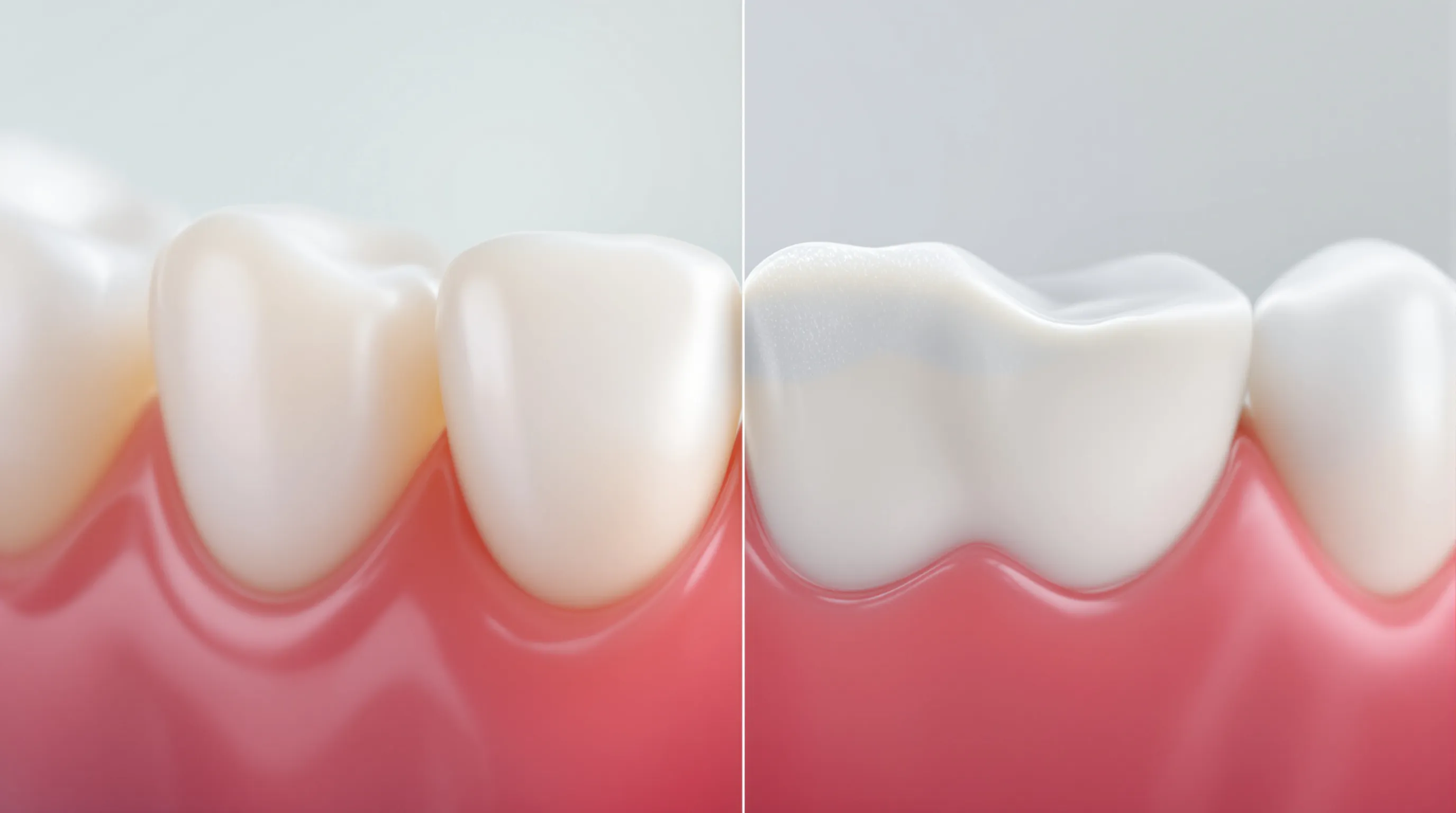
Before
The Difference the Right Protocol Makes
After
The Common Pattern
A patient arrives with a two-year-old layered zirconia crown on an upper front tooth. The feldspathic porcelain veneer has chipped at the incisal edge, a fragment roughly 2mm across has broken free. The zirconia core underneath is intact and perfectly smooth. The crown itself never "broke" in the conventional sense. But the patient is embarrassed to smile, the bite has shifted, and the exposed zirconia core looks unnaturally white against the adjacent natural teeth. The crown was placed with a conventional cement and no MDP primer.
What Proper Planning Prevents
The same patient, counseled at the time of the original crown: layered zirconia placed with correct airborne-particle abrasion and MDP-primer bonding protocol, plus a custom night guard delivered at the same appointment for her mild grinding habit. Three years on, the crown is intact, the porcelain is polished and beautiful, and she has not thought about it once since it was placed. The material did not change. The protocol and planning did.
What Will Matter Most for Zirconia Crowns in the Next 12 to 24 Months?
The honest answer is that the biggest shift I am watching is not a new material at all. It is the spread of better bonding protocols into more practices. For years, the research on zirconia adhesion has been clear: surface treatment matters enormously, and the practices that reliably prep crowns with airborne particle abrasion and MDP-containing primers see dramatically better retention outcomes. As digital workflows and chairside milling systems become more common, the materials education that travels with them is also improving. I am hopeful that within two years, the gap between best practice and common practice will close significantly.
On the material side, high-translucency multilayer zirconia is getting genuinely good. The newest fifth-generation zirconia materials offer optical properties that come very close to lithium disilicate aesthetically while retaining considerably more fracture resistance. What this means practically is that the old compromise: full-contour for strength, layered for aesthetics, will become less stark. Dentists will have more monolithic options that look beautiful enough for front teeth, which removes the single biggest source of the chipping problem altogether.
I am also watching two developments on the patient side. First, more patients are arriving at consultations already informed: they have done their research, they have read discussions in forums, and they are asking sharper questions about material selection than patients were asking five years ago. That is genuinely good for outcomes. Second, the rise of direct-to-consumer dental monitoring tools means that crown wear and marginal integrity can be tracked over time, which should accelerate how quickly the field notices, and fixes, protocol-related failure patterns. If you are getting a crown in the next year or two, my advice is still the same: ask explicitly about the type of zirconia and the bonding protocol. But I do think the answer you receive will be better-informed than it might have been a few years ago.
Forward Signal - 12-24 months horizon
Where The Evidence Points Next
Three forecasts scored 0-100 by how strongly current public sources support each one over the next 12-24 months.
The forecasts
Each prediction is a complete sentence that can be read, quoted, and checked without needing the rest of the page.
Over the next 12-24 months, more practices and labs will treat crown longevity as a preparation and fit problem, standardizing on parameters like a minimum 0.6mm marginal chamfer depth, at least 1.5mm occlusal reduction, and tighter spacer settings, rather than relying on zirconia's material strength alone to prevent failure.
As same-day zirconia workflows (in-office CAD/CAM scanning and milling) expand, early failure incidents such as chipping, margin gaps, and crowns detaching within months will persist or increase, even as zirconia continues to be marketed as more predictable and durable than materials like e-max.
Dental labs will continue offering standardized 5-year or 7-year zirconia fracture warranties, and more dentists will adopt sliding-scale replacement discounts tied to time in service, shifting how the cost of early crown failure is split between patients, dentists, and labs.
Weak signals watched: Dental Economics detail on specific zirconia prep tolerances (0.6mm chamfer minimum, 1.5mm+ occlusal reduction, spacer settings as loose as 500 microns versus an ideal of a few microns) alongside a retention technique of roughening the prep surface before cementation. A reported case of 5 of 6 zirconia crowns failing within the first 6 months of placement, and a separate case where a digital scan that missed part of the tooth still proceeded to lab production despite being flagged as outside normal margins. Reddit dental practitioner discussion describing lab-provided zirconia fracture warranties of 5 or 7 years and sliding-scale patient discount schedules (e.g., year 1 free, year 2 at 20%, year 3 at 40%) alongside typical crown replacement costs around $600 against an original $1,000 crown.
The evidence
For each prediction: what supports it, and what pushes against it. Both sides are shown for every forecast.
- Why are some zirconia crowns failing? - Dental Economics supports this forecast. [Industry Publication]
- Improving Retention of Zirconia Crown Preparations supports this forecast. [Video]
- Cracked Crown Repair: Everything You Need to Know - Trident Dental supports this forecast. [Industry Publication]
- How long do modern crowns last? is the clearest counter-signal. [Community / Forum]
- 5 out of 6 Zirconia crowns broke in first 6 months!! supports this forecast. [Community / Forum]
- Zirconia crown reshaping supports this forecast. [Community / Forum]
- HOW TO Remove OLD ZIRCONIA Crowns | Ep 1 supports this forecast. [Video]
- Who else thinks zirconia is so much more predictable than e-max? is the clearest counter-signal. [Community / Forum]
- How Long Do Dental Crowns Last In Hayward? Signs It's Time To is the clearest counter-signal. [Industry Publication]
- How do you handle a crown that failed in less than 5 years? supports this forecast. [Community / Forum]
- How Long Do Dental Crowns Last In Hayward? Signs It's Time To supports this forecast. [Industry Publication]
- How long do modern crowns last? is the clearest counter-signal. [Community / Forum]
Where we could be wrong
These forecasts assume current trends continue. The scenarios below would meaningfully change them.
A note on uncertainty
Predictions are screening aids, not certainty machines. The strongest signal here (75/100) still has counter-evidence, and the contrarian signal (64/100) reflects real disagreement among sources.
- If regulators or buyers move in the opposite direction, Preparation and cementation tolerances become the primary failure lever would weaken first.
- If the source mix shifts toward stronger contrary evidence, Same-day CAD/CAM production may raise early-failure risk despite zirconia's strength reputation could become the more durable forecast.
10-25%
of layered zirconia crowns show porcelain chipping within five years, a complication rate that meets or exceeds that of older PFM crowns in multiple clinical studies, despite zirconia's superior core strength.
Full-Contour Zirconia: No Chipping Problem, Different Trade-Off
Knowing what we know about veneering porcelain chipping, the natural question is: what about monolithic, full-contour zirconia with no porcelain layer at all? If chipping is the main problem with layered zirconia, why doesn't everyone just use full-contour zirconia all the time? It is a fair question, and the answer reveals why material selection in dentistry is never quite as simple as "use the strongest option."
Full-contour zirconia crowns are genuinely excellent for back teeth. No veneering layer means no chipping problem. Fracture resistance is outstanding, core fracture rates below 2% in long-term studies. As one well-regarded clinician described it, monolithic zirconia is among the best materials available for second molars, "beaten only by gold crowns." CAD/CAM fabrication allows for precise fit. The material handles the heavy biting forces that premolars and molars experience every day. For posterior restorations in patients without severe bruxism, monolithic zirconia is often the best available choice. I use it in my practice for back-tooth cases with great confidence.
But full-contour zirconia brings a notable complication: it is hard on opposing natural teeth. Standard feldspathic porcelain, the material in the veneering layer of layered zirconia and in older crown designs, wears against natural enamel in a way that roughly mimics how enamel meets enamel. Monolithic zirconia does not. Studies have documented measurable wear on opposing natural teeth when they meet against full-contour zirconia over time. The critical variable here is surface finish. A properly polished full-contour zirconia crown is substantially less abrasive than a glazed one, because glazing (a fired surface coating) can actually create a harder, rougher surface than careful mechanical polishing. As one experienced clinician noted: "polished zirconia is very friendly to gingival tissue and bacteria slide right off of it", the same logic applies to how polished zirconia treats the opposing enamel. This is one reason why the quality and attention of the dental laboratory matters enormously.
The aesthetic factor also plays a role. Even with newer high-translucency zirconia formulations, full-contour material is less translucent than layered alternatives for most patients with natural teeth adjacent to the crown. This makes monolithic less than ideal for high-aesthetic anterior cases. Some newer ultra-translucent zirconia grades have improved considerably, but most anterior aesthetic cases in standard practice still rely on layered design, which brings back the veneering porcelain vulnerability. Right material for the right tooth is never a cliché in dentistry. It is the whole conversation.
Why Tooth Location Changes the Entire Zirconia Conversation
When someone tells you "zirconia is better," the most useful follow-up question you can ask is: better for which tooth? Because the research, the aesthetics, and the failure modes all shift significantly depending on where in your mouth the crown is going. This is exactly the kind of nuance that gets lost in the shorthand of dental marketing, and patients genuinely deserve a clearer picture before they consent to treatment.
For back teeth, premolars and molars, monolithic zirconia is frequently the superior option. These teeth bear the heaviest chewing forces. Aesthetics matter far less because they are rarely visible during normal conversation. The strength of full-contour zirconia is genuinely relevant here, and the opposing-tooth wear concern is manageable with proper polishing protocols and regular monitoring. If your dentist recommends monolithic zirconia for a molar, that recommendation has solid clinical backing behind it.
For front teeth, incisors and canines, the calculus shifts entirely. These teeth show when you smile, when you talk, when you laugh. Natural teeth have a depth and translucency that standard monolithic zirconia does not replicate well for most patients. So most anterior zirconia crowns use the layered design for aesthetics, which is reasonable and often the right call. But it means you should know, going in, that a porcelain layer with a 10 to 25% chipping rate over five years is part of the material, and that the bonding protocol your dentist uses matters enormously for long-term success.
Bruxism: teeth grinding, often during sleep, throws an additional variable into this that I have frank conversations with patients about every single week. One patient who experienced multiple crown failures in quick succession noted that a dentist had told him he didn't need a night guard with zirconia, because "they never break." Well, that dentist could not have been more wrong! Grinding against layered zirconia accelerates porcelain chipping. Grinding against monolithic zirconia accelerates opposing tooth wear. In my practice, a night guard is a non-negotiable part of any crown treatment plan for a patient who grinds.
The questions worth asking before any crown placement are not just "is it zirconia?" but: "Is it monolithic or layered? What bonding protocol will you use? And have you assessed my bite and grinding habits?" Those three answers determine whether your crown lasts two years or twenty. That is the conversation I wish every patient could have before treatment begins.
Key Takeaways
Key Takeaways
- Zirconia crown cores rarely fracture, clinical data shows under 3% fracture rates at five years. The "unbreakable" reputation is warranted for this specific thing.
- Layered zirconia crowns (used on front teeth for aesthetics) have a porcelain veneering chipping rate of 10-25% at five years, often higher than PFM crowns they replaced.
- Debonding happens when correct adhesive protocol (airborne particle abrasion + MDP primer + resin cement) is skipped. It is a protocol failure, not a material failure.
- Monolithic zirconia eliminates chipping but can wear opposing natural teeth if the crown surface is not mechanically polished.
- Before any crown, ask three questions: monolithic or layered? What bonding protocol? Has my bite and grinding been assessed?
I started practicing dentistry because I genuinely love restoring people's confidence in their smiles: watching a patient see their new crown for the first time, that moment of recognition and relief, never gets old for me. But a crown is only as good as the thought that went into choosing and placing it. Zirconia is a wonderful material. Used correctly, with the right design for the right tooth and the right bonding protocol, it can last many, many years. But the "it's zirconia, it'll be fine" shortcut has consequences, and those consequences show up as chipped porcelain and crowns that have come loose at the most inconvenient moments. If you are considering crown work, I hope this article arms you with the right questions to ask. You deserve that clarity before you say yes to treatment.
Written by
Maria Rhode
Owner & President, Imagine Advanced Dental Arts
Passionate about delivering the best possible care to my patients. From my days in residency to owning a beautiful hi-tech dental office, I never stop learning and advancing myself and now my practice.
Connect on LinkedInThe verdict
How to Choose the Right Crown: A Patient's Decision Guide
The right crown material for your situation comes down to three questions. Work through them in order before agreeing to any treatment plan.
Step 1: Which tooth are we restoring?
- Back tooth (molar or premolar): Monolithic (full-contour) zirconia is usually the best option. Strength is the priority; aesthetics are secondary because back teeth are rarely visible. Ask the laboratory to mechanically polish the crown rather than just glaze it.
- Front tooth (incisor or canine): Aesthetics drive the decision. Layered zirconia or lithium disilicate (e-max) are the common choices. Understand that layered zirconia carries a 10-25% chipping risk at five years and requires a specific adhesive bonding protocol.
Step 2: Do you grind or clench your teeth?
- Yes, or possibly: Every crown material faces greater stress. A night guard is essential and should be part of the treatment plan. Discuss how your parafunctional habit affects the material recommendation before the crown is ordered.
- No: Follow the location-based recommendation above and ensure routine monitoring at hygiene visits.
Step 3: What bonding protocol will your dentist use?
- For any zirconia crown, ask specifically: "Will you use airborne particle abrasion, an MDP-containing primer, and resin cement?" If the answer is vague, or your dentist plans to use glass ionomer without surface treatment, that significantly increases debonding risk. The bonding protocol matters as much as the crown material itself.
Three answers to three questions. That is what separates a crown that lasts twenty years from one that is back in your hand two years later.
Frequently Asked Questions About Zirconia Crown Failures
Can a zirconia crown chip?
Yes, but it depends entirely on the type. Full-contour (monolithic) zirconia crowns almost never chip because the entire crown is one solid piece of zirconia ceramic with no applied veneer layer. Layered zirconia crowns, which have a feldspathic porcelain coating on the outer surface for aesthetics, chip at rates of 10-25% over five years in clinical studies. If you have been told your crown "can't chip" because it is zirconia, ask specifically whether it is monolithic or layered.
Why did my zirconia crown fall off without breaking?
A crown that comes off without visible fracture is almost always a bonding failure, not a material failure. Zirconia requires a specific adhesive protocol: airborne particle abrasion of the crown interior, an MDP-containing primer, and resin cement. When conventional glass ionomer or zinc phosphate cement is used without proper surface treatment, the bond can fail over time and the crown debonds. The zirconia is typically undamaged and can often be re-cemented using the correct protocol.
Is zirconia really stronger than porcelain?
The zirconia core material is far stronger, 900 to 1,200 megapascals versus 60 to 80 megapascals for feldspathic porcelain. But a "zirconia crown" can mean two very different things: a full-contour crown (all zirconia, genuinely very strong) or a layered crown (zirconia core plus porcelain veneer, where the veneer is the weak component). The marketing claims about zirconia strength are technically accurate about the ceramic material itself, but they can be misleading about the finished layered restoration.
How long should a zirconia crown last?
With the correct material choice for the tooth location, proper bonding protocol, and a night guard for patients who grind, a zirconia crown can last 15 to 20 years or more. Most dental crowns have a general lifespan of 10 to 15 years, with many lasting longer under good conditions. The 10-25% five-year chipping statistic applies specifically to layered zirconia; monolithic zirconia crowns placed on back teeth with proper protocols show much lower complication rates.
What is the difference between monolithic and layered zirconia?
Monolithic (full-contour) zirconia is milled from a single solid block of zirconia ceramic: no layers, no added porcelain overlay. It is extremely strong and resistant to fracture, but less translucent than natural tooth enamel. Layered zirconia has a zirconia core with feldspathic porcelain fired on top for a more lifelike, translucent appearance. Layered is typically used on front teeth for aesthetics; monolithic is preferred for back teeth where strength matters most.
Will a zirconia crown wear down my other teeth?
Full-contour zirconia can wear opposing natural teeth more than other crown materials, particularly when the surface is not properly polished. A mechanically polished monolithic zirconia crown is significantly less abrasive than a glazed one. Layered zirconia with its porcelain veneering surface wears against natural enamel more similarly to how enamel meets enamel. If you are getting a back-tooth crown in full-contour zirconia, ask your dentist specifically about the laboratory's finishing and polishing protocol.
Summarize This Article With AI
Open this article in your preferred AI engine for an instant summary.