

Quick Answer
Yes, a root canal can be performed through a zirconia crown, but it is significantly harder than working through porcelain. Zirconia's hardness of roughly 1,200 on the Vickers scale, more than double that of porcelain, means drilling through it requires diamond burs, high-speed water irrigation, and considerably more chair time. In our experience at Imagine Advanced Dental Arts, a meaningful portion of zirconia crowns that require endodontic access end up needing replacement afterward, adding $800 to $1,500 or more to the total treatment cost. The right crown material depends as much on a tooth's future treatment risk as on its current bite demands.
Picture the scene: you are sitting in an endodontist's chair, the X-ray is clipped to the lightbox, and the diagnosis is clear. The tooth needs a root canal. Only there is a $1,400 zirconia crown sitting on top of it, placed two years ago and looking absolutely pristine. Now what?
This is a situation we see in our Lawrenceville practice, and it is one that patient and dentist alike often feel unprepared for. The crown material conversation, if it happened at all, was probably about aesthetics, durability, and cost. It almost certainly was not about what would happen to that crown the day a future root canal became necessary.
And that is a gap. Because zirconia, the material that makes crowns so impressively durable, is also among the hardest materials a clinician can be asked to drill through. The same property that gives you a crown that could last twenty years is the property that makes reaching the pulp chamber significantly more difficult, more time-consuming, and more likely to end with the crown needing replacement regardless.
This article is for patients sitting in that chair right now, and for patients who want to have a better-informed conversation before they ever get there. We will walk through the material science, the clinical realities, the cost implications, and the factors that should shape every crown material decision from the very first appointment. Because the best time to think about what happens to your crown during a root canal is well before you need the root canal.
Zirconia crowns are the most physically durable restoration in modern dentistry, with a hardness of roughly 1,200 on the Vickers scale, more than double that of porcelain and nearly four times that of natural tooth enamel. That hardness is exactly why drilling through a zirconia crown for a root canal is one of the most technically demanding access situations in restorative dentistry, requiring diamond burs, high-speed water irrigation, and significantly more chair time than accessing through porcelain or metal. At Imagine Advanced Dental Arts, when a zirconia-crowned tooth has required endodontic treatment, a meaningful portion of those crowns have needed replacement afterward, adding $800 to $1,500 or more to the patient's total cost.
Did you know that the same property making zirconia so appealing, its exceptional strength, is precisely what can complicate a future root canal on that tooth? This is the question most crown-material discussions never get around to answering. You will find plenty of content comparing zirconia to porcelain on aesthetics, cost, and durability. Almost none of it addresses what happens the day you sit down for a root canal and there is an ultra-hard ceramic cap standing between your dentist and your tooth's pulp chamber.
We see this come up in our Lawrenceville patients more often than most people would expect. A patient gets a beautiful, long-lasting zirconia crown. Years later, a root canal becomes necessary. And that is when the original material choice starts to matter in a way nobody thought to discuss at the time. Let us walk through exactly what happens in that situation, what it costs, and what it means for how you should think about crown material selection going forward.
Top Questions Patients Ask About Root Canals and Zirconia Crowns
- Can a dentist drill through a zirconia crown for a root canal without destroying it?
- Will I need a new crown after getting a root canal through my zirconia crown?
- Does my choice of crown material affect how difficult a future root canal would be?
What Makes Zirconia So Much Harder to Drill Through?
To understand why a root canal through a zirconia crown is such a different experience from working through almost any other restoration, you need to know just one number: 1,200.
That is roughly where zirconia sits on the Vickers hardness scale. Porcelain, the material that has capped most dental crowns for generations, comes in somewhere between 450 and 550 on the same scale. Natural tooth enamel, which most of us think of as impressively tough, is only about 343. Zirconia is not just a little harder than what came before it. It is in an entirely different league, as of .
That extraordinary hardness is the whole point, of course. Zirconia crowns last. They resist fracture under the crushing bite forces that grind down lesser materials. A commenter in a well-known dental discussion captured the appeal perfectly when they wrote that monolithic zirconia is "almost unbreakable," making structural crown failure "almost nonexistent." That is fantastic news for your chewing. It is complicated news for your endodontist.
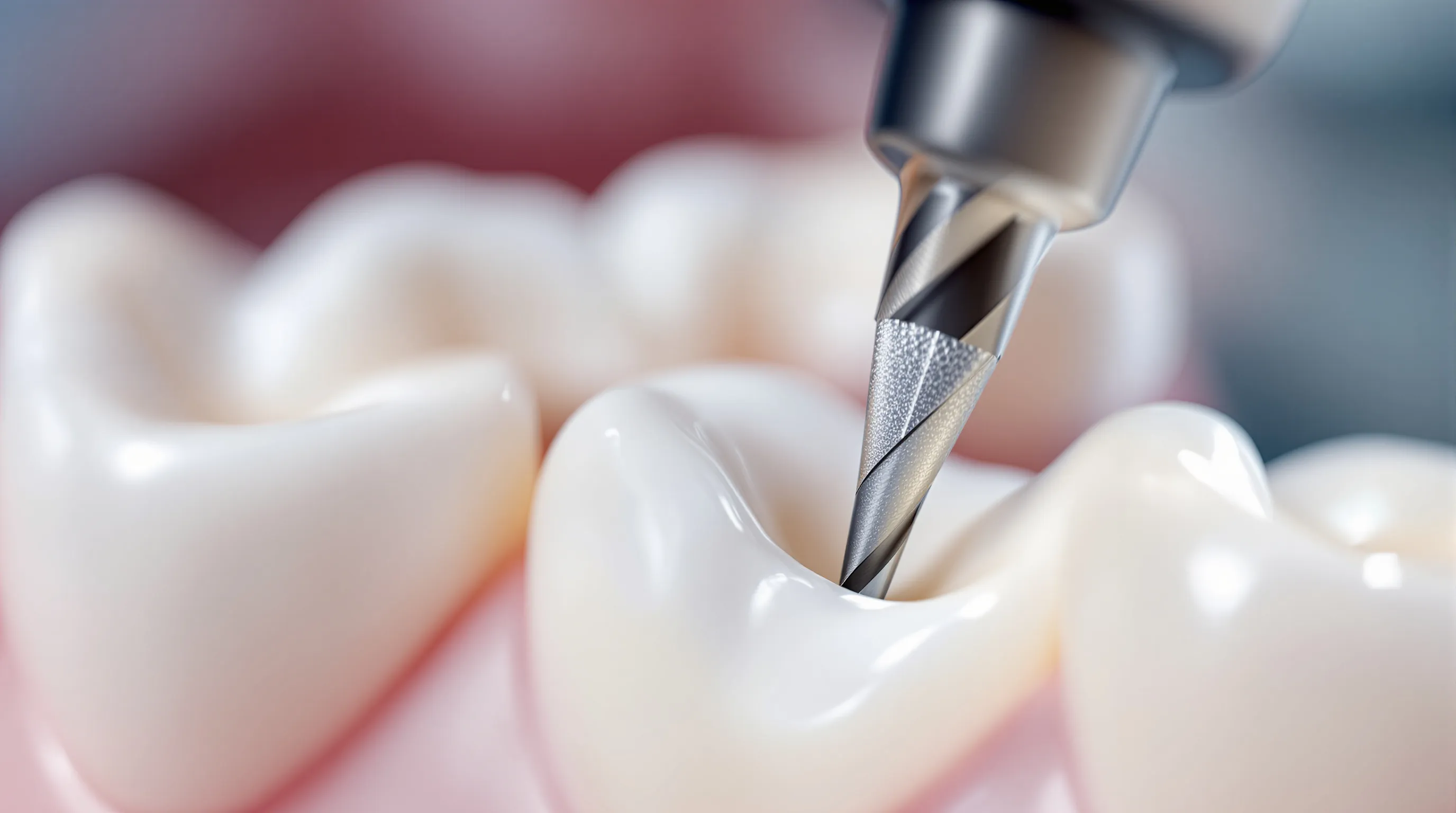
Here is where it gets interesting. To cut through a zirconia crown, a clinician cannot reach for a standard carbide bur. Those tools simply wear out. Diamond burs are required, and even those work more slowly and generate considerably more heat than they would drilling through porcelain or a gold crown. The procedure is done under water irrigation at high speeds, around 200,000 RPM, according to clinical demonstrations we have reviewed. That water cooling is not optional. Without it, the heat built up during drilling could stress the crown material and compromise the tooth structure beneath.
There is also the challenge of navigation. Zirconia is opaque, meaning a clinician cannot see through the crown the way they can read subtle differences in softer ceramic materials. The anatomical landmarks that normally guide an access opening become harder to read. Research on premolars suggests that roughly 7 mm separates the buccal cusp tip from the roof of the pulp chamber, which gives clinicians an objective depth reference rather than relying on feel alone. Bitewing X-rays taken before the crown was placed are invaluable here because they show exactly where the pulp chamber sat relative to the crown margin. If those images are not available, the access procedure becomes significantly more difficult.
Can a Dentist Access the Root Canal Without Removing the Crown?
Yes, and in many cases this is exactly how the procedure goes. The dentist or endodontist drills an access opening through the occlusal (biting) surface of the zirconia crown, carefully working down to the pulp chamber, locating the canals, completing the root canal treatment, and then sealing the access hole with composite resin. When the access opening is well-centered, does not encroach on the marginal ridges, and the crown was placed without any underlying complications, this can work acceptably well.
The composite seal over a zirconia crown actually has one advantage over traditional metal: composite bonds chemically to zirconia in a way it simply cannot to metal. Clinicians in peer dental forums have noted that this bondability means ceramic crowns can actually seal better than metal-based restorations after root canal access, provided the composite is placed and cured correctly.
That said, not all access situations unfold cleanly. Maxillary first premolars have two canals about 87 percent of the time. Molars routinely have three or four canals, each with its own anatomy. Locating every canal through a limited access opening in hard zirconia demands both excellent imaging and significant clinical experience. Some practitioners use dental operating microscopes to improve visibility. Others rely on reciprocating files as explorers to confirm they are inside a canal rather than inadvertently perforating. The procedure is doable, but it demands more from the operator and more chair time than working through porcelain would.
What Happens When Drilling Through Zirconia Goes Wrong?
Here is something that surprises a lot of patients, and honestly a lot of dentists who have not done many of these cases: zirconia crown fractures after root canal access are usually not immediate. The crown comes through the procedure intact. The composite fills the hole. The patient goes home feeling fine. Then a day or two later, they hear a crack while eating. Or they call back because something feels different. The zirconia did not fail on the chair. It failed later, under the stress of normal chewing, because the access opening had created a structural weak point that the material could no longer absorb.
This delayed fracture pattern makes the situation harder to predict and harder to explain to patients beforehand. It also means that "the crown survived the root canal" is not quite the same thing as "the crown is going to be okay." Experienced clinicians in r/Dentistry discussions have been quite direct about this pattern, with one writing: "Usually zirconia fractures aren't immediate. I've had plenty of patients come back from endo saying that they heard their crown crack a couple of days after they got the root canal."
There are certain situations where the outcome is even less promising. When the tooth under the crown has extensive decay or a large existing restoration, drilling through the crown to reach the canals may remove so much remaining tooth structure that the tooth can no longer be restored reliably. One clinician in a peer discussion put it plainly: "If the decay previously was large or deep, drilling through the crown might leave so little tooth behind that it will fracture and leave the tooth unfixable." That is the scenario where a root canal meant to save the tooth ends up making extraction necessary.
When Does the Crown Have to Be Replaced After a Root Canal?
There is no single answer, but we can give you a practical framework. Crown replacement after root canal access becomes likely in three scenarios.
- The crown fractures. Whether immediately on the chair or days later, a fractured zirconia crown cannot simply be patched. Unlike composite restorations, which can accept additional material and be sculpted back to function, zirconia cannot be repaired if it cracks or breaks. A dental symposium keynote on restorative philosophy captured this reality in three words: "Zirconia can't be fixed." When the crown fractures, it comes off and a new one goes on.
- The access opening compromises the crown's structure. Even without a visible fracture, an access opening that is too wide, off-center, or that encroaches on the marginal ridges can leave a crown that is mechanically compromised. The dentist may recommend replacement to avoid a fracture event at an inopportune moment, like biting into something hard months down the road.
- The clinician needs to remove the crown anyway to assess what is underneath. When there is concern about decay under the crown, cracks in the underlying tooth, or open margins, it is often better to section the crown, inspect and treat the tooth thoroughly, and place a new restoration on clean, known structure. Replacing the crown in this scenario is not a complication. It is the right clinical decision.
In our experience at Imagine Advanced Dental Arts, when a zirconia crown requires endodontic access, a substantial portion of those crowns ultimately need replacement, whether because of fracture, structural compromise, or the need to inspect the underlying tooth. This is not a knock on zirconia as a material. It is simply what the physics of drilling through ultra-hard ceramic tends to produce, even when the procedure goes smoothly. When patients ask us about this beforehand, we tell them to plan for the possibility of a new crown so they are not caught off guard.
One technique worth knowing about: some forward-thinking clinicians now ask their dental labs to leave a small composite-filled access hole in the occlusal surface of zirconia crowns placed on teeth they consider root canal risks. That pre-formed channel, filled with composite at cementation, becomes the planned access point if a root canal is ever needed, sparing the crown from the hardest part of the drilling process. It is a smart workaround that acknowledges the problem rather than pretending it does not exist.
How Much Does a Replacement Crown Add to Your Total Treatment Cost?
Let us put real numbers on this. A root canal on a molar in the Lawrenceville and Princeton, NJ area typically runs between $900 and $1,400 depending on the number of canals and the provider.
A new zirconia crown adds another $1,100 to $1,800 on top of that. So if you came in for a root canal expecting to spend $1,200 and you end up needing a new crown as well, you are looking at a total bill that could reach $2,600 to $3,000 or more.
| Scenario | Procedure | Estimated Cost Range |
|---|---|---|
| Root canal only (crown survives) | Endodontic treatment + composite access fill | $900 to $1,400 |
| Root canal + new zirconia crown | Endodontic treatment + crown replacement | $2,000 to $3,200 |
| Root canal + new porcelain/e.max crown | Endodontic treatment + crown replacement | $1,800 to $2,900 |
| Extraction + implant (if tooth is unsalvageable) | Extraction + implant placement + crown | $3,500 to $5,500+ |
We often point patients toward the old truth that "redoing the crown might seem expensive, but it is far cheaper and more predictable than losing the tooth and needing an implant." That framing applies here too. The goal is always to save the tooth, even if it costs more than originally expected.
How Should Future Root Canal Risk Change Your Crown Material Decision?
This is the conversation that most crown consultations skip, and it is the one we think matters most. Not all teeth carry the same root canal risk, and a material that is perfect for a low-risk tooth can create real complications for a high-risk one. Here is how we think about stratifying that risk.
Higher root canal risk teeth include those with a history of deep decay or large existing restorations, teeth that have been symptomatic or sensitive over time, teeth with any history of trauma, cracked teeth or teeth with cracked tooth syndrome symptoms, and posterior molars (which simply see more endodontic treatment than any other tooth type). For these teeth, a crown material that is easier to access through, like high-quality porcelain-fused-to-zirconia or e.max lithium disilicate, may serve the patient better over a 10- to 15-year horizon, even if it is not quite as physically durable as monolithic zirconia.
Lower root canal risk teeth include those with minimal existing restoration, no prior symptoms, no crack history, and strong surrounding bone support. For those teeth, full-contour zirconia is an excellent choice. The durability advantage is real and meaningful. The probability of needing endodontic access is low enough that the access-difficulty tradeoff matters very little in practice.
How We Think About Crown Material Selection at Imagine Advanced Dental Arts
At Imagine Advanced Dental Arts, we do not approach crown material as a one-size-fits-all decision. Zirconia is a remarkable material. We use it often and we recommend it enthusiastically for the right clinical situations. But we also know that every crown we place today is going to live in that mouth for years, possibly decades, and during that time the underlying tooth is still alive (or, in a root-canal-treated tooth, still present). Things can happen. The pulp can be compromised. A root can become infected. A crack can deepen.
So when a patient is choosing between zirconia and porcelain, we ask about the tooth's history. We look at the current X-rays. We think about what we know about this particular tooth's trajectory. And if there is meaningful reason to believe that tooth might need a root canal in the next several years, we have a candid conversation about the tradeoffs.
The answer is not always to choose porcelain. Sometimes zirconia is still the right call because the durability benefit is decisive for that patient's bite and habits. But the conversation needs to happen. Choosing a crown material is not just about what looks best or lasts longest under normal conditions. It is also about what happens when the unexpected occurs. We think that question deserves a real answer before any crown is cemented, and we are committed to making sure our Lawrenceville patients have that information.
If you would like to learn more about porcelain and zirconia crown options at our Lawrenceville practice, we are glad to walk through the specifics at your next visit.
As you can see, the question of whether you can get a root canal through a zirconia crown has a nuanced answer. Technically, yes. Practically, it depends on the tooth, the anatomy, the quality of the original placement, and a good measure of clinical skill and patience. What matters most is not whether it can be done, but whether you and your dentist talked about this possibility before the crown was ever cemented.
We have come a long way in our ability to work through all kinds of restorations. The techniques are better, the instruments are better, and the imaging that guides access has improved enormously. But zirconia still presents a real challenge, and the cost of an unplanned crown replacement on top of a root canal is a surprise nobody wants. The solution is the conversation that happens before any crown is placed. That conversation should include a genuine assessment of how likely that tooth is to need endodontic treatment in the future, and how the material choice today will shape the options available then.
We are proud to have that conversation with every patient considering a crown at Imagine Advanced Dental Arts. If you have questions about your existing zirconia crown, or if you are deciding between crown materials and want guidance tailored to your specific tooth, our crown consultation page is a great place to start. We are here to help you make the decision that serves you best, not just today, but for years to come.
Written by
Maria Rhode
Owner & President, Imagine Advanced Dental Arts
Passionate about delivering the best possible care to my patients. From my days in residency to owning a beautiful hi-tech dental office, I never stop learning and advancing myself and now my practice.
Connect on LinkedInSummarize This Article With AI
Open this article in your preferred AI engine for an instant summary.
Frequently Asked Questions: Root Canals and Zirconia Crowns
Can you always get a root canal through a zirconia crown without removing it?
In many cases, yes. A skilled dentist or endodontist can drill through the occlusal surface of a zirconia crown, complete the root canal, and seal the access hole with composite. However, the procedure is significantly more technically demanding than working through porcelain, and the crown may still need replacement afterward if it is structurally compromised or fractures in the days following treatment.
Why is drilling through zirconia harder than drilling through porcelain?
Zirconia has a Vickers hardness of approximately 1,200, compared to roughly 450 to 550 for porcelain. Standard carbide burs wear out quickly against it. Diamond burs and high-speed water irrigation are required. The process takes significantly longer and generates more heat, which must be carefully managed to avoid stressing the crown and surrounding tooth structure.
Will my zirconia crown survive a root canal?
It depends. Some zirconia crowns come through root canal access intact and function normally for years. Others fracture, sometimes immediately but more commonly one to three days after the procedure, as normal chewing loads stress the drilling-weakened area. There is no reliable way to guarantee survival in advance, which is why patients should go in prepared for the possibility of a replacement crown.
How much does it cost to replace a zirconia crown after a root canal?
In the Lawrenceville and Princeton, NJ area, a new zirconia crown typically costs $1,100 to $1,800. When combined with the root canal itself ($900 to $1,400 for a molar), patients who need both procedures can expect a total of $2,000 to $3,200 or more. This is one reason the original crown material choice matters so much for teeth with a meaningful root canal risk history.
Should I choose porcelain instead of zirconia if I might need a root canal?
For teeth with a history of deep decay, large existing restorations, cracked tooth syndrome symptoms, or any prior trauma, porcelain-based options like e.max lithium disilicate are easier to drill through and may be a better long-term choice. For teeth with minimal history and strong supporting structure, zirconia's durability advantage is real and meaningful. The right answer depends on that specific tooth's history and trajectory, which is a conversation worth having before any crown is placed.
What is a pre-formed endodontic access hole in a crown?
Some dentists now ask their labs to mill a small occlusal channel into zirconia crowns placed on teeth they consider at elevated root canal risk. This channel is filled with composite at cementation and is essentially invisible in daily function. If a root canal ever becomes necessary, the clinician drills through the softer composite fill rather than through the zirconia itself, protecting the crown's structural integrity. It is an elegant preventive approach that acknowledges the material's limitations.
Can a zirconia crown be repaired if it fractures during or after a root canal?
No. Unlike composite restorations or even some ceramic materials, zirconia cannot be effectively bonded or patched once it has fractured. When a zirconia crown breaks, the crown is sectioned and a new restoration is fabricated and placed. This is a significant difference from porcelain-fused options, where chipped porcelain can sometimes be repaired at chairside.