

Quick Answer
Clear ceramic bracket braces suit New Jersey adults whose teeth need constant force, rotation or up-and-down movement, or who will not wear trays all day; clear aligners win on near-invisibility and easier cleaning.
Choose wrong and the calendar stretches. Aligners only move teeth while they are in your mouth. Some moves still need small bonded buttons. Brackets never come out, which is exactly why a Lawrenceville adult with a tricky bite or a hectic schedule often finishes on time with them, while a disciplined tray wearer gets the quieter look.
Key Points
- Hosts of The Informed Patient Podcast said aligners only work if worn 20 to 22 hours a day, calling noncompliance the number one reason treatment fails or runs long.
- A Blue Sky Bio clinical video explains that aligners need bonded buttons to move teeth up or down, while ceramic brackets give the wire a grip on every tooth all day.
- A 2012 study presented at the American Association for Dental Research meeting found conventional braces needed 2.4 months longer treatment and about 2.6 more visits than Invisalign.
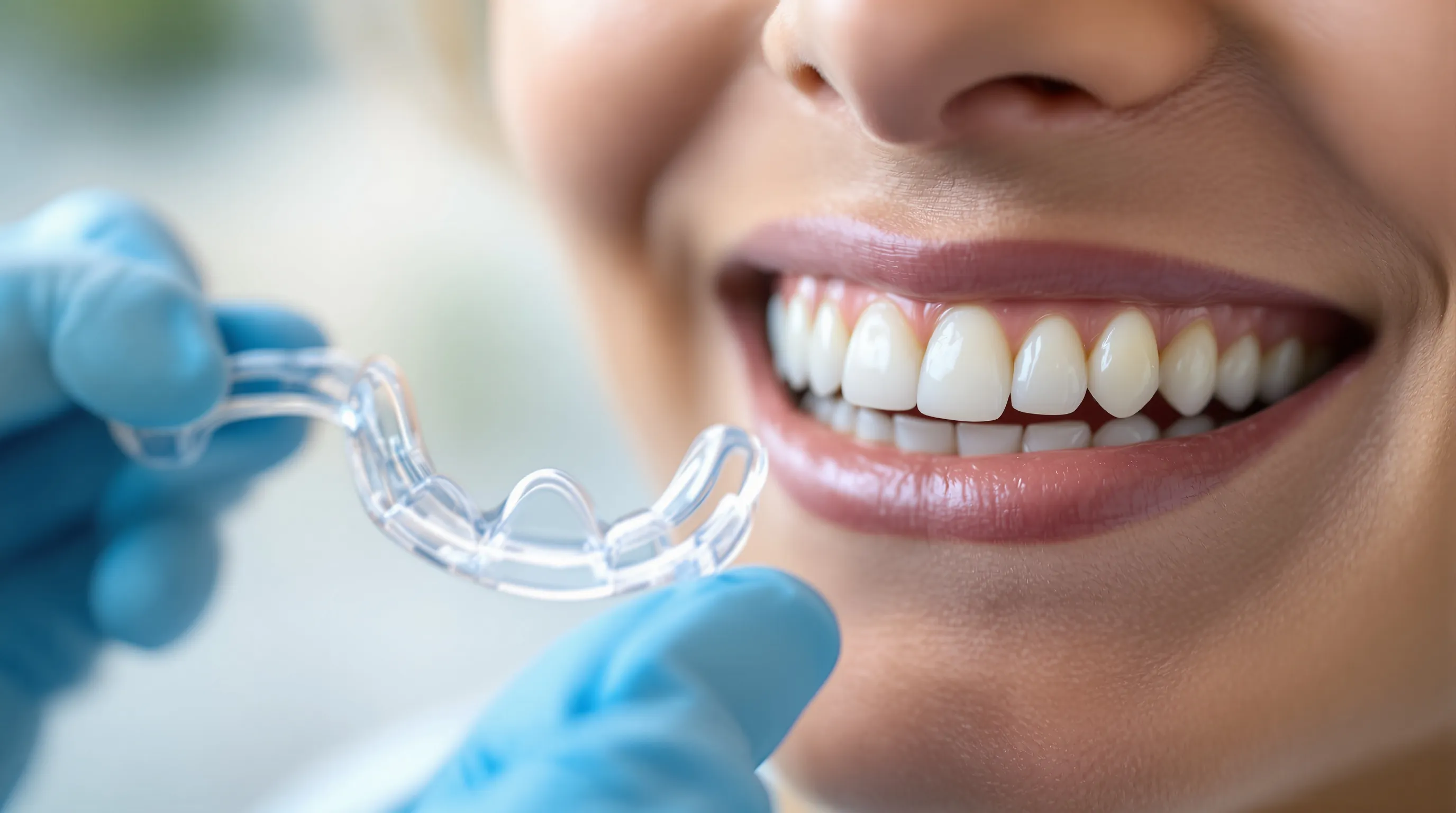
Ceramic brackets or clear trays? The right pick depends on the bite and the daily routine.
Look for one that handles family checkups and adult straightening under one roof, because teeth naturally shift with age and that drift can quietly harm oral health and confidence.
Did you know your smile keeps moving long after your teenage braces came off? The American Association of Orthodontists warns that teeth naturally shift with age. Misaligned teeth can lead to excessive and uneven enamel wear, decay and gum disease. That is a health problem, not just a vanity one! So the parent who books a child's cleaning in Lawrenceville often ends up asking about their own crowded front teeth before the visit is over.
That is exactly why a family dental home matters so much here. At Imagine Advanced Dental Arts, family and general dentistry, ClearCorrect clear aligners and cosmetic care all live in one Lawrenceville office, so parents and kids keep one familiar team while the grown-ups weigh their straightening options.
Picking the office is step one. Picking the appliance is trickier. When aligners do the work, some movements, like nudging a tooth up into the gum or drawing it down, require small bonded buttons on the tooth to give the tray something to grip. Brackets carry those moves on the wire itself.
And what about the other question Mercer County patients type into search bars: who are the best cosmetic dentists in Lawrenceville? Well, star ratings only go so far. The real test is how a team handles adult bites like yours, case by case, starting with the cases below.
Picture a Princeton commuter on a Monday morning train, grinning at a client over coffee, with a full set of braces that almost nobody notices. Did you know that scene is completely ordinary now? The American Association of Orthodontists, a group of over 19,000 orthodontist members, reported in 2018 that 1 in 3 orthodontic patients were adults. Grown-ups have been quietly kicking butt in the orthodontist's chair for years!
The tools have changed far more than the patients. As of April 2021, one market analysis counted about 20 million malocclusion cases started per year, roughly 80% of them treated with wires and brackets. Clear trays were the fast-growing challenger. Brackets were the workhorse.
For an adult in Mercer County, that leaves a real fork in the road. Tooth-colored ceramic brackets sit on the front of each tooth with a wire running through them, so ask to see a sample bracket held against your own enamel before you decide. Clear aligners come out for meals and meetings, but they only push where the plastic can grip. Some movements, like rotating round teeth or raising and sinking teeth, need extra bonded bumps before a tray can manage them at all.
Neither choice is wrong. The most useful question to bring to a consultation is which movements your own bite needs, because that list, more than looks, narrows the choice.
Questions this article answers
Top 3 questions this guide answers
- When do clear ceramic bracket braces beat aligners?
- Have clear aligners really replaced bracket braces for adults?
- Why are New Jersey adults weighing clear brackets against aligners?
Each answer starts with your bite, then your habits. Looks come third!
Why are so many New Jersey adults weighing clear brackets against aligners right now?
Imagine Advanced Dental Arts, rated 4.9 from 587 Google reviews, helps Lawrenceville adults choose between tooth-colored bracket braces and clear aligners by matching each option to the case and the daily routine.
Before you fall in love with either one, answer these four questions honestly:
- Does your bite need big rotations or up-and-down tooth movement, or only mild straightening?
- Will you really keep removable trays in your mouth nearly all day, every single day?
- How much would a visible appliance bother you at work, on video calls or in photos?
- Can you keep brackets spotless through a long day of coffee, snacks and meals?
Hold on to those answers. They decide more than any brochure does!
The Informed Patient Podcast put the choice beautifully in a January 2026 episode on adult orthodontics. The hosts described it as "maximum force and certainty versus, let's say, maximum discretion and flexibility." They counted "about four main paths today": metal braces, ceramic braces with tooth-colored or clear brackets, lingual braces hidden behind the teeth, and clear aligners. For most adults who care about appearance, the real contest narrows to two of those four. Ceramic brackets on one side. Clear trays on the other.
Here is where a stubborn myth needs retiring. The common assumption is that braces belong to awkward middle schoolers, and that grown-ups missed their chance. Well, that idea could not have been more wrong! The same hosts stress that there is no age limit, reporting "successful treatments for people in their 60s and 70s," and they add that treatment is "driven by the health of the bone that supports your teeth, not your calendar age." Healthy gums and teeth matter. Birthdays do not.
Bring your four answers to the consultation and ask which one changes the recommendation for your bite, because a careful team weighs your habits right alongside your teeth. That is why we treat straightening as part of the whole smile. Our practice brings DMD and residency training with honors in prosthodontics and oral reconstruction, so we think about how moved teeth will support future crowns, bridges or a balanced bite. We are also certified in BOTOX Cosmetic and dermal fillers, which keeps our eyes on how teeth frame the whole face, not just how they line up on a model.
So what does that mean for you? Your choice is personal. It is also clinical.
If you are driving in from a nearby town, our guide to choosing a dentist near West Windsor is a helpful first stop, since the provider matters as much as the appliance. And once you know who will guide you, the next question is how adults ever got from clunky metal wires to trays you can barely see, a story with some truly amazing turns.
Have clear aligners really replaced bracket braces for adults?
Not even close! Brackets still carry a big share of cases, and after forty-two years in the same Lawrenceville office, most of our cases finish here rather than moving between specialists.
Let's look at how we got here, because the story is a lot more surprising than the ads suggest.
Picture a patient a century ago, sitting still while small metal squares were fixed to the fronts of the teeth, each one holding a wire that slowly coaxed the smile into line. On the Care Experts with CareCredit podcast in October 2024, a veteran orthodontist explained that traditional braces have been around for over 125 years, and they still work. Same basic idea. Same steady pull.
In the year 1985, that same orthodontist first placed lingual braces, the hidden kind bonded behind the teeth. Who wanted them? News anchors and stage actors, mostly, people whose faces were their livelihood. Though they were about twice as hard to work on, they were the only truly hidden option of the day! Then clear trays arrived, with Invisalign launching in 1999, and adults finally had a removable choice.
So you would expect brackets to be fading into history by now. Well, they are not. Contrary to the headlines, the orthodontist reported that at least half of all orthodontic patients still get braces as part of their treatment, even since aligners arrived. One orthodontic practice's own adult guide goes further and calls traditional braces the most popular adult option, though that is a single clinic speaking about itself.
Why the staying power? The answer offered on that podcast is refreshingly plain. The number one reason to choose braces is that your doctor recommends them, because some tooth problems respond better to brackets and others to trays. The orthodontist compared it to crossing the country by car or by plane. Both get you there. One may simply suit the trip better.
That is the real tension for adults. Aligners feel modern, and brackets feel old. Yet the bite does not care about trends.
Because our team includes a Diplomate of the American Board of Dental Sleep Medicine (ABDSM), board certified in dental sleep medicine, we never look at tooth position in isolation from the jaw and airway that surround it. And after four decades under one roof, we can follow a case from the first scan to the last retainer check without handing you off. That kind of continuity is worth asking about anywhere, and our guide to choosing a dentist near Plainsboro lays out the other checks worth making before you book.
Which brings us to the question that settles most cases before preference ever enters the room: what kind of movement do your teeth actually need, and can a plastic tray deliver it?
When do clear ceramic bracket braces beat aligners?
Clear ceramic brackets win when round teeth must rotate or teeth must move up or down. At Imagine Advanced Dental Arts, a Practice of the Year winner, that mechanical question comes before looks.
Here is why. A tray can only push where it touches. The American Association of Orthodontists explains that with braces, archwires "fit into the slots in braces and actually move the teeth," while elastics add "extra force to a tooth or teeth in ways that braces alone cannot." Brackets give the wire a handle on every tooth, all day and all night. Aligners, by contrast, are trays the patient puts in and takes out, so the force depends on fit and on wear.
A short clinical explainer video from Blue Sky Bio spells out exactly where trays struggle. Some movements are easy for plastic. Others are not. Here is the split it describes:
- Usually predictable with trays alone: tipping front teeth forward or back, and minor rotations of large, flat front teeth.
- Difficult without help: rotating round teeth such as premolars, canines, upper lateral incisors and lower incisors, which need a bonded bump called a button to act as a lever.
- Require buttons every time: intrusion (sinking a tooth deeper into the bone) and extrusion (drawing a tooth further out of it).
Intrusion is the sneaky one. Blue Sky Bio notes that it needs buttons on a minimum of two to three strong anchor teeth, or the tray will likely pop off the neighbors instead of moving the problem tooth. The video calls these "very sophisticated movements" that demand "much more experience, monitoring, and excellent patient compliance."
What does that mean for you? If your plan is full of rotations and vertical moves, trays become a lot more work. Brackets simply keep pulling.
To be fair to aligners, they have come a long way! One Invisalign-focused orthodontist now says trays can handle deep bites, severe crowding and crossbites once limited to braces, and the AAO lists both braces and aligners for problems like crowding, underbites and open bites. Both camps are right about the easier cases. The disagreement lives in the hard ones.
A candid aside here. None of the evidence we reviewed gives a head-to-head success rate for ceramic brackets against aligners on these tough movements, so nobody should quote you one as settled fact. What the evidence does show is the mechanics, and mechanics are not a matter of opinion.
Ceramic brackets also matter when other dental work is coming. If a crown, bridge or implant is in your future, our guide to choosing between cosmetic and restorative treatments explains how the pieces fit together. And a bite that needs steady, constant force raises the next question, the one that is far too easy to skip: will you really wear the trays?
Which finishes sooner for an adult, ceramic brackets or aligners?
Ask how much faster aligners are and the answer shrinks depending on who is talking. Ask what makes them fast, and even a company selling aligners gives a blunt reply.
Start with the speed claims. On a 2025 podcast, an Atlanta-area orthodontist introduced as a top Invisalign provider and Invisalign lecturer cited a study the guest attributed to the NIH. In that study, cases that typically take about two years in braces finished in about 18 months with aligners.
Align Technology, which makes Invisalign, puts the figure at "five months faster" on average, according to an analysis by the investment newsletter scuttleblurb. The same analysis reports the most independent number we found. A study presented at the 2012 meeting of the American Association for Dental Research measured 2.4 months more treatment with conventional braces, plus about 2.6 more visits.
On average, then, aligners do look faster. The gap gets smaller the further a source is from selling aligners. An average describes a group of patients, though. Your own timeline depends on something no study can do for you: wearing the trays.
"They only work if you wear them 20 to 22 hours a day," the hosts of The Informed Patient Podcast, a dental health show, said in a January 2026 episode. They cited data suggesting noncompliance is "the number one reason clear aligner treatment fails or just takes longer than expected." The American Association of Orthodontists is just as direct about trays: "Patients are responsible for insertion and removal."
2 to 4 hours
Wearing trays 20 to 22 hours a day leaves 2 to 4 hours for every meal, every drink other than plain water, and brushing both your teeth and the trays.
The bluntest version comes from an aligner seller. In a July 2026 explainer video, the host for toothsi, an aligner brand in India, said "Discipline is equal to speed." The host listed too few hours of wear, skipped or lost trays and poor cleaning as mistakes that "can add months to your treatment." Brackets sit on the other side of that ledger. Fixed braces, the podcast hosts said, "require no discipline when it comes to wear time."
Complex cases make that discipline matter more. As the section above explains, rotating round teeth and moving teeth up or down call for bonded buttons. A 2019 instructional video for clinicians from Blue Sky Bio adds the catch: such sophisticated movements "require much more experience, monitoring, and excellent patient compliance." The toothsi host also conceded that "traditional braces are stronger for complex cases" and that aligners suit no one who wants "zero responsibility." So the cases that ask the most of the trays also ask the most of the person wearing them.
Clean teeth come with the same condition. The Atlanta orthodontist said bacteria trapped around brackets can leave enamel scars called white spot lesions, along with plaque and gum inflammation. The same study the guest cited found less plaque, bleeding and inflammation with aligners. An orthodontist interviewed on a CareCredit podcast in 2024 also thought aligners were probably a little better for avoiding stains, scars and cavities, as long as the trays come out for everything except plain water. In that orthodontist's account, even flavored water sipped with trays in can do real harm, and hot drinks can change the plastic. The same orthodontist suggested that forgetful patients who tend to lose things are probably better off in fixed braces.
Line the findings up and the same pattern runs through each one. Every advantage aligners offer, from the shorter average timeline to cleaner gums to trays you can pop out for a big presentation, depends on hours of daily wear and trips to the sink. The toughest tooth movements raise that cost. Brackets bring their own tradeoffs in cleaning and visibility, yet they keep working on your teeth whether you remember them or not. Choosing between the two is really a bet on your own habits and your teeth, and an aligner brand itself warns that a lost bet can cost months.
- Log one ordinary weekday: every meal, snack, coffee and flavored drink. If those hours add up to more than 2 to 4, ask how that would change your timeline in trays.
- Ask which movements your case needs, how many bonded buttons trays would require, and how often your progress would be checked.
- When anyone quotes a speed advantage, us included, ask where the figure comes from and whether it assumes full-time wear.
- Ask what happens if you fall behind: whether extra refinement trays would be added, and how much time that usually costs.
How we checked this
We used three podcasts: one featuring an orthodontist who lectures for Invisalign, one with an orthodontist on a CareCredit show, and a 2026 dental health podcast. We also used an aligner brand's explainer video, a clinician training video, the American Association of Orthodontists' adult treatment page and an investment newsletter's analysis of the aligner market. None of the figures come from our own practice. We read Align's five-month claim and the 2012 AADR results only secondhand through that newsletter, and we could not check the original study. The guest identified the six-month study only as coming from the NIH. The CareCredit interview exists only as a machine transcript, so we paraphrased it. Several sources have a stake: one orthodontist lectures for Invisalign, Align and toothsi sell aligners, and we help adults choose between brackets and aligners. Still unknown: how many adults actually manage 20 to 22 hours a day, and how much time a typical lapse adds. None of our sources measured either.
- The Informed Patient Podcast, episode on adult orthodontia, January 2026.
- Moments with Marianne, interview on braces or clear aligners, November 2025.
- Care Experts with CareCredit, episode comparing aligners and braces, October 2024.
- toothsi by makeO, clear aligner explainer video, July 2026.
- Blue Sky Bio, video on aligner buttons and tooth movement, November 2019.
- American Association of Orthodontists, adult orthodontics page, June 2018.
- scuttleblurb, analysis of Align Technology, September 2025.
So which should a New Jersey adult choose, ceramic brackets or aligners?
Choose ceramic brackets when your bite needs constant force or you doubt your wear habits. Choose aligners when your case is suited to trays and you will truly wear them.
Speed only follows the right fit. A 2012 study presented at the American Association for Dental Research meeting, as summarized in a 2025 scuttleblurb analysis, found conventional braces needed 2.4 months longer treatment than Invisalign. If you lean toward trays, ask how many aligners your plan includes and what happens if you lose one partway through. Ask, too, how your teeth will be held in place once treatment ends, since the American Association of Orthodontists notes that teeth naturally shift with age.
If you lean toward brackets, ask how often you will need adjustment visits and how to keep the clear ties from staining between them. Then bring both sets of answers to a single consultation, so one team can weigh them against your bite.
Think back to that century-old patient with a mouthful of wire. Today an adult can walk into a Lawrenceville office and choose between brackets that nearly match the teeth and trays you can barely see. As you can see, we have come a long way! The next step is simply finding out which one your teeth are asking for.
Summarize This Article With AI
Open this article in your preferred AI engine for an instant summary.
Frequently Asked Questions
What else do New Jersey adults ask about brackets and aligners?
Most questions circle back to office visits, cost, the little attachments on aligners, age, and whether one office can care for the whole family. Here are plain answers.
Do bracket braces mean more trips to the office than aligners?
Usually, yes. A 2012 study presented at a dental research meeting found conventional braces needed about 2.6 more visits and 1.1 more emergency visits than Invisalign. For a busy Princeton commuter juggling meetings and school pickups, those extra trips add up fast!
What does a comprehensive orthodontic case cost?
A 2025 industry analysis put a comprehensive case at $6,000 to $8,000 with an orthodontist. Your own fee depends on what your bite needs. That is why we talk through the plan before anyone talks about price.
What are the little bumps some aligner patients get?
Those are buttons, small attachments bonded to the teeth so the tray has something to push against. They help rotate round teeth such as canines and premolars. They also help the tray snap into place, which matters a lot for adults whose teeth have short crowns.
Is it too late to straighten teeth in your 40s or 50s?
Not at all! Teeth naturally shift as we age, and crooked teeth are harder to clean, so uneven enamel wear can raise the risk of decay and gum disease. Straightening later in life is about health as much as looks.
Does Imagine Advanced Dental Arts treat both adults and children?
Yes. We are a family dental home serving patients across New Jersey with four credentialed dentists. Reach us through our Contact Us page to book a visit, and bring along whoever else in the family has been eyeing their smile in the mirror lately.
Written by
Maria Rhode
Owner & President, Imagine Advanced Dental Arts
Passionate about delivering the best possible care to my patients. From my days in residency to owning a beautiful hi-tech dental office, I never stop learning and advancing myself and now my practice.
Connect on LinkedIn