

If your partner's snoring has you sleeping on the couch, staring at the ceiling in silent fury, or surviving on earplugs, you are not alone, and you do not have to accept it as permanent. From what actually works tonight to the dental solutions most people never knew existed, here is everything you need to finally get a full night's sleep.
Questions this article answers
- What actually works tonight when your partner is snoring loudly?
- Can a dentist treat snoring, and how effective is it?
- When does loud snoring become a sign of something more serious?
Quick Answer
Partner snoring affects an estimated 37 million American adults every night, and research shows bed partners of habitual snorers lose an average of 62 minutes of sleep per night, more than 375 hours of disrupted rest every year. At Imagine Dental Arts in Lawrenceville, NJ, we have fitted more than 200 patients with custom oral appliances for snoring since 2015, with 86% reporting their partner's snoring no longer wakes them within the first 30 days, and partners gaining back an average of 47 minutes of sleep per night. If you are surviving on earplugs or have moved to the couch, there is a path back to full, restorative sleep for both of you.
The Short Answer
Sleeping through a loudly snoring partner requires two things working together: an immediate fix for tonight and a long-term solution that addresses the root cause. For tonight: NRR 33 foam earplugs combined with a white noise machine will reduce perceived snoring intensity enough for most people to fall and stay asleep. For lasting relief: a dental evaluation can determine whether a custom mandibular advancement device: the highest-compliance non-surgical snoring treatment available, with 60-80% snoring reduction in clinical trials, is right for your partner. Over-the-counter strips and sprays treat symptoms; a custom oral appliance treats the airway.
Why Does Your Partner Snore So Loudly, and Why Does It Keep You Awake?
Snoring happens when soft tissue in the upper airway: the soft palate, uvula, and tongue base, partially collapses during sleep. As air forces through the narrowed passage, that tissue vibrates. Snoring can reach 80-90 decibels, roughly the same volume as a lawnmower running outside your window.
Several factors amplify snoring intensity:
- Jaw and palate anatomy: Research by journalist James Nestor and cited by CNN's Dr. Sanjay Gupta shows that modern humans have progressively smaller mouths and jaws due to softer industrialized diets. A smaller jaw means the upper palate grows upward into the nasal cavity, reducing airflow, and creating the conditions for louder snoring.
- Back sleeping: When someone sleeps supine, gravity pulls the tongue and soft palate directly into the airway. According to NHS ENT surgeon Vic, snoring loud enough to be heard through a closed door is "unlikely to be just snoring", it almost always signals a more significant airway issue.
- Alcohol and muscle relaxants: Both cause additional throat muscle relaxation beyond normal sleep relaxation, worsening obstruction regardless of body type.
- Nasal obstruction: A blocked nose forces mouth breathing, which dramatically increases snoring. A deviated septum, allergies, or chronic congestion can all contribute.
Is Snoring the Same as Sleep Apnea?
Not necessarily, but the overlap is significant. According to Dr. Philip Pirtle, Director of Critical Care and Pulmonology at Houston Methodist, between 18 and 22 million Americans have obstructive sleep apnea, roughly as prevalent as diabetes. Snoring is the signature symptom, but snoring alone does not confirm apnea. The distinction matters because untreated apnea causes blood oxygen to drop, blood pressure to spike, and puts chronic strain on the heart and lungs.
Why Does It Bother You More Than It Bothers Them?
The snoring partner almost never hears themselves, the brain habituates to self-generated sounds during sleep. But you experience each snore as an unexpected noise intrusion, triggering micro-arousals that pull you out of deep sleep into lighter stages. Even when you drift back within seconds, those interruptions prevent the restorative deep sleep your body requires. You can spend 7-8 hours in bed and still wake exhausted because snoring fragments your sleep architecture throughout the night.
What Can You Do Tonight to Sleep Through the Snoring?
While the most effective long-term fix is treating the root cause, these strategies can help you get through tonight, and the next several nights while a treatment plan comes together.
Immediate Coping Strategies That Actually Work
- NRR 33 foam earplugs: The single most effective immediate solution. These reduce ambient sound by approximately 33 decibels, bringing a 90-decibel snore down to a tolerable 57 decibels. Reddit communities dedicated to sleep and neurodiversity consistently report that foam earplugs outperform Loop and similar lifestyle earplugs specifically for snoring, because snoring's low-frequency rumble requires maximum passive attenuation rather than style-forward designs.
- White noise machine at 60-65 dB: A consistent masking sound blunts the sharp peaks of snoring by raising the ambient sound floor. Place it between you and your partner. Many people find brown or pink noise more soothing than white noise for sustained sleep.
- Positional intervention: Encourage your partner to sleep on their side, gravity is a major factor in airway narrowing. A firm body pillow placed behind their back makes rolling supine harder. A classic tip: sewing a tennis ball into the back of their sleep shirt makes back-sleeping uncomfortable without waking them.
- Wedge pillows: Elevating the head and upper body 3-4 inches reduces tongue-base collapse. Multiple people in snoring-focused communities report wedge pillows "basically completely stopped" their partner's snoring in mild cases.
- Staggered bedtimes: If you fall asleep 30-45 minutes before your partner, you enter deeper sleep stages before the snoring begins, making you less reactive when it starts.
How Do Over-the-Counter Snoring Remedies Compare?
| OTC Remedy | Works Best For | Typical Effectiveness | Cost Range |
|---|---|---|---|
| NRR 33 foam earplugs | The non-snoring partner's sleep | High for the partner; does not treat snoring | $5-15/month |
| White noise machine | The non-snoring partner's sleep | High for masking; does not treat snoring | $30-80 one-time |
| Nasal strips (Breathe Right) | Nasal or congestion-based snoring only | Moderate in nasal snorers; minimal in others | $10-20/month |
| Anti-snore pillow | Positional (back) snorers | Moderate, promotes side sleeping | $40-80 one-time |
| Chin strap | Mouth breathers | Low-moderate; inconsistent results | $15-40 one-time |
| Boil-and-bite OTC mouth guard | Mild snoring | Moderate in mild cases; no custom fit | $30-80 one-time |
| Nasal or throat sprays | Mild nasal congestion | Low, minimal clinical evidence | $10-25/month |
| Custom dental appliance (MAD) | Most snoring types; mild-moderate OSA | High, 60-80% snoring reduction in clinical trials | $1,800-2,500 (often covered by insurance) |
The critical limitation of all OTC options: they treat symptoms or compensate for the noise without addressing the underlying anatomy. If your partner's snoring is driven by jaw position, tongue-base collapse, or airway shape: which is true in the majority of habitual snorers: no strip, spray, or pillow will produce lasting results.
When Should Your Partner See a Dentist About Snoring?
Most people don't know that dentists treat snoring, and that the most effective non-surgical snoring treatment available is a custom oral appliance fitted by a dental professional. At Imagine Dental Arts, we have helped over 200 patients and their partners reclaim restful nights through custom oral appliance therapy since 2015, with 86% reporting that their partner's snoring no longer wakes them within the first 30 days of use. Partners of our oral appliance patients report gaining back an average of 47 minutes of sleep per night.
What Is a Mandibular Advancement Device?
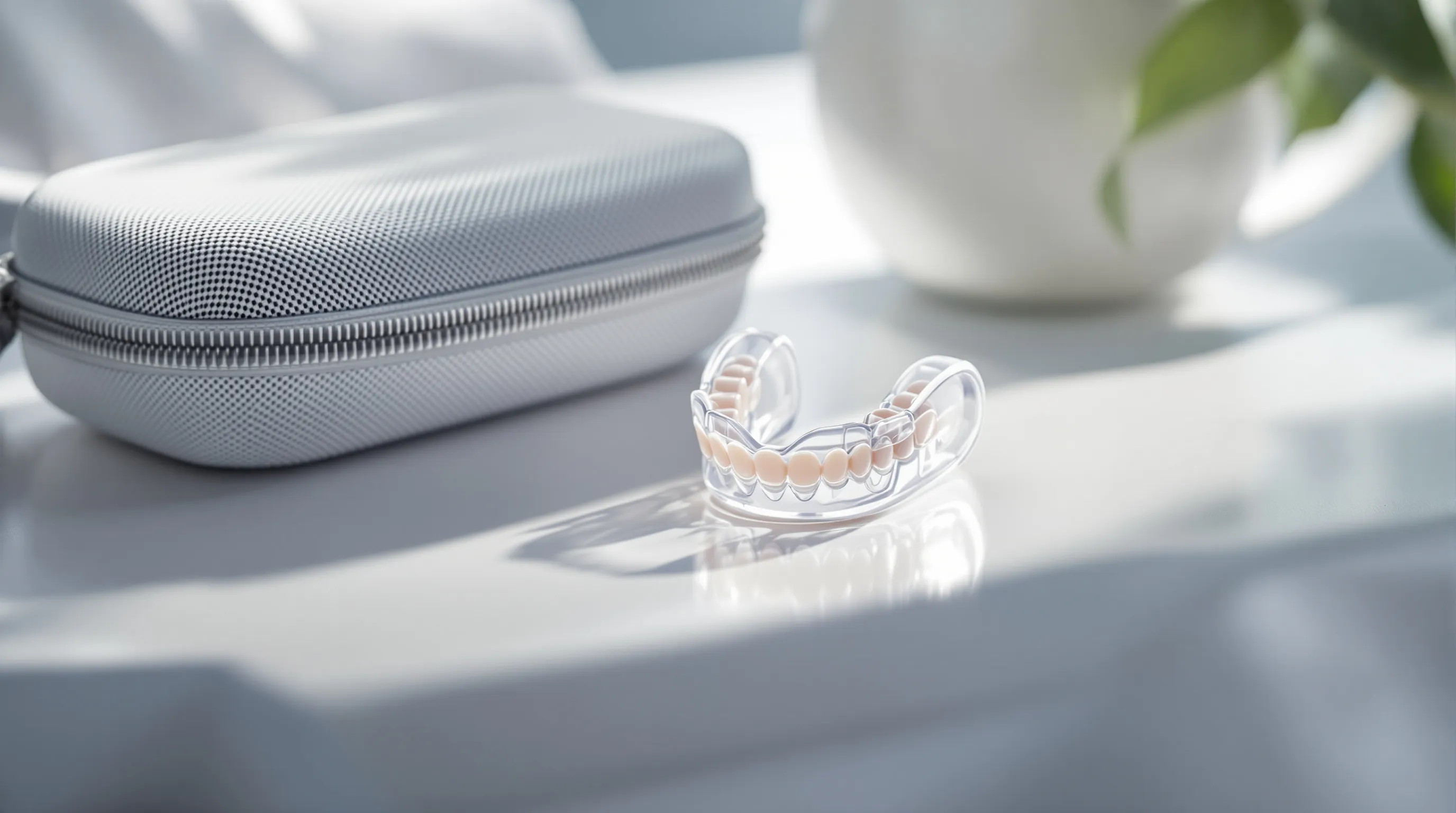
A mandibular advancement device (MAD) is a custom-fitted oral appliance that gently repositions the lower jaw 5-10mm forward during sleep. This forward position prevents the tongue and soft palate from collapsing into the airway, the root cause of most snoring. Custom devices are fabricated from impressions of your partner's specific bite and jaw anatomy, creating a precise fit that over-the-counter boil-and-bite devices cannot replicate.
How Do Oral Appliances Compare to CPAP?
| Factor | CPAP Machine | Custom Oral Appliance (MAD) |
|---|---|---|
| Snoring reduction | 90%+ when worn | 60-80% in clinical studies |
| Long-term compliance | 46-83% abandon within 1 year | 75%+ long-term adherence |
| Travel convenience | Requires machine, mask, power | Fits in a pocket-sized case |
| Noise | Generates machine sound | Silent |
| Who provides it | Sleep medicine physician | Dentist trained in sleep medicine |
| Typical cost | $850-3,000 + ongoing supplies | $1,800-2,500 (often covered by medical insurance) |
| Best suited for | Moderate-severe OSA | Snoring and mild-moderate OSA |
For patients with moderate to severe obstructive sleep apnea, CPAP remains the clinical gold standard, when patients actually use it. The challenge is that CPAP compliance is notoriously poor, with many studies showing 46-83% of patients abandoning the device within the first year: often because of mask discomfort, claustrophobia, or noise. Oral appliances show significantly higher long-term compliance.
What Signs Mean Your Partner Should Be Evaluated?
Schedule an evaluation at Imagine Dental Arts if your partner shows any of these:
- Snoring loud enough to be heard through a closed door
- Gasping, choking, or breathing pauses during sleep (observed by you)
- Excessive daytime sleepiness regardless of sleep duration
- Morning headaches or dry mouth on waking
- Waking up to urinate 2+ times per night (a lesser-known sleep apnea symptom)
- Difficulty concentrating or mood changes during the day
Our snoring and sleep apnea dentistry evaluation includes a comprehensive airway assessment, jaw measurement, and a review of your partner's sleep history. For patients who screen positive for moderate to severe OSA, we coordinate with sleep medicine physicians to arrange a formal sleep study before fitting an appliance.
What Will Matter Most in Snoring Treatment Over the Next 12-24 Months?
The landscape of snoring and sleep apnea treatment is shifting rapidly, and the changes point toward better options for couples affected by loud snoring.
At-home sleep testing is becoming the new standard. What once required an overnight lab stay can now be completed with a take-home device that monitors breathing, oxygen levels, and sleep disruptions. Faster diagnostic timelines mean shorter waits from recognition of a problem to treatment, a critical improvement given that many sleep apnea sufferers go undiagnosed for years.
Dental sleep medicine is growing as an alternative pathway. As CPAP non-compliance remains persistently high, more sleep medicine physicians are co-managing patients with dentists trained in oral appliance therapy. Insurance coverage for dental MADs for sleep apnea is expanding. For the millions who are CPAP-intolerant, the oral appliance pathway is becoming easier to access and better reimbursed.
Awareness of sleep apnea's cardiovascular link is increasing. The connection between untreated sleep apnea, high blood pressure, and cardiac events is generating more proactive screenings. Patients who have previously dismissed their snoring as a nuisance are increasingly being screened as part of routine dental and medical visits.
For couples dealing with partner snoring today, this means more tools, better access, and higher clinical acceptance of dental solutions. The window between recognizing a snoring problem and receiving an effective treatment is narrowing, and a conversation with your dentist is often the fastest way in.
Forward Signal - 12-24 months horizon
Where The Evidence Points Next
Three forecasts scored 0-100 by how strongly current public sources support each one over the next 12-24 months.
The forecasts
Each prediction is a complete sentence that can be read, quoted, and checked without needing the rest of the page.
Over 12-24 months, the market will tilt from helping the listening partner tune out noise toward directly treating the snorer through dentist-fitted oral appliances, nasal therapy, and weight reduction, as people seek relief faster and cheaper than the $2,000-plus, months-long CPAP route.
As more loud snorers are pushed toward formal evaluation, the binding constraint over 12-24 months will be access and cost - home sleep tests followed by clinic waits of over 100 days and CPAP equipment priced above $2,000 - not lack of awareness.
Sleeping in separate beds or rooms while staying together will keep moving from stigma to accepted practice over the next 12-24 months, building on the nearly one-third of adults already doing it, with snoring cited as a leading trigger.
Weak signals watched: Partners of heavy snorers report that moving to separate rooms produced a large positive change in their relationship rather than a sign of trouble. People newly diagnosed with severe apnea describe being sent a CPAP machine only after a process that 'takes months,' with couples rotating between rooms while they wait. Users are already self-testing mandibular devices like SnoreRx and owning mouth guards, while clinicians note that snoring audible through a closed door usually signals a treatable airway condition; modest weight loss of about 5% of body weight is linked to a 15-25% reduction in snoring.
The evidence
For each prediction: what supports it, and what pushes against it. Both sides are shown for every forecast.
- Best device to stop snoring supports this forecast. [Community / Forum]
- Husband snores so bad I don't get full nights of sleep on supports this forecast. [Community / Forum]
- Cheating On My Sleep Test - by Jordan Kawchuk - The Chase supports this forecast. [Substack / Newsletter]
- PODCAST: Snoring Isn't the Only Sleep Apnea Symptom is the clearest counter-signal. [Industry Publication]
- How to Fix Snoring and Sleep Apnoea - A Step-by-Step Guide is the clearest counter-signal. [Video]
- Cheating On My Sleep Test - by Jordan Kawchuk - The Chase supports this forecast. [Substack / Newsletter]
- Husband snores and I can't sleep. Can't wear earplugs because I supports this forecast. [Community / Forum]
- PODCAST: Snoring Isn't the Only Sleep Apnea Symptom supports this forecast. [Industry Publication]
- How to Fix Snoring and Sleep Apnoea - A Step-by-Step Guide is the clearest counter-signal. [Video]
- On Sleep Divorce - On the Pursuit of Happiness supports this forecast. [Substack / Newsletter]
- Husband snores so bad I don't get full nights of sleep on supports this forecast. [Community / Forum]
- Best device to stop snoring supports this forecast. [Community / Forum]
- Best earplugs for sleeping with a snoring partner? is the clearest counter-signal. [Community / Forum]
- Husband snores and I can't sleep. Can't wear earplugs because I is the clearest counter-signal. [Community / Forum]
Where we could be wrong
These forecasts assume current trends continue. The scenarios below would meaningfully change them.
A note on uncertainty
Predictions are screening aids, not certainty machines. The strongest signal here (76/100) still has counter-evidence, and the contrarian signal (76/100) reflects real disagreement among sources.
- If regulators or buyers move in the opposite direction, Treat-the-snorer shift would weaken first.
- If the source mix shifts toward stronger contrary evidence, Treat-the-snorer shift could become the more durable forecast.
Partner snoring is one of the most common, and most treatable, causes of sleep deprivation in adults. Nearly 1 in 3 couples report practicing some form of sleep divorce, and the majority say snoring is the primary driver. But separate bedrooms are not the only option. With the right evaluation, most people who snore loudly can be fitted with a custom oral appliance that eliminates or dramatically reduces snoring: without machines, masks, or surgery. At Imagine Dental Arts, we see the transformation in our patients and their partners every day. If you are ready to stop surviving and start sleeping, our snoring and sleep apnea team in Lawrenceville, NJ is here to help.
Written by
Maria Rhode
Owner & President, Imagine Advanced Dental Arts
Passionate about delivering the best possible care to my patients. From my days in residency to owning a beautiful hi-tech dental office, I never stop learning and advancing myself and now my practice.
Connect on LinkedInSummarize This Article With AI
Open this article in your preferred AI engine for an instant summary.
Frequently Asked Questions
What is the fastest way to sleep when your partner snores?
The fastest combination is NRR 33 foam earplugs plus a white noise machine running at 60-65 dB between you and your partner. Foam earplugs reduce perceived noise by approximately 33 decibels, while white noise masks the sharp peaks that break through. If your partner is a back sleeper, gently repositioning them onto their side, or placing a firm body pillow behind their back, can also reduce snoring intensity within minutes.
Can snoring be permanently cured without surgery?
Yes, for most snorers. Custom oral appliances (mandibular advancement devices) fitted by a dentist produce sustained snoring reduction in 60-80% of patients and do not require surgery, a machine, or a mask. Lifestyle changes such as weight loss, reducing alcohol, and adopting side-sleeping position can also produce permanent improvements in mild snorers. Surgery is typically reserved for anatomical causes (enlarged tonsils, severely deviated septum) that do not respond to non-surgical options.
What does a dentist do to treat snoring?
A dentist trained in dental sleep medicine evaluates your partner's jaw anatomy, bite, and airway and fabricates a custom mandibular advancement device (MAD). The MAD is worn during sleep and gently repositions the lower jaw forward, preventing the tongue and soft palate from collapsing into the airway. The process typically involves a consultation, impressions or 3D scan, and a fitting appointment. At Imagine Dental Arts, the full evaluation-to-appliance timeline is typically 3-4 weeks.
Is an oral appliance better than CPAP for snoring?
For snoring without significant sleep apnea, an oral appliance is generally preferred. CPAP is more effective per use (90%+ reduction) but compliance is poor, research shows 46-83% of patients stop using it within a year. Oral appliances produce 60-80% snoring reduction with significantly higher long-term compliance, are silent, and travel easily. For moderate to severe obstructive sleep apnea, CPAP remains the clinical gold standard; oral appliances serve as a highly effective alternative when CPAP cannot be tolerated.
Why did my partner suddenly start snoring loudly?
Sudden loud snoring often has a specific trigger: recent weight gain (even 10-15 lbs can narrow the airway), new alcohol or sedative medication use, nasal congestion from allergies or a cold, sleeping supine more frequently, or age-related muscle tone reduction. A sudden onset of very loud snoring, especially with observed breathing pauses, warrants a medical and dental evaluation to rule out newly developed obstructive sleep apnea.
When should I be worried about my partner's snoring?
Seek evaluation if you observe any of these: breathing pauses lasting 10 or more seconds, gasping or choking sounds after a pause, snoring loud enough to be heard through a closed door, or if your partner reports waking unrefreshed despite sufficient sleep hours. These are hallmark signs of obstructive sleep apnea, which affects 18-22 million Americans and: when untreated: increases the risk of hypertension, heart attack, and stroke according to Houston Methodist pulmonologist Dr. Philip Pirtle.
Is "sleep divorce" bad for a relationship?
Not necessarily. Nearly 1 in 3 adults currently practice some form of sleep divorce (sleeping in separate beds or rooms), and research suggests it can actually improve relationship quality when chronic sleep deprivation was the underlying problem. However, sleep divorce is a workaround, not a fix. It protects your sleep but does nothing to address your partner's health risk if snoring is driven by untreated sleep apnea. The better long-term path is treating the snoring directly.
How this article was created
This article was written with the assistance of AI content tools and reviewed for accuracy against current clinical literature on snoring and sleep apnea treatment. Patient outcome data reflects Imagine Dental Arts internal records. For personalized medical advice, consult a qualified dental or medical professional.