

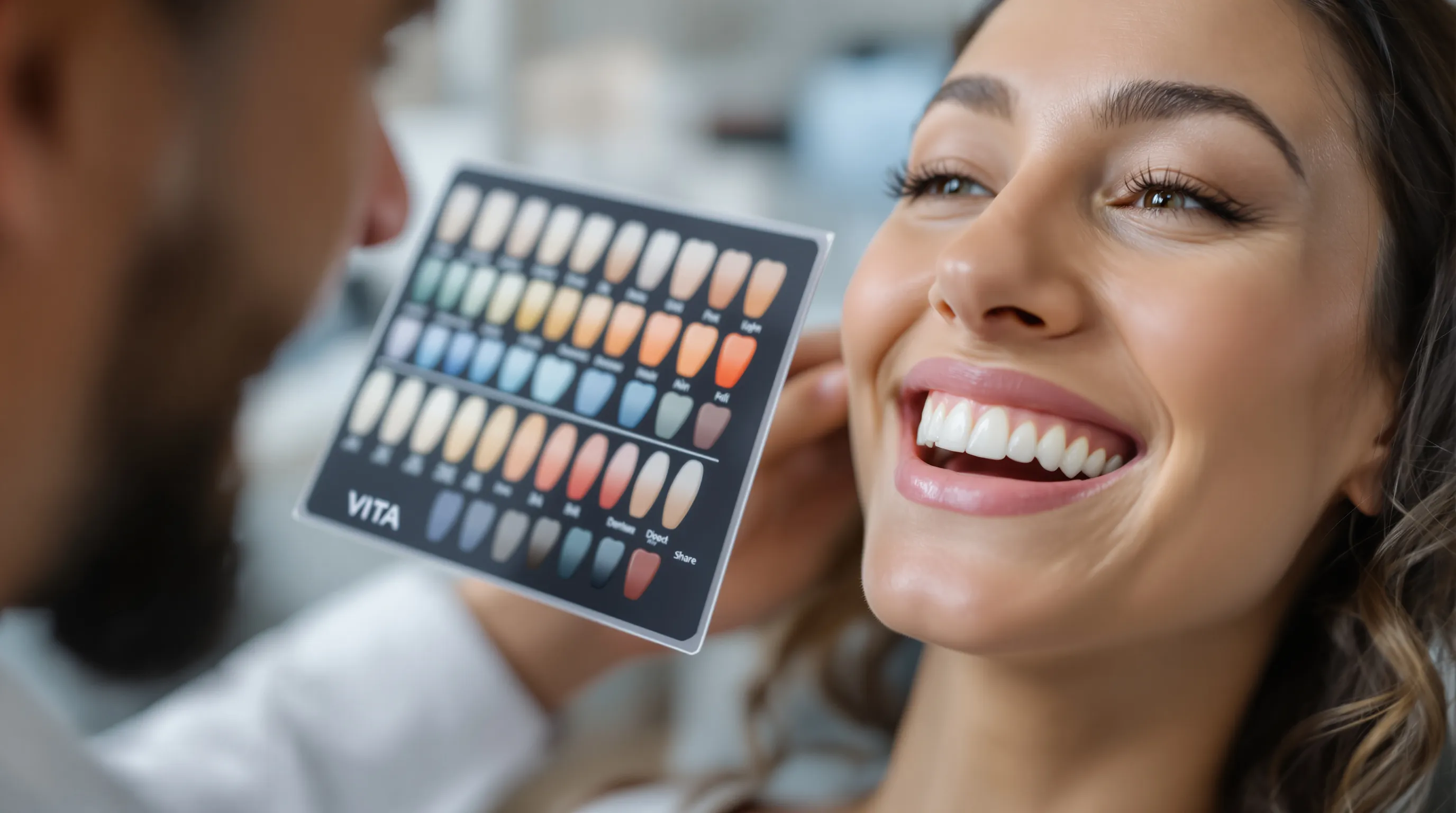
A smile makeover with a dental implant is genuinely exciting - and there is one rule that separates a perfectly coordinated result from an expensive redo. Most patients never hear it until something goes wrong. It comes down to a single question of sequence: when does the implant crown get its shade? The answer changes everything about how your makeover gets planned, and it is the conversation I wish every cosmetic dental patient had before their first procedure began.
- Can I whiten my teeth if I already have an implant crown?
- In what order should I get a dental implant, whitening, and veneers?
- What happens to my implant crown if I whiten my teeth after it is placed?
Quick Answer
The Short Answer
When your smile makeover includes a dental implant, the implant crown should be shade-matched last - after all whitening is complete and any veneers are placed on natural teeth. Ceramic and zirconia crowns cannot be whitened after fabrication. If you whiten your natural teeth after the crown is already cemented, the natural teeth get lighter but the crown stays exactly the same color, creating a visible mismatch that can only be corrected by fabricating an entirely new crown.
In 1956, a German dental technician introduced the shade guide that most dental labs still use today - sixteen porcelain tabs arranged from lightest to darkest, each one a precisely calibrated point on the color spectrum. The philosophy behind the system was as important as its engineering: before you commit a color to ceramic, you have to know exactly where you want to end up. Once the material is fired and glazed, the shade is set. There is no going back.
I think about that principle every time a patient sits down and tells me they want both a dental implant and a brighter smile. Because the same rule that governed those original porcelain tabs still governs every implant crown we place today. The crown must be shade-matched last - after whitening is done, after veneers are placed, after every natural tooth in the smile has reached its final color. Here is why that sequence matters, and exactly how to get it right.
Why a Smile Makeover Is More Than a Dental To-Do List
When patients sit down in my chair and tell me they want a complete smile overhaul - brighter teeth, a missing tooth replaced, maybe a few veneers to even out the shape - I always pause to have what I call the "bigger picture" conversation first. Because a smile makeover is not a collection of separate procedures that happen to take place in the same mouth. It is a system. And inside that system, every choice you make about one tooth has real consequences for every other tooth.
Think about it this way. Shade is the most visible quality of a smile. When you look at someone's teeth, your eye naturally scans for uniformity - whether consciously or not. A single tooth that is even slightly darker or lighter than its neighbors will stand out immediately. That effect is even more pronounced between a crown, which is made from ceramic or zirconia, and a natural tooth that has been whitened to a brighter shade after the crown was already placed, as of .
This is precisely where so many makeover plans go sideways - and I have seen it happen with patients who came to me after the fact, looking for a solution. A patient gets an implant, the crown is beautifully matched to their natural teeth at the time of placement. Everyone is pleased. Then six months later, they decide they want whiter teeth. Their natural teeth respond to whitening and brighten by several shades. The implant crown, however, stays exactly the color it was on the day it was cemented. Suddenly, what looked like a seamless result has become the most obvious tooth in the smile.
The dentist on Reddit who shared a case combining a gum lift, gingival depigmentation, porcelain veneers, and a single dental implant described his approach as a coordinated design - not four separate procedures but one unified plan with a single aesthetic outcome in mind. That is exactly the mindset a full smile makeover requires.
A true makeover starts with a conversation about everything you want, even things you are not certain about yet. Do you want whiter teeth eventually? Are you considering veneers at any point? Is there more than one tooth that might eventually need replacement? Every single one of these answers shapes the sequence of treatment. Once we know where we want to end up, we can build a roadmap to get there in the right order - so nothing has to be redone, no money is wasted, and you walk out of your final appointment with a smile that is perfectly coordinated from first tooth to last.
What Is the Shade-Sequencing Rule That Prevents a Mismatched Implant Crown?
Here is the single most important rule I share with every patient who comes to me wanting both a dental implant and a brighter smile: whiten first, match the crown last. It sounds almost too simple. But understanding why this rule exists at a material level makes it much easier to see why the sequence matters so much.
Natural tooth enamel contains organic compounds that respond to peroxide-based whitening agents. When you use a professional whitening treatment - whether an in-office session with a high-concentration gel or a customized take-home tray system - those peroxides penetrate the enamel and break up the pigment molecules that cause yellowing and discoloration. The result is a genuinely lighter, brighter tooth. Professionally guided whitening can typically move a smile four to eight shades lighter on the VITA shade guide, which is the standardized color reference system dental labs use when fabricating crowns and veneers.
Ceramic and zirconia - the materials used for implant crowns - do not respond to whitening in any way. They are inorganic materials. There are no pigment molecules for peroxide to break apart. Whatever shade is baked into that crown during lab fabrication is the shade it will be for its entire lifespan. For a well-placed, well-maintained implant, that lifespan is typically fifteen to twenty-five years or longer. The crown you place today is the crown you will have for decades.
The math is not complicated. Whiten first, reach your target shade, then have the crown made to match. When the permanent crown is cemented, your smile looks uniformly bright. Done.
Reverse the order and you create an unsolvable problem. Your natural teeth get lighter with each whitening cycle. Your crown stays fixed at whatever shade it was made. The only remedy for a crown that no longer matches is to fabricate a completely new one - another impression, another lab order, another appointment, and another cost that can run from several hundred to several thousand dollars depending on material and lab fees. One patient community online compared replacing a single crown to the cost of a major car repair - an expense that could have been entirely avoided by sequencing correctly from the start.
The rule is simple to follow. It just has to be communicated before treatment begins, not after the first crown is already in place.
Why the Implant Healing Timeline Is Actually Your Whitening Opportunity
One of the things I love most about explaining dental implants to new patients is watching their expression shift when they realize the healing period is not just waiting time - it is a genuine opportunity. People often hear "three to six months" and think about everything they will miss: comfortable chewing, the gap in their smile, the sheer inconvenience of it all. But if you are planning a full makeover, those months are some of the most productive of your entire treatment. This is genuinely exciting once you understand what it means!
Here is how the process unfolds. After the tooth situation is addressed - whether that involves an extraction or the site is already healed - we place the implant post, which is a small titanium fixture surgically seated into the jawbone. Then comes the healing phase that dental professionals call osseointegration: the period when bone tissue actually grows around and fuses with the titanium surface, creating a permanent, stable anchor for the crown to come. Osseointegration typically takes three to six months, and if a bone graft is required first, plan for another four to six months before the post can even be placed.
That adds up to roughly six to twelve months of healing time with no permanent crown fabricated yet. And during every single one of those months, your natural teeth are available to be whitened. As one implant patient reflecting on her experience noted, she wished she hadn't skipped pre-crown whitening due to tooth sensitivity - because once the crowns went in, that window closed.
In my practice, I encourage patients who want a brighter smile to begin professionally supervised whitening as soon as the surgical site is stable - typically a few weeks after implant post placement. We monitor the shade carefully using the agreed-upon target from our initial conversation. We do not rush it, because a stable final shade is what we need before the lab can be given an accurate color to match.
By the time the implant has fully integrated and we are ready to take the impression for the permanent crown, your natural teeth have already reached their target shade. The lab gets a clear, stable target. The crown comes back matching your real, current tooth color. A temporary flipper or provisional worn during healing fills the gap beautifully without committing to a permanent shade - it is the placeholder that makes the whole strategy work.
How Do You Sequence a Full Makeover When an Implant Is Involved?
Every full smile makeover I plan begins with the same question: what does the finished smile look like? Not what is the most urgent procedure.
Not what is quickest. What is the final destination? Only once we know that can we work backward and map the route to get there cleanly.
When the plan includes a dental implant alongside whitening, veneers, or other cosmetic work, here is the sequence that produces a lasting, coordinated result:
Step 1: The shade target conversation. Before a single procedure begins, we agree on the shade goal. I show patients the VITA shade guide and we discuss how bright they want to go - keeping in mind what looks natural for their skin tone, age, and facial features. That target shade becomes the anchor for every decision that follows.
Step 2: Implant post placement. Extraction (if needed), bone grafting (if needed), and post placement happen first. We address the structural foundation before any cosmetic work begins. As one experienced implant surgeon put it, proper timing between the stages is the biggest predictor of implant success - rushing any one of them is where long-term problems originate.
Step 3: Whitening during osseointegration. Once the surgical site is stable - typically two to four weeks after post placement - professionally guided whitening begins. We target the agreed shade methodically, using in-office treatments and custom take-home trays. The osseointegration period gives us the time we need.
Step 4: Veneers or bonding on natural teeth, if planned. Any cosmetic restorations on natural teeth happen after whitening is complete and the shade has stabilized. This ensures the veneers are matched to the final whitened color, not to the pre-whitened shade.
Step 5: Implant crown fabrication and final placement. Once the implant has fully integrated and natural teeth are at their stable final shade, we take the impression for the permanent crown. The lab matches it to your current tooth color. The crown goes in, is adjusted for fit and bite, and is cemented. At this point, every element of the smile is in harmony.
This sequence takes patience. It is not the fastest path from start to finish. But it is the only path that produces a result where the implant crown and your natural teeth will look like they belong together - not just today, but years from now.
What Happens When the Sequence Gets Reversed?
I wish I could say that every patient who comes through my door has already had the sequencing conversation with their previous dentist.
The truth is, most have not. And when the sequence goes wrong, the patient is the one who pays for it - in money, time, and the particular frustration of watching a problem unfold that could have been entirely prevented.
The most common version of this problem looks like this. A patient has an implant crown placed to match their natural teeth at the time. It looks great. Everyone is happy. Then - anywhere from six months to a couple of years later - the patient decides to whiten. Sometimes it is for an upcoming event. Sometimes they simply get motivated. They complete their whitening, their smile is brighter, and then one day they look in the mirror and notice it: the implant crown. It has not moved. It is now distinctly darker than everything around it.
This is not a subtle difference. Upper front teeth - precisely where implants most often replace missing teeth - are the most visible teeth in the entire smile. A single crown that is two or three shades off from the surrounding teeth is immediately noticeable, especially in bright light or flash photography. You cannot hide it by smiling differently. The shade is fixed.
There is a second version of this problem that involves veneers. Sometimes a patient gets veneers placed before doing whitening - setting the veneer shade in a pre-whitened context. Later, when whitening is done, the natural teeth may actually approach or exceed the veneer shade, making the veneers look comparatively dull. Neither scenario is ideal, and both are entirely avoidable with the right conversation upfront.
Online communities of implant patients reflect real awareness of this issue. One patient noted she was "not making the same mistake again" regarding pre-crown whitening after her previous crowns no longer matched her natural teeth once she had whitened them. That regret is the thing I am trying to prevent for every single patient who sits down in my chair with big smile goals.
Replacing an implant crown is not just an inconvenience - it is a real financial setback. The crown itself, the lab fees, the additional appointments, and any adjustments to the surrounding restorations can add thousands of dollars to a treatment plan that was supposed to be finished. Prevention is, by every measure, the better option.
How We Plan Your Full Smile Makeover at Imagine Advanced Dental Arts
When a patient comes to me wanting a complete smile transformation, my very first instinct is not to jump to treatment.
My first instinct is to listen. What do you dislike about your smile right now? What would you love to change? Is there something specific - a wedding, a milestone birthday, a job interview season - that is driving the timeline? These questions tell me more about what someone really needs than any X-ray or photograph can.
Once I understand the full picture of what a patient is hoping for, I build what I think of as a shade roadmap. This is a document that lays out every planned procedure in the sequence they should be completed, along with the shade target we have agreed on together. Everyone involved in that patient's care - every team member, the dental lab we partner with for custom restorations - has access to that roadmap. Everyone knows where we are going and exactly what comes next.
What I have found, time and again, is that the sequencing conversation actually reduces patient anxiety. When people can see their full plan laid out clearly, the process becomes less intimidating. They know when whitening begins, when the final crown goes in, and what their smile will look like at the finish line. There are no surprises, no mid-course discoveries that something needs to be redone. Just a clear path from where they are to where they want to be.
For patients in the Mercer County and Lawrenceville area who are asking "Who does veneers and smile makeovers near me?" - the answer starts with a dentist who thinks about all the moving pieces together, not one at a time. At Imagine Advanced Dental Arts, we treat the implant as one element in a coordinated aesthetic plan, not a separate clinical event that happens in a different conversation from the rest of your smile goals.
I am genuinely passionate about this work. There is nothing in dentistry I find more satisfying than the moment a patient looks at their finished result and realizes that the implant, the veneers, and the whitened natural teeth all look like they were always meant to be exactly that way together. That seamless result does not happen by accident. It happens because someone planned it carefully, in the right order, with the right endpoint in mind from day one.
If you are thinking about a smile makeover that includes a dental implant, I would love to sit down and design your personal shade roadmap together. Our smile analysis consultation is the perfect place to start that conversation.
Smile Makeover Shade-Sequence Protocol
IMPLANT + COSMETIC MAKEOVER - SEQUENCING CHECKLIST
===================================================
[ ] 1. Shade target set (VITA guide, agreed before any procedure)
[ ] 2. Implant post placed (extraction + bone graft if required)
[ ] 3. Whitening started (2-4 weeks after post placement)
[ ] 4. Natural-tooth shade stable (goal reached, confirmed)
[ ] 5. Veneers / bonding completed on natural teeth (if planned)
[ ] 6. Crown impression taken at final, stable shade
[ ] 7. Crown cemented - shade matches uniformly
===================================================
KEY RULE: Crown fabrication happens AFTER whitening is complete.
A ceramic crown cannot be lightened. Natural teeth can.
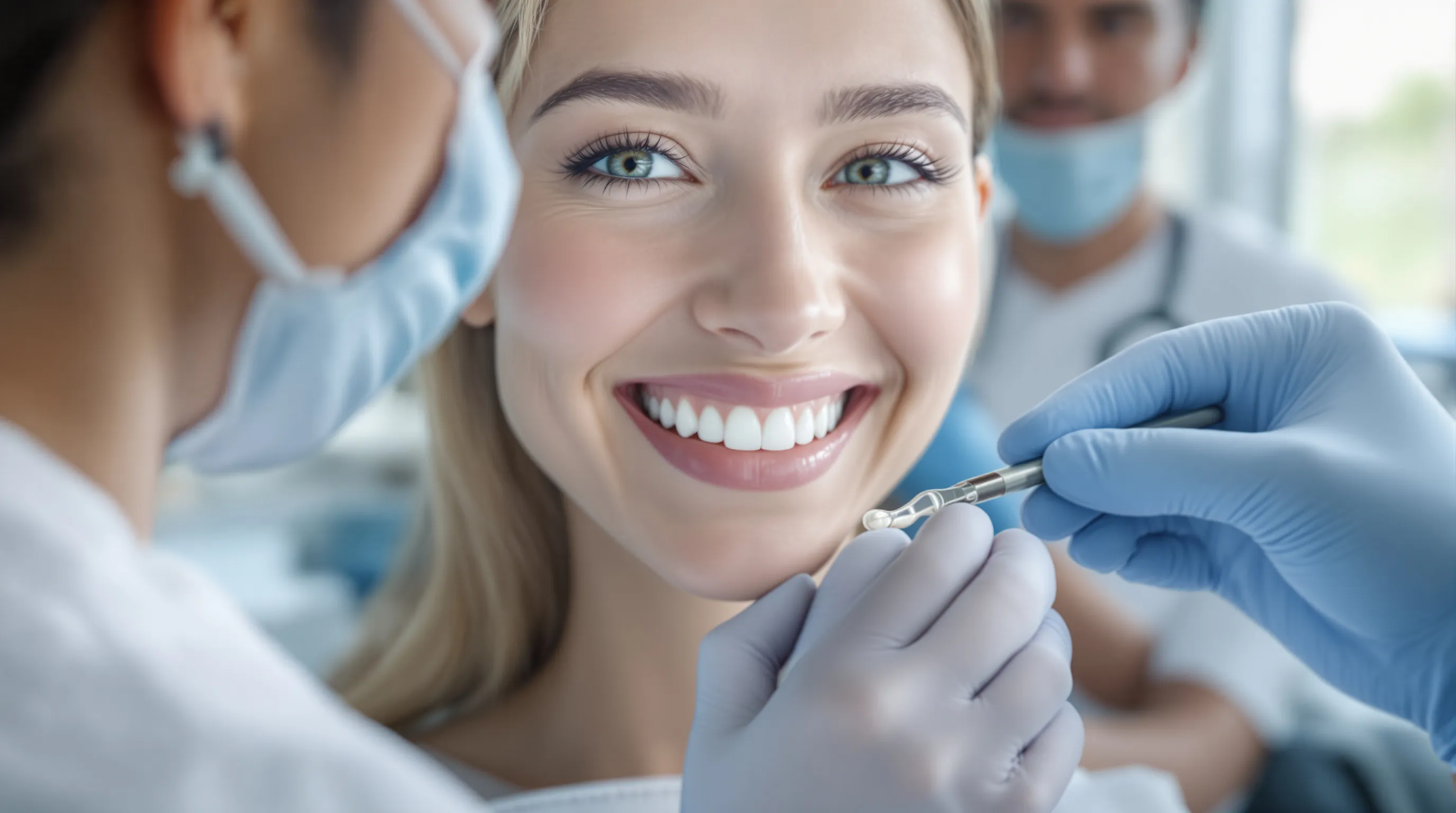
Before
After
Crown First vs. Crown Last: What the Outcome Looks Like
| Scenario | Crown Placed First, Whitening Later | Whiten First, Crown Matched Last |
|---|---|---|
| Natural teeth after whitening | 4-6 shades lighter | 4-6 shades lighter |
| Implant crown shade | Unchanged - visible mismatch | Matches whitened teeth exactly |
| Smile uniformity | One tooth noticeably darker | Uniform, coordinated smile |
| Fix required | New crown fabrication (cost + time) | None - result is lasting |
What Will Matter Most in Smile Makeover Planning in the Next 12-24 Months?
The technology behind smile makeovers is moving fast, and several shifts in the next one to two years will directly affect how implant crowns are sequenced within a full cosmetic plan. The underlying rule - whiten first, match the crown last - does not change. But the tools that help dentists and patients execute that rule are getting significantly more sophisticated, and that is genuinely exciting news for anyone planning a makeover today.
Digital shade-matching is becoming more precise. Spectrophotometer devices, which measure tooth color far more accurately than the human eye against a paper shade guide, are increasingly available in general cosmetic practices. When these are used to capture the whitened shade before crown fabrication, the lab gets a digital color value rather than a visual estimate - which means a more accurate match and fewer try-in adjustments.
In-office CAD/CAM milling is changing same-day crown possibilities. Practices with in-house milling units can already produce crowns in a single visit. As this technology becomes more common, it will shorten the gap between the shade-matching appointment and the crown delivery - though the fundamental sequencing rule still applies. The crown can only be milled to match the shade of the day it was captured, which makes the upfront whitening plan even more important, not less.
Digital smile design software is giving patients a preview before committing. Tools that show a patient a realistic simulation of their finished smile - at the target shade, with the implant crown in place - are helping the shade conversation happen earlier and with more clarity. When a patient can see on a screen exactly what their smile will look like at A1 versus B1 versus A2, the shade target decision becomes much less abstract.
What will not change is the patient's responsibility to have the shade conversation before anything is placed. Technology makes the execution better. The sequence itself has to come from a dentist who thinks about the whole plan before starting any single piece of it.
The 12-24 months Outlook, As We See It
Where Implant-Based Smile Makeovers Are Headed
Three evidence-based forecasts on how implants will factor into full smile makeover planning over the next year or two.
Full Smile Makeover Forecasts
Use these forecasts to gauge how cost, technology, and treatment timelines may shift for implant-based smile makeovers.
Despite same-day temporary-teeth marketing, most full-arch implant-based smile makeovers will continue taking 6 to 13 months to reach final crowns, with a meaningful share of patients experiencing implant rejection, shifting, or redo costs.
Practices will increasingly pair CT-scan and intraoral-scan planning with surgical guides to deliver fixed temporary teeth the same day as extraction and implant placement, positioning All-on-4/All-on-6 as the default approach for full-mouth smile makeovers.
More US patients facing $25,000-$40,000+ full-arch implant quotes will keep pursuing treatment in lower-cost markets such as Mexico and Turkey, where comparable All-on-4/All-on-6 procedures run roughly 30% of US pricing.
Small Clues Worth Watching Patients report US quotes of $40,000+ versus roughly 30% of that cost for a comparable case in Los Algodones, Mexico, and similar savings described for Turkey and the Netherlands. Multiple providers already combine CT scans, digital impressions, and surgical guides to deliver pre-fabricated fixed temporaries on the same day implants are placed. Patient accounts describe 6-13 month total timelines for healing and final crowns, along with cases of implant rejection or shifting that required removal and re-implantation at added cost.
Supporting and Contrary Evidence
Each forecast lists the real-world reports and cases that support it alongside those that complicate it.
- For those with implants on front teeth: how did you navigate life is the strongest public backing for this call. [Community / Forum]ShenaniganCity: bone graft (6 months healing) + implant integration (6 months) before crowns; then ~1 additional month for post/crown impressions and fabrication - total process spanned roughly 13 months. “If you’re toothless over Halloween I highly recommend being a Jack-o-lantern😂 It was a funny way to integrate the trauma of it all.”
- The case rests on Has anyone go to Mexico for a full dental rework? [Community / Forum]Original poster's US dentist quoted $40,000+ for full implant-based dental rework (NJ). “I had to stay in town a couple of days so they could monitor everything and do various treatments to assist with healing and prevent infections I then returned…”
- Been complaining about my dental implant really hurting is the strongest public backing for this call. [Community / Forum]Original poster (u/Noj222) paid $4,700 per implant for 4 implants (total ~$18,800), only one did not reject. “I mean it's not uncommon for implants to reject. But I got 4 all at 4700 each and only one didn't reject.”
- Step by Step Full Mouth Dental Implants and Smile Makeover is the clearest counter-signal. [Video]“what you see is what you're going to get”
- Pushing back: #1 Dentist for Dental Implants | Brunswick Twp NJ. [Industry Publication]Implant procedure is typically completed in just 30 minutes by expert oral surgeons (per site claims). “None - page contains no attributed individual quotes; all statements are unattributed site/marketing copy.”
- Step by Step Full Mouth Dental Implants and Smile Makeover supports this forecast. [Video]
- #1 Dentist for Dental Implants | Brunswick Twp NJ is the strongest public backing for this call. [Industry Publication]Full integration with the jawbone takes a few months following implant placement.
- UK Patient's All-on-6 Dental Implants in Turkey | Full Smile supports this forecast. [Community / Forum]Reflects the broader trend of UK patients traveling to Turkey for dental implant/full-mouth restoration tourism, and clinics using patient case stories/before-after narratives as social media marketing (Reddit) to attract this patient… “No direct patient quotes are present in the source; all language is clinic-authored marketing copy.”
- Against it: For those with implants on front teeth: how did you navigate life. [Community / Forum]ValueKey7411: lost teeth #8-10 in accident on 3/29; root removal and immediate implant placement on 5/17 (about 7 weeks later); bi-weekly follow-up appointments for first two months, then monthly; told permanent crowns expected before…
- Has anyone go to Mexico for a full dental rework? is the clearest counter-signal. [Community / Forum]CaffeinatedInSeattle's neighbor: dental work in the Netherlands costs ~$5k vs. ~$20k in the US, but takes 4 weeks due to required healing time between operations.
- Has anyone go to Mexico for a full dental rework? points the same way. [Community / Forum]Wide__Stance: proper implant process takes 6-12 months depending on healing speed; recommends 3-4 months healing between tooth extraction and base placement, then another 3-4 months before final post and crown.
- The case rests on UK Patient's All-on-6 Dental Implants in Turkey | Full Smile. [Community / Forum]Myra Dental Centre (via post copy) characterizes the outcome as "life-changing" and states the results are "amazing" - self-reported clinic/marketing framing, not independently verified.
- I'm considering looking into dental implants. What have people paid points the same way. [Community / Forum]Agreeable_Tonight807: implants for a full mouth typically cost around $25,000. “Make sure you have sufficient bone to support your implants for a lifetime. Inadequate bone or a failed bone graft will doom your implant investment. That was…”
- For those with implants on front teeth: how did you navigate life is the clearest counter-signal. [Community / Forum]gigglesod: implants on teeth #8 and #9 (front two); bone grafts healed for 4 months, then implants healed an additional 4 months before crowns - 8 months toothless total; began process before turning 26 to stay on parents' insurance.
- Against it: Been complaining about my dental implant really hurting. [Community / Forum]OP's implant fell out after ~2 weeks of complaints about pain; no cap/crown ever placed on top of the implant.
What Could Change These Forecasts
These scenarios describe the market shifts that would alter how implants fit into future smile makeover plans.
Keeping It Real
Our strongest call is 78, while 78 is the one most likely to surprise us.
- If regulators or buyers move in the opposite direction, Real recovery timelines and failure risk will keep lagging same-day marketing would weaken first.
- If the source mix shifts toward stronger contrary evidence, Real recovery timelines and failure risk will keep lagging same-day marketing could become the more durable forecast.
Key Takeaways
Key Takeaways
- Implant crowns are shade-permanent - ceramic and zirconia cannot be whitened after fabrication.
- Whiten first, match the crown last - this is the non-negotiable sequencing rule for any combined makeover.
- The osseointegration period (3-6 months) is your whitening window - use that healing time productively.
- Veneers on natural teeth also precede the crown - they should be matched to the post-whitening shade.
- A shade target conversation must happen before the first procedure - not after a mismatch appears.
- The only fix for a mismatched crown is a new crown - prevention is far less expensive than the remedy.
There is something deeply satisfying about watching a full smile makeover come together when it has been planned the right way. The implant crown goes in and it simply belongs - because by the time it was made, we already knew exactly what shade it needed to be. No mismatch. No redo. No financial surprise. Just a smile where every element is in harmony, and the patient cannot stop looking in the mirror.
We have come such a long way in cosmetic dentistry's ability to coordinate complex makeovers. The tools, the materials, the shade-matching precision available to us today are genuinely amazing. But none of that technology matters if the sequence is wrong. The conversation you have with your dentist before the first procedure - the shade target discussion, the roadmap - is what makes the difference between a good outcome and a great one. Start there, and everything else falls into place.
Thinking about combining an implant with whitening or veneers? Our dental implant team coordinates every element of your makeover so the final crown matches a smile you have already perfected.
Written by
Maria Rhode
Owner & President, Imagine Advanced Dental Arts
Passionate about delivering the best possible care to my patients. From my days in residency to owning a beautiful hi-tech dental office, I never stop learning and advancing myself and now my practice.
Connect on LinkedInFrequently Asked Questions
Can I whiten my teeth if I already have an implant crown?
Yes - whitening your natural teeth is safe and effective. But the implant crown itself will not change color. If the whitening results in a significant shade difference between your natural teeth and the crown, the only way to restore uniformity is to replace the crown with a new one matched to the whitened shade.
In what order should I get a dental implant, teeth whitening, and veneers?
The recommended sequence: place the implant post first, whiten your natural teeth during the osseointegration healing period (3-6 months), place any veneers on natural teeth after whitening is stable, then fabricate and cement the implant crown matched to your final shade.
Does whitening gel affect implant crowns or implant posts?
Whitening gel does not damage implant crowns or the titanium post. It simply has no effect on ceramic or zirconia materials. The post itself is entirely under the gumline and is not reached by whitening products at all.
How long does a full smile makeover with an implant take?
Plan for 9 to 18 months from the first consultation to the final crown, depending on whether a bone graft is needed. The implant healing phase (3-6 months) is the primary driver of timeline. Whitening happens during that window, which means no extra time is added to the overall plan when sequencing is done correctly.
What if my implant crown already doesn't match after whitening?
A new crown needs to be fabricated to match your current tooth shade. This involves a new impression, lab fabrication, and a cementation appointment. Discuss options with your dentist, including whether the abutment needs to be modified for optimal aesthetics with the new crown.
What is the VITA shade guide?
The VITA shade guide is the industry-standard color reference system used by dental labs worldwide. It organizes tooth shades into a spectrum that dentists and labs use to match crowns, veneers, and other restorations to natural teeth. When a dentist takes a shade before placing a crown, they are typically referencing this guide.
Summarize This Article With AI
Open this article in your preferred AI engine for an instant summary.