


If you have been searching "dental implants Princeton NJ," you have probably noticed that what comes back is mostly directory listings and ads promising same-day teeth. What almost none of them tell you is what actually determines whether you qualify, and what happens when you do not qualify right away. In this guide, I break down the exact screening criteria I use at Imagine Advanced Dental Arts, including the pre-treatment steps that roughly 1 in 6 of my Princeton-area patients need before a single implant can be placed. That is information the marketing pages simply do not give you, and I think you deserve it upfront.
Questions this article answers
- Do I have enough bone for a dental implant? Bone volume and density are the first things I check with a 3D CBCT scan. If resorption has occurred since the tooth was lost, a bone graft or sinus lift can usually restore what is needed, but it adds time to the treatment plan.
- Does gum disease disqualify me from implants? Active periodontal disease is a contraindication, not a permanent one. Once treated and stable, patients with a history of gum disease can and do get implants with excellent long-term success rates.
- Which health conditions affect my candidacy? Uncontrolled diabetes, bisphosphonate medications, and heavy smoking are the conditions that most often require extra evaluation, a modified protocol, or a physician consultation before we proceed.
Quick Answer
The short answer: Most healthy adults with adequate bone volume and controlled gum health qualify for dental implants near Princeton. However, roughly 1 in 6 patients at my practice need bone grafting, a sinus lift, or periodontal treatment before implant surgery can begin. A 3D CBCT scan, which takes about 20 minutes from capture to full review: is the definitive way to know exactly where you stand and what, if anything, needs to happen first.
Quick Answer
There is something almost mythological about the osseointegrated dental implant. The idea that a manufactured titanium post can fuse permanently with living bone, becoming so integrated that the jaw forgets it was ever a stranger. Swedish orthopedic surgeon Per-Ingvar Brånemark stumbled onto this discovery in 1952, when he found he simply could not retrieve a titanium chamber from a rabbit's femur because bone had grown directly into the metal. That happy accident gave us the modern dental implant. What it did not give us, and what still trips people up seven decades later, is a clear answer to the most important question: not "can I get an implant?" but "do I qualify right now, or is there some work to do first?"
At Imagine Advanced Dental Arts, roughly 1 in 6 patients who come in asking about dental implants near Princeton leave their first appointment with a pre-treatment plan: a bone graft, a sinus lift, or periodontal therapy, before the implant can even be scheduled. That number surprises people every time. I understand why. The marketing around same-day implants makes this whole process sound like a walk-in errand. In reality, the difference between an implant crown that lasts decades and one that fails within a few years almost always traces back to what happened, or what was skipped, before the post ever went in. Candidacy screening is not a formality. It is the whole game.
What Does It Actually Take to Qualify for Dental Implants?
People often come in expecting me to give them a yes or no on the spot.
And I genuinely wish I could do that in two minutes! The reality is that implant candidacy is a multi-factor picture, not a single checkbox, and skipping any part of that picture is exactly how you end up with a failed implant a few years later, as of .
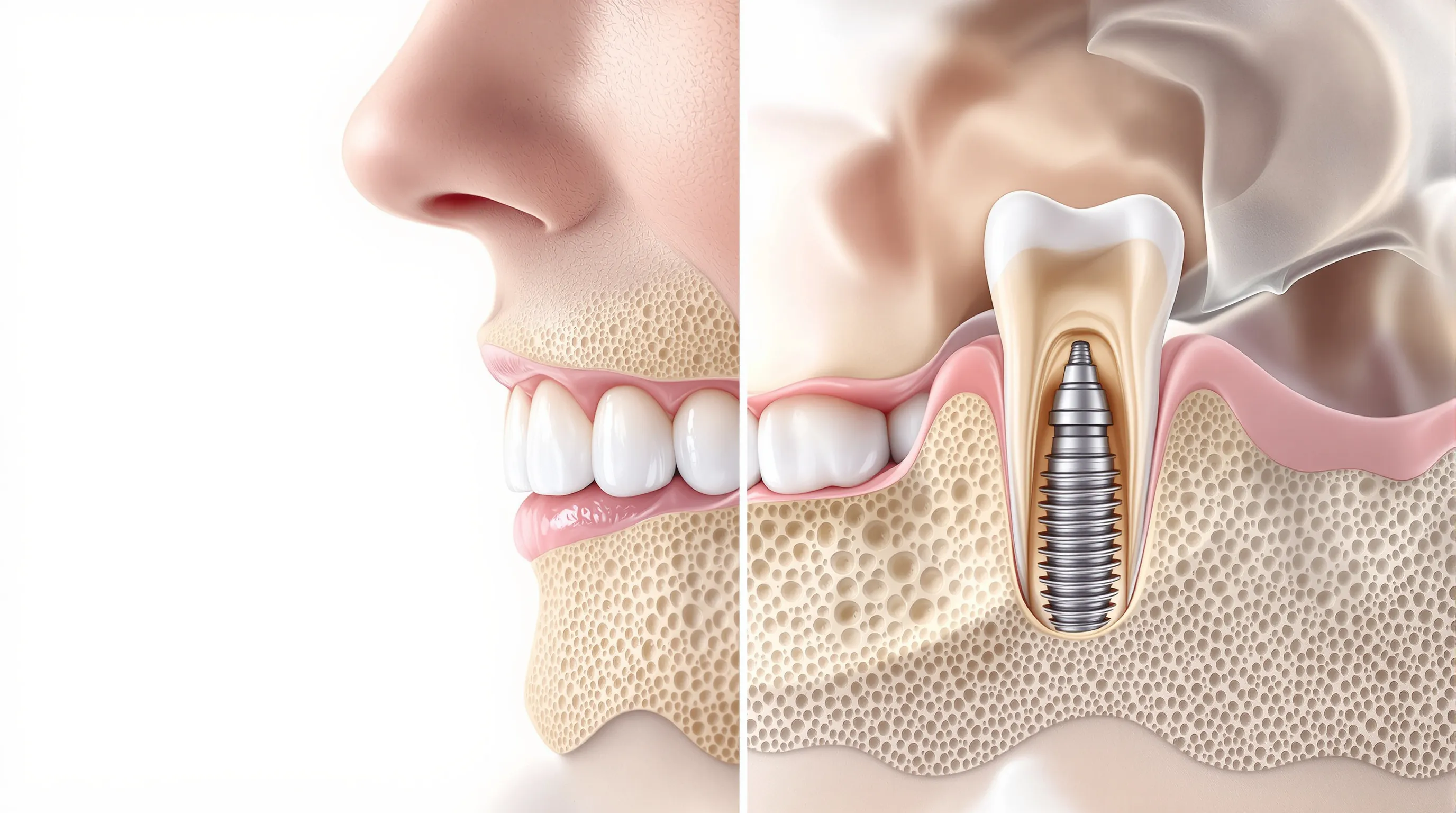
Let me walk through what I look at in every consultation. Bone volume and density are the foundation. A titanium implant post needs at least 1 millimeter of solid bone surrounding it on every side to achieve stable osseointegration, the biological process by which bone grows directly into the titanium surface. That sounds clinical, but the implication is simple: if the bony ridge where your tooth used to be has shrunk since the tooth was lost, there may not be enough material to hold the implant securely. And bone does shrink after extraction, fast. Research confirms you can lose up to 25% of bone width in the first year after a tooth is removed as the body reabsorbs tissue it no longer needs to support a root.
Gum health comes next. Active periodontal disease. The bacterial infection that attacks gum tissue and the supporting bone beneath it, is an absolute contraindication until it is treated and stable. Placing an implant into a mouth with active infection is like building on a foundation that is actively crumbling. The implant may integrate initially and still fail within a few years because the underlying infection was never fully controlled.
General health matters too, though it is more nuanced than most people expect. Here is what a strong candidacy profile looks like:
| Candidacy Factor | Ideal | May Need Pre-Treatment | Requires Full Evaluation |
|---|---|---|---|
| Bone volume | Full ridge, no resorption | Moderate resorption | Severe bone atrophy |
| Gum health | Healthy, disease-free tissue | Treated, stable periodontitis | Active periodontal infection |
| Smoking status | Non-smoker | Former smoker (>1 year quit) | Current heavy smoker |
| Diabetes control | No diabetes or well-controlled | HbA1c under 8.0% | HbA1c 8.0% or above |
| Age | Adult with complete bone growth | Any adult above ~18 | Active skeletal growth phase |
One thing I tell every patient at their first consultation: failing to qualify right now does not mean you will never qualify. For most patients who need pre-treatment, we are talking about a timeline of three to nine months of preparatory work, not a permanent door closed. Age alone is almost never a disqualifying factor. I have placed implants in patients in their 70s and 80s with outstanding results. What matters is not the number of years but the biology: bone quality, healing capacity, and the absence of conditions that interfere with osseointegration.
What Happens When Your Bone Has Already Resorbed?
Bone loss after tooth extraction is faster than most people realize, and I see the evidence of it every day in my CBCT scans.
The body is efficient: no root, no stimulation, no reason to maintain the bone. Research on this phenomenon confirms that bone loss "can be as much as 25% in the first year" after tooth removal. I would add: it does not stop there. The process continues, more slowly, for years. The longer a site has been empty, the more the ridge has typically thinned.
When I show patients their own 3D imaging and they see what their ridge actually looks like now versus how it appeared when the tooth was still present, the conversation usually becomes very concrete very fast! Bone volume deficiency is the most common reason I defer implant surgery. It accounts for roughly 60% of the cases at my practice where pre-treatment is needed before we can proceed.
The good news, and this is genuinely exciting news: is that bone grafting has advanced enormously, and a properly grafted site can absolutely support a permanent, long-lasting implant. The question is what type of graft is needed:
- Socket preservation (alveolar ridge preservation): Placed at the time of extraction to slow resorption before it starts. If you know you will eventually want an implant, this is the ideal first step, do it when the tooth comes out. Healing typically takes 3 to 4 months before implant placement.
- Lateral ridge augmentation: When width has been lost, we build out the ridge horizontally using graft material and a protective membrane. Healing runs 4 to 6 months depending on the extent of the deficiency.
- Vertical bone grafting: More complex, used when the ridge has lost significant height. Healing typically runs 6 to 9 months before implant placement: a real commitment of time, but one that produces a stable, predictable foundation.
- Sinus lift (sinus augmentation): Used specifically for upper back teeth, where the sinus cavity often expands downward after tooth loss, leaving insufficient bone height. We raise the sinus floor and pack graft material below it. A lateral sinus lift requires about 6 months of healing; an internal sinus lift can sometimes be done at the same appointment as implant placement when at least 5 to 6 millimeters of bone remains beneath the sinus floor.
Sinus lifts deserve special mention because they are so commonly needed for upper molar replacements near Princeton, and so commonly unexpected. I have had patients come in convinced they were not a candidate, sometimes another provider had told them so: who walked out with a clear, achievable treatment plan after their CBCT showed that a sinus lift would restore exactly the bone height they needed. People who were not candidates before due to bone loss are now candidates, thanks to advances in grafting techniques. That conversation is one of my favorites to have. The timeline feels long in the moment, but a properly healed graft produces the same osseointegration outcomes as a naturally intact ridge.
Why Gum Disease Can Delay, Not Derail, Your Implant
I want to be really careful here, because I have spoken with patients who walked out of other consultations having been told they could "never" get implants because of a history of gum disease.
That framing: never: is almost always wrong, and it keeps people from pursuing a treatment that could genuinely restore their bite, their confidence, and their long-term oral health. Well, that kind of blanket discouragement could not be more off-base!
Here is the accurate version: active periodontal disease is a contraindication for implant surgery. Treated, stable periodontal disease is not.
Did you know that research consistently shows implant survival rates of 95% or higher at 10 years in patients with a history of treated periodontitis, when those patients maintain regular follow-up? The maintenance matters as much as the treatment itself. But the distinction between "active" and "treated, stable" is critical, and here is why.
Periodontitis. The advanced form of gum disease, is a bacterial infection that destroys gum tissue and the bone supporting natural teeth. If that same bacterial environment is present when an implant is placed, it can cause a condition called peri-implantitis: inflammation around the implant post that mirrors what periodontitis does to natural teeth, eventually causing bone loss around the implant and potential failure. The bacteria do not distinguish between a natural root and a titanium one. This is the mechanism that makes active gum disease genuinely incompatible with immediate implant placement: not a preference, a biological fact.
So the protocol at Imagine Advanced Dental Arts for any patient with a history of gum disease looks like this:
- Full periodontal evaluation with probing depth measurements and updated radiographs
- Scaling and root planing (deep cleaning) or periodontal surgery if active disease is present
- Entry into a maintenance schedule, typically every 3 to 4 months, with at least two stable probing cycles confirming that disease is controlled
- Implant workup and CBCT imaging once tissue health is confirmed and stable
This process adds time, usually three to six months before implant surgery can be scheduled. But it is not a detour. It is the correct path. Among patients at my practice who need pre-treatment before implants, active or under-treated periodontal disease is the second most common cause, after bone volume deficiency.
My advice: if you have been told you have gum disease and you are interested in implants, do not let the diagnosis feel like an ending. Let it be the beginning of the treatment sequence, because that is exactly what it is. As you can see from the research and from what I observe in my own practice, the patients who go through proper periodontal treatment before their implant surgery are some of the most successful cases I have. Worth every bit of the patience it requires!
Implant Candidacy: Quick Reference Checklist
| Criteria | Minimum Threshold | Assessed By |
|---|---|---|
| Bone surrounding implant site | ≥ 1 mm on all sides | CBCT scan |
| Bone below sinus floor (upper back teeth) | ≥ 5-6 mm (internal lift); more for lateral lift | CBCT scan |
| Adjacent root clearance | ≥ 1.5 mm | CBCT scan |
| Periodontal disease status | Treated and stable (not active) | Probing + radiographs |
| HbA1c (if diabetic) | ≤ 8.0% | Lab value from physician |
| Smoking cessation (if applicable) | ≥ 8 weeks before surgery | Patient history |
| Skeletal maturity | Complete bone growth (typically ~18+) | Clinical history |
Which Health Conditions Need Extra Attention Before Implant Surgery?
Dental implant placement is a surgical procedure, and like all surgery, it exists within the context of your full health picture.
Most systemic conditions do not disqualify you from implants: but several require extra evaluation, physician coordination, or a modified protocol. This is one of the areas where a thorough consultation genuinely earns its value. Let me walk through the conditions I encounter most often.
Diabetes is the condition I see most frequently that demands close attention before proceeding. Elevated blood sugar impairs wound healing and increases infection risk, both of which directly affect osseointegration. The threshold I work with is an HbA1c of 8.0% or below. Patients who are well-controlled, with an HbA1c under 7.5%, typically heal comparably to non-diabetic patients. Above 8.0%, I refer back to the patient's endocrinologist for optimization before we schedule surgery. Unfazed by their diagnosis, many of my diabetic patients have gone on to get beautiful, long-lasting implants, once we took the time to get their numbers right first.
Bisphosphonate medications: prescribed for osteoporosis or certain cancers, under brands like Fosamax, Boniva, and Zometa, affect bone metabolism in ways that can complicate implant placement and healing. The risk level depends heavily on whether the drug is oral or intravenous and how long it has been taken. Oral bisphosphonates at standard osteoporosis doses generally present lower risk. IV formulations used in cancer treatment carry a significantly elevated risk of a complication called medication-related osteonecrosis of the jaw (MRONJ). Every patient on a bisphosphonate gets a physician consultation before I proceed: and in some cases, a drug holiday evaluation.
Anticoagulant therapy: blood thinners like warfarin, aspirin, or agents like rivaroxaban, requires coordination with the prescribing physician before surgery. In most cases, we do not stop the medication entirely (the cardiac or clotting risk from doing so is too high). We plan surgery at a time when anticoagulation levels are manageable and use local hemostatic agents to control intraoperative bleeding.
Smoking is the risk factor I feel most strongly about, because unlike the others, it is fully modifiable. Research consistently shows that smokers have two to three times the implant failure rate of non-smokers. I ask patients who smoke to quit at least 8 weeks before implant surgery and commit to staying smoke-free through the entire healing period. I will not place an implant in a current heavy smoker. The outcomes simply do not justify the procedure's cost and the patient's investment of time and money.
Autoimmune conditions, prior radiation therapy to the jaw, and severe osteoporosis each carry their own specific considerations, and I evaluate every case individually rather than applying a single rule across the board. The goal is always the same: a treatment plan built on your actual biology, not on a standardized assumption.
A Real Screening Scenario
Before Screening
A patient came in after seeing a same-day implant promotion online. She had lost an upper left second premolar four years earlier and never had it replaced. She was eager to proceed quickly.
What Our CBCT Revealed, and What Happened Next
3D imaging showed only 4mm of bone height remaining above the sinus floor, well below the minimum for any implant approach without pre-work. Mild active periodontitis was also present at two adjacent sites. We completed a lateral sinus lift, targeted scaling and root planing, and three months of periodontal maintenance. Nine months after the initial consultation, the implant was placed into a fully healed, 13mm bone site. At the two-year check, osseointegration is complete and the crown functions perfectly. The "delay" is what made the outcome possible.
What Does Our 3D Screening Process Check Before We Say Yes?
When someone comes in for an implant consultation at Imagine Advanced Dental Arts, one of the first things we do is a cone beam computed tomography scan, CBCT for short.
If you have only ever had traditional 2D dental X-rays, this is a meaningful step up. As one New Jersey-based implant dentist described it in a podcast interview, CBCT technology allows a clinician to "do a virtual surgery right then and there on the computer" before a single incision is made, and then produce a surgical guide for precise placement. That description really captures what the technology does for the candidacy conversation.
Here is what I am specifically looking at when I review that 3D image with you at your consultation:
- Bone height: The vertical distance from the crest of the ridge down to critical anatomy: the inferior alveolar nerve canal in the lower jaw, or the sinus floor in the upper jaw. I need sufficient clearance to place the implant at the correct depth without risking nerve proximity or sinus perforation.
- Bone width: The implant post has a specific diameter, and the ridge needs to be wide enough to accommodate it with at least 1 to 2 millimeters of bone on each side. A narrow, resorbed ridge often needs augmentation before placement.
- Bone density: The CBCT gives a visual assessment of bone quality, dense cortical bone versus softer trabecular structure. Denser bone integrates faster and more reliably with the titanium implant surface.
- Nerve mapping: In the lower jaw, the inferior alveolar nerve runs through a canal that I trace in three dimensions. The implant must be positioned with enough clearance to eliminate any risk of nerve proximity or trauma.
- Sinus evaluation: For upper back teeth, I measure the exact distance between the sinus floor and the ridge crest to determine whether a sinus lift is needed and, if so, which type is most appropriate.
- Adjacent tooth root spacing: The implant post must have at least 1.5 millimeters of clearance from neighboring roots. The CBCT shows their exact three-dimensional positions, information that flat 2D films simply cannot provide.
The CBCT scan takes about 20 seconds to capture and about 20 minutes for me to review in full detail with the patient. That review session is where most people really see their own jaw anatomy for the first time: where the bone is abundant, where it has thinned, and what the plan will be in either case. It is the step that same-day implant marketing tends to rush or skip entirely.
In my experience, that 20-minute conversation predicts more of the long-term implant outcome than almost anything that happens after it. Patients who understand their own bone structure before surgery have realistic expectations, follow the post-operative protocol more carefully, and, in my observation, have better healing experiences. The technology is amazing, but what really matters is the honest conversation it enables.
The Implant Candidacy Path at Imagine Advanced Dental Arts
- Initial Consultation, Medical history review, periodontal evaluation, 2D radiographs
- 3D CBCT Scan: 20 seconds to capture / 20 minutes to review with patient: bone height, width, density, nerve mapping, sinus anatomy
- Candidacy Decision
- Proceed directly → implant scheduling
- Pre-treatment needed → bone graft, sinus lift, and/or periodontal therapy (3-9 months)
- Modified protocol → physician coordination for systemic health factors
- Pre-Treatment (if required), Graft heals, perio stabilizes, systemic health optimized
- Implant Placement, Guided surgery using CBCT-derived surgical plan
- Osseointegration, 3 to 6 months of bone growing into the titanium post
- Crown Delivery, Final restoration placed; implant is functional
- Ongoing Maintenance, Regular hygiene visits; implants monitored at every appointment
Questions This Article Answers
- How much bone do I actually need for a dental implant?
- Will my history of gum disease prevent me from getting implants?
- How does diabetes affect whether I qualify for implant surgery?
- What does a 3D CBCT scan show that a regular X-ray misses?
- How long does bone grafting add to the overall implant timeline?
What Will Change in Implant Candidacy Screening Over the Next 12, 24 Months?
The candidacy criteria themselves: bone volume, gum health, systemic control, are not going to change. Osseointegration biology is remarkably stable science, and the thresholds I described in this article are grounded in decades of outcomes data. What is changing, and changing fast, is how precisely and how early we can measure and address those criteria.
AI-assisted CBCT analysis is moving from research settings into clinical practice. Software that auto-segments bone volume in three dimensions, flags marginal nerve proximity, classifies bone density, and overlays proposed implant positions is now commercially available and improving rapidly. In the next year or two, I expect this to become a routine part of implant planning rather than a novelty. The practical effect for patients: faster candidacy assessment, more precise pre-surgical planning, and fewer intraoperative surprises. A consultation that currently takes 20 minutes of active review may eventually include a preliminary AI-assisted read before the patient even sits down.
Growth factor protocols for bone grafting are also evolving in ways that matter to anyone facing a graft-first timeline. Platelet-rich fibrin (PRF), a concentrate prepared from the patient's own blood and applied directly to the graft site, has shown meaningful benefit in some studies for reducing healing time and improving graft maturation. What I am watching closely is whether combining PRF with newer synthetic bone graft materials can reliably compress the healing window. If a 6-month lateral sinus lift healing period can become a 4-month period with equivalent long-term outcomes, that matters enormously to patients who are eager to get to the implant placement stage.
Fully integrated digital implant planning workflows are also advancing. The CBCT, the digital impression, and the surgical guide are already designed in one platform in forward-looking practices. The next phase connects that workflow directly to outcomes tracking, so that the bone measurements taken at consultation can be compared automatically to post-osseointegration stability readings, building a longitudinal picture of implant performance over time.
What I do not expect to change: the importance of the pre-treatment conversation. Technology can make screening faster and more precise, but the clinical judgment about what a patient's tissue and bone actually need, and whether they are truly ready, still comes down to an honest conversation. That is not going anywhere, and I would not want it to.
The 12-24 months Outlook, As We See It
Where Princeton Implant Candidacy Is Headed
Three scored forecasts on who becomes eligible for dental implants around Princeton and Lawrenceville over the next one to two years.
Three shifts in who gets implants
Read each forecast as a scenario to weigh before you commit to a timeline or a single treatment plan.
Over the next 12-24 months, a growing share of Princeton-area extractions will be paired with immediate implant placement, because practices are acting on the roughly 25% of jawbone that can resorb in the first year after a tooth is removed. Same-appointment placement and grafting become the default move to protect eligibility rather than waiting and losing bone.
Against the market's premise that implants are the right end-state for everyone, expect more Princeton patients to be routed to bridges or dentures and to scrutinize clinics for over-treatment over the next 12-24 months, following cases like the Chinese clinic that pulled 12 teeth and sold 10 implants for about $2,800. Second opinions and denture-versus-implant deliberation stay common rather than fading.
Age-based screening keeps loosening, and patients in their 60s, 70s, and even 80s will make up a rising share of implant recipients around Princeton. Bone quality and gum health, not birth year, will decide eligibility, while the one firm exclusion stays skeletal immaturity in patients under roughly 18.
Small Clues Worth Watching Providers already describe placing an implant at the same appointment a tooth is extracted, and a cone-beam CT scan measuring available bone width is now a routine first step before treatment. Practicing dentists now state directly that implant success does not fall with age and that many patients in their 60s and 70s have done well, while caregivers report pursuing implants for parents in their 80s. Patients report being told they are not candidates because of root angulation and being given a Maryland bridge instead, and denture-versus-implant deliberation remains a live decision for people facing tooth loss.
What supports and counters these calls
Each forecast lists both the sources that back it and the ones that cut against it.
- Dental Implants in Park Slope - Staged Placement Restoration supports this forecast. [Blog]
- How Dental Implants are Put In points the same way. [Video]
- Not a dental implant candidate is the clearest counter-signal. [Community / Forum]
- Backing it: Not a dental implant candidate. [Community / Forum]
- Dentures or Implants? points the same way. [Community / Forum]
- The case rests on Be Careful Where You Get Those Dental Implants. [Substack / Newsletter]
- Pushing back: Dental implants at age 55? [Community / Forum]
- Anyone here who's gotten a dental implant 10 yrs or more ago? How is the strongest argument against it. [Community / Forum]
- Should I convince my mom to have dental implants? is what puts this forecast on the board. [Community / Forum]
- The case rests on Dental implants at age 55? [Community / Forum]
- Anyone here who's gotten a dental implant 10 yrs or more ago? How is what puts this forecast on the board. [Community / Forum]
- Not a dental implant candidate is the strongest argument against it. [Community / Forum]
What could change the outlook
Cost barriers, durability data, or grafting limits are the conditions that would flip these forecasts.
A Little Wiggle Room
We are most confident in 80, though 77 could prove us wrong in the best way.
- Buyers changing priorities, or regulators changing rules, hit Extraction and placement collapse into one visit first.
- A source base that turns contrary would leave Buyers steer back toward alternatives and scrutinize clinics as the forecast still standing.
Frequently Asked Questions: Dental Implant Candidacy Near Princeton, NJ
Am I too old for dental implants?
Age alone is almost never a disqualifying factor. I have placed implants in patients well into their 80s with outstanding results. What matters is bone quality, systemic health, and healing capacity, not the number of years you have lived. See our dedicated article: Are Dental Implants Worth It After Age 70?
Can I get an implant if I have had gum disease?
Yes, if the gum disease has been treated and is stable. Active periodontal infection must be resolved before implant surgery, but a history of treated gum disease does not disqualify you. Research shows 95%+ implant survival rates at 10 years in treated periodontitis patients who maintain regular maintenance visits.
How long does bone grafting add to the overall timeline?
It depends on the type of graft needed. A socket preservation graft placed at the time of extraction heals in roughly 3 to 4 months. A lateral sinus lift requires about 6 months. Vertical augmentation grafts typically need 6 to 9 months before implant placement is appropriate.
Does smoking disqualify me from dental implants?
Heavy current smoking significantly increases failure risk, and I will not place an implant in a patient who is actively smoking heavily. However, quitting at least 8 weeks before surgery meaningfully changes the risk profile. Former smokers who have been quit for over a year perform comparably to non-smokers in many studies.
What does a 3D CBCT scan show that regular X-rays miss?
CBCT imaging shows the exact three-dimensional bone height, width, and density at the implant site: as well as precise nerve canal position, sinus anatomy, and the spatial relationship to neighboring tooth roots. Two-dimensional X-rays compress all of this into a single flat image and cannot show width or depth accurately.
How much does bone grafting add to the cost?
Socket preservation grafts typically add $500 to $1,000 to the overall treatment cost. A lateral sinus lift can add $2,000 to $3,500 or more, depending on complexity. We provide complete, itemized pricing during the consultation so there are no surprises.
Key Takeaways
- Roughly 1 in 6 implant consultations at Imagine Advanced Dental Arts result in a pre-treatment plan (bone graft, sinus lift, or periodontal therapy) before surgery can begin
- Bone volume deficiency is the most common reason for deferral, accounting for ~60% of pre-treatment cases
- Active gum disease delays implants; treated and stable gum disease does not, long-term survival rates in treated periodontitis patients exceed 95% at 10 years
- Diabetes (HbA1c ≤ 8.0%), smoking cessation (8+ weeks), and bisphosphonate use all require evaluation, none are automatic disqualifiers
- A 3D CBCT scan (20 minutes) is the definitive candidacy screening tool, it reveals what 2D X-rays cannot
- Most pre-treatment timelines run 3 to 9 months before implant placement; the preparation is what makes the outcome predictable
What I hope this guide makes clear is that "do I qualify for dental implants near Princeton?" is a question with a real, specific answer, not a marketing non-answer that just gets you in the door. For most people, the answer is yes, though it often comes with some preparatory steps. For roughly 1 in 6 patients at my practice, a bone graft, sinus lift, or period of periodontal treatment stands between the consultation and the surgery. That is not a disappointment. That is the honest, predictable path to an implant that lasts.
We have come a long way since Per-Ingvar Brånemark's 1952 discovery: in the quality of graft materials, in the precision of 3D imaging, in our understanding of what makes osseointegration succeed or fail. The technology is amazing. But the most important thing I can offer any patient considering implants near Princeton is a completely honest conversation about where they actually stand, not where same-day marketing says they should stand. That conversation starts with a CBCT scan and about 20 minutes of my undivided attention. Learn more about our implant services or schedule your consultation today.
Sources & Further Reading
Authoritative Resources
- American Academy of Implant Dentistry, patient education and clinical standards for dental implants
- American Academy of Periodontology, guidelines on periodontal disease and implant candidacy
- National Institute of Dental and Craniofacial Research (NIH), peer-reviewed implant and bone grafting research
- American Dental Association, Dental Implants, patient information and evidence-based guidance
Related Articles
Written by
Maria Rhode
Owner & President, Imagine Advanced Dental Arts
Passionate about delivering the best possible care to my patients. From my days in residency to owning a beautiful hi-tech dental office, I never stop learning and advancing myself and now my practice.
Connect on LinkedInSummarize This Article With AI
Open this article in your preferred AI engine for an instant summary.