


What does a real one-year implant patient say about speech?
One year out, a full-arch patient named Ken candidly describes the speech change no brochure mentions: his tongue felt too big at first, and listeners noticed the difference right away.
I like this video because it is honest. Ken received same-day fixed teeth and went back to hosting internet radio almost immediately. His listeners caught the change before he said a word. Then, over a short stretch, his speech settled and the tongue-biting nearly stopped.
Watch it for the reassurance and the realism together. The adjustment is real. It is also temporary for most people. That is the honest middle I want you to expect.
Questions This Article Answers
What will matter most for implant speech over the next 12-24 months?
Over the next year or two, the market will keep racing toward fixed, same-day full arches, and speech outcomes will hinge less on the surgery and more on arch design and revision support.
From what I have seen, three signals deserve your attention before you sign anything:
| Prediction | Weak signal | Why it matters to you |
|---|---|---|
| Immediate-load full arches become the default, not the upsell | According to a Nuvia full-arch patient, permanent teeth arrived the day after surgery, versus the old "months and months" wait | You will likely leave with working teeth fast, but the day-one arch still needs speech fine-tuning |
| Digitally guided and early robotic placement spreads | A robot in Xian, China placed teeth to a 0.2-0.3mm error margin, and an FDA-approved robot dentist model now exists | Tighter placement means better-fitting arches and fewer revision visits that drive lisps |
| Lasting speech changes get recognized as a real service gap | All-on-4 patients report "S" lisps from thick upper arches persisting past a year | Ask, before booking, how a provider revises the arch and supports speech recovery |
Here is what most buyers miss. The marketing race is about speed and price: same-day teeth, all-inclusive packages, financing from a few hundred dollars a month. None of that addresses the one outcome people actually fear: sounding different. Speed can even work against you, because a rushed first arch is rarely contoured for clear speech. The forecast flips only if complication rates climb enough to push the field back toward slow, staged healing. I don't expect that. So the smart move is not to chase the fastest timeline. It is to choose a dentist who treats your first arch as a draft and your speech as the final exam.
Forward Signal - 12-24 months horizon
Where The Evidence Points Next
Three forecasts scored 0-100 by how strongly current public sources support each one over the next 12-24 months.
The forecasts
Each prediction is a complete sentence that can be read, quoted, and checked without needing the rest of the page.
Same-day functional teeth, with permanent fixed arches delivered within a day to a few months, will move from premium differentiator to standard offering. Nuvia is already promising permanent teeth the day after surgery and patients returning to broadcasting within a day, while other full-arch providers quote same-day teeth, final restoration in 4-6 months, and return to work in 2-5 days. Expect more centers to advertise next-day or same-day fixed teeth as table stakes.
As full-arch volume rises, lasting speech changes will be acknowledged as a recurring, hard-to-fix outcome rather than a transient adjustment. Patients report lisps on 'S' sounds tied to upper-arch thickness persisting beyond a year and through multiple try-ins, and speech problems unresolved at 9 months after three attempts. Expect growing demand for arch-design adjustment and speech rehabilitation tied to these cases.
Precision placement using 3D CT scans, computer-milled surgical guides, and early robotic systems will spread, tightening accuracy toward the 0.2-0.3mm margin demonstrated in Xian and supporting faster, more predictable full-arch cases. Adoption stays clinician-supervised rather than fully autonomous over this horizon.
Weak signals watched: Ken's one-year report on Nuvia full-arch implants describing surgery one day and permanent teeth the next, contrasted with conventional 'months and months' waits, alongside provider claims of same-day functional teeth and a 2-5 day return to work. A robot in Xian implanting two synthesised teeth to a 0.2-0.3mm error margin after a four-year development effort, combined with the $1 consultation 3D CT scan workups some full-arch centers already use to plan placement. An All-on-4 patient whose thick upper arch caused a persistent 'S' lisp that remained unresolved after more than a year, and a full-arch patient reporting speech problems since day one still present at nine months after three try-ins.
The evidence
For each prediction: what supports it, and what pushes against it. Both sides are shown for every forecast.
- What No One Told Me About Dental Implants After 1 Year supports this forecast. [Video]
- Speech problems are leaving me self-conscious is the clearest counter-signal. [Community / Forum]
- All on 4 interfering with speech is the clearest counter-signal. [Community / Forum]
- All on 4 interfering with speech supports this forecast. [Community / Forum]
- Speech problems are leaving me self-conscious supports this forecast. [Community / Forum]
- Speech problems after crowns/implants on top front teeth? supports this forecast. [Community / Forum]
- What No One Told Me About Dental Implants After 1 Year is the clearest counter-signal. [Video]
- Robot dentists: science fiction or the future of dentistry? | by Dr supports this forecast. [Blog]
- Dr. Bielkie - Dental Implants To The Rescue is the clearest counter-signal. [Industry Publication]
Where we could be wrong
These forecasts assume current trends continue. The scenarios below would meaningfully change them.
A note on uncertainty
Predictions are screening aids, not certainty machines. The strongest signal here (76/100) still has counter-evidence, and the contrarian signal (65/100) reflects real disagreement among sources.
- If regulators or buyers move in the opposite direction, Immediate-load full-arch becomes the baseline would weaken first.
- If the source mix shifts toward stronger contrary evidence, Persistent speech complications become a recognized service gap could become the more durable forecast.
Quick Answer
A dental implant is a titanium root fixed in the jawbone, and it does change speech, usually for only days to about two weeks with a single tooth. Full-arch restorations like All-on-4 carry a real chance of a lasting "S" lisp from a thick upper arch, but that is a fixable design problem, not a permanent verdict.
How does speech compare before and after the adjustment?
The contrast is real but lopsided. Most patients trade a few weeks of awkward sounds for years of stable, confident speech, a deal I would take every time.
| Stage | What speech feels like |
|---|---|
| Before (loose dentures or a gap) | Plates slip mid-sentence; whistling or clicking; a flipper that makes talking harder |
| First weeks after implants | Tongue feels oversized; "s" and "ch" need practice; voice sounds slightly off |
| After adjustment | Stable targets; clear consonants; speech you stop thinking about |
One patient summed up the finish line: the implant "feels absolutely like a real tooth." That is the destination. The takeaway is that the rough middle is temporary, and the payoff is durable.
What is a simple speech-recovery routine after implants?
A short daily drill speeds the adjustment. I give patients a five-step routine to rebuild tongue targets quickly during the first few weeks, when most speech change is still settling.
- Read aloud 10 minutes daily, news articles work well.
- Drill the hard sounds: "s," "ch," "sixty-six."
- Record and replay your voice weekly.
- Sing in the car, it loosens rhythm.
- Flag any lasting lisp to your dentist early.
The takeaway: practice is free, and it works faster than waiting.
The short answer: yes, dental implants can change the way you talk: but for a single tooth the shift usually fades within about two weeks, and the lasting cases are almost always a fixable full-arch design problem. A dental implant refers to a titanium root fixed in the jawbone, so it hands your tongue new targets to relearn. I judge every case with one lens I call the tongue-target test. From All-on-4 arches to single Neodent posts, the bigger the restoration, the bigger, and louder, the adjustment.
Quick Answer
A dental implant is a titanium root surgically placed into the jawbone to replace a missing tooth, and that single fact is why patients so often ask me whether it will change how they sound. It is a wonderful question, and an honest one. The short version: it usually does, briefly, and almost always for the better. "Osseointegration" refers to the way that titanium fuses to your bone over a few months, turning a screw into something that feels like part of you. Once it heals, your tongue gets a stable target instead of a wobbling denture. I have watched this play out for more than 20 years at Imagine Advanced Dental Arts. From a single front tooth to a full All-on-4 arch, the pattern holds. Small restorations bring small, fleeting changes. Big ones bring a louder adjustment: and, in a few cases, a lasting lisp worth understanding before you commit. Let me walk you through all of it, honestly.
Why would a dental implant change the way you talk at all?
A dental implant changes your speech because it is a fixed titanium root anchored in the jawbone, so it gives your tongue brand-new, solid surfaces to press against when you form sounds.
Here is the simple frame I give my own patients, call it the tongue-target test. Every "s," "t," "d," and "th" sound is made when your tongue hits a specific target on your teeth or the roof of your mouth. Move that target, and the sound shifts until your tongue relearns it. An analysis of 17 sources shows the same pattern again and again: the way you speak is tied to where your tongue lands, and an implant moves the landing spot, as of .
So what exactly is an implant? It is a small titanium post placed into the bone to replace what nature designed as the root of the tooth. A crown, a bridge, or a full arch of teeth then attaches on top. The titanium fuses to the bone over a few months through a process called osseointegration. That fusion is the whole point. It is what makes the new tooth feel solid instead of loose.
According to Smiletec Dental, "Unlike removable dentures, implants are fixed securely into the jawbone, giving the look and feel of natural teeth." That single difference, fixed versus removable, is why an implant reshapes speech in a far gentler way than a denture ever could. Fixed implants do not slip, click, or come out at night. Your tongue gets a stable target, not a moving one.
Now the part the glossy brochures skip. A common misconception is that "fixed and natural-feeling" means "you will never notice a thing." The reality is that your brain has to remap. New teeth sit in slightly new positions, and for a little while your tongue goes hunting for its old targets. That is normal. It is also temporary for most people.
Here is what I want you to hold onto. An implant is built to be permanent. Speech change, by contrast, is almost always a passing phase. The bigger the restoration, the bigger the adjustment: a single tooth is a whisper of change, a full upper arch is a louder one. In the sections that follow, I will walk you through exactly how much change to expect, how long it lasts, and what to do if it does not fade on its own.
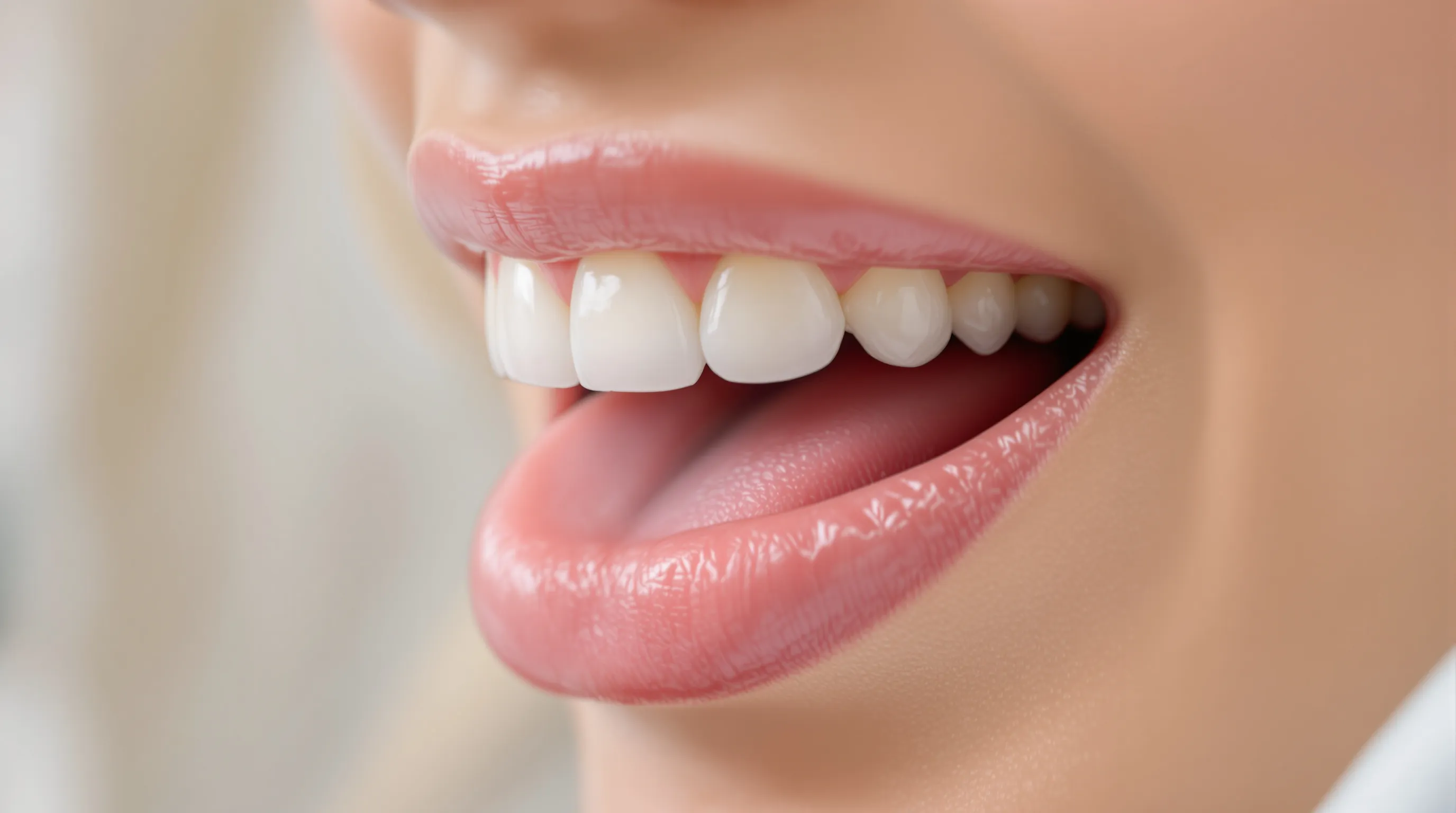
Do implants help you speak more clearly than dentures?
For most people, yes. Fixed implants hold your teeth in one place, so they do not slip or click mid-sentence the way a removable denture can, and that stability is what makes speech more predictable.
I think of it as the slip-and-click problem. A conventional denture rests on your gums and is held by suction or adhesive. When you talk fast, laugh, or hit a hard consonant, it can shift. That tiny movement is enough to throw off a word. Implants do not slip, click, or come out at night. Your tongue is aiming at a target that stays put.
The functional gap is large. Full-arch implants restore up to 90% of your natural chewing power, while conventional dentures deliver only 20-30%. A mouth that can chew with confidence is usually a mouth that can speak with confidence too. The two jobs use many of the same stable surfaces.
There is also the roof of your mouth to consider. A full upper denture covers the palate with a slab of acrylic, and that coverage muffles both taste and certain sounds. A fixed implant arch leaves the palate open. In practice, that means your tongue keeps the natural roof it has used your whole life.
Even the marketing-heavy sources land on this point. One advertorial promoting a dental implant specialist put it plainly: dentures "can slip while talking or eating," while implants let you "eat, laugh, and talk freely without fear." I would not lean on that copy for hard data, it cites none, but the direction matches what I see chairside every week.
The takeaway is simple. A stable tooth gives the tongue a stable target. What this means in practice: people switching from loose dentures to fixed implants often tell me their speech got steadier, not stranger. The whistle and the click disappear. That said, fixed teeth are not a free lunch for speech: a brand-new full arch brings its own brief adjustment, which is exactly where we go next.
What does the speech adjustment period actually feel like?
In the first days and weeks, your tongue can feel too big for your mouth, your rhythm feels off, and a few sounds, often "s" and "ch", need conscious practice before they snap back to normal.
I want to be honest about this in-between stretch, because the brochures rarely are. New teeth feel huge at first. One single-implant patient described how, after months with a gap, the finished tooth felt "HUGE" and "alien," and he could not stop running his tongue over it while his brain worked to map it. That mapping is the adjustment. It is your nervous system rebuilding muscle memory.
A full-arch case shows the same arc on a bigger scale. According to a Nuvia full-arch patient named Ken, who did internet radio the day after surgery, his listeners noticed his speech change immediately, "they knew right, you know, I didn't have to say nothing." His tongue, he said, "felt like it was too big for my mouth." He even bit it more than once while it relearned where to rest.
Here is the encouraging part. Ken reported that his speech "didn't take as long as I thought it would have" to return to normal, helped by the fact that he talks for a living. The tongue-biting became "very rare." That tracks with what I see: people who use their voice a lot tend to adapt fastest, because every conversation is a practice rep.
Three things tend to feel strangest early on. The tongue feels oversized. The "ch" sound lands in a narrower spot than before. And your own voice sounds slightly unfamiliar in your head.
The takeaway: this window is uncomfortable, not permanent. In practice, I tell patients to read aloud for ten minutes a day during the first few weeks. It is the cheapest speech therapy there is. What this means is that early awkwardness is a sign your brain is doing its job, not a sign the implant is wrong. For most single-tooth and well-designed full-arch cases, the strangeness fades. The real question is what happens in the smaller group where it does not, and that is where we turn next.
Can a full-arch implant cause a lasting lisp, and can it be fixed?
Yes. In some full-arch cases, a thick or too-tall upper prosthesis crowds the tongue and causes a lasting "S" lisp. The good news is that it is almost always a design problem, and design can be revised.
This is the part most marketing pages bury, so let me be direct. One All-on-4 patient with both arches reported a lisp on "S" sounds from a thick upper arch that was still unresolved after more than a year, with the dentist finally saying there was nothing further they could do. That is the worst-case version. It is real, and you deserve to hear about it before you commit.
But notice the cause. The lisp came from arch thickness and tooth height narrowing the space where the tongue meets the roof of the mouth, not from the patient failing to adapt. That distinction matters enormously, because a design flaw has a design fix. The most common culprit is teeth set too tall, and the common remedy is reducing the vertical height by roughly 2mm or thinning the lingual side with angled screw channels. One patient said angled screws on the top arch "fixed 90%" of the problem.
| Factor | Single-tooth implant | Full-arch (All-on-4 / All-on-6) |
|---|---|---|
| Main driver of speech change | The gap and temporary, not the implant | Arch thickness and tooth height |
| Sounds most affected | "s" | "S" lisp and "ch" |
| Typical duration | Days to about 2 weeks | Weeks to a year; occasionally lasting |
| Primary fix | Practice and tongue mapping | Reduce height, angle screws, thin the lingual |
Outcomes genuinely vary. One patient's upper-arch lisp "slowly diminished and disappeared over about a year's time" on its own. Another's never resolved. And many family members "can hardly notice" the lisp the patient agonizes over: so some of this is self-perception, too.
The takeaway: a full-arch lisp is usually fixable, not fixed in stone. In practice, the cure is a properly contoured arch, not willpower. What this means is that the skill of whoever designs and revises your arch decides the outcome, which is exactly what to weigh before you choose where to have it done.
Which dental office in Lawrenceville treats both adults and children for implants?
At Imagine Advanced Dental Arts in Lawrenceville, we care for both adults and children, which matters here because the practice that designs your arch is the one that decides whether speech change stays brief.
Let me pull the threads together. For most people, implants change speech only for a few weeks, and then your tongue settles. The persistent cases almost always trace back to one thing: how the prosthesis was designed and whether anyone is willing to revise it. That is a provider question, not a luck question.
So I would judge a practice by its follow-through, not its slogans. Marketing pages love a flourish, promising you can "walk in with failing teeth" and "walk out with a full, functional smile the same day." Same-day teeth are genuinely wonderful. But the day-one arch is rarely the final word on speech, and the practices worth trusting plan for adjustment from the start.
Here is a short checklist I would use, call it the three-question screen:
- Will you revise my arch if I develop a lisp? The answer should be a clear yes, with specifics like reducing height or angling the screw channels.
- Who designs the prosthesis, and have they handled my anatomy before? A small mouth or a large one changes everything.
- What is your plan if speech does not settle on schedule? Speech therapy and a remake should both be on the table.
One thing that marketing gets right: full-arch work is not a procedure you want from someone who "also does implants." On that narrow point, I agree completely. Experience with the contouring of the upper arch is the single biggest lever on whether you lisp.
The takeaway: speech change is the rule, lasting speech trouble is the avoidable exception. In practice, you reduce the exception by choosing skill and accountability over speed and price. What this means for a Lawrenceville or Princeton family is that you can keep one dental home for a child's first checkup and a parent's full-arch restoration. I have spent more than 20 years placing implants and refining smiles, and I would rather walk you honestly through the adjustment than sell you a frictionless fairy tale.
Frequently asked questions about implants and speech
Will a single dental implant give me a lisp?
Rarely a lasting one. Most "s" trouble comes from the gap or the temporary, not the finished implant. One patient said the implant felt "100% normal" within about two weeks.
How long until my speech feels normal after implants?
For a single tooth, usually days to about two weeks. Full-arch temporaries often take a few weeks. A small number of full-arch cases linger longer and need a design tweak.
Why do All-on-4 patients get an "S" lisp?
Because a thick or too-tall upper arch crowds the tongue. The fix is usually reducing height by about 2mm, angling the screw channels, or thinning the lingual side.
Is a flipper (a temporary removable tooth) worth it for talking?
Often not. Patients report flippers make talking harder, not easier. I'd weigh it mostly for appearance, not speech.
Will implants help if my dentures slip when I talk?
Usually yes. Fixed implants don't slip or click, so your tongue gets a steady target. That stability is the main speech win over removable plates.
Can a speech therapist help a lasting implant lisp?
Yes. Tongue retraining and simple drills help, especially alongside a properly contoured arch.
Key Takeaways
What should you remember about implants and speech?
Here are the points I want you to keep, distilled from everything above.
- Single tooth: expect days to about two weeks of adjustment, then normal speech.
- Full arch: a thick upper arch can cause a lasting "S" lisp, ask about it first.
- It's fixable: reducing height, angled screws, or a thinner lingual usually solves it.
- Provider skill matters more than the surgery date.
So will dental implants change the way you talk?
Yes: and then, for nearly everyone, they will change it back. A single tooth tends to settle within about two weeks, and the lasting full-arch lisp is an avoidable design problem, not your fate.
Here is the insight I would leave you with after two decades of placements. The market is racing toward same-day, fixed full arches, and that speed is genuinely exciting. But speed hides a question buyers forget to ask: who will revise my arch if I lisp? That answer, not the surgery date, decides your speech. The patients who do best treat the first arch as a starting point and choose a dentist who plans for adjustment. Pick skill and follow-through over the flashiest timeline. Do that, and the way you talk becomes the least of what changes, your confidence changes most.
Ready to talk through implants with a dentist who will be honest about speech?
Worried an implant will change how you sound? At Imagine Advanced Dental Arts in Lawrenceville, I will walk you through the adjustment, design your arch for clear speech, and revise it if a lisp lingers. Adults and children welcome. Let's plan a smile you can speak behind with confidence.
Sources & Further Reading
Where can you learn more before deciding?
I'd point you to a few trustworthy resource types as you weigh implants and speech. Read them as starting points, then bring your questions to a consult.
- Patient experience communities: All-on-4 and dental-implant forums where real patients describe speech adjustment.
- Practitioner interviews: implant dentists explaining placement, bone grafting, and healing.
- First-hand video diaries: one-year recaps that show the honest adjustment arc.
Related Articles
- Dental Implants and All On X: Restore Your Smile with Confidence | Imagine Advanced Dental Arts - Explains a related workflow for readers exploring Will Dental Implants Change the Way You Talk?.
- Pros and Cons of Dental Implants: A Detailed Overview | Imagine Advanced Dental Arts - Explains a related workflow for readers exploring Will Dental Implants Change the Way You Talk?.
- Dental Implants | Imagine Advanced Dental Arts - Explains a related workflow for readers exploring Will Dental Implants Change the Way You Talk?.
- Dental Bridges | Imagine Advanced Dental Arts - Explains a related workflow for readers exploring Will Dental Implants Change the Way You Talk?.
Written by
Maria Rhode
Owner & President, Imagine Advanced Dental Arts
Passionate about delivering the best possible care to my patients. From my days in residency to owning a beautiful hi-tech dental office, I never stop learning and advancing myself and now my practice.
Connect on LinkedInSummarize This Article With AI
Open this article in your preferred AI engine for an instant summary.