

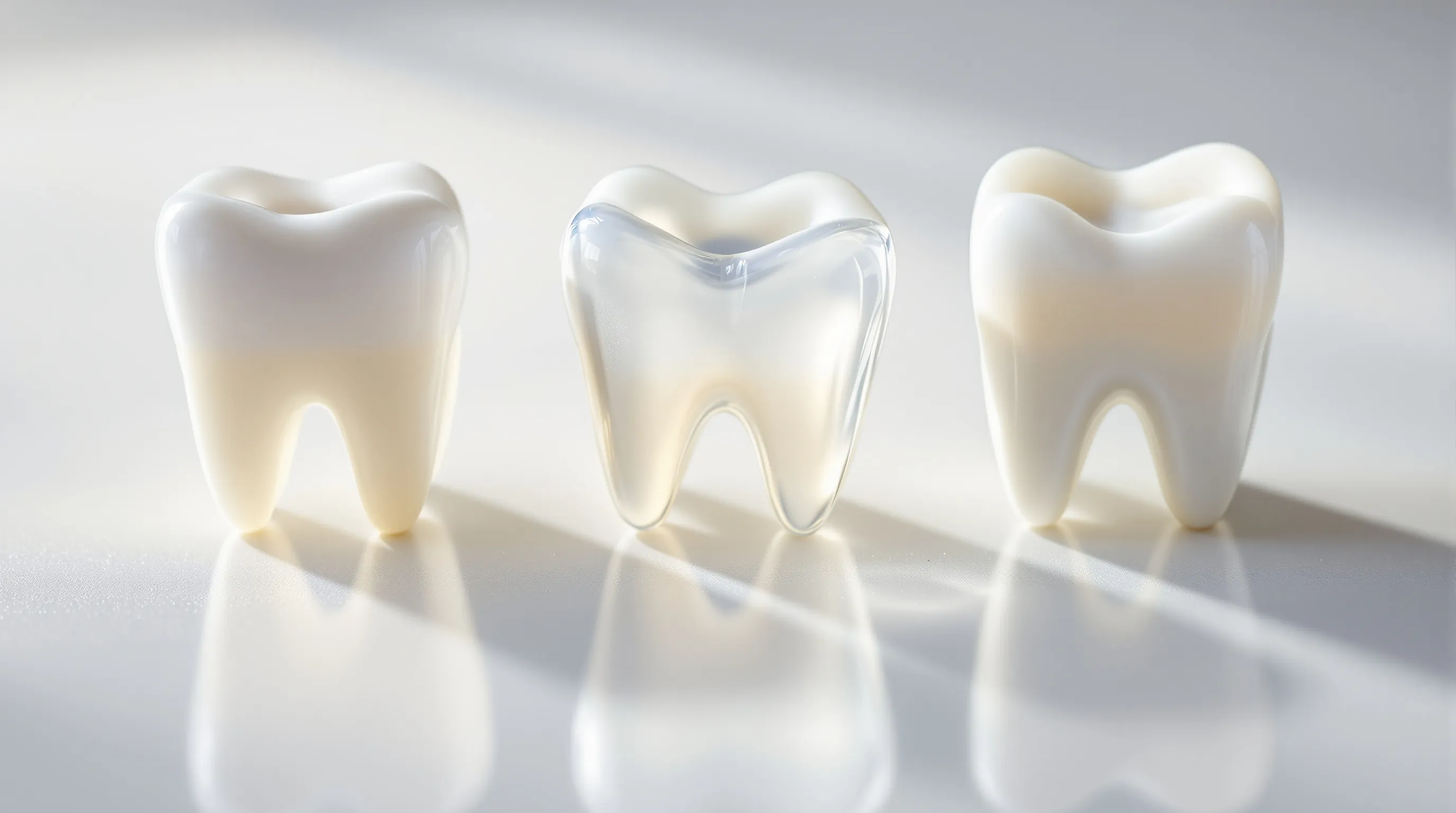
Questions this article answers
- Is zirconia actually stronger than porcelain, and does that strength matter for every tooth?
- What is e.max (lithium disilicate) and why do many dentists prefer it for front teeth and premolars?
- How does a dentist decide which ceramic to use, and what should you ask at your consultation?
Quick Answer
The Short Answer
The crown ceramic decision is a three-way choice, not two. Monolithic zirconia wins for back molars and for patients who grind or clench, its flexural strength of 900 to 1,200 MPa makes it virtually unbreakable under real-world bite forces. Lithium disilicate (e.max) wins for premolars and most front teeth, it combines roughly 400 MPa of strength with a translucency that closely mimics natural enamel and bonds adhesively to the tooth for added durability. Layered feldspathic porcelain earns its role only when a front tooth must match a complex natural neighbor at the highest possible esthetic level and bite forces are low. Most patients will do best with either zirconia or e.max, and the right choice comes down to where the crown is going and how hard that tooth works.
Quick Answer
The first modern porcelain crowns appeared in 1903. By the 1950s, porcelain-fused-to-metal had become the dominant restoration of the twentieth century. Then, by the end of the 1990s, Ivoclar perfected something that changed the anterior crown entirely: e.max, a lithium disilicate ceramic that is both strong and genuinely translucent. Did you know that? Most patients have never heard the name, even when they are sitting in the chair about to have one placed. I still remember the first time I held an e.max crown up to a natural tooth and could barely distinguish them. That was a moment of real wonder: because for so much of dental history, "tooth-colored" had meant "obviously fake."
Today we have three serious ceramic families for crowns, and choosing among them is not a matter of picking the strongest or the prettiest. It is a matter of matching material to clinical reality: tooth position, bite force, and esthetic demand. After placing thousands of crowns at Imagine Advanced Dental Arts, I now have clear rules for every case: monolithic zirconia for back molars and grinders, lithium disilicate (e.max) for premolars and most front teeth, and layered feldspathic porcelain reserved for the rare case where esthetic perfection cannot be achieved any other way. Most websites still frame this as two choices. It has always been three. Let me walk you through all of them.
What My Case Files Actually Reveal
A few years ago, a patient came to me frustrated after losing her third crown on the same lower first molar. Two previous dentists had each placed a layered ceramic crown there. Both had chipped: not the inner structure, but the outer porcelain layer, because she clenched at night and that molar absorbed the full force of it. We placed a full-contour monolithic zirconia crown, fitted her with a custom nightguard, and when she came back two years later, that crown looked exactly as it had on day one. No chips. No cracks. No drama.
I have also seen the opposite situation. A patient needed a central incisor crowned after trauma, the most visible tooth in any smile. Zirconia looked opaque and flat next to the neighboring natural teeth. An e.max crown in the right shade was the answer. The translucency matched the natural tooth closely enough that the patient left looking in the mirror at herself and smiling. Those two cases are the clearest possible illustration of the three-way decision this article covers.
Well, what these cases showed me is something I now apply to every crown case at Imagine Advanced Dental Arts. The material has to match the mechanical reality of the mouth first, position and force, and the esthetics come second. Get the order wrong and you are setting a patient up for the exact frustration that third-crown patient carried into my office. Get it right and the crown becomes a non-event in their life, which is exactly what it should be.
What Is Monolithic Zirconia, and When Does It Win?
Zirconia is a ceramic that behaves nothing like the porcelain most people picture. Where traditional dental porcelain is essentially a glass, zirconia is a crystalline oxide, yttria-stabilized tetragonal zirconia polycrystal if you want the technical name: and in its monolithic (single-piece) form, its flexural strength runs between 900 and 1,200 megapascals. For comparison, normal molar bite forces run roughly 150 to 250 pounds per square inch. High-strength zirconia handles that with room to spare, and in patients with bruxism who generate forces several times higher, it still performs. As Dr. Sean Flynn put it when describing full-contour zirconia to his patients: it is simply "the most durable monolithic ceramic" because there are no added materials and nothing to delaminate.
The word "monolithic" is the key distinction. Older zirconia crown designs used a zirconia substructure, think of it as an inner skeleton, with porcelain hand-layered on top for esthetics. That layered porcelain could chip, and it gave early zirconia a bad reputation it did not entirely deserve. Modern monolithic zirconia eliminates that layer entirely. The entire crown is milled from a single block of zirconia, sintered, stained, and glazed. No porcelain. Nothing to chip off. The result is a restoration whose fracture resistance is unmatched by any other ceramic in clinical use, as of .
Where Monolithic Zirconia Belongs in My Practice
- Lower and upper first and second molars. These teeth bear the highest bite forces in the mouth and rarely show in the smile; durability beats esthetics every time
- All bruxism and clenching cases, grinding multiplies occlusal forces dramatically; zirconia is the only ceramic I trust in confirmed bruxers regardless of tooth position
- Short clinical crown scenarios: when there is limited vertical space, zirconia maintains structural integrity even at thinner cross-sections
- Implant-supported posterior crowns: implants transmit force differently than natural teeth, and zirconia's strength absorbs that mechanical reality reliably
The Honest Esthetic Tradeoff
Here is where I always level with my patients: monolithic zirconia is not as naturally beautiful as e.max or layered porcelain, particularly on front teeth. Standard-grade zirconia tends toward opacity; it can look "blocky" in the smile zone. Today's high-translucency and multi-layer zirconia grades have narrowed that gap considerably, but on a central incisor that catches every light in the room, the difference still matters. On a lower second molar that nobody sees? The esthetic question is essentially irrelevant. I use monolithic zirconia for any molar crown and for any patient with confirmed bruxism, wherever the crown sits. The durability case is simply too strong to argue against in those situations.
What Is Lithium Disilicate (e.max), the Material Most Articles Never Mention?
If monolithic zirconia is the workhorse of the ceramic family, lithium disilicate is the thoroughbred.
Lithium disilicate is a glass-ceramic reinforced with interlocking crystals of lithium disilicate mineral, and the most widely known brand, e.max, made by Ivoclar, has become the benchmark for anterior and premolar crowns in practices that care equally about strength and esthetics. Ivoclar perfected the e.max formulation by the end of the 1990s, and the material has been refined steadily ever since. Its flexural strength lands around 400 megapascals, which sounds modest next to zirconia's 900-plus. But let me reframe that: natural tooth enamel has a flexural strength of roughly 10 to 50 megapascals. E.max is dramatically stronger than the tissue it is replacing.
What sets e.max apart is its optical character. The glass-ceramic microstructure allows light to pass through in a way that mimics the translucency of natural enamel. When you hold an e.max crown next to a natural tooth, the light behavior is close enough that even trained eyes can be fooled. For any tooth that shows prominently in the smile zone, this optical quality matters enormously. One Reddit r/Dentistry discussion put it simply: "Do you need esthetics? Emax. Do you need strength? Zirc." That binary is a bit reductive, but it captures the core tradeoff accurately enough to be useful.
Where E.max Belongs at Imagine Advanced Dental Arts
- Upper and lower premolars (bicuspids): these teeth are visible in most smiles, take moderate bite forces, and are the sweet spot for e.max
- Upper and lower anterior teeth, central and lateral incisors and canines all live in the high-visibility zone where translucency drives the result
- Veneers and onlays: lithium disilicate bonds adhesively to tooth structure, making it ideal for partial-coverage restorations
- Patients without confirmed bruxism, e.max performs beautifully in normal function; I am cautious placing it on confirmed grinding cases
The Bonding Advantage That Changes the Equation
One reason e.max outperforms its raw strength number in clinical use is how it is cemented. Zirconia crowns are typically seated with a conventional luting cement. E.max can be etched with hydrofluoric acid and bonded with resin cement, meaning the tooth and the crown form an adhesive unit. The tooth structure reinforces the ceramic, and the ceramic protects the tooth. That bond adds meaningful fracture resistance beyond what the material's MPa rating suggests. In my experience, well-prepared e.max crowns on properly prepped anterior and premolar teeth are among the most predictably successful restorations in contemporary dentistry, and my patients almost never have to think about them again once they are in.
What Is Layered Feldspathic Porcelain, and When Is It Still the Right Call?
Feldspathic porcelain is the oldest of the three ceramic families, and it still has a legitimate role in dentistry even as it has been displaced for most single-crown cases.
This is a glass-based material that dental ceramists build in successive layers, each layer fired in a porcelain oven to fuse it, creating a result with the highest possible esthetic ceiling of any dental ceramic. A skilled ceramist working with feldspathic porcelain can reproduce virtually any combination of translucency, internal color, surface texture, and characterization that a natural tooth displays. Think of it as painting in three dimensions rather than milling from a block. That is why it still exists, and that is why certain esthetic cases still call for it.
The catch is mechanical. Feldspathic porcelain has a flexural strength of only 60 to 150 megapascals, a fraction of both zirconia and e.max. It chips. It fractures under high bite forces. It demands precise preparation geometry to avoid stress concentration at the margins. And it requires a highly skilled ceramist, which means longer fabrication times, higher lab fees, and significant outcome variability between labs. The Protrusive Dental Podcast's ceramics episode captured this well: "Layered ceramics can enhance aesthetics but may compromise strength." That is the tradeoff in a single sentence.
Where Layered Ceramics Still Make Sense
- Complex full-mouth esthetic rehabilitations where every visible tooth must be color-matched precisely and bite forces are low or managed with a nightguard
- Unusual natural tooth matching: when adjacent teeth have complex internal color, fluorosis bands, or unusual characterization that no milled ceramic can reproduce faithfully
- Porcelain veneers, feldspathic porcelain remains the standard for ultra-thin veneers on front teeth; this is not a crown, but the material is the same
A Word on Layered Zirconia Hybrids
Worth mentioning here is layered zirconia, a crown design with a zirconia inner framework and feldspathic porcelain applied over it for esthetics. This was the standard approach when first-generation zirconia was too opaque for anterior use. I have largely moved away from it. The zirconia-porcelain bond is still the weak point: the porcelain can chip off the substructure, which gives you the cost of zirconia combined with the fragility of layered porcelain. That is not a trade I would recommend to a patient today. Modern high-translucency monolithic zirconia has made the hybrid largely unnecessary for most cases. If I need strength, I choose monolithic zirconia. If I need esthetics, I choose e.max. The hybrid sits in neither camp cleanly.
How Do I Decide Which Ceramic Fits? The Three-Way Clinical Protocol
The question I get asked most often is: "Doctor, which crown would you choose for my tooth?" And I always say the same thing: it depends on three things: where the tooth is, how hard you bite (or grind), and how much the esthetics matter for that specific tooth. Let me walk you through the exact decision sequence I use at Imagine Advanced Dental Arts.
Step 1, Identify the Tooth Position
Is it a molar? Lower first molars take the highest occlusal loads in the entire mouth. Upper and lower second molars are not far behind. For any molar, my default is monolithic zirconia. There is occasionally an argument for high-translucency zirconia on an upper first molar with a very high smile line, but even then, the durability case for monolithic zirconia is compelling. I do not place e.max on molars as a routine choice.
Is it a premolar? Upper and lower bicuspids are visible in most smiles, yet take moderate bite forces: not molar-level forces, but real-world chewing loads. This is the classic e.max case. Strong enough for normal function, beautiful enough to blend seamlessly with the anterior teeth. I place e.max crowns on premolars routinely and see excellent outcomes over years of follow-up.
Is it an anterior tooth? Central and lateral incisors and canines are in the highest-visibility zone of the smile. E.max is my first choice for most anterior crown cases: the translucency is superior, adhesive bonding is straightforward, and the strength is sufficient for normal anterior function. Layered porcelain becomes a conversation only in complex esthetic cases where e.max cannot match the neighboring natural teeth closely enough.
Step 2, Assess Bite Force and Grinding History
Does the patient grind or clench? Bruxism, typically nocturnal tooth grinding, can multiply bite forces three to six times above normal chewing forces. For any patient with confirmed bruxism, my material recommendation shifts toward zirconia regardless of tooth position. I have seen e.max crowns fracture on grinding patients even with correct preparation and cementation technique. When grinding is confirmed, the molar protocol extends to premolars. We place zirconia, we make a nightguard, and we protect the investment on both fronts.
Step 3, Evaluate Esthetic Demand
Ask: when this patient smiles fully, is this tooth visible? If the answer is no, as with most lower molars: esthetics play almost no role in the decision, and zirconia wins on durability alone. If the answer is yes, esthetic performance matters. E.max covers most anterior and premolar cases. And in a small number of exceptional cases: a prominent front tooth, complex adjacent tooth color, no grinding history, and access to premium lab work, layered feldspathic porcelain remains a valid choice worth discussing.
| Tooth Position | No Grinding | Confirmed Bruxism |
|---|---|---|
| Lower or Upper Molar | Monolithic Zirconia | Monolithic Zirconia |
| Upper or Lower Premolar | Lithium Disilicate (e.max) | Monolithic Zirconia |
| Anterior (Incisors, Canines) | E.max or High-Translucency Zirconia | High-Translucency Zirconia |
| Front Tooth, Complex Esthetic Match | Layered Feldspathic (if no grinding) | Not Recommended |
"The most common mistake I see is a layered ceramic crown on a confirmed grinding molar. No ceramic survives that combination indefinitely. Match the material to the mechanical reality of the mouth first, position and bite force, and let the esthetics follow from there."
- Maria Rhode, DMD, Owner & President, Imagine Advanced Dental Arts
Value and Cost: What to Expect From Each Ceramic
All-ceramic crowns represent a real investment, and the ceramic type does influence cost, though not always in the direction patients expect.
Monolithic zirconia is often the most cost-efficient option per crown. The material is milled by computer-aided design and manufacturing (CAD/CAM) from a standardized puck, which means less hand labor at the lab. Practices with in-office milling systems like CEREC can even deliver a zirconia crown in a single appointment, eliminating the temporary crown phase entirely. The material cost is comparatively low, the process is automated, and the result is highly predictable. From a value-per-year-of-service standpoint, monolithic zirconia on a molar is exceptional.
Lithium disilicate (e.max) crowns typically cost similarly to zirconia or marginally more, depending on whether they are milled (CAD/CAM) or pressed by the lab. Pressed e.max carries a slight esthetic edge over milled; both are clinically excellent. Either way, the value case for e.max on a premolar or anterior tooth is strong: the combination of longevity, esthetics, and adhesive bonding produces a restoration that rarely needs attention for years.
Layered feldspathic porcelain is consistently the most expensive of the three, because it requires a skilled ceramist building the restoration by hand in multiple fired layers. Lab fees are higher. Turnaround time is longer. And the esthetic result depends on the individual ceramist's skill. You are paying for art as much as function. As one dental lab director noted in a well-known YouTube educational video, the generation of skilled porcelain-stacking technicians is "disappearing faster than it's being replaced." The value case for layered porcelain as a single-unit crown is narrow and should be reserved for cases where no other material can achieve the esthetic outcome the patient needs.
900, 1,200 MPa
Flexural strength of monolithic zirconia6 to 8 times stronger than feldspathic porcelain and approximately 20 times stronger than natural tooth enamel
Key Takeaways
Key Takeaways
- Three ceramics, not two: Zirconia, e.max (lithium disilicate), and layered feldspathic porcelain each have a specific clinical role
- Monolithic zirconia (900, 1,200 MPa) is the strongest option and the right choice for molars and grinding patients
- Lithium disilicate (e.max) at ~400 MPa balances real strength with superior translucency, ideal for premolars and most front teeth
- Layered feldspathic porcelain achieves the highest esthetic ceiling but has the lowest strength (60, 150 MPa), use selectively for complex anterior cases
- Confirmed bruxism always shifts the recommendation toward zirconia, regardless of tooth position
- The question to ask your dentist: "Which ceramic are you recommending, and why for this specific tooth?"
What Will Matter Most in Ceramic Crowns Over the Next 12, 24 Months?
The landscape of dental ceramics is not standing still, and the changes arriving in the next year or two are worth understanding before you commit to a crown, especially if you are on the fence between materials.
Multi-Layer Zirconia Is Closing the Esthetic Gap Fast
The most significant development in ceramic crowns right now is the rapid improvement of multi-layer and gradient zirconia: discs engineered to transition from higher-strength, more opaque zirconia at the core to higher-translucency zirconia at the incisal edge. This mirrors the optical gradient in natural human teeth, where the root zone is more opaque and the biting edge is more translucent. Several manufacturers now offer multi-layer zirconia grades that approach e.max levels of translucency while maintaining flexural strength above 600 MPa. If this trend continues at its current pace, the esthetic argument for choosing e.max over zirconia on anterior teeth will narrow significantly over the next two years. The distinction that currently feels clear, e.max for front teeth, zirconia for back, may become more nuanced as zirconia esthetics improve.
In-Office CAD/CAM Milling Is Expanding Access to Same-Day Crowns
Practices with in-office milling systems, CEREC, Planmeca FIT, and similar platforms, can now deliver both zirconia and e.max crowns in a single appointment. The patient skips the temporary crown phase entirely: the tooth is prepared, scanned digitally, the crown is designed on screen, milled in the office, and cemented, all in one visit. As in-office milling systems become more common and their ceramic libraries expand, same-day crown options for both zirconia and e.max will become a patient expectation rather than a premium offering. Additive manufacturing in healthcare is already a disrupting force across medical devices, and dental ceramics are part of that trajectory.
Resin-Ceramic Composites: A Niche to Watch
Resin-ceramic hybrid materials (brands like Vita Enamic and 3M Lava Ultimate) occupy an interesting space: they mill well, bond well, and absorb bite force in a way that neither zirconia nor e.max can match, the polymer network in the ceramic absorbs shock elastically. They are not as strong as zirconia or as esthetic as the best e.max on front teeth, but for patients who place extreme loads on their restorations, the shock-absorbing properties may matter. This material class is not ready to replace zirconia or e.max as primary crown ceramics, but it is developing quickly.
What This Means for Your Decision Today
If you are getting a crown on a molar today, monolithic zirconia remains the right call, and will continue to be for the foreseeable future. If you are getting a crown on a front tooth today, e.max remains an excellent choice. The three-way framework described in this article: position, bite force, esthetic demand, will guide these decisions the same way in 2027 as it does today. The ceramics are improving; the clinical logic for choosing them is not going to change.
What's Coming in the 12-24 months
Where Crown Material Choices Head Next
Three evidence-based forecasts on how zirconia, e.max, and porcelain crown choices will shift over the next one to two years.
What's Likely Next For Crown Materials
Use these forecasts to gauge which crown material dentists and labs will favor as strength, esthetics, and warranties keep evolving.
More general dentists will default to zirconia for both posterior and a growing share of anterior crowns over the next 12-24 months, citing higher survival and improving 5Y multilayer esthetics, while porcelain-fused-to-metal keeps losing ground.
Single anterior crowns will keep favoring e.max and porcelain over the next 12-24 months, since dentists report faster same-day anterior workflows and better translucency with these materials, while zirconia's gains stay concentrated in molars.
Over the next 12-24 months, more patients and dentists will shop for or negotiate 8-10 year warranties on zirconia crowns to hedge against chipping and against insurance rules that often require 5-10 years before a replacement crown is covered.
Not Quite Proof Yet A dentist who worked almost exclusively with e.max for their first three years now works almost exclusively with zirconia seven years later, and a lab technician reports defaulting to zirconium remakes over e.max when shade needs correcting. Dentists report same-day e.max crowns in the front of the mouth are faster to produce than zirconia, which needs an extra refiring step, and clinicians still rank porcelain and e.max above zirconia for esthetics. Dental labs already offer 8-10 year warranties on zirconia crowns, particularly on higher-cost cases, while insurance replacement policies commonly require 5, 7, or 10 years between crowns on the same tooth.
Evidence Behind The Crown Material Forecasts
Each forecast is checked against supporting and contrary reports from dentists, technicians, and patients.
- Who else thinks zirconia is so much more predictable than e-max? supports this forecast. [Community / Forum]Original poster (u/lite_hause) spent their first 3 years as a dentist working almost exclusively with e.max; 7 years later now works almost exclusively with zirconia. “There is a place and time for both restorations. I use both but I try to stay emax when I can.”
- As a dentist, what crown material would you personally get on your is what puts this forecast on the board. [Community / Forum]Original poster (u/chaosphoenix440) needs a crown on tooth #30 (mandibular first molar) and is deciding between materials. “Personally, I would not get an eMax or empress or celtra or PFM crown on my molar.”
- Backing it: Zirconia vs emax vs other. [Community / Forum]fedlol's stated material hierarchy: Zirconia is stronger than emax which is stronger than porcelain; porcelain is more esthetic than emax which is more esthetic than zirconia; porcelain is more abrasive than emax which is more abrasive…
- Pushing back: Can someone explain the difference between zirconia and eMax. [Community / Forum]Zirconia is described as a "white metal" (crystalline ceramic), while e.max is lithium disilicate, a glass ceramic (per deleted user, dental professional commenter). “Zirconia is actually a 'white metal', while emax is lithium disilicate which is a glass. Zirconia can withstand more forces, but is not as translucent or…”
- What is a zirconia crown and are they stronger than other materials? is the clearest counter-signal. [Video]Common crown material types cited: metal, porcelain, porcelain-fused-to-metal (PFM), resin, ceramic, and zirconia. “zirconia itself is a type of ceramic or zirconium oxide that's actually stronger than porcelain and actually stronger than some metal alloys”
- Zirconia vs emax vs other is the strongest public backing for this call. [Community / Forum]GC's Initial LiSi is cited as an emax alternative, described as "slightly less esthetic than emax but also less abrasive" (fedlol).
- What is a zirconia crown and are they stronger than other materials? supports this forecast. [Video]Zirconia is a type of ceramic (zirconium oxide) described as stronger than porcelain and stronger than some metal alloys.
- Can someone explain the difference between zirconia and eMax is what puts this forecast on the board. [Community / Forum]Zirconia withstands more occlusal/lateral forces than e.max but is less translucent/aesthetic, per the same commenter.
- Who else thinks zirconia is so much more predictable than e-max? is the clearest counter-signal. [Community / Forum]Commenter dirkdirkdirk states zirconia strength "plateaus in regards of relevance at around 600-800 mpa" - no additional strength benefit needed beyond that inside the average mouth.
- Against it: Types of Dental Crowns and Materials - Gold, Porcelain, Lithium. [Video]Four materials commonly used for dental crowns today: porcelain, lithium disilicate, zirconia, and solid metal. “in my opinion there is no aesthetic comparison for a well-made porcelain crown”
- The case rests on Chipped the corner of my front tooth, a porcelain crown that. [Community / Forum]Original poster (u/noradicca) chipped the corner of a porcelain crown that was "really expensive.". “It doesn't matter what you keep it in. Some dentists have porcelain bonding kits, but it doesn't work that well.”
- Chips on corner of crown is the strongest public backing for this call. [Community / Forum]There are 4 basic types of tooth-colored crowns: 1) metal + porcelain (PFM), 2) Zirconia + porcelain (e.g., Lava), 3) all porcelain (e.g., "eMax"), 4) all zirconia (e.g., Bruxzir) - per commenter eran76. “So you bit into something really hard and it chipped your crown. If it was enough trauma to damage a crown it most likely would have damaged a natural tooth.”
- As a dentist, what crown material would you personally get on your cuts the other way. [Community / Forum]u/HuskerCaturday, a dentist, has a gold crown on #30, made from wax cast in "type 3 dental gold" during their 3rd year of dental school.
What Could Change These Forecasts
Watch for shifts in zirconia's translucency, e.max's fracture rates, and insurance replacement rules that could alter these predictions.
The Fine Print
78 has the most evidence behind it, but keep an eye on 64, since that is where we are least certain.
- If multilayer zirconia closes the translucency gap dentists still report versus e.max and porcelain, or its refiring time drops to match same-day anterior workflows, zirconia would expand further into front-tooth crowns.
- If more reports of zirconia needing bonding or extra tooth reduction would slow that shift.
Ceramic crown science has come an amazing way from the days when "tooth-colored" meant fragile. We now have three legitimate ceramic families, each with a clear and defensible role: monolithic zirconia protects molars and grinders, lithium disilicate gives premolars and front teeth both strength and beauty, and layered porcelain delivers the highest esthetic ceiling when everything else is favorable. As you can see, the real question is never simply "which material": it is which material for this tooth, this patient, this bite.
If you are weighing a crown at Imagine Advanced Dental Arts, this three-way framework is exactly what guides our conversation at your consultation. I will not tell you "we use zirconia" or "we use e.max" as a blanket policy. I will ask about your tooth, your bite history, your smile, and your goals, and then I will make a recommendation that fits your actual clinical situation. That is how it should be done! Learn more about the crown options we offer or schedule a consultation to find out which ceramic fits you.
Porcelain & Zirconia Crowns at Imagine Advanced Dental Arts
At our Lawrenceville, NJ practice, we offer all three ceramic options: monolithic zirconia, lithium disilicate (e.max), and layered porcelain for select esthetic cases: matched to your tooth position, bite, and goals. Every crown recommendation begins with a clinical evaluation, never a blanket material preference.
Explore Our Crown OptionsNot sure which ceramic is right for your tooth? Schedule a crown consultation at Imagine Advanced Dental Arts and receive a material recommendation matched to your specific tooth position, bite force, and esthetic goals.
Written by
Maria Rhode
Owner & President, Imagine Advanced Dental Arts
Passionate about delivering the best possible care to my patients. From my days in residency to owning a beautiful hi-tech dental office, I never stop learning and advancing myself and now my practice.
Connect on LinkedInFrequently Asked Questions: Ceramic Crown Materials
Is zirconia better than porcelain for crowns?
It depends on the tooth position. For molars and grinding patients, monolithic zirconia outperforms porcelain on every durability metric, its flexural strength of 900 to 1,200 MPa handles real-world bite forces that weaker ceramics cannot. For front teeth, lithium disilicate (e.max), which most people loosely call "porcelain", usually looks better while still being strong enough for normal anterior function. The question is not which is better overall; it is which is better for your specific tooth and bite.
What is e.max and how does it compare to zirconia?
E.max is Ivoclar's brand name for lithium disilicate ceramic, perfected by the late 1990s and now considered the standard of care for anterior and premolar crowns in esthetic dentistry. It is not stronger than zirconia (roughly 400 MPa vs. 900 to 1,200 MPa for zirconia), but it is significantly more translucent and can be bonded adhesively to the tooth, which both improves esthetics and adds fracture resistance. For front teeth and premolars in non-grinding patients, e.max typically produces better overall results than standard zirconia.
Do zirconia crowns look natural on front teeth?
Modern high-translucency and multi-layer zirconia crowns look significantly more natural than early-generation zirconia, which was quite opaque. For back teeth, monolithic zirconia looks perfectly acceptable. For the highest-visibility front teeth, central incisors especially, many dentists still prefer e.max or high-translucency zirconia for a more lifelike result, because the light behavior in the smile zone matters enormously.
How long do ceramic crowns last?
Monolithic zirconia and lithium disilicate both show 5-year survival rates in the 93 to 98 percent range in clinical studies. Layered feldspathic porcelain has a slightly lower survival rate due to chipping risk. With proper care: regular dental visits, a nightguard if you grind, avoiding habits like biting nails or ice, either ceramic crown can last 15 years or more.
Can I get a ceramic crown on a dental implant?
Yes, and monolithic zirconia is often the preferred material for implant-supported crowns on posterior teeth. Dental implants transmit bite forces more directly than natural teeth, which have a periodontal ligament that absorbs some shock. Zirconia's exceptional strength handles those implant-mediated forces reliably. Learn about our dental implant options and how we select the right ceramic for each case.
What is layered porcelain and when is it still used?
Layered (feldspathic) porcelain is the oldest ceramic crown material, built up by a skilled ceramist in multiple fired layers. It achieves the highest esthetic ceiling of any dental ceramic but has the lowest strength (60 to 150 MPa). It is now used mainly for complex anterior esthetic cases and porcelain veneers: rarely for routine single-unit crowns, and never for molars or grinding patients.
What should I ask my dentist about crown ceramic choice?
Ask specifically: "Which ceramic are you recommending for this tooth, and why?" A good answer will reference your tooth position, your bite history, and your esthetic goals. If the dentist recommends the same material for every patient without explaining the clinical reasoning, consider seeking a second opinion from a practice that personalizes material selection.
Summarize This Article With AI
Open this article in your preferred AI engine for an instant summary.