

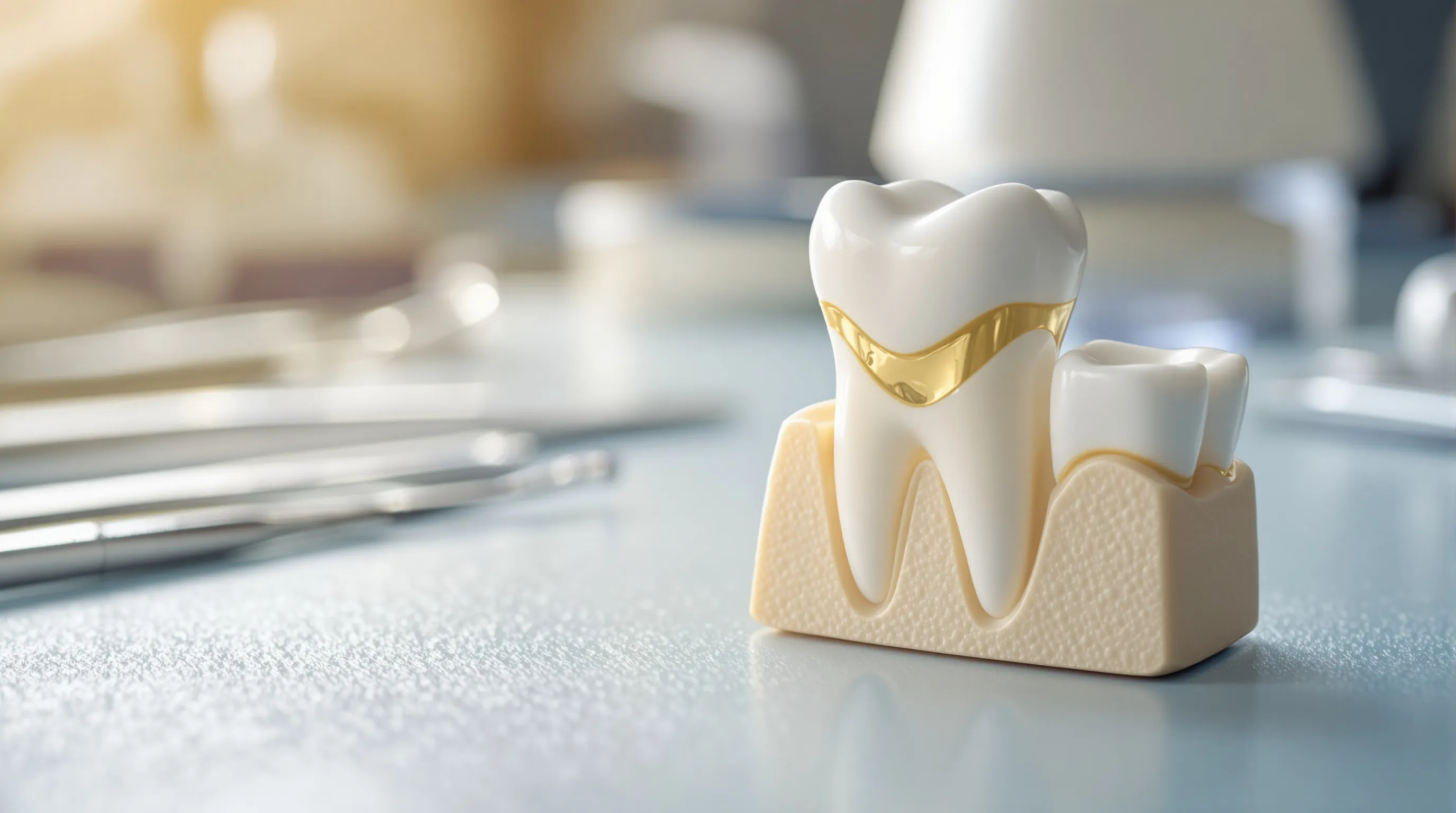
Most patients who ask me about crowns want to know: zirconia or porcelain? It is a fair question, and there is an answer. But after more than 40 years of placing and replacing crowns in my New Jersey practice, I have learned that the material debate is almost always the wrong starting point. The real predictor of whether a crown will still be doing its job in 15 or 20 years is not what it is made of. It is how the tooth beneath it was prepared, and whether the margin seals cleanly against that tooth for decades.
Questions this article answers
- Does zirconia actually last longer than porcelain in real patients?
- What causes most dental crowns to fail before they should?
- What should I ask my dentist about their crown prep approach before agreeing to treatment?
Quick Answer
The short answer: Tooth preparation quality and margin fit predict whether a crown survives 15 to 20 years far more reliably than whether it is made of zirconia or porcelain. Recurrent decay at an imperfect margin is the leading cause of crown failure, and that failure mode exists regardless of which ceramic sits on top. Get the prep right, and almost any modern crown material will serve a patient well for a very long time.
Quick Answer
After more than 40 years of placing, monitoring, and replacing dental crowns, the pattern I see most often is not what patients expect: the material chosen for the crown rarely determines whether it survives. The preparation underneath almost always does. In my practice in Lawrenceville, New Jersey, I have seen flawless zirconia crowns fail at year four because of a margin gap too small to see with the naked eye, and I have seen 22-year-old porcelain-fused-to-metal crowns come in for routine recalls looking as tight as the day they were placed. The difference was not the ceramic. It was the precision of the preparation and the care taken at every step from tooth reduction to cement placement.
The dental industry: websites, YouTube channels, patient forums, has invested enormous energy in the zirconia vs porcelain debate. It is the question patients bring to nearly every consultation. But it is the second question they should be asking. The first question is always: how well will this tooth be prepared?
Is the Zirconia vs Porcelain Debate the Right Question?
Every time a patient sits down in my chair to discuss a crown, the first question is almost always the same: "Should I get zirconia or porcelain?" I understand why.
It is the question that dental websites answer, the one YouTube videos debate, and the one that pops up on every dental forum. Patients have done their homework. They know zirconia is strong. They have heard that porcelain can look more natural. They arrive ready to make an informed choice, as of .
And I do not want to take that away from them. The material conversation is worth having! But I want to have a more important conversation first, because in my 40-plus years of placing, monitoring, and replacing dental crowns in New Jersey, I have seen the pattern play out so many times it has become almost predictable. A crown fails. The patient blames the material. And the real culprit. The preparation underneath, never gets discussed.
Here is something that tells the whole story: when patients ask online how long crowns last, the answers they get span a staggering range. Some crowns go five decades. Others last only a couple of years. Studies suggest roughly 26% of crowns survive 20-plus years, while a meaningful percentage fail before the 10-year mark. If material alone were the deciding factor, the variance would be much smaller. The range exists because crown longevity is determined by a chain of clinical decisions, and the material choice is just one link.
The leading cause of crown failure is recurrent caries, new decay forming at the margin between the crown and the tooth. The second most common cause is loss of retention, where the crown loosens. Both failure modes trace directly back to the quality of the preparation and the fit of the margin. Not the ceramic. The preparation.
When a margin has even a tiny gap: sometimes less than 50 microns, invisible to the naked eye, bacteria colonize that gap over time. They do not care whether the crown above them is made of the most advanced CAD/CAM zirconia or a classic porcelain-fused-to-metal. They find the opening, they set up shop, and over three to five years, they work their way under the crown and start breaking down the tooth beneath. By the time the patient notices sensitivity, the damage is already substantial. I have PFM crowns in patients' mouths right now that are 20-plus years old and clinically perfect: not because PFM is superior to zirconia, but because the preparation beneath each one was done right from day one. That is the real story nobody is telling.
What Does Poor Crown Preparation Actually Look Like?
Preparation problems come in a few specific flavors, and once you know what to look for, you start to see why they cause so much downstream trouble.
Dentists in professional communities openly discuss crowns that fail before the five-year mark: and when you read those threads carefully, the failures almost never trace back to a weak ceramic. They trace back to a weak preparation.
The most common prep problem I encounter when replacing failed crowns is inadequate reduction. To fit a crown properly, the dentist needs to remove a specific amount of tooth structure. For an all-ceramic crown on a front tooth, that means 1.5 mm of incisal reduction and 1 to 1.5 mm of facial reduction. For a posterior zirconia crown, it means 1.5 to 2 mm on the biting surface. When a dentist removes too little, the lab must fabricate the crown too thin in those areas. Thin ceramic either fractures under load or forces the crown to sit slightly too high in the bite. Both outcomes concentrate stress at the margin, exactly where the seal is most critical.
Overtaper is the equal and opposite problem. A well-prepared crown needs walls that are nearly paralleltypically 6 to 10 degrees of taper, to create the mechanical retention that keeps the crown in place. When walls are cut with too much taper (20 to 25 degrees is not unusual in rushed preparations), the crown has dramatically less retention. It may seat perfectly and look beautiful on day one. But it is sitting on walls that will not hold it for a decade of chewing forces, and it loosens.
Margin placement is where I have seen the most dramatic clinical failures in my career. The margin is the finish line. The precise edge where the ceramic crown meets the tooth, and it has to seal completely. Even a marginally open margin, a gap well within the range some practitioners consider clinically acceptable, is a biological invitation. Bacteria do not need much. They find the gap, colonize it, and over years, quietly destroy the tooth beneath the crown.
I have seen crowns come in for replacement that looked perfect from the outside: no cracks, no wear, but had extensive recurrent decay underneath with almost nothing left to crown again. The crown itself had done nothing wrong. The prep had failed the patient. Once that decay starts under a crown, no amount of ceramic quality stops it.
What Proper Crown Preparation Actually Requires, And Why It Cannot Be Rushed
Here is something patients rarely realize: proper crown preparation is not one skill. It is five or six skills practiced together with precision, and none of them can be faked with speed.
The first is reduction depth. For an all-ceramic crown on a central incisor, you need 1.5 mm of incisal reduction, 1 to 1.5 mm of facial reduction, and a clean circumferential finish line of at least 1 mm. These are not estimates. They are the minimum clearances the lab needs to fabricate a crown with adequate strength and accurate marginal fit. Go too shallow and you force the lab to compensate with a thinner crown or an over-contoured profile. Go too deep and you risk pulpal complications or unnecessary structural sacrifice of the tooth. Depth matters at every wall.
The second is taper. Axial walls must be prepared with near-parallel angulation, 6 to 10 degrees is the clinical target, so the crown has sufficient mechanical retention once cemented. Achieving this consistently requires two-handed technique, good magnification, and a willingness to stop and measure. Rushing this step is how you end up with over-tapered preps that look fine clinically but hold the crown with a fraction of the intended retention force.
The third is margin quality. The finish line must be crisp, consistent in depth, and placed at the correct location relative to the gum tissue. A shoulder margin for a PFM or rounded shoulder for a ceramic gives the lab a defined ledge to work against. A chamfer is the standard for most zirconia. The choice of margin type is not aesthetic preference. It determines whether the lab technician can accurately read and replicate the finish line in ceramic.
The fourth is capture quality. Even a perfect preparation produces a poor crown if the impression or digital scan does not faithfully record every detail. A bubble over the margin area, tissue that has not fully retracted, moisture contamination of the impression material, any of these sends the lab imperfect data. And the lab can only build what the data shows them.
I use digital impressions in my practice now, and the precision genuinely is remarkable. But the best scanner in the world only captures what the preparation gives it. Garbage in, garbage out, that principle applies in dentistry as clearly as anywhere. A conservative preparation, executed with precision and captured accurately, sets up almost any modern crown material to thrive.
Before
A Case Study: When the Material Was Right but the Prep Was Not
After
Before
A patient came to me with a failing zirconia crown placed elsewhere five years earlier. She had specifically requested zirconia for its strength after reading about it online. The crown itself was visually intact: no cracks, no chipping. But probing revealed a margin gap on the lingual aspect, and an X-ray showed recurrent decay that had progressed nearly to the pulp. The zirconia had performed exactly as designed. The preparation beneath it had not. An inadequate margin had allowed bacteria years of unobstructed access to the underlying tooth structure.
After
We performed endodontic treatment, rebuilt the tooth with a post and core, and placed a new crown, this time a porcelain-fused-to-metal with a precisely prepared shoulder margin and resin cement placed under full rubber dam isolation. That crown is now nearly a decade old and clinically perfect at every recall appointment. The material was not the change that made the difference. The preparation precision and technique were. The lesson writes itself: the right material on a poor foundation fails; almost any modern material on a precise foundation thrives.
What Will Change in Crown Preparation Over the Next 12 to 24 Months
The technology behind crown prep and fabrication is genuinely evolving, and several developments are going to change what patients experience and what dentists can deliver, though the underlying biology of why crowns succeed or fail is not going to change at all.
Real-time digital prep analysis is arriving in clinical practice. Some CAD/CAM systems are beginning to incorporate feedback during the preparation process itself. The software compares what the dentist has cut against an ideal digital target and flags areas of inadequate reduction, overtaper, or margin inconsistency before the impression is taken. This matters enormously. The most common prep errors today are ones the dentist cannot easily detect by eye alone. When software shows you a real-time map of your margin discrepancy, the quality floor rises for every practice that uses it consistently.
AI-assisted margin detection in digital scans is also evolving rapidly. Current digital impression systems already capture more detail than traditional impressions with good technique, but they still depend heavily on the operator's skill at isolating the field and ensuring full margin capture. Newer AI overlay tools are improving the ability to predict and flag scan areas where the margin may not have been fully captured, prompting a rescan before the case is sent to the laboratory. Fewer bad scans means fewer poorly fitting crowns arriving back from the lab.
Zirconia formulations continue to improve in aesthetics. First-generation monolithic zirconia was extremely strong but had poor translucency. Fourth and fifth-generation zirconia formulations are delivering strength close to the original while achieving translucency levels that make anterior zirconia a more reliable aesthetic option. This does not change the fundamental argument, prep still predicts longevity, but it does mean the zirconia vs porcelain debate will narrow in practical terms as zirconia becomes more competitive aesthetically across the arch.
What will not change in 12 to 24 months: bacteria will continue to find margin gaps. Conservative prep will continue to preserve tooth structure. The fundamentals of why crowns survive or fail are not technological. They are clinical. They are about the time a dentist takes and the precision they apply. No scanner or software replaces that commitment.
26% of dental crowns survive 20-plus years, while some fail in just a couple of years. That gap in outcomes is not explained by which ceramic was used. It is explained by preparation quality, margin fit, and cement technique.
When the Material Choice Between Zirconia and Porcelain Actually Does Matter
I want to be fair here. I have been making the case that prep quality predicts longevity more than material choice, and I believe that deeply.
But I also want to be honest that there are real clinical situations where the material choice carries genuine weight, and getting it wrong has meaningful consequences.
The clearest case is bruxism, chronic teeth grinding and clenching. Patients who grind heavily generate occlusal forces that can easily exceed 900 to 1,000 newtons, compared to the 300 to 400 newtons of ordinary chewing. Feldspathic porcelain and layered ceramics simply cannot absorb that kind of force over years of use. Porcelain chips. It fractures. The online dental community has threads full of patients and practitioners describing beautifully made porcelain restorations destroyed in under two years by unmanaged bruxism. For these patients, monolithic zirconia: solid, unchipped, extraordinarily tough, is genuinely the better choice. Not marginally better. Significantly better.
The second situation is the aesthetic zone. The upper front teeth that show when a patient smiles have different demands from a lower molar. Zirconia has become far more translucent in recent years, and modern high-translucency zirconia can look beautiful in the anterior zone. But achieving a natural result requires a highly skilled ceramist and precise communication between the dentist and the laboratory. When that communication breaks down, zirconia in the smile zone can look flat and opaque in a way that porcelain or lithium disilicate does not. In those cases, e.max or a carefully crafted PFM with porcelain margins may deliver a more reliable aesthetic outcome.
The third is bridge span length. When replacing a missing tooth with a bridge, forces on the pontic are transmitted through the connector areas to the abutment crowns. Zirconia can be fabricated with a larger connector cross-section, providing meaningful structural advantage over longer spans or in the posterior. For a three-unit posterior bridge on a bruxer, zirconia is genuinely the right call.
The approach I follow in my practice: address the prep question first, then the material question. Once the preparation is precise and the margin is clean, then we evaluate the patient's specific situation: their bite habits, their aesthetic goals, and the location in the arch. In most straightforward posterior restorations with excellent prep, either modern material performs beautifully. In specific cases: heavy bruxism, anterior esthetics, longer spans. The material distinction becomes a meaningful clinical decision. But the prep foundation is always first.
The Cement Variable Nobody Talks About, and Why It Matters
There is a third variable that almost never comes up in patient conversations, and it has always frustrated me because it is genuinely important: the cement.
Most patients assume the cement is a minor detail, a last step after all the real decisions have been made. In my experience, that assumption costs people crowns.
There are several cement families in common clinical use. Zinc phosphate cement is the old standard with a long track record. It is strong in compression, but it does not bond to the tooth or the crown. It works purely through mechanical interlocking. For a preparation with excellent retention form and near-parallel walls, zinc phosphate can be perfectly adequate. For a preparation with less-than-ideal retention, it offers no adhesive help whatsoever.
Resin cements, when used correctly, create a genuine adhesive bond between the crown and the tooth. This bond supplements mechanical retention, a meaningful advantage when a preparation has slightly less retention than ideal. But resin cements are considerably more technique-sensitive. They require excellent moisture control, specific surface preparation of both the tooth and the crown interior, and correct light-curing. Done right, they perform beautifully. Done hastily in a contaminated field, they can fail at the adhesive interface in a way that looks identical to a mechanical retention failure, and the crown loosens.
I have seen crowns replaced not because the prep was poor and not because the material was weak, but because the cement was placed in a contaminated field. Saliva, blood, gingival crevicular fluid, any of these can compromise an adhesive bond before the patient leaves the chair. The crown seats perfectly. It probes fine. The patient leaves happy. And three years later it loosens because the bond never fully formed beneath the surface.
Practitioners who have been around long enough will recognize this pattern from experience, the crown that "just came off" with no obvious prep failure and no visible crack. The cement is frequently the answer. What makes a crown last long-term is the full chain: preparation quality, margin precision, accurate capture, laboratory fabrication, cement selection, and meticulous placement technique. The ceramic choice is one link in that chain, an important link in specific clinical situations. But no ceramic choice compensates for weak links earlier in the process. Get the whole chain right, and almost any modern crown material will serve a patient well for 15 to 20 years and beyond.
Key Takeaways
Key Takeaways
- Tooth preparation quality and margin fit predict crown longevity more reliably than the choice between zirconia and porcelain
- Recurrent decay at a poorly fitted margin is the leading cause of crown failure across all ceramic materials
- Monolithic zirconia is the preferred choice for bruxism, heavy posterior load, and long bridge spans
- Lithium disilicate or PFM may deliver more reliable aesthetics in the anterior zone when lab communication is imperfect
- Cement selection and placement technique form the third critical variable in long-term crown survival
- Ask your dentist about their prep protocol before asking about their material preference
The Bottom Line on Zirconia, Porcelain, and What Actually Lasts
Did you know that the question "zirconia or porcelain?" is not actually the most important thing to settle before a crown? The more important question is: "Will this tooth be prepared carefully, and will that margin seal?" When the foundation is right: conservative reduction, clean margins, accurate capture, and correct cement, modern zirconia and modern porcelain restorations can both serve a patient for 15 to 20 years and more. I have seen it happen hundreds of times in my practice in Lawrenceville, NJ.
When the foundation is not right, no material saves the outcome. I have seen that happen too. The lesson I carry from more than four decades of cases: find a dentist who talks about prep protocol with as much care as they talk about their material selection. That dentist has actually thought about why crowns last. That is the dentist whose crown will still be in your mouth 20 years from now.
Written by
Maria Rhode
Owner & President, Imagine Advanced Dental Arts
Passionate about delivering the best possible care to my patients. From my days in residency to owning a beautiful hi-tech dental office, I never stop learning and advancing myself and now my practice.
Connect on LinkedInThe verdict
Questions to Ask Your Dentist Before Agreeing to a Crown
Before you ask your dentist "zirconia or porcelain?", try having a different conversation. These are the questions that reveal far more about the likely outcome of your crown than any material specification sheet:
- "What reduction amount are you targeting for this tooth, and why?" A dentist who thinks carefully about prep can tell you their target in millimeters and explain the reasoning. Uncertainty here is a signal worth noting.
- "What margin type will you use for this material?" The answer should match the crown type: chamfer for zirconia, shoulder for PFM, and they should be able to explain why the match matters.
- "Do you use digital impressions or traditional, and how do you ensure the margin is fully captured?" Either technique can succeed with good execution; what matters is that they have thought about it.
- "What cement will you use, and how do you control moisture during placement?" A dentist who has thought carefully about cement selection has thought carefully about the entire procedure.
- "If the prep does not come out exactly as planned, what do you do?" This tells you whether they will re-prep rather than proceed with a compromised foundation.
You are not trying to quiz your dentist. You are having a professional conversation that signals you care about the long-term outcome. The right dentist will welcome every one of these questions. They have already thought through all of it, and they will be glad to walk you through their approach. If those questions create discomfort rather than a confident explanation, that is your answer too.
Frequently Asked Questions About Crown Prep and Material Choice
Does zirconia really last longer than porcelain?
In laboratory strength testing, monolithic zirconia outperforms feldspathic porcelain. In real-world clinical outcomes with excellent preparation and marginal fit, both materials show comparable survival rates. Material strength becomes a decisive factor mainly in specific situations: heavy bruxism, long bridge spans, or posterior teeth under high occlusal load.
What is the most common reason dental crowns fail?
Recurrent caries, new decay forming at the margin between the crown and the tooth, is the leading cause of crown failure in long-term clinical studies. This is a preparation and margin-fit problem, not a material problem. The ceramic above the gap is often perfectly intact when the crown is removed.
Can a poorly prepared crown be fixed after it is cemented?
No, not without removing the crown entirely. If a margin gap or poor fit is identified after cementation, the correct solution is to take the crown off, reassess the preparation, and remake the restoration. Ignoring a compromised margin allows bacteria access to the tooth beneath.
How long should a well-made crown last?
With excellent preparation, precise margin fit, and correct cement, a well-placed crown should last 15 to 20 years or more. Studies suggest roughly 26% of crowns exceed the 20-year mark, the best ones often lasting considerably longer. The range in outcomes reflects differences in preparation and technique more than material choice.
Should I always choose zirconia for back teeth?
Zirconia is often an excellent choice for posterior restorations, especially for patients with bruxism or heavy bite. But a well-prepared porcelain-fused-to-metal or lithium disilicate crown will outlast a poorly prepared zirconia crown in any location. The preparation comes first; the material recommendation follows from that foundation.
Summarize This Article With AI
Open this article in your preferred AI engine for an instant summary.