

Quick Answer
Yes, early gingivitis can be reversed at home, but only by removing plaque daily with careful brushing and flossing; salt water rinses soothe gums, while viral remedies cannot replace either habit.
A 2019 Natural Health Remedies video calls gingivitis "a mild form of gum disease" driven mainly by plaque, "a layer of bacteria that continually develops" around and between teeth. Plaque keeps coming back. So the cleaning has to keep coming too. Bleeding that lasts despite solid habits calls for a dentist.
Key Points
- The National Institute of Dental and Craniofacial Research says early gum disease can often be reversed by daily brushing and flossing, alongside routine check-ups and professional cleanings.
- A study of 1,650 adults in Costa Rica, Mexico City and Bogotá, led by Gina Murillo Knudsen, found gingivitis in 99.6% and named plaque the most important risk factor.
- The American Dental Association's 2015 guideline estimated chronic periodontitis affected 47.2 percent of U.S. adults aged 30 or older and named scaling and root planing the first treatment.
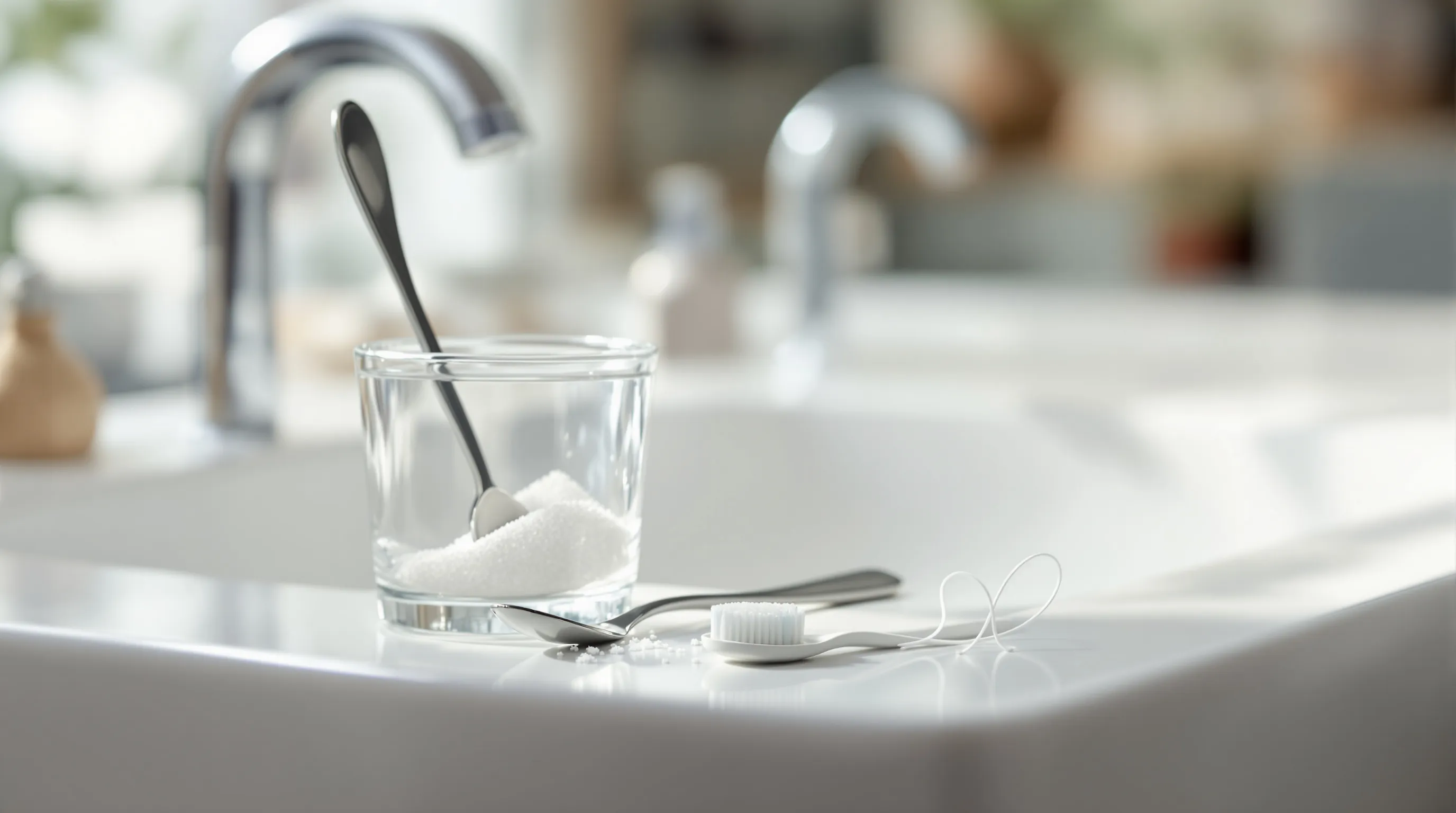
Salt water, a soft brush and floss: the simple tools behind most home care for early gingivitis.
Salt water or hydrogen peroxide? That one question has launched countless late-night searches, and the answers online rarely agree! On one online dentistry forum, a poster with mildly bleeding gums floated a rinse of 1/4 teaspoon of salt per cup of water. A commenter shot back that they had read "too much salt water can actually be bad for oral hygiene and that it's only beneficial for short term use."
Well, who is right? A 2019 Natural Health Remedies video landed somewhere in the middle. Its narrator pointed to a 2016 study showing that a salt water rinse "can be very beneficial" for gums inflamed by gingivitis, then gave a recipe of 1/2 to 3/4 of a teaspoon of salt in a glass of lukewarm water, swished for up to 30 seconds, 2 to 3 times per day. The same video also cautioned that "using salt water rinse too often or too long could have negative effects on tooth enamel." Gentle does not mean unlimited.
Even the stronger stuff is easy to grab. Antiseptic mouthwashes containing chlorhexidine are sold over the counter at pharmacies, the narrator noted. Convenience is not a cure, though. That same narrator conceded that "the best way to treat gum disease is to practice good oral hygiene although additional dental and medical treatments are sometimes necessary."
For anyone who finds a stronger antiseptic rinse hard to tolerate, a commenter in a 2021 online forum thread offered a simple rule: "If you cannot tolerate the Clorhexidene, then saltwater is the way to go." Another commenter in that thread explained why salt soothes at all: warm salt water is hypertonic, so it draws excess water out of swollen gum tissue and calms it down.
Can a better routine at home really calm bleeding gums? Yes, in most early cases! A 2024 r/DentalHygiene thread shows how quickly things can turn: a poster with bleeding gums switched to a soft brush, regular flossing and a water flosser on low pressure, and after a single day reported that "most of my gums aren't bleeding." One good day is not a cure, of course. A commenter in the same thread warned that bleeding from flossing can last "a couple of weeks," and urged readers not to let it put them off.
Well, hold on a second! Is the fancy water flosser the secret ingredient? Not really. Another commenter called water flossers "an excellent adjunct" that does not replace string floss, while a third pointed to a "pretty good" electric toothbrush costing under $40 back in 2024. Honestly, that trade-off favors the cheap tools. A gadget that sits in the drawer does less for your gums than a roll of floss you actually use every night.
Why does acting early matter so much? Once gum inflammation reaches periodontitis, it becomes a major cause of tooth loss in adults, and 2015 estimates put moderate periodontitis at 30 percent of adults and severe periodontitis at 8.5 percent. Those are the stages where home care stops being enough. Below, the remedies that earn a place in your daily routine get sorted from the ones that only feel helpful, starting with what a toothbrush and floss can do in the first week.
Questions this article answers
Questions this guide answers, from a Lawrenceville practice whose founder earned a DMD and completed residency with honors in prosthodontics and oral reconstruction:
Can gingivitis really be reversed at home?
Yes! Early gingivitis can be reversed at home, as long as your daily habits physically remove plaque along the gumline and between your teeth before it hardens into tartar.
Before you start, check whether home care is the right first move for you:
- Your gums bleed or look puffy, but you have no pus, facial swelling or loose teeth.
- You can commit to brushing thoroughly twice a day and cleaning between your teeth every single day.
- You are ready to keep going even if your gums bleed a little at first.
- You will book a professional cleaning for anything your brush cannot budge.
Did you know that a study of 1,650 adults in Costa Rica, Mexico City and Bogotá found gingivitis in 99.6% of them? Researchers led by Gina Murillo Knudsen at the Universidad de Costa Rica also recorded average gum bleeding on probing of 43%. So if your gums bled when you brushed this morning, you are in very good company! The team found that plaque was the most important risk factor, with a correlation of r=0.59 between plaque and gingivitis. And where did plaque pile up most? Between the teeth, exactly the spots a toothbrush tends to skim past.
Contrary to the fear that bleeding gums mean permanent damage, the early stage is a two-way street. Rick Buck, a dentist of 16 years who explains gum health on the Baseline Dental channel, calls gingivitis "the early stage of gum disease" and says good home care, regular dental cleanings and improved oral hygiene can help reverse it. Left alone, though, it can progress into periodontitis. That is a very different animal.
There is one catch. Every single person in that Latin American study had tartar on at least one of the 18 sites examined. Tartar is plaque that has hardened onto the tooth. Home care can stop new plaque. It cannot chip off old tartar.
Combining 5 sources points to the same two-part recipe: daily plaque removal at home, plus a professional cleaning for the buildup you cannot reach. In 2024, a commenter on a dental hygiene forum put it cheerfully: "Gingivitis is completely reversible so it's good you're doing something about it!" A clinician in the same community stressed that the basics of brushing and flossing come before any add-on product, and a natural remedies channel likewise named good oral hygiene as the best treatment, with dental care sometimes needed on top.
We are proud that Imagine Advanced Dental Arts was awarded "Practice of the Year," and we love sharing good news like this one: your gums are remarkably forgiving when you give them a fair chance! If you are new to Mercer County and still comparing offices, our guide to choosing a dentist near West Windsor walks through what to check before you book.
So where exactly does plaque hide, and how do you chase it out? It starts with the angle of your toothbrush.
Which popular home remedies for gingivitis are a waste of time?
Most viral gum remedies soothe for a moment without removing any plaque, a few get misused, and some essential oil mixes can irritate the very gums you want to heal.
Picture the scene. It is late, your gums are throbbing a little, and a video promises sixteen natural fixes straight from your spice rack. Tempting, right? A 2020 video from the Natural Health Remedies YouTube channel serves up exactly that menu, from a turmeric paste (a quarter teaspoon mixed with water, left on the gums for five minutes, daily for one to two weeks) to a baking soda paste left on for 2 minutes and a homemade spray of about five drops of oregano, peppermint or clove oil in water. Here is how we sort that kind of list:
- Ineffective on their own: pastes, tea bag compresses and hot or cold packs. They sit on the surface and may ease soreness, but none of them reaches the plaque wedged between your teeth. Even that 2020 video concedes "there's no point in using any of these gum disease remedies if you don't brush and floss every day."
- Misused: hydrogen peroxide. In a 2019 r/Dentistry thread, a poster with slightly swollen gums around three teeth remembered that their dentist once told them to dilute hydrogen peroxide 1:1 with water and brush around a tooth while it wore a temporary crown. That was advice for one short window, now being recycled for a brand new problem. In 2019, a commenter did describe nightly water flosser use with a 50% hydrogen peroxide solution, but on their periodontist's recommendation, not a hunch.
- Risky: concentrated essential oils. Even an affiliate product roundup that recommends tea tree oil warns readers not to swallow it, "as it can be toxic in large amounts."
Feeling better is not the same as getting better. Your grocery cart may do more than a powder: a Southern California dentist explaining swollen gums on YouTube in 2024 says a vitamin C deficiency in particular can lead to swollen and bleeding gums, and a diet rich in fruits and vegetables helps prevent it.
Then there are the jars that promise to regrow receded gums. Well, hold on a second! One 2026 first-person review of an herbal gum balm reports a gumline that appeared to be "filling in," yet the same review admits that conventional wisdom, and many dentists, hold that receded gum tissue does not come back without surgery. A personal impression and unnamed customer reviews are thin proof for a claim that big. And that same 2019 thread had a third suggestion: a commenter's uncle used to take vitamin C powder. Nobody said whether it worked.
Our honest take is simple. Before you buy any remedy, ask your hygienist at your next cleaning to point out exactly where plaque is collecting in your mouth, so your effort goes to those spots first. If your bleeding has outlasted every trick in the cupboard, our guide to choosing a dentist near Plainsboro lays out what to check before you book, because at that point your gums are asking for more than a recipe.
What actually decides whether home care clears up gingivitis?
Most online debates about gingivitis start with which rinse to use. A study of 1,650 adults points somewhere less glamorous: the narrow spaces between teeth, and a deposit that every single participant had.
Between June and December 2015, a team led by Gina Murillo Knudsen of the Universidad de Costa Rica's School of Dentistry examined 550 adults each in Costa Rica's greater metropolitan area, Mexico City and Bogotá. Gingivitis showed up in 99.6%, and on average 43% of probed gum sites bled.
Beside the earlier studies the authors cite, that figure looks ordinary.
In all four groups, inflamed gums were the norm. The useful question is where the inflammation starts. In the Latin American study, plaque piled up most at interproximal sites, the surfaces between neighboring teeth, and plaque levels tracked gum inflammation with a correlation of 0.59. "Dental plaque accumulation was the most important risk factor associated with the establishment of the disease," the authors concluded. Because each person was examined once, the study shows a strong link and can't prove cause.
The study didn't test which tool cleans those gaps best. The National Institute of Dental and Craniofacial Research, the federal oral health research agency, lists an interdental brush, a wooden or plastic pick, or a water flosser "recommended by a dental professional." On a dental hygiene forum, one commenter called water flossers "an excellent adjunct" that "don't replace flossing." Any tool helps only if used, and a clinician on the same forum wrote, "I can barely get some of my patients to brush for a full 2 minutes twice daily and floss daily."
The second finding is harder on home care. All 1,650 adults had dental calculus, better known as tartar, at one or more of the 18 sites examined. MedlinePlus, the National Library of Medicine's health encyclopedia, says plaque left in place "turns into a hard deposit called tartar (or calculus) that becomes trapped at the base of the tooth," and that both "irritate and inflame the gums."
Official advice covers both kinds of care. The NIDCR says early gum disease "can often be reversed by daily brushing and flossing," and lists a routine check-up and professional cleaning among habits for healthy gums. Rick Buck, a Southern California dentist of 16 years who sells his own oral care products, says reversal takes "good home care and regular dental cleanings." Michigan periodontist Joe Neimoth says, "A thorough dental cleaning will go a long way towards reducing swollen gum tissue." We perform those cleanings, so keep our stake in mind.
| What builds up | Where it sits | What deals with it |
|---|---|---|
| Soft plaque | Along the gumline | Brushing angled about 45 degrees into the gumline, per forum advice |
| Soft plaque | Between teeth, where the study found the most | Daily floss, an interdental brush or a pick, with a water flosser as an extra |
| Tartar | Trapped at the base of the tooth | A professional cleaning alongside daily home care |
| Periodontitis | Pockets and gum recession | Scaling and root planing, the ADA's recommended first treatment |
Timing is the other thing people misread. Gums that bleed when you start flossing properly can look like a reason to stop. On r/DentalHygiene, one commenter wrote, "Bleeding can happen for a couple of weeks so do not let that put you off flossing!" Another relayed a dentist's advice that gums "may become irritated at first, but then get used to it." Both posts are anonymous, and nobody said when bleeding should start to worry you, so the trend over those weeks tells you more than the first night.
Letting gingivitis linger has a cost home care can't cover. The Costa Rican team notes that "when not treated it becomes a risk factor for periodontitis." Authors of the American Dental Association's 2015 guideline estimated that chronic periodontitis affects 47.2 percent of U.S. adults 30 or older, and the ADA advises treating it first with scaling and root planing, which the NIDCR calls a deep cleaning. For periodontitis, Buck says, "professional treatment is necessary to manage and halt this progression."
Across these sources, inflamed gums are the ordinary state of an adult mouth, held in check by two kinds of work: daily cleaning between the teeth, where plaque gathers most, and periodic removal of the tartar found in every adult studied. The rinse debate touches neither.
Checks for your routine
- Clean between your teeth once a day with floss, an interdental brush or a pick, and treat a water flosser as an extra.
- At your next visit, ask the hygienist which between-the-teeth tool fits the gaps in your mouth.
- At each cleaning, ask where tartar is building up, since the study found it in every adult examined.
- Give consistent flossing a couple of weeks before you judge the bleeding, and notice whether it is easing.
- If your gums are pulling back or a dentist mentions pockets, ask whether you need a deep cleaning before you try another home remedy.
How we checked this
We drew on a peer-reviewed prevalence study, two federal health information pages, a news report on the ADA's 2015 periodontitis guideline, video interviews with a dentist and a periodontist, and two dental hygiene forum threads. No figures in this section come from our practice. The prevalence study ran in three Latin American cities in 2015 and examined each person once, so it shows links and can't prove cause. The other prevalence figures are earlier studies as that paper cites them. Forum posts are anonymous, and we couldn't verify anyone's credentials. One dentist quoted sells his own oral care products, and we perform professional cleanings, so we both have a stake. Still unknown: how often someone with early gingivitis needs a cleaning, and how long bleeding can reasonably last before it signals a problem. None of our sources answered either question.
- Gina Murillo Knudsen and colleagues, gingivitis prevalence study in three Latin American cities, Odontos, published online February 16, 2018.
- National Institute of Dental and Craniofacial Research, periodontal gum disease overview, retrieved November 25, 2026.
- MedlinePlus Medical Encyclopedia, gingivitis entry, retrieved November 25, 2026.
- Dental Tribune, report on the ADA gum disease guideline, July 30, 2015.
- Rick Buck, DDS, Baseline Dental video on swollen gums, June 2024.
- Joe Neimoth, periodontist, video on causes of swollen gums, June 2020.
- r/DentalHygiene, thread on building a gingivitis routine, November 2024.
- r/DentalHygiene, thread on mouthwash and oil pulling, November 2023.
When is it time to see a dentist for bleeding gums?
Book a visit when bleeding outlasts better flossing or gums start receding; with forty-two years in the same Lawrenceville office, most of our cases finish here rather than moving between specialists.
Even a perfect home routine has a ceiling. Ask yourself a few plain questions: Is the bleeding getting better or worse? Do your gums look puffy or feel tender? Has it been a while since your last cleaning? No rinse can rebuild bone. So how do you know you have hit that ceiling? Book a visit if you notice any of these:
- Bleeding that will not quit after several weeks of gentle, consistent flossing.
- Gums pulling away from your teeth, or teeth that look longer than they used to.
- Bad breath that sticks around no matter how carefully you brush.
- Swelling around one spot, which can mean something like a popcorn kernel is trapped under the gum.
- Gum overgrowth after starting a new medication, since some blood pressure drugs can enlarge gum tissue.
- Pus, facial swelling, severe pain or a numb lip or tongue. Call right away.
That last one deserves a spotlight. Dentist Dr. Utkarsha Lokesh, speaking on the Doctors' Circle health platform, lists pus discharge, numbness of the lip or tongue and visible facial swelling as signs of an abscess, which she describes as "a pocket filled with pus." Her advice could not be blunter: "If at all it leads to abscess, there is no way you can wait." Left untreated, an infection beneath the tongue can push the tongue up and block the airway, a dangerous condition called Ludwig's angina that needs emergency care. For everyone else, she recommends checkups "around once every 6 months."
Why not just wait and see? Her answer is that even small warning signs count: "Not only hurting even a little sensitivity, please don't avoid, don't neglect." In 2015, the American Dental Association issued guidelines advising dentists to use scaling and root planing, a deep cleaning below the gumline, as the initial treatment for chronic periodontitis. Back in 2015, the guideline authors reported that chronic periodontitis affected 47.2 percent of U.S. adults aged 30 or older. ADA President Maxine Feinberg, a periodontist herself, said the guidelines would help patients "receive the right treatment at the right time."
Timing is everything. A cleaning at the gingivitis stage is a far gentler fix than a deep cleaning after pockets form.
Our forty-two years in the same Lawrenceville office mean most cases finish right here rather than bouncing between specialists, so the cleaning, the exam and any deeper gum care stay in one familiar place. Patients driving in from the east side of Mercer County can read our guide to choosing a dentist near Mercerville, and anyone can request a visit through the contact page at imaginedentalarts.com/contact-us. Bring that stubborn bleeding spot with you, and let us take a good look at it!
What should you do about bleeding gums starting tonight?
Brush gently, floss daily and rinse with salt water, then book a cleaning if bleeding lingers. Our Lawrenceville team includes a Diplomate of the ABDSM, board certified in dental sleep medicine.
Did you know the most powerful gum remedy costs almost nothing? A dental hygiene student in that 2024 r/DentalHygiene thread put it plainly: keep the routine twice a day, "schedule regular cleanings and you can absolutely reverse early gingivitis this way." The kitchen can pitch in, too. One commenter in an online explainer called salt water "simply a more gentle form of antiseptic rinse," which makes it a soothing sidekick. Got a teen in braces? Dentist Rick Buck calls brackets "havens for dental plaque," so those smiles need the most patient flossing in the house.
Looking ahead, the stakes only climb. Gum inflammation showed up in nearly every adult in the large study near the top of this article, so having it is common, and catching it early is what keeps your options simple and inexpensive. Tonight, set your floss right next to your toothbrush so the two habits travel together, and jot down any spots that bleed so you can point them out at your next visit. Well, nobody wants that detour!
So grab the floss tonight. Give your new routine a fair trial, and if your gums are still bleeding after that, our contact page at imaginedentalarts.com/contact-us/ is where the next chapter of your smile begins.
Summarize This Article With AI
Open this article in your preferred AI engine for an instant summary.
Frequently Asked Questions
What else do people ask about home remedies for gingivitis?
Most questions about home remedies for gingivitis come down to technique, timing and rinses; daily brushing and flossing do the heavy lifting while rinses only support them.
Is oil pulling worth trying for gingivitis?
Oil pulling means swishing oil around your mouth and spitting it out. A clinician in a 2023 hygiene forum discussion said it takes 15-20 minutes at a go to really see benefits, yet most people only manage a few seconds to a minute or two. Another commenter warned the oil may clog drains. Treat it as an extra, never a swap for brushing and flossing.
Does mouthwash cure gingivitis?
No. That same clinician suggested more brushing and flossing paired with an anti-gingivitis mouthwash when gum disease is behind the problem. A fellow commenter cautioned that "alcoholic mouthrinse will dry your mouth and cause more damage," so an alcohol-free rinse is the gentler pick.
How long should you brush, and at what angle?
The baseline that clinician described is a full 2 minutes twice daily, plus daily flossing, and plenty of patients fall short of it. A commenter in a 2024 hygiene thread added a technique tip: angle the brush head 45 degrees into the gum line, right where teeth and gums meet. Small change, big payoff!
Is a water flosser better than string floss?
Think of it as a teammate, not a replacement. Forum advice was to start a water flosser at low pressure and raise it every couple of weeks if it stays comfortable. String floss still wins between tight teeth, especially when you curve it into a C-shape around each tooth.
How long does it take to reverse gingivitis at home?
The evidence we reviewed does not give a fixed timeline. Bleeding often eases as steady cleaning removes plaque, and some people notice changes quickly. If it keeps bleeding despite a solid routine, that is your cue to have a dentist take a look.
How do you book a gum check with Imagine Advanced Dental Arts?
Reach us through our contact page at imaginedentalarts.com/contact-us/. Our practice serves patients across New Jersey with four credentialed dentists, and a cleaning visit is the natural next step after a few weeks of better habits at home.
Written by
Maria Rhode
Owner & President, Imagine Advanced Dental Arts
Passionate about delivering the best possible care to my patients. From my days in residency to owning a beautiful hi-tech dental office, I never stop learning and advancing myself and now my practice.
Connect on LinkedIn