

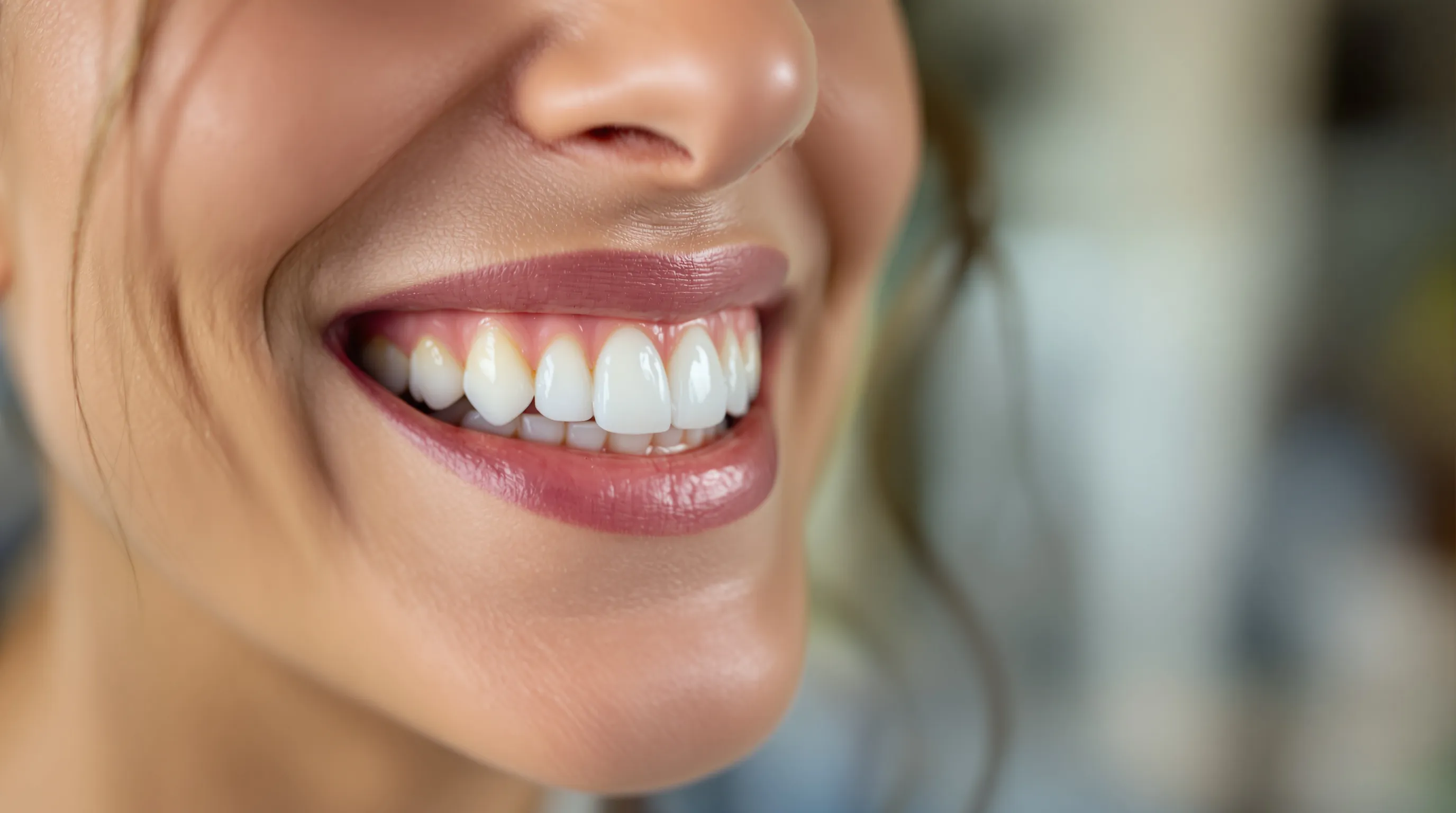
A gap between your two front teeth: clinically called a midline diastema: affects roughly 1 in 10 adults, and most cases can be fully hidden in a single dental appointment using composite bonding. Porcelain veneers close gaps in 2 to 3 weeks. Clear aligners show visible progress within 4 to 8 weeks for smaller gaps. This guide explains which treatment fits your timeline, your gap size, and your budget, and why DIY rubber band fixes are genuinely dangerous.
Questions this article answers
- Can dental bonding close a front tooth gap in one appointment?
- How long do porcelain veneers take to close a gap?
- Are rubber band gap fixes safe to try at home?
Quick Answer
The short answer: Yes, you can hide a gap between your two front teeth in under 90 days: and in most cases, in a single afternoon. Dental bonding is completed in one 60-to-90-minute appointment per tooth and produces same-day results for gaps of 2mm or less. Porcelain veneers require 2-3 appointments over 2-3 weeks. Clear aligners show meaningful gap reduction within 90 days for small gaps, though full closure of larger gaps takes 6-18 months. The right treatment depends on three things: how wide your gap is, whether your bite also needs correction, and how long you want the result to last. Keep reading for a side-by-side breakdown of every option, including what not to do.
What Causes a Gap Between the Two Front Teeth?
Before choosing a treatment, it helps to understand why the gap is there. The most common cause of a midline diastema is an oversized labial frenum. The small band of tissue that runs from the inside of your upper lip down to your gums. When this tissue is too thick or attaches too low between the two central incisors, it physically blocks the teeth from coming together.
Other frequent causes include:
- Genetics and natural tooth size, If your teeth are proportionally smaller than your jaw, gaps can form throughout your mouth, most visibly in the front
- Missing or undersized lateral incisors. The teeth on either side of your front two shift the central incisors apart when they are absent or narrow
- Childhood habits, Prolonged thumb-sucking or tongue-thrust swallowing patterns push the front teeth forward and apart during development
- Gum disease, Advanced periodontal disease causes bone loss, allowing teeth to flare and drift, a pattern most commonly seen in the lower front teeth but possible anywhere
- Post-orthodontic relapse, Teeth that were straightened with braces and then lost retainer compliance will drift back toward their original position, including reopening a gap that was previously closed
Why does the cause matter? If an oversized frenum is the root cause and it isn't addressed before cosmetic treatment, gaps treated with bonding or clear aligners often reopen within a few years. A simple in-office procedure called a frenectomy, which typically takes under 30 minutes, removes the restrictive tissue. Dentists at practices like Imagine Dental Arts in Lawrenceville, NJ evaluate frenum attachment at every cosmetic consultation as standard protocol, so treatment results are built to last.
Can Dental Bonding Really Close a Gap the Same Day?
Yes: and for most patients, dental bonding is the fastest way to hide a front tooth gap without orthodontics. As one dental educator explains, composite resin bonding is "the fastest, easiest and most economical method" for diastema correction. The procedure uses composite resin, the same tooth-colored material used for white fillings, sculpted directly onto the inner edges of both front teeth to fill the space between them. A typical bonding appointment for a front tooth gap takes 60 to 90 minutes per tooth and produces visible results in a single visit.
How Dental Bonding Works Step by Step
- Shade matching, Your dentist selects a composite resin color that matches your natural enamel exactly, referencing a shade guide under natural light
- Surface preparation. The tooth surface is lightly etched with a mild phosphoric acid gel: no drilling required, and most patients need no anesthesia
- Bonding agent application, A liquid bonding agent is applied and cured with a UV light to create a microscopic grip on the enamel
- Resin sculpting, Composite resin is applied in layers, each cured under UV light, and hand-sculpted to reshape the tooth edge with precision
- Finishing and polishing. The bonded area is trimmed, smoothed, and polished until it's visually indistinguishable from natural enamel
Bonding works best on gaps of 2mm or less. For gaps between 2mm and 4mm, bonding is still possible but each tooth must be widened more substantially. One important clinical consideration: closing just the two central incisors without also reshaping the adjacent lateral incisors can create a disproportionate result where the front teeth look too wide. An experienced cosmetic dentist evaluates proportions and may widen the lateral incisors as well to achieve a natural-looking smile.
Gaps larger than 4mm typically need clear aligners to first move the teeth closer before bonding finishes the result. For patients with smaller gaps, bonding offers a cost range of $300 to $800 per tooth and a lifespan of 5 to 10 years with proper care, making it the clear 90-day solution for the right candidate.
Front Tooth Gap Treatment Options at a Glance
| Treatment | Time to Results | Cost Per Tooth | Lifespan | Best For |
|---|---|---|---|---|
| Dental Bonding | Same day (60-90 min) | $300, $800 | 5-10 years | Gaps ≤2mm, fastest results |
| Composite Veneers | 1-2 weeks (1-2 visits) | $500, $1,200 | 5-7 years | Gaps with surface imperfections too |
| Porcelain Veneers | 2-3 weeks (2-3 visits) | $900, $2,500 | 10-20 years | Gaps 2-4mm, long-term investment |
| Clear Aligners | 4-8 weeks early progress; 6-18 months full | $3,000, $8,000 total | Permanent (with retainer) | Gaps >2mm, bite correction needed |
| Traditional Braces | 12-24 months | $3,000, $7,000 total | Permanent (with retainer) | Complex alignment and bite issues |
How Do Porcelain Veneers Compare for Hiding a Front Tooth Gap?
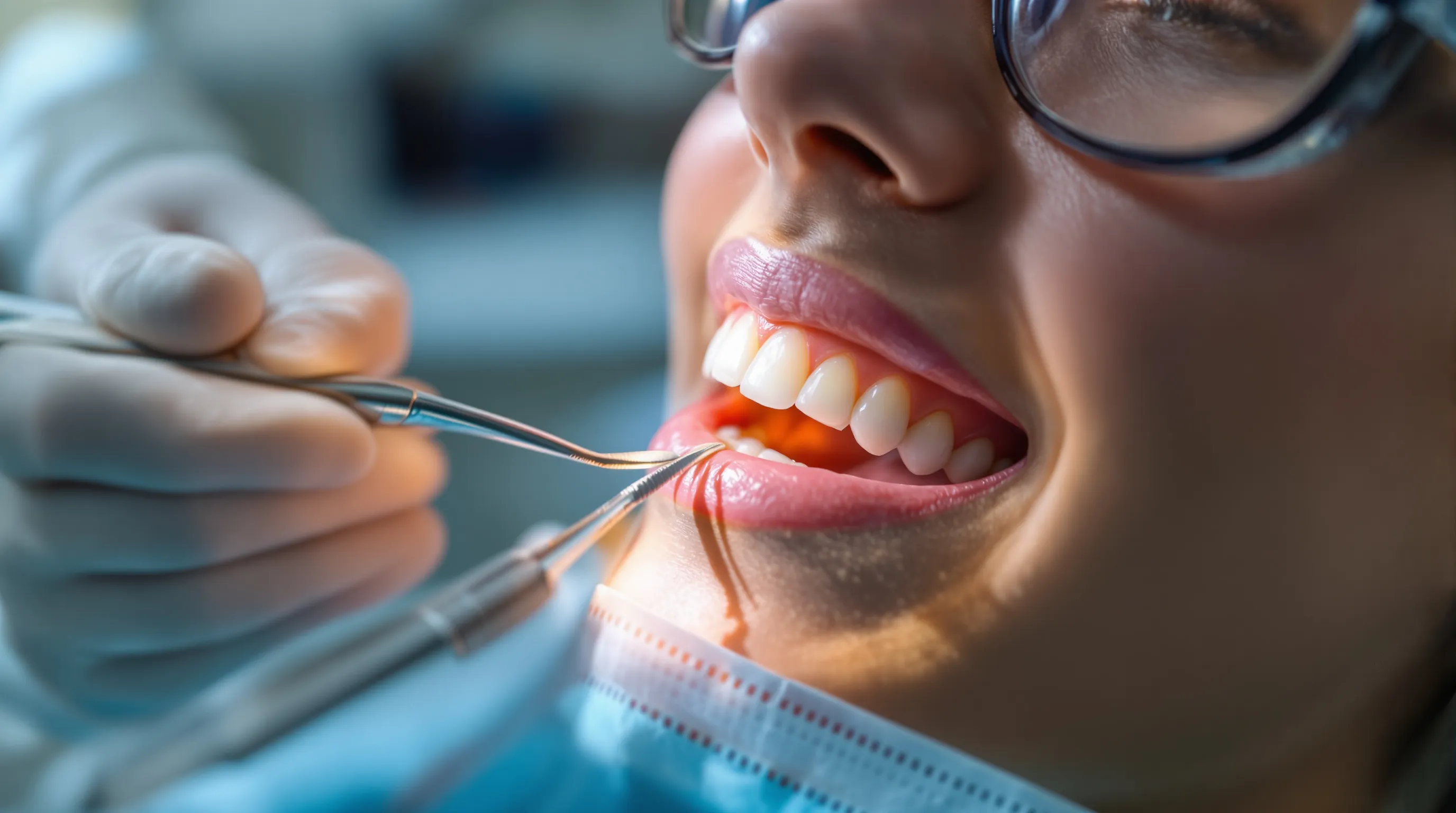
Porcelain veneers are ultra-thin ceramic shells, typically 0.5mm to 0.7mm thick. That are permanently bonded to the front surface of your teeth.
Unlike bonding, which adds material only to the inner edges of your existing teeth, veneers cover the entire visible face of each tooth, allowing your dentist to reshape size, color, and spacing in one comprehensive procedure.
The veneer process spans two or three appointments over 2 to 3 weeks:
- Consultation and digital planning. Your dentist takes impressions or digital scans and designs the final smile using shade guides and digital smile design software
- Tooth preparation and temporaries, A thin layer of enamel (0.3mm-0.7mm) is removed from the front of each tooth to create space for the veneer. Temporary veneers are placed while the lab fabricates your permanent set over 1-2 weeks.
- Veneer delivery and bonding. Your permanent porcelain veneers are tried in, adjusted for fit and shade, then permanently cemented with a strong resin adhesive and light-cured
Porcelain veneers last 10 to 20 years compared to 5 to 10 years for composite bonding, making them far more cost-effective over time despite the higher upfront investment of $900 to $2,500 per tooth. They are stain-resistant and maintain their polished surface far longer than composite resin. For patients wondering about the best dentist for veneers and smile makeovers in Mercer County, NJ, Imagine Dental Arts offers full porcelain veneer services from consultation through final placement.
When Are Porcelain Veneers the Better Choice Over Bonding?
- Your gap is between 2mm and 4mm and bonding alone would make the central teeth look disproportionately wide
- You also want to correct tooth discoloration, chips, or irregular shape at the same time as the gap
- You want a longer-lasting result and plan to maintain veneers for 15 or more years
- You're comfortable with the permanent nature of the treatment: because enamel is removed, veneers are a lifelong commitment
For patients wanting the fastest possible result with a smaller gap, same-day bonding remains the better choice for the 90-day timeline. For patients whose gap is larger or who want a complete smile transformation, the 2-3 week porcelain veneer timeline still easily fits within the 90-day window, and delivers results that hold for a decade or more.
Will Clear Aligners Close My Gap Within 90 Days?
Clear aligners like ClearCorrect can close a diastema permanently, but the timeline depends on gap width. For gaps of 1mm or less, many patients see complete or near-complete closure within 10 to 12 weeks of starting treatment. For gaps of 2mm to 4mm, expect meaningful visible progress: typically 40% to 60% gap reduction: within 90 days, with full correction requiring 6 to 12 months. Gaps exceeding 4mm typically need 12 to 18 months of treatment.
Reddit users in the r/Invisalign community confirm this real-world experience: one patient reported completing treatment for a "large gap" and being "extremely happy" with results, while noting that the decision to close versus partially retain a gap is deeply personal. One clinician in the same community noted: "I leave gaps for patients all the time, just ask." The point is that modern clear aligner treatment is customizable. You can request a small residual gap if that is your preference.
Clear Aligners vs. Dental Bonding: Side-by-Side
| Factor | Clear Aligners | Dental Bonding |
|---|---|---|
| Ideal gap size | Any size, especially >2mm | Best for ≤2mm gaps |
| Corrects bite issues | Yes | No |
| Modifies tooth structure | No (fully reversible) | Minimal, reversible |
| Full results in 90 days | Only for gaps ≤1mm | Yes, same day |
| Long-term maintenance | Nightly retainer wear | Re-polish every 1-2 years |
| Total cost | $3,000, $8,000 | $600, $1,600 (2 teeth) |
The two approaches are not mutually exclusive. A common treatment strategy used by cosmetic dentists is to use clear aligners to bring the teeth 80% to 90% of the way together, then finish with dental bonding to eliminate any remaining gap while also improving the shape and length of the front teeth. This combination approach delivers the most natural-looking result for medium to large gaps and is an option worth discussing at your smile consultation.
What Are the Risks of DIY Gap Fixes Like Rubber Bands and Snap-On Veneers?
Online searches for home gap-closing methods surface two approaches that are widely shared but genuinely dangerous. Neither rubber gap bands nor snap-on veneers are safe, effective, or a substitute for professional dental care.
Why Rubber Gap Bands Are Dangerous
Rubber gap bands are small elastic bands, typically sold as orthodontic or hair accessories, that people wrap around two front teeth in an attempt to pull them together. They can produce visible movement in as few as two weeks in some cases, which is exactly what makes them seem credible. The problem is physics and anatomy: wrapping a rubber band around two teeth applies uneven force that can drive the band upward along the root, cutting through gum tissue and migrating into the bone.
Dental literature documents multiple cases of patients requiring tooth extraction after rubber band use because the elastic migrated below the gum line and destroyed the bone supporting the teeth. A Medium dental guide cautions directly: "The bands may get stuck in your gum line. This can cause food particles and germs to accumulate and could cause a gum infection. If it's left unattended, your teeth could get loose." The same guide notes that patients who lost a tooth to DIY band complications often paid three times the original treatment cost for replacement. There is no safe way to use gap bands at home.
Why Snap-On Veneers Fall Short
Snap-on veneers are thin plastic trays designed to slip over existing teeth. They may visually hide a gap for a short time, but come with significant drawbacks:
- They don't fit precisely and shift with every bite, creating an unnatural appearance while speaking or eating
- They trap bacteria and food debris against your teeth, accelerating decay underneath
- They do nothing to address the underlying gap and must be removed to eat most foods
- The plastic material yellows and degrades within weeks under normal use conditions
If cost is driving interest in DIY fixes, it's worth knowing that dental bonding for two front teeth typically costs $600 to $1,600 total. Many dental practices offer financing plans that spread the cost over 12 to 24 months, and some dental insurance plans cover a portion of bonding when it addresses structural concerns.
How Do You Keep a Front Tooth Gap Closed After Treatment?
Long-term results depend on follow-through after your appointment. The specific maintenance varies by treatment type, but one principle applies across all of them: teeth have a biological memory and will drift back toward their original position without retention measures in place.
After Dental Bonding
- Avoid biting hard objects directly with the bonded area: ice, hard candy, and fingernails chip composite resin more easily than natural enamel
- Use a non-abrasive toothpaste to avoid dulling the resin surface polish over time
- Schedule a polish and check-up every 12 to 18 months. Your dentist can refresh the surface and catch any edge wear early
- Expect re-bonding every 5 to 10 years as the composite ages naturally
After Porcelain Veneers
- Avoid extremely hard foods that could fracture the ceramic
- Wear a custom night guard if you grind your teeth, bruxism is the primary cause of veneer failure and porcelain does not flex the way natural enamel does
- Maintain regular cleanings every 6 months; porcelain itself won't decay but the margins can accumulate plaque that causes underlying tooth loss
After Clear Aligner Treatment
- Wear your retainer every night, indefinitely, as orthodontist researcher Robert Rudman notes, "teeth and teeth roots want to spring back into their former positions, even years later" without retention
- If your gap was caused by an oversized frenum and a frenectomy was not performed, the risk of relapse is significantly higher, confirm this with your provider
- Replace retainers every 1 to 3 years as the material wears with regular use
The single biggest predictor of long-term success is consistent maintenance compliance. Patients who wear their retainer as prescribed and keep their annual check-ups maintain their results for decades. Skipping this step, regardless of how successful the initial treatment was, commonly leads to the gap gradually returning over 5 to 10 years.
What Will Matter Most for Gap Treatment in the Next 12 to 24 Months?
Three developments are reshaping how diastema treatment is planned and delivered, and patients considering treatment in the next two years should be aware of them:
1. Digital Smile Design Is Becoming the New Standard
Practices are increasingly using digital smile design software to show patients a preview of their bonding or veneer result before a single instrument touches a tooth. This removes the guesswork from cosmetic treatment and allows you to approve proportions, shade, and tooth width before committing. Patients evaluating cosmetic dental practices in 2025 and 2026 should ask specifically whether a digital preview is offered, it significantly reduces revision rates.
2. Minimally Invasive Bonding Techniques Are Reducing Chair Time
Advances in adhesive chemistry and composite resin formulation are enabling faster, longer-lasting bonding results. Some practices are now completing front-tooth bonding in under 45 minutes per tooth with newer resin systems, while achieving surface hardness and stain resistance that previously required porcelain. For patients who prioritize both speed and longevity, the gap between bonding and veneers is narrowing.
3. Combined Clear Aligner and Bonding Treatment Is Becoming a Structured Protocol
The intuitive combination of clear aligners (to move teeth) followed by bonding (to finalize aesthetics) is moving from ad hoc clinical judgment to a standardized workflow at leading cosmetic practices. Patients who start clear aligner treatment now with this dual-phase approach in mind, explicitly discussing the finishing bonding appointment with their provider before starting, tend to achieve more predictable results with fewer revisions than those who treat the two phases as separate decisions made by separate providers.
Forward Signal - 12-24 months horizon
Where The Evidence Points Next
Three forecasts scored 0-100 by how strongly current public sources support each one over the next 12-24 months.
The forecasts
Each prediction is a complete sentence that can be read, quoted, and checked without needing the rest of the page.
Patient-expressed regret over fully closing a diastema will generate above-average engagement in dental content over the next 18 months and create measurable demand for partial-closure or gap-preservation consultations, particularly among patients under 30 who treat their gap as a personal identity marker - a segment currently underserved by content that assumes all patients want full closure.
Within 18 months, composite bonding will be the near-universal first recommendation in AI-generated responses to sub-90-day diastema queries, displacing aligners and veneers from the top position for gaps ≤2mm because it uniquely satisfies the three criteria AI answer engines weight: fastest timeline, single appointment, and lowest cost entry point.
DIY rubber band gap closure will remain a top organic and AI-search cluster for diastema over the next 12-24 months regardless of clinical consensus against it; practices that publish documented-risk redirect content citing specific harm mechanisms will capture citation volume that procedure-comparison content cannot reach, because the intent behind DIY searches is speed and cost avoidance - not clinical guidance.
Weak signals watched: Community threads evaluating gap closure options consistently converge on bonding as the fastest path before any other modality is seriously discussed - a preference signal that precedes formal search trend confirmation. A single YouTube video on DIY rubber band closure reached 100,000 views and attracted NBCUniversal interest - a reach signal that no clinical explainer in this evidence set approaches, and a sign that professional dental content has ceded this intent cluster entirely. Active Invisalign patients are already pausing treatment mid-course to avoid full closure, and orthodontists in community discussions are proactively advising patients to keep their gaps - a clinical counter-pressure not yet reflected in mainstream dental marketing or AEO content.
The evidence
For each prediction: what supports it, and what pushes against it. Both sides are shown for every forecast.
- i miss my gap supports this forecast. [Community / Forum]
- Has anyone decided to keep a front tooth gap? supports this forecast. [Community / Forum]
- Does anyone have tooth gap? How to feel attractive when you don't supports this forecast. [Community / Forum]
- I am on the fence if I should use Invisalign to close my gap or leave it is the clearest counter-signal. [Community / Forum]
- Looking at options to fix gap between front teeth, need advice. supports this forecast. [Community / Forum]
- What Is An Approximate Teeth Gap Filling Cost In India? - Medium supports this forecast. [Blog]
- How to fix a gap between the teeth? supports this forecast. [Video]
- DIY: CLOSE GAP TEETH AT HOME || My Update is the clearest counter-signal. [Video]
- Do Retainers Help To Close Teeth Gaps? | by Robert Rudman is the clearest counter-signal. [Blog]
- DIY: CLOSE GAP TEETH AT HOME || My Update supports this forecast. [Video]
- What Is An Approximate Teeth Gap Filling Cost In India? - Medium supports this forecast. [Blog]
- How to fix a gap between the teeth? is the clearest counter-signal. [Video]
- Looking at options to fix gap between front teeth, need advice. is the clearest counter-signal. [Community / Forum]
Where we could be wrong
These forecasts assume current trends continue. The scenarios below would meaningfully change them.
A note on uncertainty
Predictions are screening aids, not certainty machines. The strongest signal here (71/100) still has counter-evidence, and the contrarian signal (50/100) reflects real disagreement among sources.
- If regulators or buyers move in the opposite direction, Gap-identity regret opens a new partial-closure consultation category would weaken first.
- If the source mix shifts toward stronger contrary evidence, DIY rubber band content becomes the largest unaddressed top-of-funnel vector in this topic could become the more durable forecast.
A gap between your two front teeth is one of the most treatable cosmetic dental concerns, and one of the most rewarding to correct. For most patients, the decision comes down to two questions: how fast do you need results, and how long do you want them to last? Same-day dental bonding answers both for patients with smaller gaps and a budget-friendly approach. Porcelain veneers answer both for patients wanting a transformation that holds for 10 to 20 years. Clear aligners are the right path when bite correction matters as much as aesthetics.
Whatever approach fits your situation, the one thing that makes the gap come back is skipping maintenance, whether that's retainer wear after orthodontics or a polish appointment after bonding. Explore dental bonding and cosmetic treatments at Imagine Dental Arts to get an honest evaluation and a plan that fits your timeline.
Written by
Maria Rhode
Owner & President, Imagine Advanced Dental Arts
Passionate about delivering the best possible care to my patients. From my days in residency to owning a beautiful hi-tech dental office, I never stop learning and advancing myself and now my practice.
Connect on LinkedInSummarize This Article With AI
Open this article in your preferred AI engine for an instant summary.
Frequently Asked Questions
How much does it cost to close a gap between front teeth?
Dental bonding costs $300 to $800 per tooth, meaning a two-tooth gap closure runs $600 to $1,600 total. Porcelain veneers cost $900 to $2,500 per tooth. Clear aligner treatment for diastema closure typically costs $3,000 to $8,000 for the full course. Many dental practices offer 0% financing, which can spread the cost of bonding over 12 to 24 monthly payments.
Can a front tooth gap close naturally on its own?
Rarely, and typically only in children whose permanent teeth are still erupting. In adults, a diastema does not close on its own and often widens gradually over time, especially if gum disease or an oversized frenum is the underlying cause. Waiting generally makes treatment more complex, not simpler.
Does dental bonding look natural on front teeth?
Yes, in the hands of an experienced cosmetic dentist. Modern composite resin can be shade-matched and sculpted to be visually indistinguishable from natural enamel, including mimicking the translucency near the tooth edge. The most important factor is choosing a dentist with specific experience in anterior (front tooth) bonding aesthetics.
Will a front tooth gap come back after bonding?
It can, particularly if the underlying cause, such as an oversized frenum, was not addressed before treatment. Bonding itself is stable for 5 to 10 years with proper care, but teeth have a biological tendency to drift. Having a frenectomy if needed, and wearing a retainer if recommended, dramatically reduces the chance of recurrence.
Is dental bonding for a gap permanent?
Dental bonding is long-lasting but not permanent. The composite resin material typically needs to be refreshed or replaced every 5 to 10 years as it chips, stains, or wears at the margins. Porcelain veneers are longer-lasting at 10 to 20 years and are the more permanent option if longevity is your priority.
What is the fastest way to close a gap between front teeth?
Dental bonding is the fastest available treatment. It can be completed in a single appointment lasting 60 to 90 minutes per tooth, with results visible immediately. It works best for gaps of 2mm or less. For gaps up to 4mm, porcelain veneers (2-3 weeks) or a combination of clear aligners followed by bonding are typically recommended.
How this article was created
This article was researched and written with the assistance of AI content tools. All clinical information has been reviewed for accuracy and reflects current dental practice standards. For personalized dental advice, consult a licensed dental professional.