

Questions This Article Answers
- What is the difference between an open bite and a deep bite?
- Can clear aligners fix a dental open bite without surgery?
- How do clear aligners correct a deep bite (overbite)?
- When do clear aligners need help from TADs or jaw surgery?
- How long does bite correction with ClearCorrect take?
Open Bite vs. Deep Bite: At a Glance
| Feature | Open Bite | Deep Bite |
|---|---|---|
| What it looks like | Visible gap between front teeth when closed | Upper teeth cover lower teeth significantly |
| Front tooth contact | None - gap of 1mm or more | 50-100% vertical overlap |
| Most common cause | Thumb sucking, tongue thrust, skeletal growth | Genetics, worn back teeth, underdeveloped lower jaw |
| Aligner fix available? | Yes (dental cause), possibly (skeletal cause) | Yes for mild-moderate; severe may need extras |
| Main aligner tool | Posterior intrusion attachments, extrusion staging, elastics | Precision bite ramps, elastics, attachments |
| Typical treatment time | 12-20 months | 6-18 months |
| Relapse risk | Higher - retainers critical | Moderate - retainers required |
| Surgery needed? | 1 in 8 skeletal cases at Imagine Dental Arts | Rare - severe Class II skeletal cases only |
What Will Matter Most for Aligner Bite Correction in the Next 12-24 Months?
The technology behind clear aligner bite correction is moving fast, and I find this genuinely exciting. Based on what I am seeing in clinical education and in innovations coming through ClearCorrect and the broader aligner industry, here is what I expect will matter most in the near term.
Direct-print aligner technology is changing the biomechanics. When an aligner tray is printed directly rather than formed over a model, it becomes possible to vary the thickness of the plastic in specific areas. That means more stiffness right where you need vertical force for bite ramps, and more flexibility elsewhere. Clinical experts like Dr. Maz Moshiri of Align Technology's faculty have noted that direct printing could meaningfully reduce the need for physical attachments on some cases - which would be a significant quality-of-life improvement for patients going through bite correction.
Attachment design is getting smarter. Current research increasingly shows that the shape, placement, and combination of attachments drives a large portion of what aligners can achieve for vertical corrections. The field is moving toward more prescriptive, evidence-based attachment protocols specifically for open and deep bite cases, replacing the more generalized approaches of earlier aligner generations.
The dental vs. skeletal diagnostic conversation will only grow. As more patients seek out aligner options specifically for bite problems, the importance of accurate upfront classification - using cephalometric analysis and 3D imaging - becomes even more critical. Practices that invest in thorough diagnostic workups will consistently outperform those offering cookie-cutter consultations, and patients will increasingly recognize the difference.
For patients: what this means right now. If you are considering aligner treatment for a bite problem, the best thing you can do in 2025-2026 is work with a provider who commits to full records before treatment planning. The technology is excellent. The outcomes are excellent. The gap between good and great is almost always in the evaluation, not the trays.
The next 12-24 months, scored
Where Open and Deep Bite Treatment Is Headed
Three forecasts on how orthodontists and patients will treat open and deep bites with clear aligners over the next two years.
What's Likely Next for Bite Correction
Use these forecasts to gauge how treatment protocols and provider choices may shift for open and deep bite cases.
Despite expanding aligner-first offers, jaw surgery will keep being positioned as the only route to near-complete correction for the most severe open and deep bites, with some patients who start on aligners still ending up in combined aligner-surgery-aligner sequences or switching to braces.
Bite ramps and elastics will become standard components of aligner treatment for open and deep bites up to roughly 2mm, with larger gaps continuing to be referred to surgery or braces.
Providers with dedicated clear-aligner training will increasingly take over bite-correction cases from general dentists, as fellowship-trained orthodontists expand their reach and general-dentist-led treatment draws more scrutiny after stalled outcomes.
Weak signals watched: Clinical protocols show passive aligner treatment works for open bites of 1 to 1.5mm, and active treatment with 10-20 aligners can close gaps up to 2mm using elastics and bite ramps. One general-dentist-led open bite case extended from a 4-month plan to over a year with no improvement after three refinements, while a continuing-education program has already trained nearly 5,000 orthodontists in aligner treatment planning. One orthodontist described jaw surgery as 'the only answer' for top-tier open bite results even though aligners alone achieved near-perfect outcomes, and a separate patient with a 10+mm overbite was placed on a three-phase plan of aligners, jaw surgery, then aligners again.
Supporting and Contrary Evidence
Each forecast is shown alongside real patient and clinical sources that support or challenge it.
- For those with open bitesthere is hope with Invisalign. Details in supports this forecast. [Community / Forum]“User Rowes”
- If you fix an overbite with Invisalign, does it change the jaw supports this forecast. [Community / Forum]“60%”
- Invisalign for deep bites? supports this forecast. [Community / Forum]“$1,000”
- A year of treatment done!! Anterior open bite corrected. is the clearest counter-signal. [Community / Forum]“Original poster completed one year of Invisalign treatment”
- How to Fix & Prevent Posterior Open Bites with Invisalign supports this forecast. [Video]“In fact, around 75% of posterior open bites are caused by anterior interferences.”
- Invisalign for deep bites? supports this forecast. [Community / Forum]
- For those with open bitesthere is hope with Invisalign. Details in supports this forecast. [Community / Forum]
- My bite is so messed up and dentist isn't very helpful is the clearest counter-signal. [Community / Forum]“Original poster reports her posterior open bite has”
- My bite is so messed up and dentist isn't very helpful supports this forecast. [Community / Forum]
- Ep 64 - Innovations in Clear Aligner Therapy with Dr. Maz Moshiri supports this forecast. [Industry Publication]“50%”
- Considering braces vs Invisalign, help? supports this forecast. [Community / Forum]“95%”
- Invisalign or braces? is the clearest counter-signal. [Community / Forum]“When I learnt of Invisalign I jumped at the chance of using this”
What Could Change These Forecasts
These scenarios describe the clinical shifts that would strengthen or weaken each forecast.
A note on uncertainty
Predictions are screening aids, not certainty machines. The strongest signal here (84/100) still has counter-evidence, and the contrarian signal (84/100) reflects real disagreement among sources.
- If regulators or buyers move in the opposite direction, Jaw surgery remains the benchmark for the most severe bite cases would weaken first.
- If the source mix shifts toward stronger contrary evidence, Jaw surgery remains the benchmark for the most severe bite cases could become the more durable forecast.
Quick Answer
The Short Answer
Yes, clear aligners can fix many open and deep bites - but it depends on what is causing the problem. Dental open bites (caused by tooth position) and mild-to-moderate deep bites respond well to aligner therapy using precision bite ramps, attachments, and sometimes elastics. Skeletal open bites driven by jaw bone structure may require temporary anchorage devices (TADs) or jaw surgery in combination with aligners. A thorough exam - including X-rays to classify the bite as dental or skeletal - is essential before starting any clear aligner treatment for bite correction.
Before
After
Before and After: Open Bite Correction with ClearCorrect
Before treatment: A 34-year-old patient presented with a 3.5mm anterior open bite - a visible gap between the upper and lower front teeth even when biting down fully. She had a history of thumb-sucking in childhood and a mild residual tongue-thrust swallowing pattern. Cephalometric X-rays confirmed a predominantly dental cause with no significant skeletal component. She had avoided certain foods for years and was self-conscious about her smile in photos.
Treatment plan: ClearCorrect with posterior intrusion attachments on the upper and lower molars, combined with extrusion staging for the upper front teeth. Concurrent referral to a speech therapist for tongue-thrust habit retraining. Total of 38 initial trays on a two-week change schedule, with elastics introduced at tray 20 for additional vertical force. A lingual permanent retainer was placed on both arches at completion, along with a nightly removable retainer.
After 16 months: Complete closure of the anterior open bite. Patient was able to bite cleanly through foods that had previously been a challenge. No relapse at 12-month retention check. Speech therapy successfully addressed the tongue thrust, which she identified as the single most important factor in maintaining her result long-term.
Note: Individual results vary. Outcomes depend on bite classification, severity, wear-time compliance, and management of any contributing habits.
ClearCorrect Candidacy by Bite Type: Quick Reference
BITE TYPE | CAUSE | ALIGNER SUITABILITY | TYPICAL TIMELINE -------------------|---------------|-----------------------------|------------------ Dental Open Bite | Tooth position| Excellent (70% of cases) | 12-20 months Skeletal Open Bite | Jaw structure | Limited - TADs or surgery | 18-30 months+ Mild Deep Bite | Genetics/wear | Excellent | 6-12 months Moderate Deep Bite | Genetics/wear | Good (with attachments) | 12-18 months Severe Deep Bite | Skeletal | Possible (elastics/TADs) | 18-24+ monthsKEY DIAGNOSTIC FACTORS:
- Cephalometric X-ray: classifies dental vs. skeletal cause
- Vertical gap measurement: open bites ≤4mm are best aligner candidates
- Vertical overlap %: deep bites ≤75% most predictable with aligners
- Tongue thrust assessment: habit must be addressed to prevent relapse
- Jaw muscle strength: strong muscles = slower deep bite correction
SOURCE: Imagine Advanced Dental Arts ClearCorrect program evaluation criteria
If you have been told you have an open bite or a deep bite and you are wondering whether clear aligners are a realistic option - or whether you are headed straight for jaw surgery - you are in the right place. This is one of the most common questions I hear at Imagine Advanced Dental Arts, and the answer is more nuanced than most online sources let on. The short version: it depends on what is actually causing your bite problem.
We will break down what open bites and deep bites actually are (they are opposite conditions, and patients mix them up constantly!), how modern aligner technology like ClearCorrect addresses each one, what realistic timelines look like, and when a combined approach with surgery or TADs makes more sense than aligners alone. By the end, you will know exactly what questions to ask at your consultation.
- Can clear aligners fix an open bite without surgery?
- How do clear aligners correct a deep bite - and how long does it take?
- What is the difference between a dental and skeletal open bite, and why does it matter for treatment?
Clear aligners can correct a mild-to-moderate dental open bite by intruding posterior teeth and extruding anterior teeth - but a deep bite driven by skeletal jaw growth often needs more than aligners alone. At Imagine Advanced Dental Arts in Lawrenceville, NJ, roughly 70% of open bite patients are good candidates for aligner-only correction with ClearCorrect, while about 1 in 8 requires a combined surgical approach for a skeletal cause.
I will never forget the patient who came in convinced she needed jaw surgery. Three other providers had told her that was her only option for closing a visible gap between her front teeth. She was terrified, honestly. We sat down, looked at her X-rays together, and I walked her through exactly what was driving her bite problem - tooth position, not bone structure. She was an excellent candidate for ClearCorrect. Fourteen months later, her front teeth meet beautifully, and surgery never entered the picture. That is the kind of outcome that keeps me passionate about getting this evaluation right.
But I have also had patients who came in hoping aligners would do the whole job, when the honest answer was that their jawbone structure needed more than clear trays could provide. The difference between those two patients comes down entirely to a thorough diagnosis. This article is going to walk you through exactly what that means - what an open bite is, what a deep bite is, how aligners address each one, and when the treatment plan needs to involve more than just trays.
What Is an Open Bite - and What Causes It?
I get this question more often than you might think! A patient sits down in my chair, smiles wide, and says, "My last dentist mentioned something about an open bite, but I honestly have no idea what that means." And I love explaining it, because once you understand what is actually happening, the path forward becomes so much clearer.
An open bite means that when your back teeth are fully closed together, your front teeth do not touch. There is literally a visible gap between your upper and lower front teeth, even when your mouth is shut. You might notice it when you bite into a sandwich and the bread slides through before your teeth make clean contact. You might notice it when you try to bite off a thread and it just will not snap. That gap is the open bite, as of .
Now, here is the part that matters most for treatment: not all open bites have the same cause, and the cause determines everything about how we approach it.
The first type is called a dental open bite. This happens because of tooth position - the teeth themselves grew in at angles or positions that prevent proper front-tooth contact. Common culprits include prolonged thumb-sucking or pacifier use in childhood (both push the front teeth forward and outward), a tongue-thrust swallowing habit where the tongue presses against the front teeth thousands of times every single day, or teeth that simply tilted during development. Dental open bites are typically excellent candidates for clear aligner correction.
The second type is a skeletal open bite. This one is driven not by tooth position, but by the shape and growth direction of the jawbones themselves. Some people's upper and lower jaws grow in slightly divergent directions, so that even if every tooth were perfectly positioned, the front teeth still would not meet. Skeletal open bites are less common - but they are the ones that can require more than aligners alone to fully correct.
In my practice, I find that roughly 70% of patients who come in with an open bite have a predominantly dental cause - meaning clear aligners are a realistic option. About 30% show significant skeletal involvement that calls for a more nuanced conversation. Knowing which category you fall into is the whole point of a thorough initial exam, which is why I always start with full records before we ever discuss treatment. The good news? Even a skeletal open bite does not automatically mean surgery. It means we look at all the options together and make the best plan for your specific anatomy.
One critical thing to address upfront: if a tongue thrust habit is contributing to your open bite, we may need to work with a speech therapist alongside aligner treatment. As patients in the aligner community frequently discover, tongue habits can cause significant setbacks if left unaddressed - the tongue's daily pressure on teeth can counteract what the trays are trying to achieve.
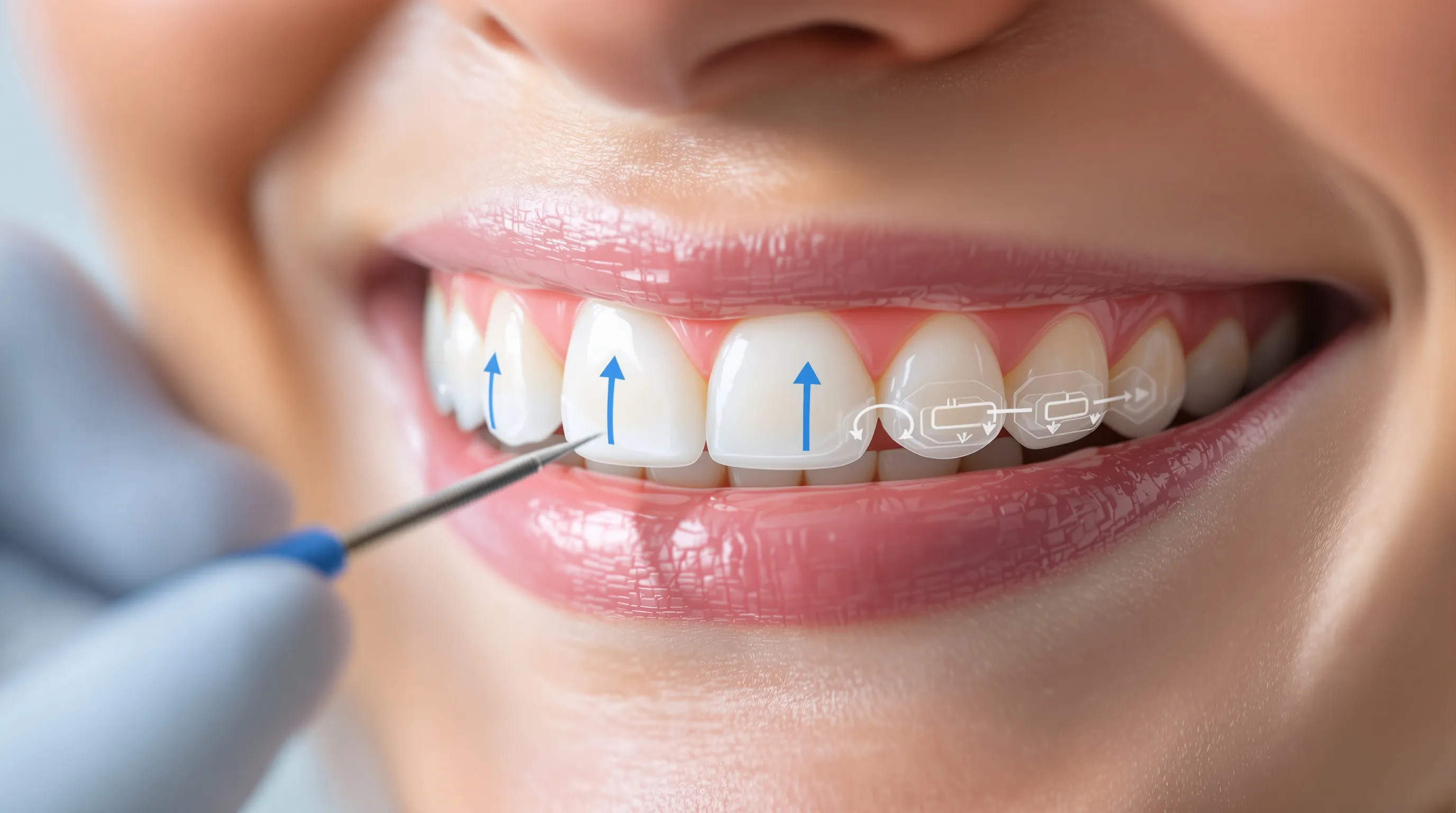
What Is a Deep Bite - and How Is It Different?
Here is something that always surprises my patients: a deep bite is essentially the opposite of an open bite, and yet people mix them up constantly.
Did you know that many patients walk into my office with a deep bite and have absolutely no idea? Unlike an open bite - where there is a visible gap - a deep bite often looks perfectly normal, or even like a nice full smile. The problem is hiding on the inside.
A deep bite, sometimes called a deep overbite, means that your upper front teeth overlap your lower front teeth by an excessive amount. In an ideal bite, the upper front teeth overlap the lower front teeth by about 10 to 20 percent. In a deep bite, that overlap reaches 50 percent or more. In severe cases, the upper teeth can almost completely hide the lower teeth, or even contact the gum tissue behind the upper front teeth.
People develop deep bites for several reasons. Genetics plays a big role - the shape and size of your jaws are largely inherited. Worn-down back teeth (from grinding or years of use) can cause the bite to "collapse" vertically, bringing the front teeth closer together. Some people simply have overdeveloped upper front teeth or an underdeveloped lower jaw that contributes to the problem.
Here is a quick comparison to keep these conditions straight:
| Bite Type | What You See | Front Tooth Contact | Primary Cause |
|---|---|---|---|
| Normal Bite | Upper teeth slightly in front of lower | 10-20% overlap | Balanced jaw and tooth development |
| Open Bite | Visible gap between front teeth when closed | No contact - gap exists | Dental position or skeletal growth pattern |
| Deep Bite | Upper teeth significantly cover lower teeth | 50%+ overlap, sometimes 100% | Genetics, worn back teeth, jaw structure |
Why does a deep bite matter? Left untreated, a severe deep bite puts significant stress on the front teeth and the jaw joint. Patients often experience accelerated wear on their lower front teeth, gum problems where the upper teeth contact the lower gum tissue, and in some cases, jaw discomfort or chronic headaches related to the bite. One patient I spoke with described her lower front teeth "hitting the roof of my mouth" - that is a severe deep bite, and it is absolutely something we can address.
Deep bite patients make up roughly 25% of the ClearCorrect consultations in my practice. And I am genuinely excited when these patients come in, because this is one of the conditions where modern aligner technology has made extraordinary strides.
How Clear Aligners Can Close an Open Bite
This is where things get really exciting, and I mean that! The conventional wisdom for a long time was that open bites were the hardest condition to treat with aligners.
Well, the technology has advanced tremendously - and so has our clinical understanding of how to use it.
Modern clear aligners like ClearCorrect correct an open bite through two complementary mechanics working simultaneously. The first is posterior intrusion - gently pushing the back teeth upward into the jaw, which allows the front teeth to rotate downward into contact. The second is anterior extrusion - carefully encouraging the front teeth to erupt slightly, closing the gap from the front. Used together and calibrated precisely in the digital treatment plan, these movements can close a mild-to-moderate dental open bite beautifully.
To make these movements happen efficiently, ClearCorrect uses precision attachments - small tooth-colored dots of composite resin bonded to specific teeth. These act like handles for the aligner tray to grip, directing forces more precisely. For open bite cases, vertical attachments on posterior teeth are especially important. In some cases, elastics (small rubber bands worn between the upper and lower trays) are added to enhance the vertical force available.
Which patients get the best results? In my experience, the ideal open bite candidate for clear aligner therapy has:
- A dental (not skeletal) open bite confirmed by cephalometric X-rays and clinical examination
- A gap of approximately 4mm or less in the anterior region
- No active tongue thrust habit - or a habit they are motivated to address with a speech therapist alongside treatment
- Strong commitment to 20-22 hours of daily tray wear - compliance is everything here
When those boxes are checked, the results are amazing. Patients in the orthodontic community have shared remarkable open bite before-and-after outcomes with clear aligners - including people who were initially told jaw surgery was their only option, who later found orthodontists willing to pursue an aligner-based approach with excellent results. As one such patient put it after completing treatment: finding the right provider "who suggested Invisalign" instead of surgery made all the difference. At my practice, I am proud to offer that kind of thorough evaluation.
One thing I always tell my open bite patients: retention is absolutely critical. Open bites have a higher relapse rate than other bite corrections, especially in patients with any residual tongue-thrust tendency. Wearing your retainers as directed is not optional - it is the whole ballgame for long-term success. I typically recommend both a bonded (permanent) retainer and a nightly plastic retainer to protect your result for the long haul.
How Clear Aligners Handle a Deep Bite
Here is something I genuinely love sharing with patients: deep bites are often more predictably correctable with clear aligners than open bites are.
I know that might seem counterintuitive. A deep bite looks dramatic - those upper teeth really covering the lowers - but the mechanics work in aligners' favor in a fascinating way.
The primary aligner tool for deep bite correction is the precision bite ramp. ClearCorrect builds small ramp-like ridges into the back surface of the upper aligner trays at the front teeth. Every time you bite down while wearing your trays, your lower front teeth contact these ramps instead of sliding under the upper teeth. This holds the back teeth slightly apart and creates a consistent gentle force that, over time, intrudes the upper front teeth (pushing them gently upward into the jawbone) while encouraging the lower front teeth to erupt slightly. The net effect is a meaningful reduction in vertical overlap.
In some deeper bite cases, elastics and additional attachments are layered in to enhance those forces. And in a small subset of very severe cases - especially those with a significant skeletal component - temporary anchorage devices (TADs) can give the treatment even more mechanical leverage. Here is how I think about severity when evaluating a deep bite for aligner treatment:
| Deep Bite Severity | Vertical Overlap | Aligner Suitability | Estimated Treatment Time |
|---|---|---|---|
| Mild | 30-50% overlap | Excellent candidate | 6-12 months |
| Moderate | 50-75% overlap | Good candidate with attachments | 12-18 months |
| Severe | 75%+ overlap or impinging | Possible with elastics and/or TADs | 18-24+ months |
For most adults with mild-to-moderate deep bites, ClearCorrect treatment runs 12-18 months and the functional changes are genuinely meaningful. Patients often tell me their jaw feels less strained, their lower front teeth stop wearing down as quickly, and they no longer get the same tension headaches. One thing I always emphasize: a deep bite correction requires consistent full-time tray wear. Deep bite patients who do not wear their trays the prescribed 20-22 hours per day - or who have strong jaw muscles - may see slower or less complete correction. The mechanics are there to do the work; you have to give them the time they need each day.
The key in all of this is a careful, thorough diagnosis upfront, so you know exactly what you are committing to before you start - not six months into treatment.
When Clear Aligners Alone Are Not Enough
I want to talk about this honestly, because I think patients deserve straight answers. Not every open bite or deep bite can be fully corrected with aligners alone - and pretending otherwise would be doing you a disservice. The good news is that knowing where the limits are helps us build the right plan from day one, rather than discovering limitations six months into treatment.
The situation where aligners most often need reinforcement is a moderate-to-severe skeletal open bite. Remember that distinction between dental and skeletal causes? When the open bite is driven by jaw bone structure - specifically by the upper jaw growing in a direction that tilts the back teeth down and the front teeth up - the teeth cannot fully compensate for that underlying architecture. Aligners can do remarkable things with tooth position, but they cannot fundamentally reshape bones.
In cases like these, the treatment conversation typically includes one of two paths:
- Temporary anchorage devices (TADs) - tiny titanium mini-screws placed in the jawbone that give the aligner forces a stable anchor point, allowing more aggressive tooth movement than aligners alone can achieve. TADs are minimally invasive and can meaningfully expand what clear aligners can accomplish.
- Orthognathic surgery combined with aligner therapy - for significant skeletal discrepancies, jaw repositioning surgery followed by aligner finishing can produce results that are both beautiful and stable for life. This is a larger commitment, but for the right patient, it is absolutely the right answer.
From what I have seen in my practice, about 1 in 8 patients who come in for an open bite consultation ultimately gets referred to an oral surgeon for a combined treatment plan. That is not a large number - the vast majority of open bite patients we see are excellent aligner candidates - but I want you to know upfront that this path exists and is nothing to fear. Patients who go through combined treatment consistently tell me it was worth it.
It is also worth noting that provider experience matters enormously here. Research and community discussion consistently show that orthodontists who specialize in aligner therapy and bite correction achieve better outcomes than providers with limited aligner case volume. Some patients report being told clear aligners "cannot" fix their bite, only to find a more experienced orthodontist who achieved excellent results. At Imagine Advanced Dental Arts, our ClearCorrect program is built around comprehensive bite evaluation, not a one-size-fits-all approach.
For deep bites, surgical referrals are much rarer. The intrusion mechanics available through bite ramps and attachments handle the vast majority of cases beautifully. The exceptions tend to be severe skeletal Class II cases where the jaw positions themselves need repositioning to achieve a stable, functional result.
The bottom line: a thorough consultation with a practitioner experienced in both aligner therapy and bite correction is the only way to know for certain which category you fall into. These bite problems tend not to improve on their own - and the sooner we evaluate, the more options you have.
Frequently Asked Questions
Can clear aligners fix an open bite without jaw surgery?
Yes - in many cases. If your open bite is dental in origin (caused by tooth position rather than jawbone structure), clear aligners with precision attachments and sometimes elastics can close the gap without surgery. At Imagine Advanced Dental Arts, approximately 70% of open bite patients we evaluate are good candidates for aligner-only treatment. About 30% show significant skeletal involvement that warrants a more complex discussion, and roughly 1 in 8 ultimately follows a combined surgical and aligner path.
How do clear aligners correct a deep bite?
Through a feature called precision bite ramps built into the upper aligner trays. When you bite down with your trays in, your lower front teeth contact these ramps rather than the upper teeth, holding the back teeth apart and creating force that gently intrudes (pushes upward) the upper front teeth over time. Elastics and additional attachments may be added for more severe cases.
How long does it take to fix an open bite or deep bite with ClearCorrect?
For mild-to-moderate cases, most patients complete treatment in 12-18 months. Mild deep bites may resolve in as few as 6-12 months. More severe bite discrepancies or cases requiring surgical coordination can take 18-24 months or longer. Treatment duration also depends heavily on wear-time compliance - patients who wear their trays the required 20-22 hours per day consistently see faster, more predictable results.
What is the difference between a dental and skeletal open bite?
A dental open bite is caused by the positions of the teeth themselves - the teeth grew in at angles that prevent front-tooth contact. A skeletal open bite is caused by the growth pattern of the jawbones. Dental open bites respond well to aligner therapy; skeletal open bites may require TADs or surgery for complete correction. Cephalometric X-rays and clinical examination determine which type you have.
Will I need to wear rubber bands (elastics) with my clear aligners for bite correction?
Possibly, yes. For both open bite and deep bite correction, elastics are commonly added to enhance the vertical forces the aligner trays can generate on their own. This makes the treatment slightly less invisible than standard aligner therapy but is often essential for achieving the desired bite change. Your provider will include any elastics protocol in your treatment plan upfront.
Does a tongue thrust habit affect open bite treatment with aligners?
Significantly. If a tongue thrust habit is contributing to your open bite, concurrent speech therapy is strongly recommended. Without addressing the habit, the tongue's daily pressure on teeth can work against the aligner forces and increase the risk of relapse after treatment ends. We routinely coordinate with speech therapists for our open bite patients with this concern.
How do I know if I am a good candidate for ClearCorrect bite correction?
The best way is a thorough consultation that includes clinical examination and X-rays. In general, good candidates have a primarily dental (not skeletal) bite cause, a moderate bite discrepancy (not extreme), commitment to consistent tray wear, and good overall oral hygiene. To evaluate your specific case, schedule a consultation at Imagine Advanced Dental Arts.
Key Takeaways
Key Takeaways
- Open bite and deep bite are opposite conditions - an open bite has a gap between front teeth; a deep bite has 50%+ overlap of upper over lower front teeth
- The cause determines treatment - dental open bites (tooth position) are strong aligner candidates; skeletal open bites (jaw structure) may need TADs or surgery
- At Imagine Advanced Dental Arts, approximately 70% of open bite patients qualify for aligner-only correction with ClearCorrect
- About 1 in 8 open bite patients we evaluate requires a combined surgical and aligner treatment plan
- Deep bites are often more predictable than open bites for aligner correction, using precision bite ramps and attachments
- Mild-to-moderate deep bites typically correct in 12-18 months with ClearCorrect; mild cases may complete in 6-12 months
- 20-22 hours of daily wear is non-negotiable for bite correction with aligners
- Tongue thrust habits require concurrent speech therapy - unaddressed habits are a leading cause of open bite relapse after treatment
- A thorough clinical exam including cephalometric X-rays is the only way to accurately classify your bite and set realistic expectations
How to Find Out If You Are a Candidate
As you can see, the question "can clear aligners fix my bite?" does not have a universal yes or no answer. What it has is a process - a careful, thorough evaluation that classifies your bite problem, measures its severity, and maps out a treatment path that is honest about what aligners can do and where they need help.
We have come a long way from the days when open bites and deep bites were automatically sent to the surgical suite. Today, with modern aligner systems like ClearCorrect, precision attachments, bite ramps, and TADs available as needed, the vast majority of bite corrections I see in my practice can be handled without surgery. The ones that do need surgery are better served by knowing that upfront than discovering it mid-treatment.
If you are in the Lawrenceville or Princeton, NJ area and you are ready to find out which category your bite falls into, I would love to talk through it with you. Our ClearCorrect program starts with a full clinical evaluation - no guesswork, no one-size-fits-all treatment plan. Just a clear picture of your specific situation and what we can realistically achieve together.
Sources & Further Reading
Related Articles
- Zirconia vs Porcelain Crowns: Which Should You Choose? - Explains a related workflow for readers exploring Can Clear Aligners Fix an Open or Deep Bite?.
- How to Decide Between a Dental Implant and a Bridge for One Missing Tooth - Explains a related workflow for readers exploring Can Clear Aligners Fix an Open or Deep Bite?.
- Will Dental Implants Change the Way You Talk? - Explains a related workflow for readers exploring Can Clear Aligners Fix an Open or Deep Bite?.
- Why Advanced Cosmetic Dentistry Combines Multiple Treatments - Explains a related workflow for readers exploring Can Clear Aligners Fix an Open or Deep Bite?.
- How Modern Cosmetic Dentistry Differs From the Past - Explains a related workflow for readers exploring Can Clear Aligners Fix an Open or Deep Bite?.
Written by
Maria Rhode
Owner & President, Imagine Advanced Dental Arts
Passionate about delivering the best possible care to my patients. From my days in residency to owning a beautiful hi-tech dental office, I never stop learning and advancing myself and now my practice.
Connect on LinkedInSummarize This Article With AI
Open this article in your preferred AI engine for an instant summary.