

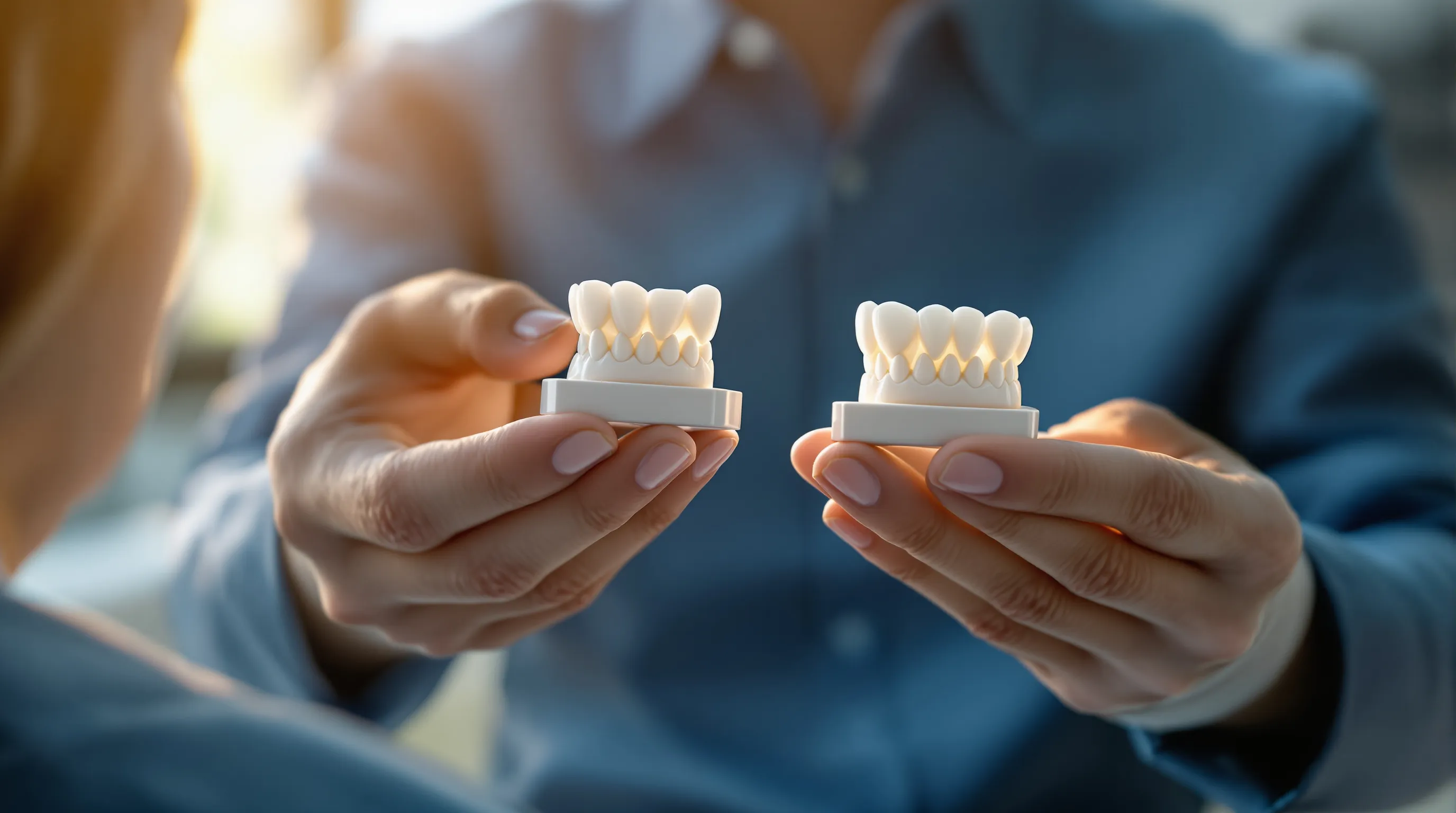
Choosing between zirconia and porcelain depends on where in your mouth the crown goes and how important esthetics are for that tooth.
Zirconia and porcelain are both exceptional crown materials: but they are not interchangeable, and choosing the wrong one for the wrong location can cost you years of crown life. The decision comes down to three things: where in your mouth the crown is going, how strong your bite is, and how much the esthetics of that particular tooth matter to you. In this guide, I walk you through everything I have learned from placing hundreds of crowns at our Lawrenceville, NJ practice over the past 40 years, so you walk into your next consultation already knowing the right questions to ask.
Questions this article answers
- Is zirconia stronger than porcelain for crowns? Yes, monolithic zirconia (900-1200 MPa) is significantly stronger than all-ceramic porcelain (~400 MPa for e.max), making it far better suited for back teeth and heavy biters.
- Which crown looks more natural? All-ceramic porcelain still offers the most lifelike translucency for front teeth, though high-translucency zirconia is closing the gap and works well for most cases today.
- How long do zirconia crowns last compared to porcelain? Zirconia typically lasts 15 to 25+ years; porcelain-fused-to-metal crowns average about 10 years before chipping on back teeth; all-ceramic porcelain lasts 10-15+ years on front teeth with lighter load.
Zirconia and porcelain crowns each have a clear strength, and choosing the wrong material for your specific tooth can cut your crown's lifespan in half. Monolithic zirconia crowns withstand forces of 900 to 1,200 MPa, making them the undisputed choice for back molars and patients with heavy bites or bruxism. All-ceramic porcelain crowns, particularly lithium disilicate (IPS e.max), offer unmatched translucency and natural light-scattering for front teeth in the smile zone. At Imagine Advanced Dental Arts in Lawrenceville, NJ, I have been placing both materials for over 40 years and can tell you from direct experience that this decision matters enormously for long-term outcomes.
The short answer: Choose zirconia for back molars and premolars where strength and longevity are paramount. It lasts 15 to 25+ years and will not chip under heavy chewing. Choose all-ceramic porcelain for front teeth where translucency and cosmetic matching matter most. And when you are in between: visible teeth in a heavy grinder: ask about high-translucency zirconia, which gives you the best of both worlds.
I remember the days early in my career when porcelain-fused-to-metal crowns were essentially the standard for anything needing real durability. They worked well. No argument there, but patients would come back years later and I could see that telltale gray line starting to show at the gum margin as their gums naturally receded. It always bothered me. I kept thinking, "There has to be something better."
When zirconia became genuinely viable for crown work, it felt like a revelation. The first time I placed zirconia crowns on a patient who had already fractured through two PFM crowns on her second molars: a serious grinder, bite forces that would exhaust most materials, I was genuinely thrilled to offer her something designed to handle exactly that challenge. That was over a decade ago. Those crowns are still perfect. That is the kind of outcome that makes this work so rewarding.
At the same time, I have never stopped reaching for all-ceramic porcelain when a patient needs a crown in their smile zone. Matching the translucency of adjacent natural teeth, capturing the subtle color gradient, making it indistinguishable from what nature gave them: that is an art, and it remains porcelain's great gift. Both materials have earned a permanent place in my practice. Knowing precisely when to use which one. That is what comes from 40 years of crown placements right here in Lawrenceville, NJ.
What Is a Zirconia Dental Crown?
If you have ever heard a dentist mention "the white metal," they were probably talking about zirconia.
Zirconia is a crystalline oxide of zirconium, the same category of hard industrial material used in cutting tools, and it turns out to be absolutely extraordinary for dental restorations. In the 1990s, dental engineers figured out how to mill it into tooth-shaped crowns, and that development changed everything!, as of .
The type most commonly placed today is the monolithic zirconia crown: milled from a single solid block, with no layered porcelain on top. That matters enormously because there is simply nothing to chip off. According to a discussion among practicing dentists in r/Dentistry, monolithic zirconia "has no porcelain to chip and is typically milled from a solid block.. very robust even under large chewing stress." That matches exactly what I have seen in my own practice over the past 40 years here in Lawrenceville, NJ.
Patients also love one other property: zirconia is completely metal-free. No gray shadow creeping into the gum line as years go by. No potential for metal sensitivity reactions. Your body tolerates zirconia exceptionally well. It is so biocompatible it is also used in hip replacement joints! Did you know that the process involves milling the zirconia block at about 30% larger than the final size, then sintering it at high temperature to shrink it down to perfect fit? Remarkable engineering, and the result is a crown that holds up like nothing before it.
What Is a Porcelain Crown and When Does It Shine?
Porcelain crowns have been the gold standard of aesthetic dentistry for decades, and there is a wonderful reason for that.
All-ceramic porcelain mimics the translucency of natural tooth enamel better than any material I have encountered in my entire career. Light hits a great porcelain crown and scatters through it the same way it travels through a real tooth. That is something zirconia: especially standard monolithic zirconia: simply cannot replicate yet, because it is inherently more opaque.
Let's look at what "porcelain crown" actually means, because there are important distinctions. Porcelain-fused-to-metal (PFM) crowns have a metal substructure coated with porcelain: strong, and used since the 1960s, but carrying one serious cosmetic risk: a visible gray margin at the gum line as gums age and recede. Dentists at r/Dentists have noted that PFMs have a typical lifespan of about 10 years before the porcelain begins to chip, and that "intraoral porcelain repair cannot be done predictably." All-ceramic crowns, made from lithium disilicate (the premium IPS e.max brand) or high-quality feldspathic porcelain: contain no metal whatsoever and offer the most esthetic, natural-looking result of anything available today.
In my experience, patients who need a crown on a visible upper front tooth are almost always far happier with a beautifully crafted all-ceramic porcelain result. The translucency, the color gradient from the neck of the tooth to the edge: it is an art form, and porcelain captures it better than anything else right now.
Which Crown Is Better for Back Teeth vs. Front Teeth?
This is the question I hear almost every single day in consultations, and the answer is genuinely clear once you understand what each material does best.
For back molars and premolars, zirconia is almost always the right call. Your back teeth are the workhorses of your mouth. They handle the full force of chewing, day after day, year after year. A single molar can generate tremendous bite pressure, one commenter in a dentist discussion on Reddit noted that "over 900 PSI" qualifies as a "heavy biter" in clinical terms, and even average bite force is substantial enough to eventually fracture porcelain. Zirconia does not fracture under those conditions the way layered ceramics can.
Dentists discussing their own crown preferences on r/Dentistry were remarkably consistent: "Zirconia everywhere" for posterior teeth was a common refrain, with the consensus that polished zirconia is also "non-abrasive to the opposing teeth", an important point since a crown that wears down adjacent teeth creates its own set of problems down the road.
For front teeth in the smile zone, the decision flips. Esthetics are paramount. All-ceramic porcelain: or increasingly, high-translucency (HT) zirconia, is the material of choice. HT zirconia has closed much of the gap in translucency while retaining superior strength, making it an ideal compromise for patients who need a visible crown but also grind heavily. As you can see, location and bite habits together drive the right material choice every time!
Which Crown Material Lasts Longer?
Longevity is where zirconia pulls ahead in a real and meaningful way. Zirconia crowns routinely last 15 to 25 years with proper care, and many of the earliest placements from the late 1990s are still performing. The monolithic structure is the reason: there is nothing to delaminate, nothing to chip off. I have placed zirconia crowns that have genuinely outlasted everything else in some patients' mouths, and that brings me enormous satisfaction!
Porcelain, particularly PFM and older all-ceramic designs, tells a different story for back teeth. Practitioners on r/Dentistry confirmed that once porcelain cracks, "the crack can propagate" and repeated chipping follows. A 10-year lifespan is widely cited as typical for a posterior PFM crown before the porcelain begins to chip. One dentist commenter noted: "Cracked porcelain will likely continue to crack, so it's unlikely this crown will last 20 years." That is not a knock on porcelain. It is simply the reality of placing a glass-ceramic material under heavy compressive bite forces. For front teeth with lighter loading, all-ceramic porcelain holds up beautifully and can last well beyond 10 years.
Here is a truth I share with every patient: the right material in the right location will always outlast the wrong material, even if that wrong material is technically higher-end. A zirconia crown on a molar that never chips beats a premium all-ceramic porcelain crown that eventually fractures. Matching material to location is everything.
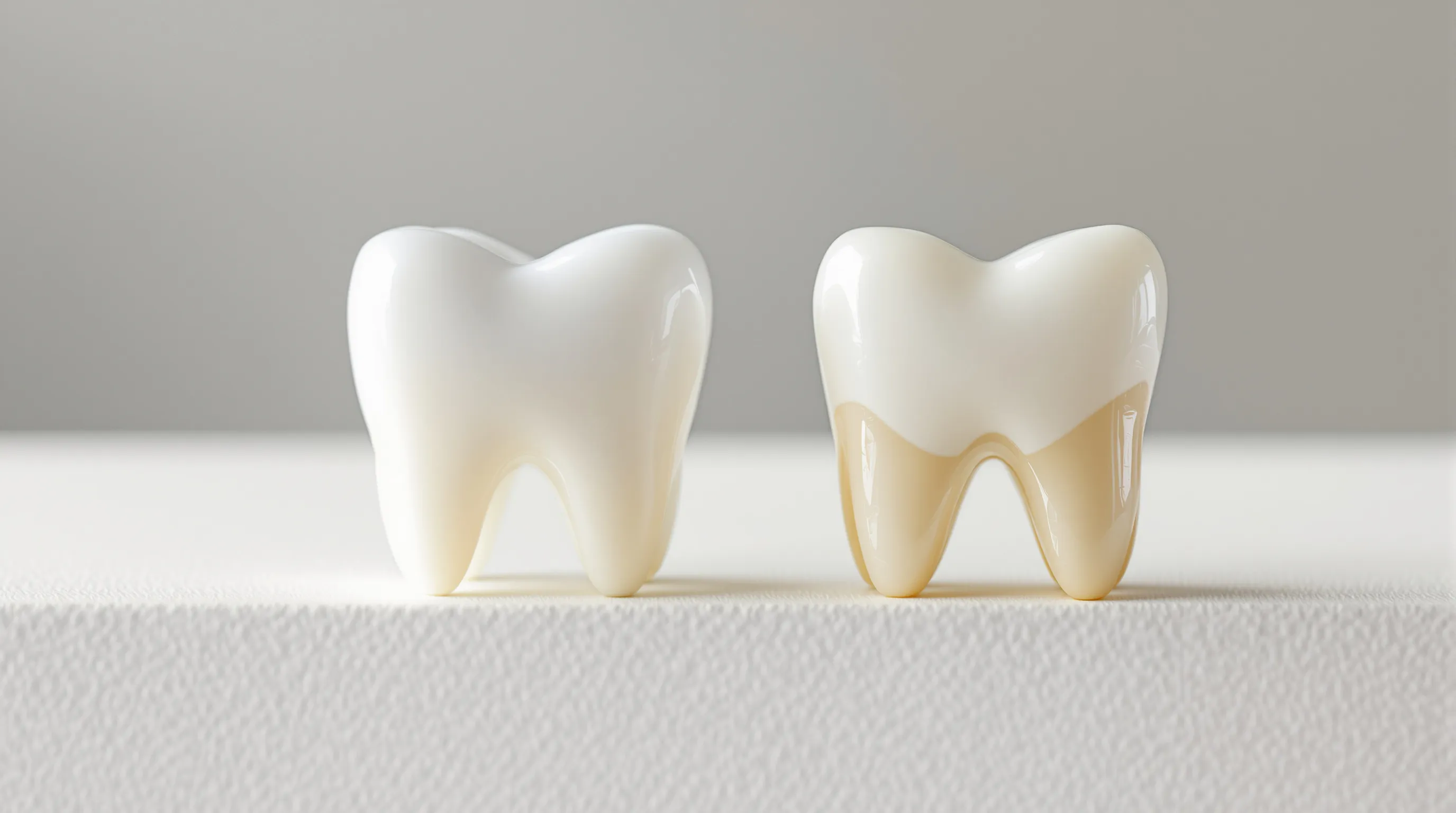
"Zirconia holds its own on strength, nothing beats it for a molar under heavy load. But porcelain still takes the crown when it comes to true smile-zone esthetics. My job is helping you figure out exactly which one your specific tooth needs.", Maria Rhode, DMD, Owner & President, Imagine Advanced Dental Arts
What Do Zirconia and Porcelain Crowns Cost, and Which Offers Better Long-Term Value?
Cost is always part of the conversation, and I genuinely respect that. Real-world patient discussions confirm that a single dental crown typically runs $900 to $2,000+ depending on material, office location, and case complexity. Zirconia crowns and premium all-ceramic lithium disilicate crowns sit at similar price points, often $1,000 to $2,000 per tooth. Traditional PFM crowns often come in slightly lower, which is one reason they persisted so long despite the gray-margin limitation.
Here is how I frame the value question for patients: which option costs you the least over the next 20 years? A zirconia crown placed on a molar today is very likely still performing well two decades from now. An all-ceramic porcelain crown placed on that same back molar in a patient who grinds may need replacement in 8 to 10 years. That replacement means a new appointment, temporary crown, lab fees, and time in the chair. What seemed like a modest upfront difference evaporates entirely.
The genuine best value is always matching the right material to the right location from the very beginning. For front teeth in the smile zone, all-ceramic porcelain delivers cosmetic outcomes that justify its price point. For back teeth under heavy load, zirconia's superior longevity makes it the smarter investment, every time. I always help my patients see the full picture, not just the upfront number. That is what our crown consultations at Imagine Advanced Dental Arts are designed to do.
Key Takeaways
Key Takeaways
- Zirconia wins on strength: Monolithic zirconia (900-1,200 MPa) can handle heavy bite forces without chipping, ideal for back molars and bruxers.
- Porcelain wins on front-tooth esthetics: All-ceramic porcelain (lithium disilicate / e.max) provides the most natural translucency, the best choice for visible smile-zone teeth.
- Longevity favors zirconia: Expect 15-25+ years for zirconia vs. 10-15+ years for all-ceramic anterior crowns and approximately 10 years for PFMs on back teeth.
- HT zirconia is the smart middle ground: High-translucency zirconia combines improved esthetics with superior strength, perfect for visible premolars or grinding patients who need a front-region crown.
- Grinders should always choose zirconia: Bruxism significantly increases fracture risk for porcelain-bearing crowns; monolithic zirconia handles grinding forces without compromise.
- Cost is comparable: Both materials run $1,000-$2,000 per tooth: let clinical suitability, not price alone, drive your decision.
- Location is everything: The right material matched to the right tooth position will always outperform the wrong choice, no matter the price point.
What Will Matter Most in Crown Materials Over the Next 12-24 Months?
Crown material technology is moving at a genuinely exciting pace right now! Two developments stand out as worth watching closely over the next year or two.
First, ultra-translucency (UT) zirconia continues to improve rapidly. Materials scientists have been engineering the crystalline microstructure of zirconia to allow significantly more light transmission while maintaining impressive flexural strength, well above what all-ceramic porcelain can offer. At the current pace of development, UT zirconia may soon be a genuinely competitive esthetic option even for upper central incisors, the most demanding cosmetic test in dentistry. That would be an amazing milestone! The gap between "strong crown" and "beautiful crown" is shrinking with every new generation of material.
Second, in-office CAD/CAM milling technology is becoming more precise and more widely adopted. Same-day crown fabrication, where a digital scan of your tooth is milled into a finished crown in a single appointment: is improving in material quality, shade-matching accuracy, and fitting precision. For patients, this means the potential for a completed crown without a multi-week wait for laboratory fabrication.
What will not change over the next 12-24 months, however, is the fundamental principle: the right material still needs to go in the right location. Better technology gives us better tools, but clinical judgment about which material a specific tooth needs, and why, remains the irreplaceable human element. That is something a machine cannot mill for you!
Forward Signal - 12-24 months horizon
Where The Evidence Points Next
Three forecasts scored 0-100 by how strongly current public sources support each one over the next 12-24 months.
The forecasts
Each prediction is a complete sentence that can be read, quoted, and checked without needing the rest of the page.
Within 12-24 months a growing share of new crown placements will be monolithic zirconia rather than porcelain-fused-to-metal, as clinicians switch away from PFM toward a material that is stronger than metal, requires roughly half the minimum tooth reduction of PFM, and avoids the gray gum-line margin PFM shows when tissue recedes.
As metal prices climb and ceramic adoption rises, the decision will increasingly be framed around lifetime cost rather than upfront price, with zirconia's higher initial cost weighed against fewer replacements; with single crowns commonly quoted around $900 to $1,400 and replacements near $1,300, durability differences will dominate value comparisons over the next 12-24 months.
The longstanding division of labor where porcelain owns the visible front teeth and zirconia owns the molars will blur over 12-24 months, as multi-grade zirconia, including high-translucency 5Y near 500 MPa with strength comparable to lithium disilicate, becomes accepted for anterior restorations where appearance matters most.
Weak signals watched: Practitioners reporting a personal practice shift from e.max and PFM toward 'almost exclusively zirconia,' alongside market segmentation showing ceramic crowns projected to grow at a higher CAGR than ceramic-fused-with-metal crowns amid rising metal prices. Clinicians noting that 5Y zirconia matches lithium disilicate in strength while offering translucency, and that zirconia's natural whiteness gives an aesthetic advantage, even as some patients still complain a zirconia restoration 'isn't porcelain.'. Guidance that zirconia costs more upfront but may save money over time through longer life, set against reports of porcelain-fused-to-metal crowns fracturing at the typical 10-year mark and needing replacement.
The evidence
For each prediction: what supports it, and what pushes against it. Both sides are shown for every forecast.
- Dental Crowns and Bridges Market: The report aims to provide a supports this forecast. [Blog]
- Zirconia Crowns for your Teeth | Dentist Explains the Truth supports this forecast. [Video]
- PFM vs Zirconia supports this forecast. [Community / Forum]
- Porcelain on my crown broke, what should I do? is the clearest counter-signal. [Community / Forum]
- Patient is complaining zirconia isnt porcelain is the clearest counter-signal. [Community / Forum]
- Zirconia vs Porcelain Crowns: 5 Tips to Choose the Right Dental supports this forecast. [Video]
- Dental Crowns and Bridges Market: The report aims to provide a supports this forecast. [Blog]
- Porcelain on my crown broke, what should I do? supports this forecast. [Community / Forum]
- A reversal would require porcelain and metal-backed crowns to regain durability or price advantage, a sustained drop in metal prices that makes PFM cheaper again, or persistent patient and clinician dissatisfaction with how translucent zirconia looks and sounds against natural teeth becoming the dominant experience rather than an edge case.
- PFM vs Zirconia supports this forecast. [Community / Forum]
- Zirconia Crowns for your Teeth | Dentist Explains the Truth supports this forecast. [Video]
- What are the best dental crowns? supports this forecast. [Community / Forum]
- Patient is complaining zirconia isnt porcelain is the clearest counter-signal. [Community / Forum]
- Zirconia vs Porcelain Crowns: 5 Tips to Choose the Right Dental is the clearest counter-signal. [Video]
Where we could be wrong
These forecasts assume current trends continue. The scenarios below would meaningfully change them.
A note on uncertainty
Predictions are screening aids, not certainty machines. The strongest signal here (76/100) still has counter-evidence, and the contrarian signal (64/100) reflects real disagreement among sources.
- If regulators or buyers move in the opposite direction, Metal-backed crowns keep losing ground to zirconia would weaken first.
- If the source mix shifts toward stronger contrary evidence, Translucent zirconia invades porcelain's aesthetic niche could become the more durable forecast.
Zirconia or Porcelain? Here Is My Honest Recommendation
After decades of crown placements and thousands of patients, here is where I have landed: there is no universally superior crown material: there is only the right material for your specific tooth, bite, and smile goals. Zirconia is extraordinary for molars, implant crowns, and anyone who grinds. Porcelain is extraordinary for front-tooth cosmetics where translucency is everything. High-translucency zirconia is the brilliant middle ground for visible teeth that still take a beating.
What I want every patient to take away from this is simple: you deserve a crown tailored to your situation, not just whatever material happens to be the default that week. At Imagine Advanced Dental Arts, our team of four credentialed doctors evaluates every case individually: your bite forces, your habits, the location of the tooth, your aesthetic expectations. That individualized approach is why we have earned a 4.9-star rating from 565 patients right here in Lawrenceville, NJ, and why so many of our patients have been coming back for 20 and 30 years. Explore your crown options with us and let us figure out the perfect fit for your smile. We would love to help!
Porcelain & Zirconia Dental Crowns at Imagine Advanced Dental Arts
- Service: Porcelain & Zirconia Crowns
- Materials available: Monolithic zirconia, high-translucency zirconia, lithium disilicate (IPS e.max), porcelain-fused-to-metal
- Best for: Damaged, cracked, or cosmetically compromised teeth at any location
- Practice: Imagine Advanced Dental Arts, Lawrenceville, NJ, 4.9 stars from 565 Google reviews
- Experience: 40+ years placing crowns, four credentialed doctors on staff
- Contact: 609-896-0589
Curious about which crown material makes sense for your situation? Explore our porcelain and zirconia crown options or call 609-896-0589 to schedule a personalized consultation at Imagine Advanced Dental Arts in Lawrenceville, NJ, where four credentialed doctors have been placing crowns with precision and care for over 40 years.
Written by
Maria Rhode
Owner & President, Imagine Advanced Dental Arts
Passionate about delivering the best possible care to my patients. From my days in residency to owning a beautiful hi-tech dental office, I never stop learning and advancing myself and now my practice.
Connect on LinkedInFrequently Asked Questions About Zirconia vs. Porcelain Crowns
Is zirconia better than porcelain for dental crowns?
It depends on where the crown is going. Zirconia is better for back teeth, molars and premolars under heavy chewing force, because of its extraordinary strength (900-1,200 MPa for monolithic zirconia) and its resistance to chipping. All-ceramic porcelain is often better for front teeth in the smile zone, where its superior translucency creates a more natural, lifelike look. In my practice, I use both materials routinely, choosing based on the individual tooth and patient.
How long does a zirconia crown last compared to a porcelain crown?
Zirconia crowns typically last 15 to 25+ years. The monolithic structure has nothing to chip or delaminate. All-ceramic porcelain crowns (lithium disilicate / e.max) generally last 10 to 15+ years for front teeth. Porcelain-fused-to-metal crowns have a typical lifespan of about 10 years on back teeth before the porcelain begins to chip, and once cracking starts, it tends to continue. Regular checkups and good home care extend the life of any crown.
Can you tell the difference between a zirconia crown and a porcelain crown?
On back teeth, most people cannot tell the difference. On front teeth, standard zirconia is more opaque than natural enamel or all-ceramic porcelain, and a trained eye may notice. High-translucency (HT) and ultra-translucency (UT) zirconia options have dramatically closed this gap and look beautiful in most visible-tooth situations. For truly exacting smile-zone cosmetic cases, however, all-ceramic porcelain still has the edge in mimicking enamel's light-scattering properties.
Which crown is better for someone who grinds their teeth?
Zirconia is almost always the better choice for bruxers. The monolithic structure handles repeated high-force grinding far better than layered porcelain-bearing crowns, which are more likely to chip under that sustained stress. I also recommend a custom night guard alongside any crown for patients who grind, it protects the crown and the surrounding natural teeth equally. All-ceramic porcelain on a back molar in an active grinder is a higher-risk choice.
Are zirconia crowns more expensive than porcelain?
Not significantly. Both materials typically run $1,000 to $2,000 per tooth, depending on the practice, location, and complexity of the case. Premium cosmetic porcelain cases, especially those involving custom laboratory staining and layering for front teeth, may sit at the higher end. Traditional PFM crowns can come in slightly lower. The better value question is which material will last longest in your specific tooth and situation, not just the upfront number.
Does a zirconia crown look natural?
Yes, especially high-translucency and ultra-translucency zirconia options. Zirconia can be shade-matched to surrounding teeth, and modern milling technology creates subtle surface texture that mimics enamel. For back teeth, even standard zirconia looks entirely natural. For visible front teeth, HT/UT zirconia placed by an experienced cosmetic dentist can be beautiful, though all-ceramic porcelain (lithium disilicate) remains the gold standard for the most demanding esthetic cases.
Can Imagine Advanced Dental Arts help me choose between zirconia and porcelain?
Absolutely! At our Lawrenceville, NJ practice, I personally evaluate each patient's bite, habits, tooth location, and cosmetic goals before recommending a crown material. We offer both porcelain and zirconia crowns, along with full cosmetic consultations. You can also explore our Smile Analysis service for a comprehensive look at all your cosmetic options. Call us at 609-896-0589 to schedule.
Summarize This Article With AI
Open this article in your preferred AI engine for an instant summary.