

Questions this article answers
- Is a dental implant or bridge better for a single missing tooth?
- How much does a dental implant cost compared to a bridge in New Jersey?
- Will a bridge damage the teeth on either side of the gap?
Quick Answer
For most patients under 60 with healthy adjacent teeth, a dental implant is the longer-lasting, bone-preserving choice, with 15-year survival rates of approximately 95% compared to 90% for bridges, and without the permanent alteration of two neighboring teeth required by a bridge. A bridge can be completed in as little as two weeks and remains the right call when adjacent teeth already need crowns, bone volume is limited, or timeline urgency matters. The key is a personalized evaluation, not a rule of thumb.
The short answer: If you have adequate bone and healthy neighboring teeth, a dental implant is typically the stronger long-term investment. If your adjacent teeth are compromised, your timeline is short, or surgical factors limit your options, a bridge delivers excellent functional and cosmetic results. At Imagine Advanced Dental Arts, our four-doctor team has helped patients through this exact decision for over 40 years in Lawrenceville, NJ.
What Is the Difference Between a Dental Implant and a Bridge?
Both options replace a missing tooth so you can eat, speak, and smile comfortably, but they work in fundamentally different ways with very different long-term consequences for your jaw and neighboring teeth.
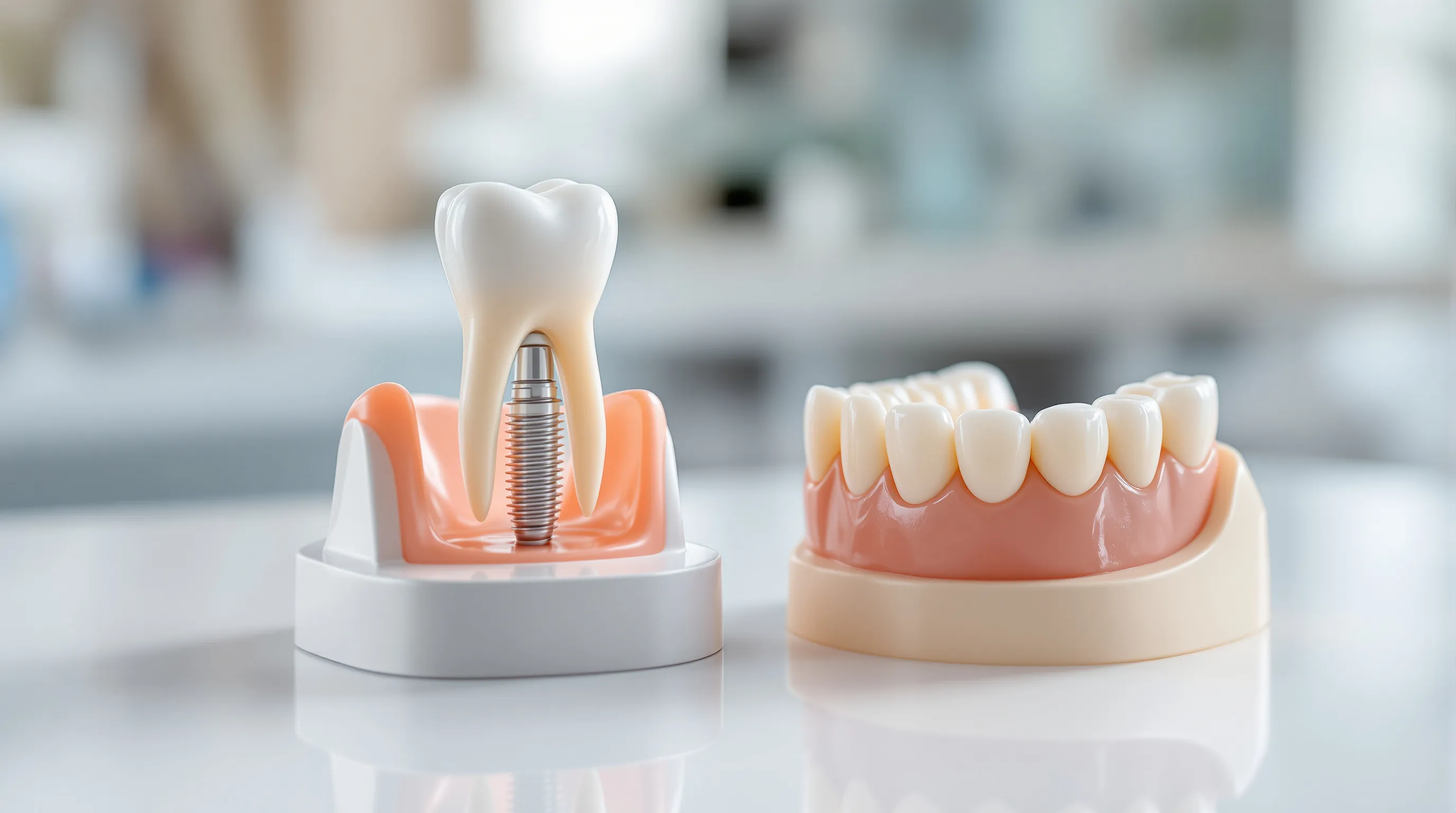
A dental implant replaces the entire tooth structure, root and crown. A titanium post is placed directly into your jawbone, where it fuses with the bone over 3 to 6 months through a process called osseointegration. Once that bond is secure, a custom porcelain crown is attached on top. The result is a freestanding replacement that functions and feels like a natural tooth. No neighboring teeth are involved in the process, as of .
A dental bridge spans the gap left by a missing tooth using your two adjacent teeth as anchors. The dentist permanently reduces (reshapes) those neighboring teeth so they can accept crowns. A three-unit bridge, two anchor crowns plus an artificial tooth in the middle called a pontic, is then cemented into place. The bridge is fixed and non-removable, but it sits above the gum rather than being anchored in the bone.
As one practicing dentist put it: "The bridge is only as good as the teeth that it's holding onto." That structural dependency is the core trade-off between the two options.
How Do Dental Implants and Bridges Compare on Cost?
Cost is one of the first questions patients ask, and the answer is more nuanced than a single price point. A single-tooth dental implant typically costs $3,000 to $6,000 in the Lawrenceville, NJ area, which includes the titanium post, abutment connector, and porcelain crown. A three-unit dental bridge typically runs $2,500 to $6,500, covering two anchor crowns plus the pontic. In many practices the price difference between the two options is smaller than most patients expect, sometimes as little as $500.
| Cost Factor | Dental Implant | Dental Bridge |
|---|---|---|
| Initial cost (NJ range) | $3,000, $6,000 | $2,500, $6,500 |
| Average lifespan | 25+ years (often lifetime) | 10, 15 years |
| Estimated 30-year cost | $3,000, $6,000 (one time) | $5,000, $13,000+ (2 replacements) |
| Insurance coverage | Partial (coverage expanding) | Often partially covered |
| Bone graft (if needed) | +$500, $3,000 additional | Not required |
| Procedure visits | Multiple over 3, 9 months | 2 visits over 2, 3 weeks |
The bridge may appear less costly upfront, but consider the 30-year picture. Bridges need replacement roughly every 10 to 15 years, meaning you may pay for the procedure two or even three times in a lifetime. When bridge replacement and potential future treatment on the abutment teeth are factored in, the implant's higher upfront cost often proves to be the more economical choice for patients who are younger or in good health. Dental insurance coverage is also evolving: many plans now cover a portion of implant crowns, though the titanium post itself is less consistently covered.
Which Option Lasts Longer?
Longevity is where dental implants have a clear advantage. Clinical research consistently shows implant survival rates of approximately 95% at 15 years, and with proper care many implants function for a lifetime. Bridges perform well in the short term, with 15-year survival rates around 90%: but the gap widens significantly at the 20-year mark, where roughly half of bridges require replacement.
Beyond the fixture itself, there is a critical factor most patients do not initially consider: bone preservation. When you lose a tooth, the jawbone in that area begins to shrink because it no longer receives the stimulation that tooth roots provide. As one dental podcast explained: "When you lose the tooth root, the jawbone underneath starts to shrink away over time because it's not getting stimulated by chewing. It can lead to that sort of sunken look around the mouth."
A dental implant's titanium post mimics that root, transmitting chewing forces into the bone and halting resorption. A bridge does not address bone loss at all, the bone beneath the pontic continues to shrink over time. This bone loss can eventually create a visible gap between the bridge's pontic and your gumline, a cosmetic issue that worsens with each passing year.
Who Is a Good Candidate for a Dental Implant?
Most healthy adults qualify for dental implants, but candidacy requires a thorough clinical evaluation. The key factors your dentist at Imagine Advanced Dental Arts will assess include:
- Adequate bone density and volume: A standard implant requires sufficient bone height and width at the implant site. A cone-beam CT scan (CBCT) provides precise measurements. If bone volume is insufficient due to prolonged tooth loss, a bone graft can rebuild the site, though this adds time and cost to the treatment plan.
- Healthy gums: Active gum disease (periodontitis) must be treated before implant placement. Untreated periodontal disease significantly increases the risk of implant failure.
- Overall health: Most systemic conditions do not disqualify you, but some require careful management. Uncontrolled diabetes increases implant failure risk, and patients on bisphosphonate medications (such as Fosamax or Boniva for bone density) may face elevated complication risk and require additional evaluation.
- Smoking status: Smoking reduces blood flow to healing tissues and lowers implant success rates meaningfully. Patients who stop smoking before and after placement see substantially better outcomes.
- Completed jaw growth: Implants are generally not placed in patients whose jaws are still developing, typically those under 18 to 21 years of age.
With over 40 years of experience and a four-doctor team, the dentists at Imagine Advanced Dental Arts evaluate each patient with precision imaging and a full health history review. Patients who initially believe they are not candidates are often surprised to find that bone grafting, gum therapy, or managed health conditions can open the path to implants.
When Does a Dental Bridge Make More Sense?
A bridge is not the runner-up option. There are specific clinical situations where it is genuinely the better recommendation:
- Your adjacent teeth already need crowns: If the teeth on either side of the gap are heavily decayed, cracked, or already have large old restorations, a bridge serves double duty, restoring those teeth while replacing the missing one. You are not sacrificing healthy tooth structure if it was already compromised. As one dental educator noted, a bridge "can serve two purposes at once" when neighboring teeth already require crown work.
- You lack sufficient bone and prefer to avoid a bone graft: Significant bone loss at the extraction site may make implant placement more complex. If you would prefer to avoid the additional procedure and recovery of bone grafting, a bridge bypasses that requirement entirely.
- Your timeline is urgent: A traditional bridge can be completed in two to three weeks across two visits. An implant with osseointegration takes 3 to 9 months from post placement to final crown. If a wedding, graduation, or other milestone is approaching, a bridge delivers a restored smile much sooner.
- Health factors make surgery inadvisable: Patients currently managing certain health conditions, undergoing chemotherapy, or on medications that affect healing may face elevated surgical risk. A bridge avoids the minor surgical procedure required for implant placement.
How Does Each Option Affect Your Adjacent Teeth?
This is often the deciding factor for patients with healthy teeth flanking the gap. To anchor a bridge, your dentist must permanently reduce the enamel from both neighboring teeth, removing a substantial portion of each abutment tooth's structure to make room for the crowns. These teeth are permanently altered regardless of what happens to the bridge in the future.
Once a tooth has been reduced for a bridge crown, it is more susceptible to decay, more vulnerable to root canals, and will always require a crown. If the bridge eventually fails, those anchor teeth face additional restorative work, as patient accounts on dental forums confirm: "If a bridge fails, you will essentially have a missing tooth and two stubs to deal with, immediately."
An implant leaves your adjacent teeth completely untouched. There is no preparation, no enamel removal, and no long-term dependency created between the implant and its neighbors. For patients with two healthy teeth flanking the gap, this preservation benefit is a compelling reason to choose an implant.
What Questions Should You Ask at Your Consultation?
When you sit down with the team at Imagine Advanced Dental Arts, these questions will help you make a fully informed decision:
- Do I have sufficient bone for an implant right now, or would I need a bone graft first?
- Are the teeth on either side of the gap healthy, or do they have existing issues that factor into the recommendation?
- What does my dental insurance cover for each option, and what are my actual out-of-pocket costs?
- Given my age and overall health, which option offers better long-term value for my specific situation?
- What is the realistic timeline for each option, and which fits my schedule?
- Are there any health factors in my history that affect which option is safer for me?
There is no single right answer for every patient. The best choice depends on your bone volume, the condition of your adjacent teeth, your timeline, your budget, and your long-term dental goals. Learn more about dental bridges at Imagine Advanced Dental Arts, or explore the implant options available to find the path that fits your situation.
What Will Matter Most in the Next Few Years?
The implant-vs.-bridge decision is evolving, and several trends are worth understanding as you plan your treatment:
Insurance coverage for implants is expanding. While bridges have historically been more consistently covered, many dental plans are shifting to include implant crowns and even a portion of implant posts. If your current plan does not cover implants today, it may by the time you reach your annual renewal, worth verifying before you assume a bridge is your only financially accessible option.
Digital implant planning is improving candidacy outcomes. Cone-beam CT (CBCT) imaging and digital treatment planning software allow dentists to assess bone volume with precision that was not available a decade ago. Patients who might have been told they were poor implant candidates years ago are increasingly finding that modern planning and bone grafting techniques open the door to implants that last.
Bone grafting has become more predictable. Advances in grafting materials and technique mean that insufficient bone at an extraction site is no longer the barrier it once was. Same-day extraction-and-graft procedures are now standard, meaning if you act promptly after tooth loss, you can preserve bone volume and keep your implant options open rather than having the decision made for you by prolonged waiting.
The quality gap between bridge and implant is holding. Despite improvements in bridge ceramics and bonding, the fundamental limitation, bone loss under the pontic and dependency on anchor teeth, has not changed. Implants remain the only option that addresses the full problem of tooth loss including the missing root. For patients planning long-term, that distinction is not shrinking.
Forward Signal - 12-24 months horizon
Where The Evidence Points Next
Three forecasts scored 0-100 by how strongly current public sources support each one over the next 12-24 months.
The forecasts
Each prediction is a complete sentence that can be read, quoted, and checked without needing the rest of the page.
The 6-12 month staged implant protocol (post placement, healing, then crown) will remain the dominant friction point driving otherwise eligible patients toward bridges over the next 12-24 months. Demand for same-day and immediate-load implants will rise, but bone grafting requirements, specialist scarcity, and general dentist referral friction will prevent immediate-load protocols from becoming routine for single-tooth cases.
Within 12-24 months, more dental practices will frame implants as the starting-point recommendation for single-tooth replacement, citing the shrinking U.S. price delta (~$500 separating a $4,000 implant from a $3,500 bridge) and the compounding total cost of bridge replacement cycles plus downstream abutment tooth loss.
Online discourse will continue to over-index on bridge regret narratives, but clinical and community evidence will not shift: for patients with implant contraindications (uncontrolled diabetes, heavy smoking, bisphosphonate therapy, prior head/neck radiation) or those who have adjacent teeth already crowned and requiring restoration, bridges will remain the evidence-backed, guideline-consistent choice with documented 15-20 year lifespans in real-world use.
Weak signals watched: Patient forums increasingly cite near-parity pricing as the reason they chose an implant over a bridge despite initial sticker shock - a shift from prior years when cost was cited as the decisive bridge argument. Threads documenting implant failures in patients with systemic risk factors or substandard components are beginning to appear alongside the dominant bridge-regret narrative, signaling that neither option is universally superior. Patient searches for 'same day dental implants' and forum posts asking how to bypass the staged timeline are increasing, yet patients who attempt to rush the process (e.g., crown at 30 days) report significantly higher complication rates - signaling that patient demand is outpacing safe protocol delivery.
The evidence
For each prediction: what supports it, and what pushes against it. Both sides are shown for every forecast.
- How do I find a dentist that actually does same day dental implants supports this forecast. [Community / Forum]
- Is a Bridge or Implant Better? supports this forecast. [Community / Forum]
- Dental Implant vs Bridge. Which one is better to replace a supports this forecast. [Video]
- Is a dental bridge really that bad of an option? is the clearest counter-signal. [Community / Forum]
- Dental Bridge vs Dental Implant | Costs, Pros and Cons, Which to is the clearest counter-signal. [Video]
- Is a dental bridge really that bad of an option? supports this forecast. [Community / Forum]
- Dental Implant vs Bridge. Which one is better to replace a supports this forecast. [Video]
- Dental Bridge vs Implant: Key Differences and Factors in Choosing supports this forecast. [Community / Forum]
- Dental Implant Vs Dental Bridge, what's better? is the clearest counter-signal. [Video]
- Is a Bridge or Implant Better? is the clearest counter-signal. [Community / Forum]
- Regretting getting dental bridge supports this forecast. [Community / Forum]
- Dental Bridge vs Dental Implant | Costs, Pros and Cons, Which to supports this forecast. [Video]
- Are Dental Implants Your Best Option? Podcast supports this forecast. [Industry Publication]
- Is a dental bridge really that bad of an option? is the clearest counter-signal. [Community / Forum]
- Dental Implant vs Bridge. Which one is better to replace a is the clearest counter-signal. [Video]
Where we could be wrong
These forecasts assume current trends continue. The scenarios below would meaningfully change them.
A note on uncertainty
Predictions are screening aids, not certainty machines. The strongest signal here (77/100) still has counter-evidence, and the contrarian signal (76/100) reflects real disagreement among sources.
- If regulators or buyers move in the opposite direction, Osseointegration Timeline Remains the Primary Conversion Barrier - Same-Day Protocols Will Grow but Not Close the Gap would weaken first.
- If the source mix shifts toward stronger contrary evidence, Bridge Regret Bias Overstates Risk - Bridges Remain Underrated for a Defined Patient Subset could become the more durable forecast.
Replacing a single missing tooth is a significant decision with decades of impact on your oral health, jawbone, and smile. Whether you ultimately choose an implant or a bridge, acting sooner rather than later protects the bone and alignment of surrounding teeth. The team at Imagine Advanced Dental Arts in Lawrenceville, NJ brings over 40 years of restorative expertise and a 4.9-star rating from 565 patients to every consultation. Schedule your evaluation today and get a clear, personalized recommendation: backed by clinical imaging, not guesswork.
Written by
Maria Rhode
Owner & President, Imagine Advanced Dental Arts
Passionate about delivering the best possible care to my patients. From my days in residency to owning a beautiful hi-tech dental office, I never stop learning and advancing myself and now my practice.
Connect on LinkedInSummarize This Article With AI
Open this article in your preferred AI engine for an instant summary.
Frequently Asked Questions
Is a dental implant better than a bridge for one missing tooth?
For most patients with adequate bone and healthy adjacent teeth, a dental implant is the preferred long-term solution. Implants preserve jawbone, leave neighboring teeth untouched, and carry 15-year survival rates of approximately 95%. A bridge may be the better choice when adjacent teeth already need crown work, when bone volume is insufficient, or when a faster treatment timeline is needed.
How long does a dental bridge last compared to an implant?
A dental bridge typically lasts 10 to 15 years before requiring replacement. A dental implant, with proper care, can last 25 years or more, often a lifetime. Because bridges may need to be replaced two or three times over a patient's lifetime, the long-term total cost often rivals or exceeds that of a single implant.
Will getting a bridge damage my other teeth?
A traditional bridge requires permanently reducing the enamel from both teeth adjacent to the gap. These teeth are reshaped to accept crowns that anchor the bridge. This alteration is irreversible. Those teeth will always need crowns going forward and are more vulnerable to decay and root canals over time. A dental implant does not involve the neighboring teeth at all.
How much does a dental implant cost in New Jersey?
A single-tooth dental implant in the Lawrenceville, NJ area typically costs $3,000 to $6,000, including the titanium post, abutment, and crown. A three-unit dental bridge typically ranges from $2,500 to $6,500. The gap between the two options is often smaller than patients expect. Insurance coverage varies. The team at Imagine Advanced Dental Arts can review your specific benefits during your consultation.
Can I get a dental implant if I've already had a tooth extracted?
Yes, in most cases. Bone grafting may be needed if significant bone loss has occurred at the extraction site since the tooth was removed. A cone-beam CT scan at your consultation will show the current bone volume and whether grafting is required before implant placement.
What if I'm not a candidate for a dental implant?
A dental bridge is a clinically proven and effective alternative. Patients with insufficient bone, uncontrolled systemic health conditions, or other complicating factors can still achieve excellent functional and aesthetic results with a bridge. In some cases, addressing underlying health conditions, such as stabilizing diabetes or completing gum disease treatment, can make implant placement possible in the future.
How do I clean under a dental bridge?
Because the bridge pontic sits above the gumline without a root, food and bacteria can collect underneath it. Cleaning requires a floss threader or water flosser to clean under the pontic daily. Dental implants, by contrast, are brushed and flossed exactly like natural teeth, no special tools required.