

Questions this article answers
- Can I use regular toothpaste on my All-on-4 implants?
- How do I clean under the bridge when I can't thread floss through?
- How often do I actually need to see the dentist with All-on-4?
Quick Answer
The Short Answer
Clean All-on-4 implants twice daily using a water flosser (60 seconds under the bridge), an interdental brush through the tissue gap (60 seconds), a soft toothbrush with low-RDA gel toothpaste (90 seconds), and an alcohol-free antimicrobial rinse. Schedule professional cleanings every 3-4 months, not every 6 months, to catch peri-implantitis before it starts.
Quick Answer
I still remember the patient who came in six months after getting her All-on-4 implants, absolutely beaming with her new smile. She had been meticulous about cleaning, or so she thought. When we looked under the bridge with our intraoral camera, the bacterial buildup was significant enough to concern us both. She was not doing anything wrong intentionally; she simply had not been shown the right technique. That experience is exactly why I put together this step-by-step guide. At Imagine Advanced Dental Arts, every All-on-4 patient leaves with a personalized cleaning kit and a hands-on demonstration. Because cleaning All-on-4 implants is not hard: but it is different, and that difference matters enormously for long-term success.
Why Cleaning All-on-4 Implants Is Different From Brushing Natural Teeth
All-on-4 implants are one of the most transformative procedures I offer at Imagine Advanced Dental Arts, and I say that after watching patient after patient walk in feeling defeated by missing teeth and walk out with a full, beautiful smile. But here is something I tell every single person before they leave: cleaning your All-on-4 is genuinely different from brushing natural teeth, and getting that right is the single most important thing you can do to protect your investment for the long term.
Unlike removable dentures: which you can take out, soak overnight, and scrub clean at the sink, All-on-4 implants are fixed permanently in your mouth. That full-arch bridge stays in place 24 hours a day, 7 days a week. The good news? You never have to worry about them slipping or falling out! The challenge? Bacteria, plaque, and food particles accumulate in the gap between the underside of the bridge and your gum tissue, and that space is harder to reach than the surface of a natural tooth, as of .
This space, clinically called the sub-pontic area, is where trouble starts if you are not addressing it every day. When bacteria builds up there consistently, it can lead to peri-implantitis, an infection of the soft tissue and bone supporting the implants. As a 2025 clinical maintenance guide from myimagedental.com notes, this is the complication that "threatens the longevity of your restoration." Peri-implantitis is the leading cause of implant failure, and in my experience, nearly every case I have seen was preventable. The right routine takes less than five minutes a day. That is a very small investment for a very significant result.
Your Morning Cleaning Routine, Step by Step
In my practice, I have found that most people instinctively reach for a toothbrush first thing in the morning: and that is a perfectly natural habit! But for All-on-4 patients, I always recommend starting with the water flosser instead. Here is why: the water flosser flushes loose debris and bacteria out of the sub-pontic gap first, so when you follow up with your brush, you are working on a much cleaner surface. You get more out of every subsequent step.
Here is the morning routine I teach every All-on-4 patient at our practice:
- Water flosser (60 seconds): Direct the tip at roughly a 45-degree angle along the gum line and slowly trace the entire arch. Pay extra attention to the four implant sites. Use warm water and start on a medium pressure setting to avoid irritating healing tissue.
- Interdental brush (60 seconds): Pass the small brush tip gently through the tissue gap from front to back along the full length of the bridge. You will feel a little resistance. That is perfectly normal and means you are reaching the right area.
- Soft toothbrush (90 seconds): Angle the bristles at 45 degrees toward the gum line, this lets them reach under the prosthetic where food and plaque accumulate. Use an extra-soft brush with a non-abrasive, low-RDA gel toothpaste and short, side-to-side sweeps rather than aggressive scrubbing.
- Antimicrobial rinse: Finish with a non-alcoholic antiseptic rinse to knock out residual bacteria without drying out the gum tissue. Swish for a full 30 seconds and spit.
Total time: about 4-5 minutes. Not bad at all for protecting a permanent, full-arch restoration!
The Night Routine, The Most Critical Cleaning of the Day
If you could only commit to one thorough cleaning per day, I would tell you to make it the evening one, and here is the science behind that.
During the day, saliva is constantly washing over your implants, providing natural antimicrobial protection and flushing away debris. At night, saliva production drops dramatically. That means any bacteria left on or under your bridge gets a long, undisturbed window to multiply and form biofilm. The bacteria that causes peri-implantitis thrives in exactly this kind of low-saliva, overnight environment. Giving it eight hours of free time is not something we want to do.
Your evening routine should follow the same steps as your morning routine, but I encourage patients to slow down and be more deliberate. This is not the routine you rush through while half-asleep. Take an extra 30 seconds with the water flosser on the back implant sites, where angled implants sit and debris collects most stubbornly. If you have had your implants for more than six months, your hygienist may have already shown you the "sling technique" using super-floss or unwaxed dental tape, threading it under the bridge and making a C-shape motion around each implant post for a deeper clean. Patients in the r/Allon4ImplantDentures community report that once you get the technique down, it takes only 3-4 minutes for both arches. That is very doable!
A tip I always share: do your implant cleaning before you brush any remaining natural teeth on other arches. That way you give the All-on-4 your full attention first, then wrap everything up together. Consistency beats perfection here every single time.
The Exact Tools We Send Patients Home With
One of the things I am most proud of at Imagine Advanced Dental Arts is that we do not just hand you a pamphlet and wish you luck.
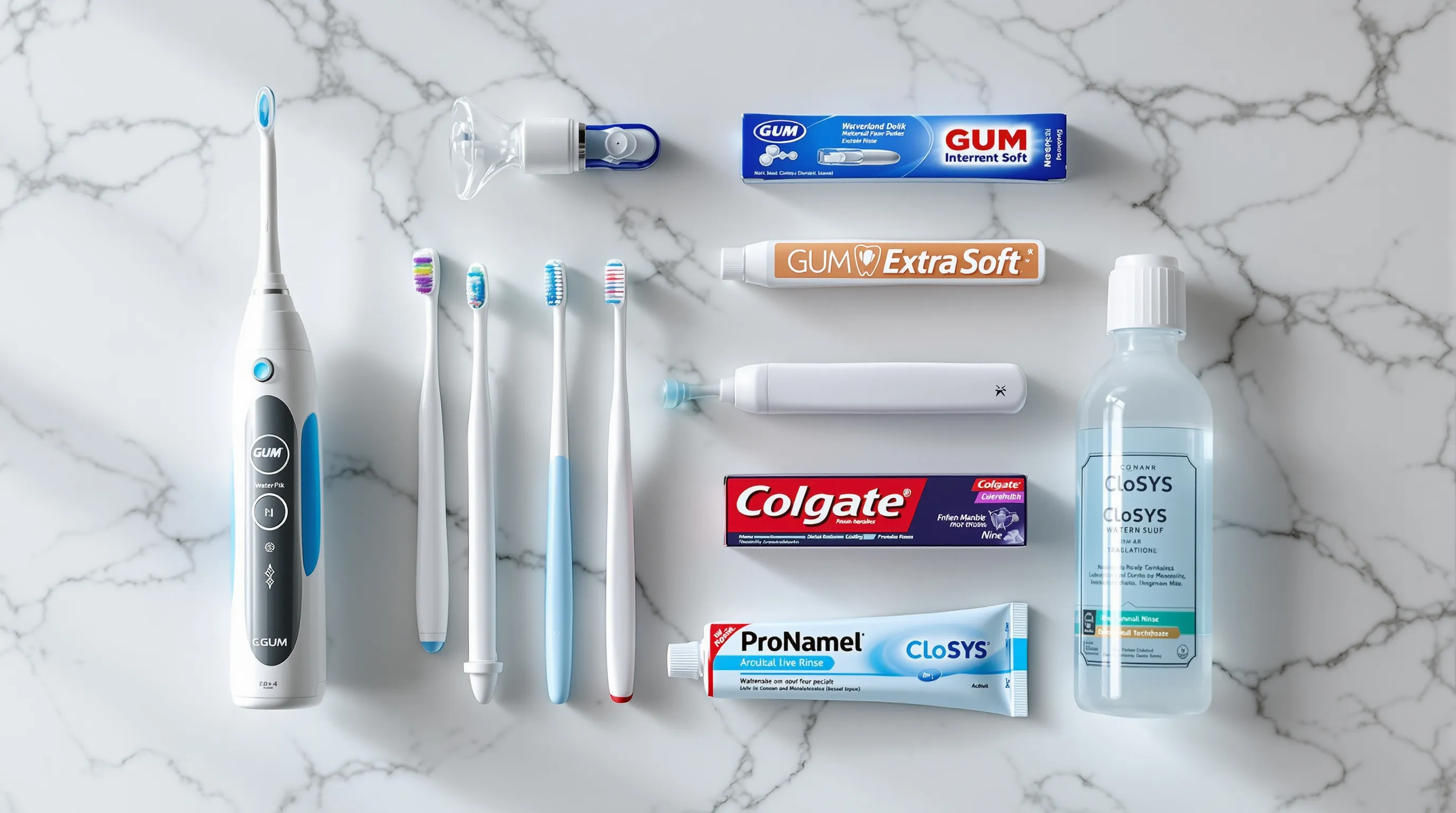
After your All-on-4 procedure, every patient leaves with a personalized home-care kit and a hands-on demonstration so you actually know how to use everything before you walk out the door. As one patient shared in the r/Allon4ImplantDentures community, receiving clear tool guidance and a consistent protocol led their dentist to confirm "perfect hygiene" at the next appointment, and that is exactly the outcome we are after. Here is exactly what goes into our kit and why we chose each item:
| Tool | Why We Recommend It | Frequency |
|---|---|---|
| WaterPik Aquarius Professional | 10 pressure settings; the angled tip reaches the sub-pontic gap that no brush can access | Twice daily |
| GUM Soft-Picks or Proxabrush (#1/#2 tip) | Correctly sized to pass through the tissue gap; must be inserted without forcing | Twice daily |
| Colgate Extra Soft or Sensodyne Gentle | Extra-soft bristles protect the prosthesis surface from micro-scratches that trap bacteria | Twice daily |
| Sensodyne ProNamel or Tom's of Maine (low-RDA) | Low-abrasion formula will not pit or dull the acrylic or zirconia bridge surface | Twice daily |
| CloSYS or Listerine Zero (alcohol-free rinse) | Reduces bacterial load without drying gum tissue, alcohol-based rinses can impair healing | Once daily |
| Chlorhexidine rinse (first 2 weeks post-surgery only) | Prescription antimicrobial for the critical initial healing window; not for long-term use | As prescribed |
If someone tells me they can only commit to one additional tool beyond a toothbrush, the answer is always the water flosser. That single tool does more for sub-pontic hygiene than anything else on this list.
Common Cleaning Mistakes That Can Damage Your Implants
I have been practicing long enough to have seen the same honest mistakes come up again and again with All-on-4 patients.
None of them come from carelessness. They are simply habits that worked perfectly well for natural teeth but do not translate to an implant-supported prosthesis. Here are the five I see most often:
- Using whitening toothpaste: I completely understand the appeal, everyone wants a bright smile! But whitening toothpastes contain abrasive particles designed to scour surface stains, and those particles scratch the bridge surface over time, creating tiny grooves where bacteria hide. Stick with a low-RDA non-abrasive gel formula instead.
- Relying on the water flosser alone: The water flosser is amazing, but it is not enough on its own. As patients in the All-on-4 community have noted, brushing and threading super-floss under the bridge are essential complements. The water flosser flushes; it does not scrub away biofilm. Long-term debris against the tissues will cause your body to respond in ways that compromise the implants.
- Using alcohol-based mouthwash: Alcohol dries out oral tissue, which paradoxically makes it easier for bacteria to colonize. Switch to an alcohol-free antiseptic rinse like CloSYS or Listerine Zero.
- Using stainless steel scalers for self-cleaning: If you go anywhere near your implants with any metal tools at home, please stop. More relevantly: make sure your hygienist is using plastic or titanium-tipped scalers at professional visits. Stainless steel scratches the implant surface and makes it catch plaque more easily, increasing infection risk.
- Skipping professional visits because it looks fine: Peri-implantitis often begins below the gum line, invisible to the naked eye, long before any discomfort appears. Regular professional visits are how we catch it early.
Professional Cleanings: What We Do Differently at Our Office
No matter how thorough your home routine is, and some of my patients are truly amazing about it!, professional cleanings are a non-negotiable part of All-on-4 maintenance.
And here is something that surprises many people: All-on-4 patients should come in every 3-4 months, not every 6 months like the general recommendation for natural teeth. That more frequent schedule is not about doubting your home care. It is about catching what neither of us can see from the outside.
At Imagine Advanced Dental Arts, our hygienist is trained in implant maintenance protocols, which are genuinely different from a standard cleaning. Here is what your professional appointment includes:
- Visual and probe examination: We measure pocket depths around each implant post. A reading over 4mm warrants closer investigation of bone levels and tissue health: and we want to catch that signal at this stage, not six months later.
- Professional cleaning with implant-safe instruments: We use plastic-tipped or titanium curette instruments exclusively: never standard stainless steel scalers, which scratch the titanium surface and make it catch plaque more easily. This is a detail I feel strongly about.
- Peri-implant tissue assessment: We evaluate for bleeding, recession, or swelling around the implant posts, the earliest clinical signs of peri-implant mucositis before it progresses to full peri-implantitis.
- Annual radiographic check: X-rays once a year allow us to track bone levels over time and confirm the implants are stable before any symptoms develop.
I always tell patients: think of these 3-4 month visits as a tune-up for a very important piece of machinery. You would not skip an oil change on your car, and you definitely do not want to skip these!
DAILY ALL-ON-4 CLEANING CHECKLIST

MORNING (4-5 min)
☐ Water flosser: 60 sec, 45° angle, medium pressure
☐ Interdental brush, trace full tissue gap front to back
☐ Soft toothbrush + low-RDA toothpaste: 90 sec, 45° angle
☐ Alcohol-free antimicrobial rinse, 30 sec swish

EVENING (5-6 min: take extra time)
☐ Water flosser: 60+ sec, extra attention on rear implants
☐ Super-floss sling technique (6 months+)
☐ Soft toothbrush + low-RDA toothpaste, 90 sec
☐ Alcohol-free antimicrobial rinse, 30 sec swish

SCHEDULE: Professional cleaning every 3-4 months
Without a Proper Routine
Bacterial biofilm forms in the sub-pontic gap within 24-48 hours. Within months, persistent debris causes gum tenderness around implant posts. At the 6-month check, the hygienist finds calcified deposits that home tools cannot remove, and early probe-depth readings above 4mm signal the beginning of bone-level concern.
With the Right Daily Routine
Consistent twice-daily water flossing, interdental brushing, and soft-bristle cleaning, paired with 3-4 month professional maintenance visits: results in stable bone levels, healthy pink gum tissue around each implant post, and zero calculus buildup at the 12-month check. Titanium implants that can truly last a lifetime.
What Will Matter Most for All-on-4 Maintenance in the Next 12-24 Months
Full-arch implant dentistry is moving fast, and the maintenance side is catching up. Here is what I am watching closely for my patients at Imagine Advanced Dental Arts:
Smarter water flossers with pressure feedback. The next generation of oral irrigators is arriving with built-in sensors that alert you when you are pressing too hard or spending too little time on a specific zone. For All-on-4 patients who struggle to gauge pressure, this is a genuinely exciting development.
Guided Biofilm Therapy (GBT) at professional visits. More implant-focused practices are adopting GBT protocols, using a disclosing solution plus air-polishing with glycine powder to remove biofilm from implant surfaces without the scratching risk of traditional scalers. The hygienist community has been enthusiastic about this approach, and I expect it to become more standard.
Antimicrobial implant surface coatings. Research is active on titanium implant surfaces pre-treated with antimicrobial agents that reduce bacterial adhesion at the sub-pontic zone from the moment of placement. This would be a meaningful shift in how we think about baseline implant hygiene.
For now, the fundamentals have not changed: water flosser, interdental brush, soft toothbrush, and a 3-4 month professional schedule. That combination outperforms every newer tool I have evaluated for keeping peri-implantitis at bay.
Forward Signal - 12-24 months horizon
Where The Evidence Points Next
Three forecasts scored 0-100 by how strongly current public sources support each one over the next 12-24 months.
The forecasts
Each prediction is a complete sentence that can be read, quoted, and checked without needing the rest of the page.
Practitioner recommendations will increasingly shift away from water flossers as a standalone solution for All-on-4 home care, as accumulating patient-reported outcomes show that fixed prosthetic arches physically block flosser tips from reaching implant posts - pushing clinical guidance toward requiring threaded specialty floss (such as X-Floss or SuperFloss) in combination with powered irrigation rather than as an alternative to it.
Within 12-24 months, prosthesis-removal professional cleanings - currently recommended on an annual basis by patient communities and select practitioners - will move toward documented best-practice status as dental hygienists actively seek structured training on mandibular and maxillary All-on-4 removal, signaling that chair-side protocol is ahead of formal clinical guidance rather than the reverse.
As zirconia and porcelain prosthetic options - carrying projected lifespans of 10-15+ years versus 5-8 years for acrylic - capture a larger share of new All-on-4 placements, practitioners will be compelled to issue material-specific home-care instructions rather than a single universal protocol, since devices appropriate for standard acrylic bridges are already explicitly contraindicated for certain implant configurations, including zygoma implants, where water pick use can drive bacteria into the implant body.
Weak signals watched: Registered dental hygienists are publicly seeking formal courses and peer guidance on All-on-4 prosthesis removal for cleaning purposes, indicating a practical skills gap that typically precedes professional body protocol updates by one to two years. Patients more than one year post-procedure report foul taste and persistent gum tenderness beneath fixed arches despite daily water flosser use, with several noting the prosthetic base prevents the device from contacting the gumline - a pattern appearing across multiple independent patient communities. Clinical guidance specific to zygoma implants already prohibits water pick use on safety grounds while standard All-on-4 protocol recommends it - a direct contradiction within the same broad implant category that current single-sheet patient education materials do not address.
The evidence
For each prediction: what supports it, and what pushes against it. Both sides are shown for every forecast.
- What if I neglect cleaning my all-on-4 implants? supports this forecast. [Community / Forum]
- Hey so I know all on 4 are nice and all that but after having them for supports this forecast. [Community / Forum]
- How do you keep your permanent implants clean? supports this forecast. [Community / Forum]
- All-On-4 Implant Maintenance: Long-Term Care Guide For Lasting is the clearest counter-signal. [Industry Publication]
- How to Clean Fixed Full Arch Implants: Care Routine for Long-Term is the clearest counter-signal. [Video]
- All on 4 removal to clean implants supports this forecast. [Community / Forum]
- How To Clean All-On-4 Permanent Implant Dentures. Maintain Fixed supports this forecast. [Video]
- Hey so I know all on 4 are nice and all that but after having them for supports this forecast. [Community / Forum]
- How to Clean Fixed Full Arch Implants: Care Routine for Long-Term is the clearest counter-signal. [Video]
- If you could go all-on-4 or snap-in dentures which would you pick? is the clearest counter-signal. [Community / Forum]
- How to Clean Your All On 4 Plus® Dental Implants supports this forecast. [Video]
- All-On-4 Implant Maintenance: Long-Term Care Guide For Lasting supports this forecast. [Industry Publication]
- What You Need To Know About Dental Implants supports this forecast. [Blog]
- How to Clean Fixed Full Arch Implants: Care Routine for Long-Term is the clearest counter-signal. [Video]
- Essential Maintenance for All-on-4 Implants in Livermore is the clearest counter-signal. [Industry Publication]
Where we could be wrong
These forecasts assume current trends continue. The scenarios below would meaningfully change them.
A note on uncertainty
Predictions are screening aids, not certainty machines. The strongest signal here (78/100) still has counter-evidence, and the contrarian signal (78/100) reflects real disagreement among sources.
- If regulators or buyers move in the opposite direction, Water Flossers Alone Insufficient for Sub-Arch Hygiene in Fixed-Bridge Patients would weaken first.
- If the source mix shifts toward stronger contrary evidence, Water Flossers Alone Insufficient for Sub-Arch Hygiene in Fixed-Bridge Patients could become the more durable forecast.
Key Takeaways
- Water flosser first, then interdental brush, then soft toothbrush, always in that order for maximum effectiveness
- Use only low-RDA, non-abrasive gel toothpaste and an alcohol-free antimicrobial rinse
- Professional cleanings every 3-4 months, not every 6 months. The sub-pontic area needs professional attention more frequently
- Peri-implantitis is the leading cause of implant failure, and it is almost entirely preventable with consistent daily hygiene
Every All-on-4 patient I have treated carries something more than a new smile out of our office, they carry renewed confidence. Protecting that investment comes down to five minutes of daily cleaning and a visit every three to four months. As you can see, we have come a long way in full-arch dentistry, and the tools to maintain these remarkable restorations have come right along with it. The routine I described here is exactly what we teach every patient at Imagine Advanced Dental Arts. If you have questions about your cleaning technique, are due for your maintenance visit, or are considering All-on-4 for the first time, I would love to connect with you.
Considering All-on-4 or want to learn more about the procedure? Visit our All-on-4 dental implants page at Imagine Advanced Dental Arts to see what is possible for your smile.
Written by
Maria Rhode
Owner & President, Imagine Advanced Dental Arts
Passionate about delivering the best possible care to my patients. From my days in residency to owning a beautiful hi-tech dental office, I never stop learning and advancing myself and now my practice.
Connect on LinkedInFrequently Asked Questions About Cleaning All-on-4 Implants
Can I use regular toothpaste on my All-on-4?
Not if it's a whitening or "advanced cleaning" formula. Those contain abrasive particles that micro-scratch the bridge surface, creating grooves where bacteria can hide. Use a non-abrasive, low-RDA gel toothpaste, Sensodyne ProNamel and Tom's of Maine are two we recommend at Imagine Advanced Dental Arts.
How do I floss under my All-on-4 bridge?
Standard flossing doesn't work under a fixed bridge: and that's okay, because the water flosser does the heavy lifting. Direct the tip at a 45-degree angle along the gum line to flush the sub-pontic gap. For a deeper clean, use a small interdental brush passed gently through the tissue gap. At around 6 months, ask your hygienist to show you the "sling technique" with super-floss.
How often do I actually need to see the dentist with All-on-4?
Every 3-4 months, not every 6 months. All-on-4 patients need more frequent professional cleanings because the sub-pontic area builds up calculus that no home tool can remove. We also check probe depths and bone levels on a more frequent schedule than we would for natural teeth.
What is peri-implantitis and how would I know if I have it?
Peri-implantitis is an infection of the soft tissue and bone supporting your implants, and it is the leading cause of implant failure. Early signs include bleeding or puffiness around the implant posts, a foul taste or odor under the bridge, or increasing probe depths at professional visits. It often starts invisibly below the gum line before any pain appears, which is exactly why the 3-4 month schedule matters.
Can I use an electric toothbrush on my All-on-4?
Yes! An oscillating or sonic electric toothbrush with an extra-soft head works well. Use it with a gentle, guided motion rather than scrubbing back and forth aggressively: over time, heavy-handed brushing can wear down the prosthesis surface.
Do I need to do anything differently in the first few weeks after getting All-on-4?
Yes. The first two weeks are the critical healing window. We prescribe a chlorhexidine rinse for this period only (not for long-term use). Avoid alcohol-based mouthwashes and start the water flosser on the lowest effective setting, working up gradually as the tissue heals. Your complete post-procedure instructions come home with you from our office.
Summarize This Article With AI
Open this article in your preferred AI engine for an instant summary.